Equal Frights

Ghostbusters_2016_film_poster

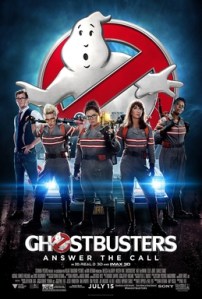
Working in Midtown Manhattan, it’s rare for a week to go by without passing through a street that’s set up for a film or television shoot. New York isn’t the largest city in the world, nor does it have the tallest buildings, but it is a city instantly recognizable at a glance. It is also a haunted city. The original Ghostbusters was a New York movie, but the reboot may be even more so (although largely shot in Boston). I’m having difficulty remembering the last time I enjoyed a movie so much. I laughed until the tears came, and the theme of spirits loose in the city appealed to that part of me that loves the strange and unusual. With several nods to the original, and cameos from the surviving cast, this is a child of love that outshines its parent. It’s almost as if it makes the original even better than it was to begin with. This is a movie with a mission.

Clearly one of the factors in making the film so good was the fact that women were the leads. They show at once the empathetic, and funny, intelligent, and challenging—roles that women routinely both possess and face. The characters have trouble being taken seriously by the males around them, yet they are fully as qualified as and indeed, know more than the establishment. Discouraged and downtrodden, they press on, saving New York City. This may be the first time women have been envisioned is such a salvific role. They are scientists, scorned for their brains and for their gender, and yet they overcome.

Sure, there’s fantasy involved here, but fantasy with a message. I applaud this movie that not only entertains, but also makes profound statements at the same time. It gives a rare glimpse of what the world would be like if men were treated with the demeaning outlooks that they already frequently give to women. It is a feminist movie, but not an angry one. I left the theater genuinely elated. Of course, I loved the first Ghostbusters, despite all the cigarettes and sausages. Still, those who made the movie had the grace to bless this new venture that takes viewers into a world where we rely on women to solve the problem. Once it’s solved, however, they are shoved into the background so that the powers that be can take the credit. It is a movie for our times. I would’ve gone to see it for the ghosts alone. I came out, however, knowing that I had seen something not only enjoyable, but which might, if taken seriously, begin to change attitudes and prejudices which haunt us to this day.
Powerful Movies

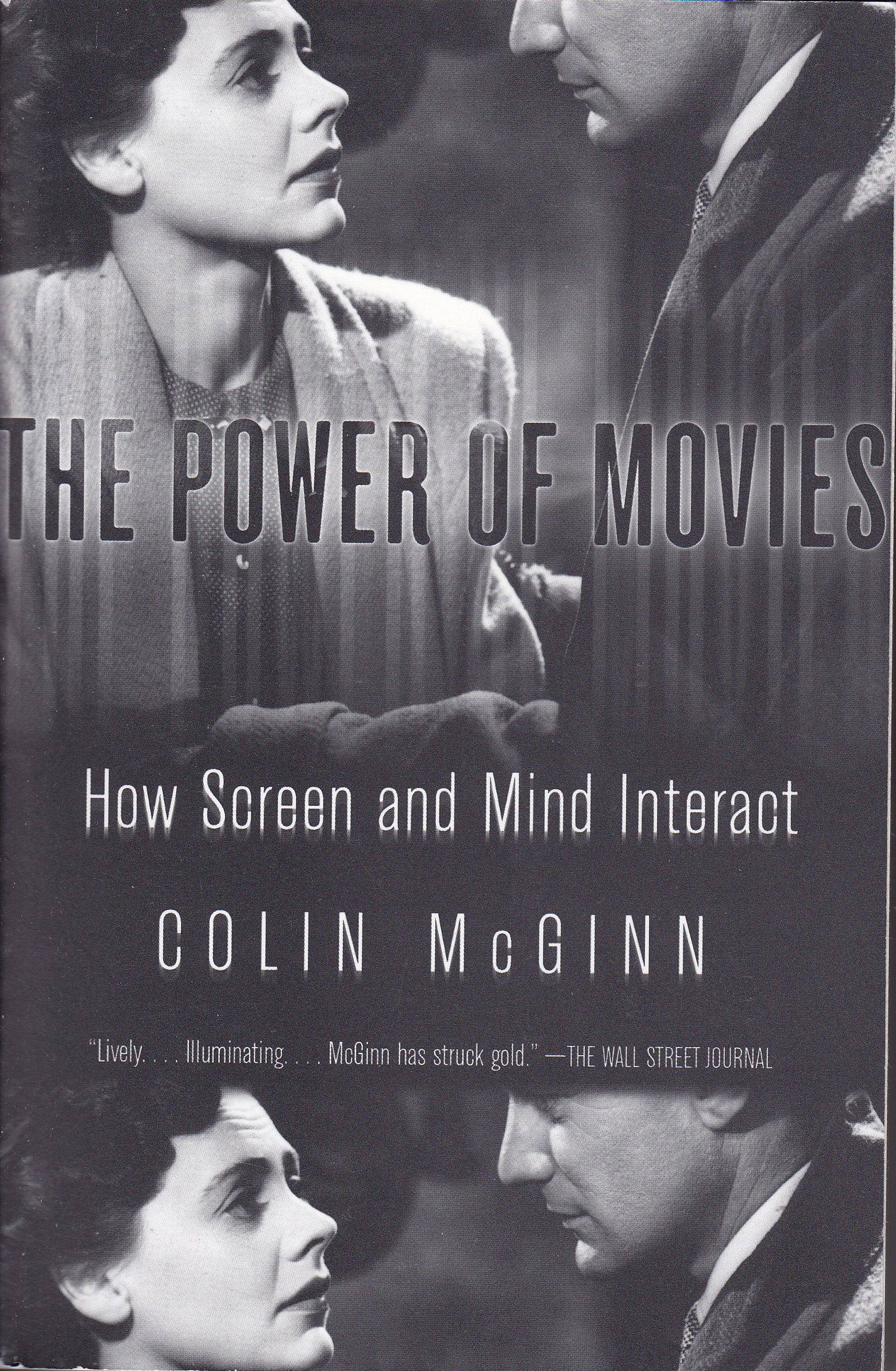
PowerOfMoviesOur friends were shocked. I don’t even remember the title of the movie, but they couldn’t believe we had gone to see it. Not because of the content of the film, but because it had been shown on a Sunday morning. Why hadn’t we been in church? This was back in Edinburgh when we had very little money—wait, we still have very little money. This was back in Edinburgh, and we had won free tickets to an early screening of a new movie. The showtime was on Sunday morning. So in our own version of weak-willed athletes from Chariots of Fire, we’d skipped church to go see the movie. I don’t remember the title and I remember very little of the film. It had something to do with Richard Wagner and a conductor. An art film. We didn’t really feel too guilty missing church to go, since at the time, it seemed like a rare opportunity and the movie was, in some sense, religious. Or at least mythological.

Movies have a way of really influencing people. Thus it has been since the invention of the art form. We’ve all had the experience, I suppose, of a movie hitting us with a profound impact. It never really occurred to me to ask why. That is, until I read Colin McGinn’s The Power of Movies: How Screen and Mind Interact. I’d always thought that movies were simply a successful form of entertainment, and scholars seldom take entertainment seriously. As McGinn makes clear, there’s a lot more than casual watching going on when we slip into the theater. As a philosopher, McGinn is duty-bound to look beyond the obvious. Time after time in this profound little book I found myself pausing to consider the implications of what he says. Ultimately, he suggests that movies access the same areas of the brain that dreams do, not only giving them dreamlike qualities, but also making films emotional experiences like dreams.

At one point, McGinn draws explicit connections between going to church and going to a movie. Beyond the superficial aspects of a darkened building with a performance meant to impact a person, there are clear parallels between going to the theater and going to church. Both can be transformative experiences. The Power of Movies is a powerful little book. As much as we like to think that we have custody of our minds, the realm beneath the surface—that which gives us dreams and syncs with movies—has more influence on us than we’d generally like to admit. More and more, scholars are beginning to realize that films do have a profound impact on viewers. This is not just entertainment. It may not be worship, but after reading McGinn I think it might not be too far from it. The mind able to dream, after all, is a mind that’s truly free.


The Film’s the Thing

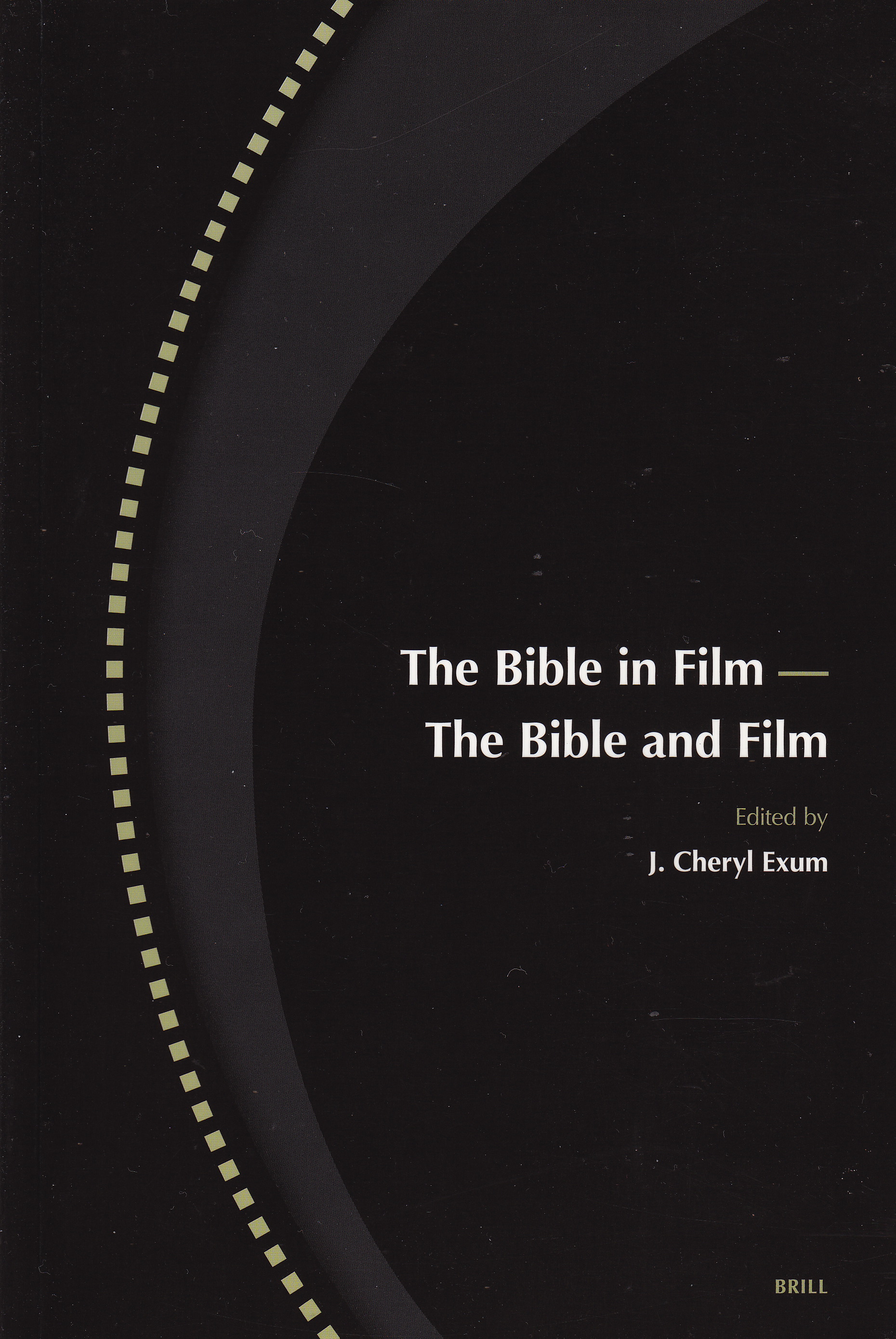
BibleFilmIn the context of teaching, I often described how movies portrayed the Bible. There is an aspect of this that may go overlooked since the Bible is, in the nicest possible way, inert. That is, the Bible frequently functions as a character in movies. In a minor, or supporting role perhaps, but clearly it has an impact on what the other characters do or say. The story wouldn’t be the same without it. So it was that I finally got around to reading The Bible in Film—The Bible and Film, edited by J. Cheryl Exum. This is a collection of 11 academic essays about the Bible in various cinematic guises. A number of the essays focused on Jesus, being the most obvious biblical character to star in movies; he had another one this past summer. The collection, however, is wide-ranging in its biblical characters.

More interesting to me, and this is just a personal preference, is the way that the Bible shows up in movies. Those who decry the study of sacred writ seem to be in denial concerning just how deeply embedded in our national psyche the Good Book is. As the various contributors to this volume show, the Bible appears in ways both subtle and overt in many films. Like it or not, the stories represented in the Bible are classics, and many film-makers find a rich source of material here (when they’re not busy making sequels). The Bible is, to a large extent, who we are.

That’s not to deny a religious pluralism to the United States. We are diverse and that is one of our strongest assets. Still, even though our founders were primarily deists, and not evangelical Christians, their culture was pervaded by the Bible. A large difference between then and now is that, although they weren’t “Bible believers” our founders knew their Bible. In a sense that is almost incomprehensible today, they realized that you don’t have to believe it to see its value. The Bible does have some good things to say. Even now when I get overwhelmed, I can still find some balancing sanity in parts of Sacred Writ. It’s not all about killing your enemies or keeping women silent in the churches. It is a very human document. That’s why, in my humble opinion, we keep coming back, as a society, to the Bible. Anything that is so momentous is bound to find its way into our movies and our other art forms. How we take that is, of course, a matter of personal taste.


Flood of Fancy

Years ago I was approached to write a book about Noah. There was still some hope at that time that I might find a university job and that my words would have more credibility than just any old internet hack. At the time I’d read just about every book about Noah that had been written—and there weren’t that many. Biblical scholars, beyond tying the story to its obvious Mesopotamian sources, have long relegated the tale to the nursery school of biblical drama. Sure, it’s a great story, but what serious scholar takes an interest in a great story? Well, I outlived my academic job and it looks like Noah is going to have the last laugh. We’re told that the Pope has been tweeted about the movie by Russell Crowe and that several Islamic nations have already banned it. According to Today Darren Aronofsky, the director, is more interested in getting non-believers into the theater than trying to please the faithful. Well, let’s face it. A movie based strictly on the Bible would have to be pretty preachy.

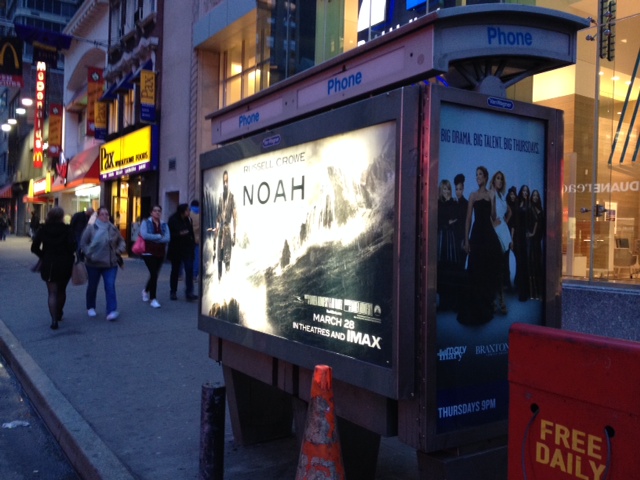
The bigger draw seems to be this: our society is simultaneously deemed secular and religious. Americans go to church. They also respond to surveys that they believe in God, the Devil, Heaven, and Hell. They also act as if none of this were true. Business practices tend to be anything but caring, and we show no concerted effort to make sure basic healthcare is offered to all our citizens, let alone the millions who are daily suffering and dying elsewhere in the world. We don’t want to reduce our emissions as a real flood—a literal flood—is on the rise on a global scale. Maybe we’re waiting for a biblical-scale miracle to save us. Noah’s face stares out at you all across Midtown. Judgment is upon us.

NoahMovie

Action films draw male viewers. Religious movies draw females. Aronofsky and Crowe have the winning combination. No gender-bias for a secular-religious nation that has enough loose change to spend a weekend at the movies. The biggest complaint is that it isn’t the Bible. I have to admit I’m kind of enjoying the hype, despite the fact that I never received the chance to write that Noah book that was next on my agenda. If I had, now it might have enjoyed the sales that Irving Finkel’s The Ark Before Noah—scheduled for release three days before the movie—surely will. Timing has never been my strong suit. Of course, money can be its own sort of flood, and many more drown in it than in the literal waters of a secular-religious society. According to Genesis a raven was released to fly about looking for land. The Crowe might have been a better choice since movies, as we all know, improve upon the book.


Just Ducky

An innocent trip to Kohl’s. I was really just along for the ride since buying clothes is not really my thing, but I’d been spending quite a bit of time at home alone, pondering my fate. We’d just changed the clocks, so we had an extra hour and my wife needed a few things. Once there popular religion gave me the old Joab-and-Abner treatment, if you know what I mean. I’m not completely naive about movie tie-ins—they are big money for all kinds of products, especially food (both fast and slow). As if eating that burger will somehow make you more like Captain America than will a few brisk minutes on the treadmill might. In any case, I’ve known Kohl’s to support charitable causes in the past: buying a children’s book or plush animal for a donation to a wildlife conservancy or some such socially conscious promotion. I was a bit perplexed to find a tremendous amount of Duck Dynasty gear in the store on my recent trip. Being outside New York City, we are hardly rural. I mean, Kohl’s sells clothes, right? But there were Duck Dynasty bauble-heads, Duck Dynasty fanny packs, and even a whole stand of Duck Dynasty books. From conserving animals to shooting them.

IMG_1105

I realize Duck Dynasty items are big money. At a local store just before Halloween I spied a Duck Dynasty costume—fairly simple; a ZZ Top beard and you’re good to go. While getting a haircut the other day the girl, young enough to be my daughter (literally), said “You gonna keep the beard?” I told her I hadn’t shaved since 1988. Her response? “Well, at least you don’t look like those Duck Dynasty guys.” Like Rip Van Winkle (whom I understand also sported an impressive beard), I feel like I’ve been asleep for quite a long time. When did facial hair come to equate home-grown evangelism and love of shotguns?

IMG_1083

To calm my nerves, I signed onto Amazon.com. Prior to becoming dramatically unemployed, I used to treat myself every once in a while to some reasonably priced reading material from our Seattle savior. Naturally, they want you to buy more, so they suggest other books, based on viewing patterns, and, more importantly, purchasing records. That’s where I saw the Duck Commander Devotional, complete with a duck-themed camouflage cover. Now I think I finally understand. Reading the Bible for yourself (like Phil Robertson does) is too much trouble. It is easier to have the hirsute heroes of Louisiana tell you what the good book says. Maybe it’s just me, but it seems like religion might be going to the birds.


Monsters Incorporated

Monsters

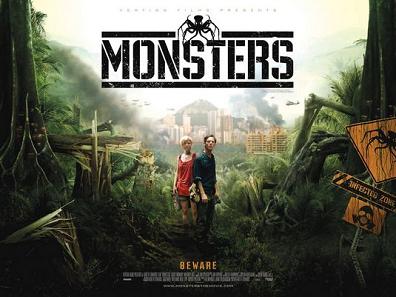
Monsters. What’s not to like? With a title so innocuous and limited US marketing, this 2010 British indie film only just came to my attention. I hadn’t even heard anything about it as I sat down to view it. The premise of invading aliens is as old as H. G. Wells, if not earlier, but this is a film without over-the-top CGI and a very human story. Showing far more tension than bloodshed, Andrew and Samantha, their Anglo names very prominent, are caught in alien-infested northern Mexico. Somewhat predictably, Samantha has a rich daddy who happens to be Andrew’s boss, but the couple has to find their way back to the United States as giant insectoid-octopi rampage through the night, destroying just about anything they can get their tentacles on. So far it sounds like standard Saturday-afternoon fare. As Andrew and Samantha reached the Rio Grande, however, overlooking the huge wall the US government built to keep out the aliens, I realized what the film is really about.

During the Bush years, shortly after the Berlin Wall had come down, a new wall was snaking its way along the Mexican border. America had become weary of “Give me your tired, your poor.” This was the land of opportunity, instead, for the chosen few. Never mind that we know that many of the jobs most of us don’t want are gratefully accepted by those who may not be technically legal in this country. Never mind that we deny social justice, in many ways, to those who make our lifestyle possible. Andrew and Samantha face the massive wall that says, “keep out.”

Of course, they make it back to Texas. They discover, however, that the aliens have breeched the walls as well. And they really pose no threat beyond wanting to draw strength from the abundant light-sources of a power-hungry world. The film’s ending is a bit ambiguous, but then again, the plight of the alien generally is. I watched the film with no expectation beyond a bit of sci-fi action to help give me the energy to make it through another week of work. Instead I saw a brash American coming to a deeper sense of humanity while standing in a church where hundreds were mourning their dead. The death of one small girl was as much a tragedy of as the breeching of the borders. Until humanity prevails over artificial borders, there will indeed be monsters. Were that they were only giant insectoid-octopi.


Say Can You See

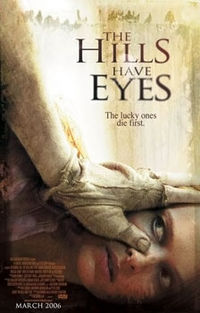
Remakes of classics. It is my sense that a classic has earned its place in its own constellation for a reason. Remakes seldom attain the je ne sais quoi of the original, but sometimes I have trouble telling them apart. I like scary movies—the classics anyway. In recent years various directors think they can improve on the masters and some of us get confused about what’s what. So it was that I came to watch the remake of The Hills Have Eyes without having seen the original Wes Craven version. As is typical for remakes, the writing tends to lack the flare that often characterizes the original vision. The story may be similar (in this case I’m only guessing) but more than the names may have been changed to protect—who? I’m afraid I didn’t care for the film. Graphic violence is seldom as effective as suggested terrors, but it can make you a bit queasy nevertheless.

I decided to stay with the movie to see if my thesis of religious elements and terror would become part of the story. In the remake, in any case, the action is set in a nuclear test zone where people disfigured by the radioactive fallout of American nuclear tests prey upon the victims they can lure into their lair. So an extended family is drawn in and very few of them make it out. The pater familias is a man who trusts his gun and has no fear of walking into the dark desert alone. But before he goes—yes! Religion. The mother of the brood, it turns out, is a devoted Christian and insists on praying before the men-folk set out to try to find help for their stranded vehicle. The eponymous eyes in the hills watch them pray and then begin to prey. The confident father says, “I trust my bullets more than your prayers.” (Or something along those lines.)

Ironically (and I can’t believe it was anything beyond coincidence) both dad and mom end up dead—the father in a crucifixion pose, the mother by being shot. Neither bullets nor begging save them from the mutants who seem to live just to cause others misery. The man who trusts his gun dies in a somewhat religious way, and the woman who trusts prayers is the victim of a gun. Now, in a classic there would be some lingering on the reversal here, but the remake syndrome is eager to add gore and grotesqueness to the screen without pausing for thought. The eerie backdrop of a nuclear testing town with mannequins still intact is effective, but otherwise you know to expect Road Warriors-type action in this small, post-apocalyptic world. The fact that even this wasteland supports a moment of prayer, however, demonstrates that fear and religion are never too far from each other.


Mermaid Missionary

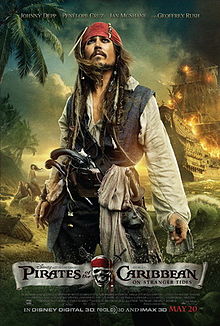
Last summer I was invited to address a church in Princeton about Christian themes in the movies. Back in my seminary days I often presented biblical material at adult forums, but my interest in religious themes in movies has grown over the years. I don’t claim to be an expert, but I have watched secular movies with an eye toward religiosity since I was in high school. The day of the presentation followed a recent viewing of Pirates of the Caribbean: On Stranger Tides. Although I’ve posted on it before, that particular movie is among the most heavily freighted with Christian themes of any I’ve seen. Now that I’ve had a chance to watch it again on the small screen without the distractions of getting home through traffic afterward, I would redouble my assertions. The very premise of the movie—the hope for eternal life—is a decidedly Christian refrain and the pirates, who wear their sins on their sleeves, are eager to attain it. The missionary, mentioned in my previous post on the film, serves as a kind of foil for that theme, insisting that all souls can be redeemed. Except, he decides, Blackbeard’s.

The reason that Blackbeard falls out of the missionary’s personal book of life is his mistreatment of a mermaid. Now the swarming, man-eating mermaids are among the most memorable images from the story. One has to be captured to unlock the magic of the Fountain of Youth, and the victim happens to be the missionary’s mermaid. In a Florence Nightingale moment, the two different species fall in love—celibate preacher and heathen, mythological creature. An odd couple indeed. Carried in a glass coffin filled with water, the mermaid also needs air to survive and the heartless pirates don’t really much care. To save the little mermaid from asphyxiation, Philip shoves his Bible into the gap he breeched between coffin and lid, saving the fishwife’s life. Talk about conversion!

When the glass coffin breaks, spilling all the water, the mermaid is reborn as a human. Echoes of Splash come to mind here, as well as Disney’s earlier effort, The Little Mermaid. The transformation in this case, seems spiritual as well as physical. Syrena, whose very name invokes the classical sirens, is the one who delivers the magical chalices (communion, anyone?) to Jack Sparrow to save the life of Angelica, or, more likely, to bring Blackbeard to an end. Our busy mermaid, now transformed again to her fishly form, saves the injured missionary by converting him to her way of life under the waves. There are shades of Lovecraft here as well as a reversal of Ariel’s fate in Little Mermaid. Although critics were harsh on this movie where a comic character now takes on a serious role, I still find it compelling. Nearly all the main characters undergo transformations as the story unfolds and whether heathenish or not, almost everyone ends up a better Christian of one sort or another.


Black Swain

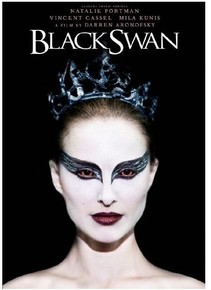
In a somewhat rare move, I watched a film that was released less than five years ago this weekend. Black Swan is difficult to classify since it crosses so many genres with relative ease and it left me strangely reflective. Although called a “thriller,” the frenetic pacing and sense of outside menace of most thrillers is lacking. Black Swan includes some horror elements, but little in the film defies rational explanation if Nina Sayers is really going insane. The underlying story, however, is something that every religion would recognize—the need for transformation. Even before John Calvin dreamed up the laughable doctrine of total depravity (and for any Presbyterian readers, I was predestined to write that), all religions have at their heart the concept that people need to change. Sometimes the transformation is subtle and gentle, at other times fiery and dramatic. If you end life the same way you began it, you are a religious failure. This premise lies behind every movie where a character transforms into something else, be it werewolf, Mr. Hyde, Mrs. Doubtfire, or a wereswan.

Our perceptions of who we are cause us considerable introspection. Nina Sayers is a timid yet ambitious girl, living with her mother yet wanting to be the seductive black swan. She really doesn’t comprehend what she is wanting to become, but she knows that it must be better than what she presently is. Again, the parallels with religion are striking. I have known good people who’ve transformed into black swans under the influence of noble religions such as Christianity and its monotheistic siblings. People who have become intolerant and judgmental, insisting that their way is the only possible correct way. In the mirror they see a white swan, but the audience sees the black one.

Black Swan is heavily symbolic and provocatively mythic. Like any honest account of life it refuses to provide any definitive answers. Since each experience we undergo leaves its mark upon us, we cannot help but transform. Volition, however, can lead us toward paradise or perdition and any ambiguous place in between. Is the Nina Sayers dying on stage the greatest sinner of all, or a saint who has been beatified as fully human? The answer to the riddle the film stubbornly refuses to relinquish. So it is with life. We will transform over its course. Religion will declare whether it is good or bad, right or wrong. At the end of the script, however, we are both the white and the black swan.


Bleak Visions

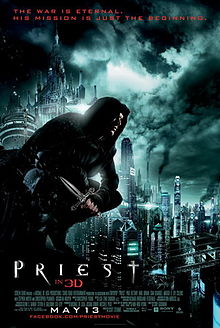
The day was leaden and rainy. Hopes for seeing the sun over the next several days dim. I had been warned about this, but once my mind has settled on vampires, they’re hard to resist. The reviews said Priest, as a movie, was full of cliched dialogue and predictable outcomes. This is true. But still, it is perhaps the most religious vampire movie ever made. While some have doubted my analyses of Underworld and other vampire films, Priest is set in a Pullmanesque world dominated by a church that has lost its belief in vampires. In fact, the civilized world, in scenes reminiscent of Blade Runner, owes ultimate allegiance to the church. Based on the graphic novels by Hyung Min-woo, the post-apocalyptic world of Priest presents an over-industrialized society where humans live in walled cities (ironically, Jericho has no walls). Vampires, more fierce than any Count, even by fifteenth-century standards, rip humans to shreds, but have been forced into reservations by the warrior priests. Their weapons are cross-shaped, but there is otherwise no reference to Jesus in the movie—only an amorphous “God.”

Despite the endless tropes, “a vampire killed my brother,” “the Priest is her father,” and endless chatter about the nobility of sacrifice, the movie is strangely compelling. Visually it maintains the appeal of a place somewhere between Planet of the Apes and the Book of Eli. And something appeals about priests who are willing to fight evil rather than sit around arguing about whether women should be allowed to join the movement or not. Keeping with modern proportions, we see only one female priest and none among the Monseigneurs, but she is the one who actually stops the vampires. And these are vampires that have evolved into the blind, naked denizens of the night who kill, apparently, for the sheer joy of it. The only article of faith the church can muster is, “if you go against the church, you go against God.”

I wonder if anyone in the world of religions is tracking how society perceives them. Religions once stood for our noblest aspirations, and our humblest weaknesses. Like bad caricatures from the movies, religious organizations don’t shy away from the desire for ultimate power. In His Dark Materials and in Priest, the church is content with nothing less than total domination. This is not missionary zeal, but good, honest power-lust. Not all religions are like that, of course. Still, there are those who perceive them that way. Maybe it is my own insecurity, or maybe it is the fact that I’m seldom convinced I have the answers, but I can’t help but feel the thrill of justification at the rebel who maintains conviction to the ideals s/he holds deeply. It takes no backbone to enforce obedience when might is on your side. But only those who have faced the vampires personally know who the real enemy is.


Deliverance from?

At times it seems strange that I missed so many formative movies when I was growing up, but then my wife pointed out that many of the films were released when we were minors. That, combined with the fact that most of them bore R ratings, acted as an effective deterrent at the time. So it was that we only saw Deliverance yesterday. References from friends, colleagues, and even The Simpsons made us feel like we’d missed a part of American culture that everyone else had seen. Of course we knew the basic story, but seeing it played out intact is a much more satisfying experience. Since I am scheduled to do a church talk on Christianity and the movies later this morning, I was interested in the way the church is portrayed in the movie.

After the three survivors make it back to civilization, the first building that meets them at the riverfront is a plain white “Church of Christ.” At the moment of their eponymous deliverance, the church is there. As Ed and Bobby are being driven to the hospital in a taxi, however, the church appears again. The valley is being flooded to bring hydroelectric power to Georgia, the reason the men set off to see the river in the first place. Since the town is shortly to be flooded, the church is being moved. The taxi driver tells the men, “We might have to wait a minute for the church to get out the way.” In the extras director John Boorman spoke about the highly symbolic nature of the film, including the way that the symbol of stability in the community, the religious establishment, could not hold its own ground.

I also sensed another element of irony here. The church had been, symbolically, in the way of the advancement of civilization. Paralleling this inhibition is the utter, and bewildering freedom from the law experienced by the men following the murder of the mountain man. The viewer is left to decide which is the worse fate. Now that I have seen the film, I think I can understand the depth of struggle it represents. As the continuing debate on the relative merits and demerits of religion in society rages on, there is always a very human aspect that stands beyond simple formulae. Perhaps we save religion in the hope that it will save us.


Movie by Faith

Yesterday’s New Jersey Star-Ledger carried an article by film critic Stephen Whitty entitled, “Where script meets scripture: Recent films take a leap of faith.” The phenomenon he observes is that mainstream, big studio-backed film-makers are more and more turning to plots and scripts that emphasize faith. It is not always standard, revealed religion-type faith, but a belief that there is something else. Something beyond that with which our daily lives presents us. People are seeking, but traditional religions are having a hard time convincing them that they have the answers.

In a striking contrast, films that present a spiritual danger frequently revert to the stock image of a Catholic priest as the means of deliverance. When is the last time a Protestant exorcist took on a demon on the big screen? Torn though it is with its long and checkered history of imperialism, exploitation, and scandal, the Catholic Church with its obscure rituals is effective where the machinations of the Protestants are not. This too is a leap of faith, one that believes in the efficacy of ritual despite its origin or lack of scientific theory. Science provides a way of understanding the world that many people experience as cold and comfortless. Even many scientists choose simply to trust in what their spiritual guides teach them.

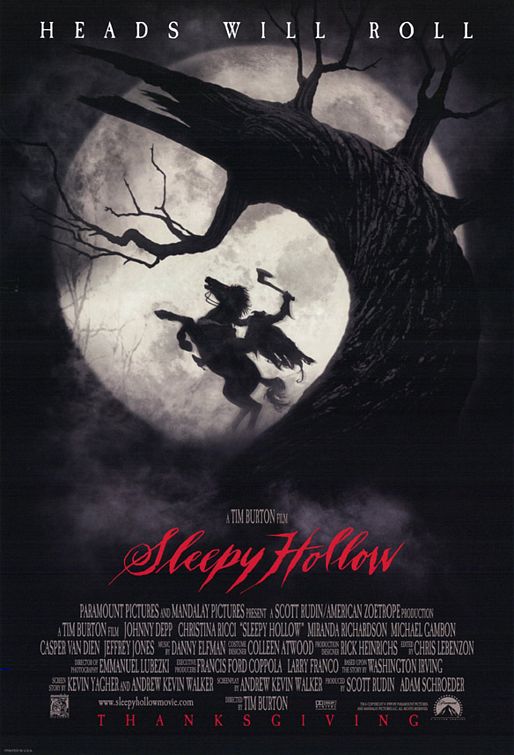
Over the weekend my wife and I watched Sleepy Hollow. It is an annual tradition; it is our October movie. In this film Tim Burton plays off the superstition of Sleepy Hollow – in fact real, in the movie – against the science of Ichabod Crane. In the end, Ichabod has to face the supernatural on its own terms in order to bring the world back to science. Having sent the headless horseman back to perdition, Crane once again returns to a New York City at the start of a new millennium, full of the optimism of science. It is the dilemma of the modern western world. People are tugged, torn even, in two diametrically opposed directions. Our experience leads us to believe in a “demon haunted world” while science placidly informs us that all can be explained. Movies do reflect the human outlook in many respects, and the end sequence has yet to be shot.


Toy Story 2.1

Summer is a season for movies. When the weather gets hot, sitting in an artificially cooled dark room for a couple hours, even if it is with strangers, seems like a good idea. Generally the movies I see in theaters are family movies – I’ve never been one to go to a theater alone and my personal taste in movies is unique in my family. The more interesting flicks usually have to wait until DVD release before I see them. Nevertheless, the movies are an experience that many of us remember fondly from childhood and children deserve good movie memories. Since the movie theater was invented it has become one of the signatures of culture in many parts of the world.

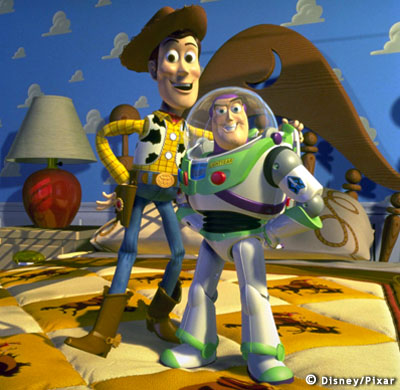
Last weekend, during the East Coast Heat Wave – a weather event so much talked about that it should have had its own theme music – we went to see Toy Story 3. In an unusual departure from my focus on religion, my comments here will focus on creativity. (Good religion is creative, after all.) Toy Story 3 opened to much critical acclaim, so my expectations ran a little high. A little too high. While I found the story to be interesting, it was a bit familiar. For those acquainted with the franchise, it felt like a remake of Toy Story 2. Both films open with the toys worried about their future because Andy is going away. In both 2 and 3 Woody is separated from his friends and has an epiphany that leads him back. Buzz gets returned to factory settings to reprise his humor in the first film. An evil toy in both movies holds the others captive against their wills. Meanwhile Woody makes new friends and with their assistance rescues the threatened toys. The evil toy ends up getting his just deserts and Andy’s toys successfully integrate.

The story line values friendship and commitment, and there is nothing to complain about there. Yet, after stepping out into the harsh sunlight, I felt like I’d just paid to see a movie I’d already seen before. Creativity – the factor that leads to truly new concepts – is not always valued in movies. This is particularly so in children’s movies. Our kids are being programmed to accept recycled stories as something new. It is not only Toy Story that has fallen into such rehashing: how many fresh ideas are shortly followed up by a 2, 3 or 4? Even if 1 wasn’t so good? I’ve even been told by publishers that publishing houses prefer to take few risks – they would rather have a product that is “like” one that has already proven a blockbuster. How many wizards and vampires have populated tween books over the last decade or so? It seems that the safe money is in the recycled story. In a society hooked on convenience, new ideas might seem just a little too dangerous. Once there was a cowboy blog…

Best friends forever and ever and ever


Eager for Eden

In a recent email from the Clergy Letter Project, Michael Zimmerman reports that the movie Creation is shortly scheduled to be released in the United States. To quote from the Project newsletter:

“You may have heard that the film, Creation, about Charles Darwin and his struggle with his faith after his daughter, Annie, died had trouble finding a US distributor because it was seen as being too controversial for the American public, particularly after being attacked on Movieguide.org, an influential site which reviews films from a supposedly ‘Christian perspective’.”

It is disturbing that a non-fiction film has been blocked from American viewers because distributors found the content too controversial. The controversy has nothing to do with sex or violence, but an assault on the fantasy of a literal interpretation of Genesis. Disturbing fact challenges comfortable fantasy.

In a related story, an article on CNN.com explores the sense of depression that several viewers of Avatar felt after the movie ended. While the reasons are deep and complex, the overall theme seems to be that these viewers can’t shake the image of a pristine world that seemed so real for two-and-a-half hours. They long for a paradise that doesn’t exist. A paradise that has never existed. I am not unsympathetic. Although I could not view the film, I left from the theater with a similar, if less intense, feeling. It is a similar emotion to that when a truly special event takes place and the mind plays it over and over like a new and significant song. Impressions and hazy images and euphoria wash over you, and a longing for a moment that can never be recaptured consumes your consciousness. These are some of the most bittersweet moments of life. They are the very heartbeat of fantasy.

There never was an Eden. Human existence has been brutal and harsh since we first stood upright and wondered why we could think. America is a nation in deep denial about this harsh reality. We would rather believe the biblical Eden is a literal paradise and that our aching imaginations are somehow giving us glimpses of a fabled utopia where life was perfect. Well, almost perfect. The movie Avatar presents a paradigm that many Americans can relate to: an electronic world of endless possibilities shielding us from the stark realities of illness, pollution, tragedy, and death. We are insulated in our surreal environment that we have created for ourselves.

The human capacity for wonder is perhaps the greatest asset that consciousness has deigned to bequeath us. We can imagine a world where all creatures live in harmony with their environment and love and peace flourish. But that is not our world. A good corrective to these tempting fantasies is to read some good old classic Greek tragedies. These imaginative explorations of the human condition are as true to life as dreams of utopian worlds are removed from it. It is all a matter of perspective. And the Greeks were writing B.C.E. — Before the Computer Era — when reality had not been hidden behind a haze of ephemeral electrons.