Still Growing

A couple of years ago I posted about Roger Corman’s Little Shop of Horrors.  Now life is so busy that when Friday rolls around my wife and I find ourselves at odds for deciding on a movie.  She’s not into horror and I’m often not in the mood for human drama after a week at work.  We recently compromised on the 1986 Little Shop of Horrors.  It has been many years since I’ve seen it although I watched it shortly after it came out.  Like Rocky Horror, the music makes the movie.  That and the appearances of Steve Martin, Bill Murray, Jim Belushi, and Christopher Guest.  The original was a comedy horror shot on a very short schedule but this Frank Oz production is a bit more lavish.  And the songs.  I’m a fan of classic rock-n-roll, and the show tunes here seem like a combination of Cats (the original) and Rocky Horror.  There’s an optimism to them.  And who couldn’t use a little hope?
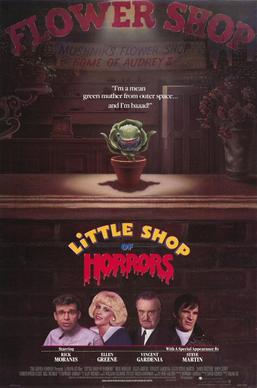
Seeing the movie again brought home a phenomenon that’s been on my mind lately.  What you see first becomes your benchmark.  I only saw the 1960 version a couple years back.  Little Shop of Horrors was, to me, a musical.  It does use some classic horror tropes: thunderstorm at night, shadows of violence on the walls, and the ubiquitous fear of being eaten.  But unlike Roger Corman’s vision, this is primarily a love story about escaping Skid Row.  And, strangely, a feel-good film.  I suppose the lingering question is whether this is a horror movie or not.  Another phenomenon that’s been kicking through my gray matter lately is that “horror” really isn’t the best description for many movies so labeled.

My interest in origins led me to go back to the original a couple of summers ago.  That story developed because Corman had access to a set from a previous movie and wanted to shoot another using it.  The story took many forms before settling on a human-eating plant.  By the way, that still works for horror, as The Ruins shows.  Since his previous movie was a horror comedy, the movie I’m sitting down to watch on a Friday night was born.  Between the original and this one, the story was adapted into a stage play.  The movie version of the stage show was a box office success, and it still appeals to me on a night where we just have trouble deciding on a movie by which to unwind.

Books and Mormons

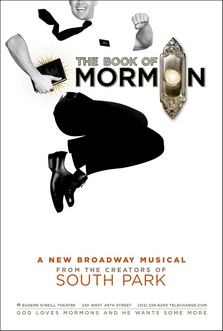
Some time ago we went to see Book of Mormon on tour.  I really knew very little about it other than it was consistently praised as being very funny.  I’m always a little concerned about poking fun at anyone else’s religion because I know people take their beliefs very seriously.  As I reflect on the show (which was quite funny) it seems that it wasn’t so much poking fun at the Latter-day Saints so much as it was poking fun at religion itself.  That’s less problematic as it’s not singling anyone out for ridicule.  It’s a system that’s being made light of.  Or at least any religion that is an effort to convert others.  There’s a kind of violence to it.  And if Book of Mormon is about anything, it’s about missionaries.  Amid the laughs it makes some valid points—trying to convert people without first trying to understand their culture is a fraught activity.

People want religious specialists who thoroughly understand their tradition.  I can say from experience, both as an erstwhile seminary student and a seminary professor, that the time given to become an expert is insufficient.  The older I’ve grown the wider the perspective I’ve tried to step back to see.  To be an expert on a religion really requires some facility with understanding other religions.  To understand, say, Methodism, you need to understand Anglicanism.  To understand Anglicanism, you need to understand Catholicism.  To understand Catholicism, you need to understand early Christianities.  To understand early Christianities, you need to understand Judaism.  And so the widening concentric circles go.  Nobody can be an expert in all of them, and each of these religions mentioned has, in its own right, sub-specializations that have their own experts.  Who has time to learn the religion of those they intend to convert?

Any religion that makes supernatural claims (and many of them do; it’s their nature) makes extraordinary allegations.  Those allegations, when examined closely, reveal some improbable elements.  Trey Parker and Matt Stone, two of the authors (most famous for South Park) apparently said that they had no intention of making fun of anyone’s religion and a spokesperson for the Latter-day Saints indicated that no real offense was taken, acknowledging that it’s parody and parody is only offensive if it’s taken seriously.  Many religions have thin skin when it comes to parody or satire.  The serious part is that some religions, in real life, take conversion of all others with a zeal that could (and does) become dangerous.  Still, this musical is very funny, as long as it’s not taken too seriously.