Father Freeze

Photo credit: Dmitry Lovetsky, Associated Press

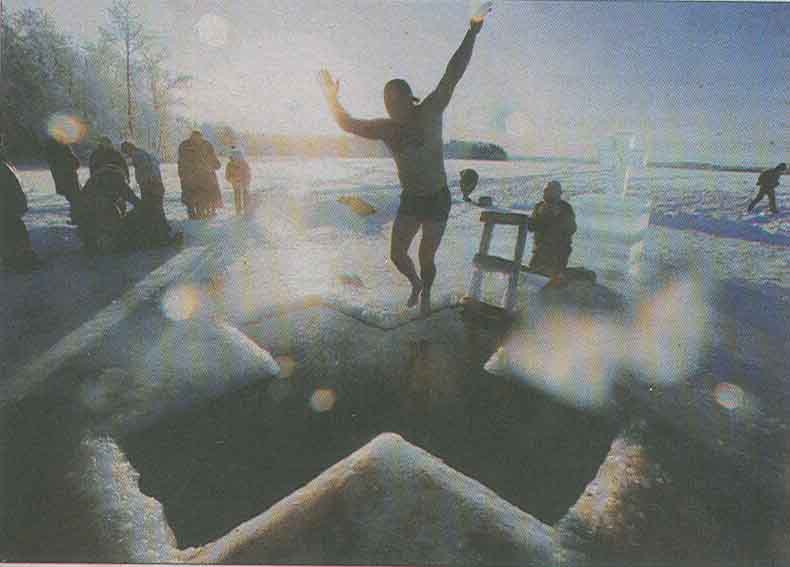
This picture appeared in the newspaper this morning. At a monastery in Valdai, some 250 miles to the northeast of Moscow, Russian Orthodox believers were celebrating Epiphany by leaping into a cross-shaped hole in the ice on a nearby lake. The temperature, as noted in the caption, was 18 degrees below zero (Fahrenheit). What the caption did not explain is that Epiphany, at least in this context, translates as Russian for “severely clenched scrotum.” Hypothermia, the Lord is frozen! Blessed is he who comes to freeze. The ice-man cometh in the name of the Lord.

Many years ago, well into the decades mark, I was talking to a friend about the liturgical churches, as opposed to the strictly Protestant ones. She had grown up staunchly Protestant and was put off by the ceremony of the sacramentally-identified churches. In our discussion she paused and mentioned a televangelist (I can’t recall which one; they all look alike after a while) who had agreed to ride down a water-slide at an amusement park, in a full three-piece suit, if his audience would raise a certain payload of cash. Although the details escape me, it seems entirely plausible ⎯ there is little a televangelist won’t do for money! Then she said, “I can’t see the Pope doing that. I guess there is some dignity to that.” I was pleased; I had made the point that some Christian groups do not need to be in the spotlight of artificial flamboyance in order to proclaim the seriousness of their message. Shortly after that I began to work at Nashotah House.

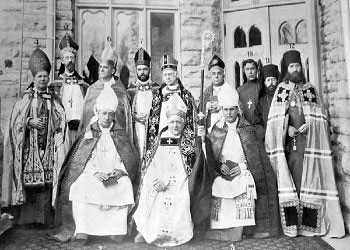
To speculate from the photo above, there was not a large gathering of the faithful on the Siberian ice. Just a few believers in an extreme masculine Christianity dressed in liturgical underwear. Nevertheless, such displays of faith have been part of religions from the very beginning. Ancient believers used to carry their statues of gods around Babylon for a day out to remind the secular that the eyes in the sky are still watching you. When a sartorially perfect prefect steps out in all his finery, what other option is there but to drop one’s hands and stare? A favored photograph at Nashotah House when I was there featured the “Fond du Lac circus,” a gathering of such high rollers in the Anglo-Catholic corner of the Episcopal Church that even a future Russian saint deigned to show up. The event was the consecration of Bishop Weller, coadjutor of the Diocese of Fond du Lac, in 1900. As I look at the Orthodox man poised over his cross-shaped hole, I wonder if my friend had it right after all. The Fond du Lac circus haunts me to this day. What is religion without the show?

The Fond du Lac Circus


Halloween All Year

Despite the obvious consanguinity with the Dawn of the Dead, I am not a mall person. Last week, however, I had a job interview and I discovered that most of my white shirts would be appropriate garb only for the undead, so my wife forced me to look around the local mall for some new apparel. As we walked down the interior boulevard crowded with people younger than us, we couldn’t help overhearing the conversation of some young women behind us. “Yeah, it’s so cool! He’s a vampire; he’s got fangs and everything!” And they weren’t discussing Edward or Lestat, but a (presumably) flesh-and-blood beau one of them knew. Yes, Halloween season is upon us again.

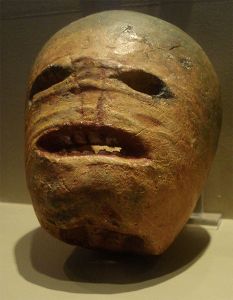
An early Celtic turnip Jack-o-lantern
(An early Celtic turnip Jack-o-lantern)

I loved Halloween when I was growing up. Despite the innate conservatism of my family, we always enjoyed dressing up, trick-or-treating, and being just a bit scared. When I reached college, however, I discovered that Halloween was perceived by many to be satanic, and I had to dig deeply into the past to argue that it came from Christian tradition and was, itself, nothing to be afraid of. Still, my friends looked at me askance. When I reached Nashotah House, a perfectly Gothic setting for the twilight of the year, I discovered that despite the theological conservatism there, Halloween was a time-honored tradition. My first year there while driving home after picking my wife up from a conference in Madison, I drove the familiar road into campus only to see a single, ghostly white face float across the road in front of us. I was so astonished I pulled the car to a stop to look back and could just make out several of the students I knew, dressed fully in black cassocks and cappa negras, only their faces showing, painted white. They stood alongside the lonely road and “floated” across it as slowly approaching cars rounded the bend. (I guess that, being potential priests, they were not too concerned with eternal consequences of metal meeting mere flesh in the dark of night.) On the campus, until the takeover by a Fundamentalist administration, All Hallows Eve was a bone fide sacral event.

The reason for Halloween’s popularity, I believe, is that deep down people really are frightened. At some level we know that we aren’t really in control of our lives and we seldom have a say about them ending. Halloween, with its dark Celtic origins, is the acknowledgment that it is acceptable to be afraid. Each year as more and more elements appear beyond our control, our pantheon of Halloween specters grows. One of our neighbors’ houses has a fake cemetery in its front yard. One of the headstones reads “The Stockmarket / 2008.” Even with the economy dipping and reeling like a drunken bat, lawns sport larger, more expensive and expansive Halloween displays. Halloween represents the pulse of fear than animates religions. We should all be afraid!


Ghosts of Nashotah House

A recent search for “Nashotah House” + ghost (not unsurprisingly) brought up my blog. Perhaps I was being bated, but I’ll bite anyway. Who can resist a good ghost story?

A wee history lesson will help to set the scene. Nashotah House is/was a seminary of the Episcopal Church nestled in the woods of what had been the frontier in Wisconsin. Established in 1842, it was originally conceived of as a monastery — an ethos it has tried to maintain ever since. It is a residential campus with both students and faculty required to live on the school grounds. I taught there from 1992 to 2005, long enough to see some strange things.

I admit up-front that I don’t know what to believe about ghosts. Very nearly ubiquitous as a cultural phenomenon (and firmly related to religion), ghosts permeate the human imagination. It is not at all unusual that ghost stories should thrive in a gothic setting like Nashotah; a simple web search will bring out the traditional hauntings of the place, especially those of the black monk. When I made my first visit to campus there were some distinctly creepy vibes that I wrote up as being non-priestly jitters amid the secretive life of the black-robed clergy. For my first two years I would be there for just part of the week, so instead of the usual faculty house to reside in, I was assigned to live in an apartment in Webb Hall. Known simply as “the Fort” for the solidity of its limestone block construction, Webb Hall had been built for a former dean, Rev. Dr. Azel Cole, as a grand three-story residence for the priest and his wife, Betsy. (Episcopal priests can marry, creating a steady siphoning of Roman Catholic priests who love both the liturgy and the ladies.) My apartment was on the third floor of the Fort, the highest point on campus. As the living dean showed me around, I had that oppressive, “something’s not right” feeling, despite the fact that the living room had been newly furnished and had a spectacular view across campus.

The dean pointed out the amenities of the spacious apartment, but when we reached the kitchen/dining area, we found something unusual. In the very center of the floor was a single dining plate, shattered. The dean muttered something about how the cleaning lady must have missed it on her rounds when she had prepared the apartment for my arrival. Otherwise the apartment was spotless. There was a door leading to a private chapel that Dean Cole had constructed. I was told it was no longer used since the only access was through the apartment, but the dean supposed I would be interested in seeing it. We stepped inside and it was coated with cobwebs and a thick layer of dead black-flies covered the floor, especially near the windows. The dean informed me that it was kept locked to prevent clandestine, unapproved Masses from being performed there by renegade priests on the faculty.

The creepiest room, however, was my bedroom. A spare room (for sleeping only, no doubt), furnished with only a new bed and side-table, it nevertheless felt crowded. When something finally did happen in that room it was after I had moved to a regular faculty residence.

[For the rest of the story please see the Full Essays page]


Bible Guy

Strange bedfellows?

Strange bedfellows?

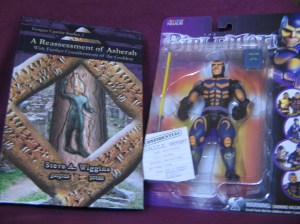
In my Nashotah House teaching days, standing sentinel in my office was the 8″ action figure of Bibleman. I first discovered Bibleman while surreptitiously skulking through a Christian bookstore seeking Veggie Tales paraphernalia (don’t ask). I quickly rounded the corner in the kids’ section and there he was, encased in purple-and-yellow body armor, packing a Bible and laser sword and a packet sealed forever from the curious eyes of Biblegirl. I knew then and there that I had to have him. I sent my wife back to buy him later.

Naturally curious, I found a website and learned that an entire culture and money-making industry had grown around this ultimate good guy. He had a sidekick called Cypher (sold separately), and arch-enemies with such names as Primordious Drool and Wacky Protestor. I marveled at the missed opportunity here — they could have called them Text Critic and Doctor Mentary Hypothesis! Fascinated, I watched video clips of Bibleman’s deft swordplay in a scene that brought back the poignant death scene in Robocop. This was certainly not the old-fashioned fundamentalism I’d grown up with. But even with a Schwarzenegger build and phallic light sword, this guy was KJV and GOP all the way.

Shortly after taking another surreal job, this time at Gorgias Press, my wife showed me a related article in the newspaper. Wal-Mart announced that it was planning to carry Bible action figures, manufactured by One2believe. The line includes Noah, Moses, Daniel, Goliath, and of course, Jesus. I must admit that I was let down that David and Bathsheba figures did not seem to be available. Jesus does have a pull-string, however, for quoting his favorite Bible verses. Even as I throw the paper aside in vexation, I know that come fall, when I find my way back into a classroom at Rutgers, Bibleman will likely have a new companion on my office shelf, and it may be the son of the Big Guy himself.