Not Quite Eschatology

Realized eschatology, if you’ll pardon my French, is a term that describes the “already/not yet” aspect of the “end of the world.”  In other words, some theologians suggest that the eschaton—the end—has elements of both the present and the future in it.  The term came back to me yesterday as we returned to our old apartment to take care of things the movers left behind.  (And “left behind,” I realize, isn’t really a biblical eschatological concept at all.)  Joined by our daughter, I felt a bit resentful of her time being taken from our new home to spend in the old.  I felt an almost adulterous desire to leave the old and cleave to the new—hadn’t we already paid, and overpaid, for that apartment many times over?  The house, on the other hand, is new (to us) and still requires much attention.

As we organized the remaining items, broke down boxes we didn’t use this time around, and waited for the Got Junk guys to arrive and haul it away, I noticed our daughter gazing wistfully at the empty space that had once had our imprint all over it.  It dawned on me that she’d spent her teenage years here—after the Nashotah House debacle, this was the place she’d lived the longest.  This empty apartment was, for her, home.  I began to feel insensitive about my earlier anxiety to leave.  We all live between at least two worlds—our pasts make us who we are in the present.  The world of our teenage years is fraught with emotion and memory.  The world looked so different at that time, as I sometimes forget.

Moving is one of the most stressful situations human beings encounter.  We have a love/hate relationship with our past.  To me the apartment represented a place we occupied out of a kind of desperation.  Five states to the west, we had to move to New Jersey with little money and tons of boxes—one of them Pandora’s, with hope nestled inside.  We told ourselves the apartment was temporary—maybe a year—only until we could buy a house.  Twelve months turned into a decade, then more, with each year accreting memories in every crack and corner.  Part of us will always be in that apartment, for every place people have lived before is haunted.  On our way back to our new home at the end of the day, we were each lost in our thoughts.  Perhaps not so much realized eschatology as experienced reality, we’d spent a day in a present that will never fully arrive.


Not Enceladus

I’m moving.  It turns out that transport companies don’t offer service to Enceladus, and inter-planetary moves are expensive, so we’re moving just one state over.  If, by chance, you know me from work you need not worry—my job will remain the same but the commute will become tele.  Over the past several weeks my wife and I have been sorting through the accumulated effects of thirty years of married life.  Our current apartment has an attic.  Uninsulated, there are few days when it’s not too hot or too cold to stand to be up there for very long—kind of like other planets, come to think of it.  Also neighbors don’t appreciate creaking floorboards over their heads the hours I’m awake.  Going through things that were hurriedly packed to get out of Nashotah House was quite poignant.  That’s the way fragments of past lives are, I guess.  You see, that was an unexpected move.  Life has a way of being complicated.

One of the more remarkable discoveries was how much we used to put on paper.  As a scholar of ancient documents, I have an inherent distrust of electronic media.  To be written means to appear on a permanent—as much as material things can be permanent—medium.  Back in my teaching days assignments were handed in on paper.  Grading was done on paper.  Teaching evaluations were distributed on paper.  Academic publications were done on paper.  In order to be a professor you needed a house.  I taught at five different schools over a span of nearly two decades.  There was a lot of paper to go through.

The academic mindset is seasonal.  I kept waiting for summer to come to have time to sort through everything.  Outside academia, I’m still learning, summer is just another series of work days.  Yes, you can cash in vacation time, but you’ll not have that entirely sensible canicule hiatus that allows you to examine what you’ve accumulated and determine if you’ll ever need it again.  It was like archaeology in the attic.  When volunteering at Tel Dor in the summer of 1987—summers were like that, as I said—I learned that by far the majority of pottery found at digs is discarded.  There are literally tons of it thrown away.  You can’t keep it all.  So the attic was a kind of triage of memories.  Not all of this was going to fit in the new house.  Decisions had to be made.  I guess I was thinking that if a company could take us to Enceladus they’d have figured out how to transport everything.  It turns out that to escape earth’s gravity, you have to get your ship as light as possible.  With over half a century of memories, however, there’s bound to be some weight to be left behind.


Breaking Day

When does the day start?  Years of awaking around 3 a.m. may have distorted my perceptions a bit, I suppose.  Here in the mid-Atlantic states, the sun is never up that early.  Year round I get out of bed when it’s still dark.  I’m not complaining—this is generally a peaceful time, a rarity in New Jersey.  If the bus didn’t come so early I’d get an awful lot done in a day.  But when does the day really begin?  I rise early to write.  Computers have changed my writing style quite a bit.  I used to write everything by hand.  Even as a kid with a second-hand typewriter, I preferred longhand first.  I still do, truth be told.  It’s slow, though, morning’d gone before I got too far.

So I get up and boot up.  I’m not sure that I’m crazy about my computer knowing so much about my personal life, but one thing it simply can’t understand is that I’m an early riser.  Many days my laptop will condescendingly ask me if I mind if it reboots—it’s been updating software when it thinks I’m asleep.  For the computer, day doesn’t begin this early.  Sometimes I worry that my blog doesn’t get readers because the new posts come up around 5 a.m., before I jump in the shower and head for the bus.  If things don’t appear in the feed at the top of the page, well, they’re old news.  I admit to being guilty of that myself; yet knowing when it’s day has consequences.  Maybe I should be posting a bit later?

For some reason my computer likes to send me notices.  Like I’m not already paying attention.  I’m sure there a setting someplace I could change, but I’m busy most of the time and figuring that sort of thing out takes longer than I have time for.  Birthday notices for complete strangers—maybe they’re connected on LinkedIn?—appear, at 9:00 a.m.  I’m at work already by then.  I think this is my devices’ way of letting me know that it’s a nine-to-five world.  As an erstwhile academic I never cottoned onto that.  I started getting out of bed at 4 a.m. when I was teaching so I would have time to write before daily chapel.  I also taught classes that ran from six-to-ten (p.m.) while at Rutgers.  When does the day start?  When does it end?  The decision’s not mine, as my laptop’s only too happy to remind me.


Belly Fires

A friend recently sent me a story from Smithsonian.com about how Evangelicalism arose partially in reaction to protests against the Vietnam War. Not that they were protesting it, but rather other mainline Protestants protesting drove evangelicals further to the right. Having grown up evangelical, I think I understand their strange reasoning fairly well. It was illustrated, for example, in a meeting of the Nashotah House board of trustees. Now, confidentiality rules—which I support—prevent me from providing details, but as you can imagine board meetings involved differences of opinion. I was a faculty representative (voice, but no vote), and I had a point to make. Being Episcopalian I politely and calmly raised my hand. At the same table one of the student representatives (voice, but no vote) was waving his arm like he had to find the nearest restroom, and quick. The chair called on him, ignoring my learned gesture. “He has a fire in the belly,” the chair said, “let’s listen to him.”

A fire in the belly. Not exactly an empirical—or even rational—reason to select one comment above another in my opinion. It was outward and dramatic gesticulation that caught the chair’s attention. Cooler considerations could be easily ignored. Nashotah House wasn’t exactly Evangelical. It was conservative, to be sure. What this episode taught me, however, is that society responds to those with bellies strangely warmed. Mainstream Protestants, for the most part, want comfortable faith experiences. Reason, after all, suggests decorum. Over 90 percent of the many, many mainline sermons I’ve witnessed have been staid and calm. Back in John Wesley’s day enthusiasm was an actionable offense in ecclesiastical eyes. Was the fire in the heart, or in the belly?

A little to the right…
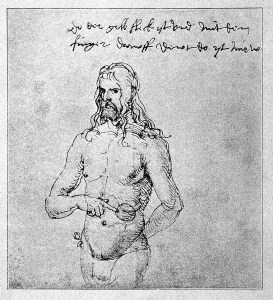
L0006082 Self Portrait of Albrecht Durer
Credit: Wellcome Library, London. Wellcome Images
images@wellcome.ac.uk
http://wellcomeimages.org
Self Portrait of Albrecht Durer.
Finger pointing to left side of torso.
By: Albrecht DurerPublished: –
Copyrighted work available under Creative Commons Attribution only licence CC BY 4.0 http://creativecommons.org/licenses/by/4.0/

So, what does this have to do with the Smithsonian story? Evangelicalism is driven not by the head but by the midriff. John Wesley’s conversion account was famous for his statement that his heart was “strangely warmed.” An inveterate doubter of his own salvation, Wesley needed to be certain. His thermo-cardiac episode helped to comfort him in the face of the lapping waves of the lake of fire at his feet. Having been evangelical once upon a time, I think I understand this constant Wesleyan concern. The fear of Hell is never easily overcome. The Greek word for strong emotion can be translated “to feel it in the bowels.” Examined more rationally, we know what moving bowels lead to. We see it every day as Evangelicals drive all three branches of government. The fire in the belly wins over cooler heads every time.


Russian Along

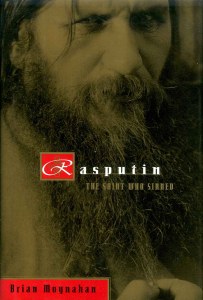
Living at Nashotah House—if you haven’t been, trust me—makes one curious about Rasputin. While on the faculty there, his name was used as a common slur. When Brian Moynahan’s Rasputin: The Saint Who Sinned came out in 1997 my wife and I bought it and read it together. Two decades on the details had become fuzzy and, having read about Aimee Semple McPherson and her faith healing reminded me of the famous Russian scallawag. For all his personal faults, Rasputin did seem to have genuine healing abilities. He was more shaman than orthodox, to be sure, and Siberia was the home of shamanism as well as Rasputin. For those who don’t know the story, in pre-Revolution Russia Grigory Rasputin rose from a Siberian peasant family to the most trusted advisor to the Empress of Russia, Alexandra Romanov. Her weak-willed husband, Nicholas, also gave credence to the mystic, despite the latter’s well known drunkenness and womanizing.

The fascinating aspect of Moynahan’s treatment is that it brings out the saintly side of this figure who’s grown such a notorious reputation. That’s not to whitewash his extreme lifestyle, but it is to acknowledge that he was far more complex than many critics make him out to be. He seems to have been sincere in his faith, and perhaps a little mentally imbalanced. He was kind to the poor, and charitable. He wasn’t a bigot, a sin quite common in his day. He was a working class mystic who took advantage of being inebriated with power. His influence over Alexandra was so strong that he could appoint Prime Ministers even in the midst of a world war. This is a fascinating personality.

Reading the book at this point in history, however, proved strangely unsettling. Many of us wonder how a rational, fairly educated and prosperous nation could tolerate the buffoons who inhabit Washington, DC. Daily we see insanity—with no exaggeration—on the level of the throes Tsarist Russia, or even of Rome under Caligula. Instead of taking steps to right the course, the Russian, excuse me, I mean Republican, Party does any and everything in its power to keep the illusion of normalcy alive. Even while foreign ministers of his own party tell the European powers to ignore their own president, American Rasputins just can’t survive without their daily power fix. The sad thing about that last sentence is that after writing it I felt as if I were somehow being unfair to Rasputin. And I lived at Nashotah House long enough to know what I’m talking about.


Ashy Valentines Day

It’s been 73 years since it’s happened. Happy Valentines Day! And depressing Ash Wednesday. This is more of a popular culture conundrum than a sacerdotal one. I noticed in my many years at Nashotah House that Saint Valentine doesn’t make the liturgical calendar. This struck me as odd, but perhaps it shouldn’t have. The church has always had a difficult time with love. At least when it starts to get physical. Even if Valentine was a saint—and nobody knows for sure which Valentine it was—he surely didn’t become beatified because of his amorous inclinations. Nothing helps to put you out of the mood like being told “You are dust, and to dust you shall return.”

As a society we’ve been living in an Ash Wednesday that has been prolonged for over a year now. A government of St. Narcissus, for the only love there is love of self. Yet when I thumb through the liturgical calendar Valentine’s still not there. Ironically evangelicals—the name now belongs to those who support Trump—dismiss love as having anything to do with Christianity. This isn’t about love. It’s about showing hatred to the poor and stranger, the kicking out of those in need. It’s about military parades and “Sieg Heils” and law makers who vote themselves even more power with our tax dollars to fund their insidious schemes. There’s no need to gerrymander around the church—it’s on your side. Is it Ash Wednesday or is it Valentine’s Day? Surely it can’t be both.

Love is valued only in so far as it can be commodified. If you can get people to spend money on cards and chocolates and condoms then you’ve got a holiday worth celebrating. Otherwise you might as well join old Job sitting on his ash heap. The last time these holidays coincided the world was at war. The President had set up safety nets to catch those who were the victims of the greed that led to the Great Depression that is now all but forgotten. Nazis were a bad thing then. Now all we have to do is blubber about “fake news” and declare the truth a lie. Christians prefer Ash Wednesday to Valentine’s Day anyway. I admit to feeling a bit conflicted about this. Patriots and lovers used to be compatible concepts. We’ve been told that America is being made great again, but they called that Depression great too. From where I sit it looks an awful lot like Ash Wednesday to me.


Emulating Icarus

According to a story by Sarah Kaplan in the Washington Post, NASA is preparing to send a probe closer to the sun than any human-made object has been before. If you’re like me, this might conjure those childhood fascinations of being blasted by impossible heat—maybe in a science fiction story of a colony on Venus, or a crew hurtling out of control in a capsule being pulled inexorably toward the inferno of the heavens—on a hot summer’s day. The Post story makes an inevitable reference to Icarus, the character from Greek mythology who flew too close to the sun. The tale has long been a parable for human overreach, but this time it seems that scientists are taking it literally. The technology used to shield the craft from Old Sol is incredibly impenetrable, and it may have applications as we try to figure out how to escape this planet we seem bent on ruining completely.

Earth flies around its personal star in what’s become known as the Goldilocks Zone—that place where it’s neither too hot nor too cold for life. But don’t wander outside in the northern hemisphere in February without a coat. The weather down here can be fatal. We live on that teeter-totter of the extremes in which our frail bodies can survive. Temperatures range from -88 degrees at Oymyakon, Siberia (at this point whether Celsius or Fahrenheit hardly matters, but for the record, it’s -126 F) to 136 in the Libyan Desert. In this incredible range of 262 degrees people can be found at all shades between. Stepping out my front door one January in Nashotah, Wisconsin the thermometer read -42. That was without wind chill. It was the kind of cold you could feel immediately through all the layers. Humans can’t survive it without artificial means of heat. And yet we have a star overhead where temperatures reach 27 million degrees in its core. Out beyond Pluto our universe reaches near absolute zero, at -459 and change, on the Fahrenheit scale.

It’s a universe of extremes. That friendly sun in the sky was recognized as a deity from earliest times. Even the Bible retains hints of clandestine solar worship. Icarus, however, lost his fear of extremism. There was nothing too outrageous to try. As long as wings of wax can hold you aloft, why not attempt to reach all those zeroes? Millions sound great until they’re exceeded by billions. At that point even the sun isn’t hot enough for some.


Augustine’s Secret Sin

I’m curious: what do you think of Augustine? Augustine of Hippo was an odd blend of saint and sinner. I don’t mean “saint” in the sense of being so designated by the Roman Catholic Church, but in the sense of having reputable and progressive ideas. For example, Augustine argued that science, such as it existed in his day, had to be taken into account when understanding Christianity. If the Bible’s account of creation didn’t match what we knew of the world, then literalism had to go—that kind of thing. This was quite liberal for someone in the fourth-to-fifth centuries. He believed in reason, to an extent. The sinner side of the equation goes beyond his Manichean days, however. The sins I’m referring to are his dangerous and long-lasting theological assumptions that’ve helped to hold back civilization throughout history.

It was Augustine, for example, who gave us the idea of original sin being involved in sexual reproduction. The church has always been cagey on why we should reproduce when the second coming is right around the corner, but Augustine declared that from our very conception (which he couldn’t understand scientifically) we were tainted with sin. But that’s not the particular sin to which I’m referring. Augustine also spread the persistent idea that curiosity itself was a sin. Christianity, in his view, was a “need to know” religion, and curiosity about the natural world could lead to uncomfortable answers. He held this in tension with his belief that we should accept what science teaches, but there were many questions, he decided, we simply shouldn’t ask.

Religions have often come to this crux. Science has a strong explanatory track record. Religion is frequently based on old texts, written in an age when science was but an infant. As the power of rationality grew, the role of miracles shrank. Over time the proof of theological structures began to crumble. And since life was all about correct theology, those edifices had to be shored up against the onslaughts of reason. If this sounds hopelessly outdated, I’ll have to confess that many of my students at Nashotah House believed reason was tainted by original sin. Augustine had the answers they believed; somehow rationality had stopped with him. Human curiosity, Augustine felt, was a sin. All questions should’ve ended with his arguments. It’s this kind of theological bravado that gets us into the mess we find ourselves in today. Voting blocs that never question what their religious leader tells them. Never curious enough to ask “Why?” Augustine was a brilliant man, in many respects. He was also a sinner of the highest degree.


Sticky Labels

Who gets to decide on their own label? We all generally know how we’d like people to think of us, but labels are limiting and divisive. An article by Tom Gjelten on NPR describes why “2017 Has Been A Rough Year For Evangelicals.” The label “Evangelical” is so protean that most people outside the specialist camp really have no idea what it means. A colleague of mine at Nashotah House used to defensively declare himself an Evangelical while holding somewhat progressive social views. I know Evangelicals who find the whole Trump charade distasteful and, quite frankly, wrong. They are, however, pasted with a label that has passed its expiration date. This label doesn’t come off easily.

The real issue is not Evangelicalism, but politics. In the version of Evangelicalism in which I was raised was non-weaponized. Yes, we believed that others should convert to “true Christianity” but whether they did so or not was their decision. In college, fellow Evangelicals in a very conservative setting declared that legislative morality was no morality at all. This was in the Reagan Era, when the GOP “discovered” the huge “bloc” of untapped voters—the Evangelicals. They discovered that this particular bloc could be rather easily swayed from voting in its own best interests, socially and financially, but emphasizing certain hot button issues. It was a political game that many Evangelicals simply didn’t recognize. You love Jesus, you vote Republican. Now these Jesus lovers must love Trump.

This discord is what Gjelten is addressing. Some Evangelicals are discussing changing their label. This can happen, of course, over time. The Moral Majority became the Religious Right became the Christian Right. Powered by televangelists when television was king, they now have to try to control the internet so the mediating influence of secular thought can be dammed. Among the casualties along the way is Jesus. The modern Evangelical movement no longer adheres to the teachings of the carpenter from Nazareth. The issues on which he spoke plainly and repeatedly have been relabeled as “liberal” and therefore evil. If you can keep the Jesus brand, eviscerated of its core beliefs, you can gather a bloc of dupes who’ll flush their own healthcare and financial wellbeing simply because sheep will follow any shepherd. Ironically, the Bible itself warns of the dangers of following false shepherds. None of that matters anymore. And those who joined the group because of that Bible wonder now who they really are.


All Is Calm

For those who prefer their solstice celebrations in Christian flavor, today’s Christmas Eve. As various denominations warn us to keep Christ in Christmas, secular NORAD provides a radar tracker to follow Santa through the skies. One hopes he’ll be cautious over North Korea this year. He may skip the White House altogether. And yet some will insist that there was no Christmas before Christ. But there was. Celebrations of the lengthening of the days began when humans reached temperate zones, at the very least. Prehistoric monuments throughout the British Isles were aligned with the sun’s position at solstices even before the Bible was scribbled on its first bit of parchment in warmer climes far away. We eagerly await the light.

Many religious traditions tell of that light within. Quakers, Unitarian Universalists, and some Asian religions focus on the divine spark, or secular light, within humankind. We are light-bearers, no matter what our religion. Back in my Nashotah House days, when Evening Prayer was a communal, daily expectation, the hymn Phos Hilaron, “gladsome light,” or, in the more liturgical mode, “O gracious light,” was the part that moved me most. We observe the coming of darkness with the hope that light might somehow continue. When days grow brief our hope grows fervent that the light will miraculously return. That it does so by the working of nature makes it no less of a wonder. We have been living in nighttime, and that light within us seems to flag at the persistent gloom. Then solstice. Christmas Eve captures that light in angelic voices.

Those who insist it’s all fake—the Tiny Tim crutch of feeble minds—need only look at NORAD today. The defense system built to keep the northern hemisphere safe from the endless winter of the nuclear species today shows a mythical object streaming across the stars with good will and cheer. Not just for Americans. Not just for Christians. Not just for true believers. No, Christmas Eve, the solstice, is for all people. Not just men. All people. Perhaps I’ve let my guard down just a little, and I’m letting my naiveté show just a bit much, but I do believe in that light. It may be that the tilt of the planet’s axis makes it inevitable, but a night when shepherds are startled and a woman brings hope to the entire world, we bask in what we deem a silent and holy night, knowing dawn will bring a longer day. And hopefully a world at peace.


Rookie Mistakes

So now it’s got a stain on the cover. And it didn’t even come with a book jacket. Perhaps it’s symbolic? The year was 1993. I’d finished my doctorate at Edinburgh the year before, and, against all odds, had landed a full-time teaching position. That position was at Nashotah House, but never mind. Like all doctoral students I’d sent out my dissertation for publication. It’d been accepted by the prestigious series Alter Orient und Altes Testament, produced by the dual publisher Verlag Butzon & Bercker and Neukirchener Verlag. Most European houses print these books cloth-bound (mine in blue!), no dust jacket, straight to the library market. I was proud. I had my first copy in hand in time to show around at the American Academy of Religion and Society of Biblical Literature annual meeting. There I spied William Holladay, my Hebrew teacher, now deceased. He was sitting on the floor in a corridor, eating his lunch. I joined him and showed him my book. In his inimitable way, he snatched it (leaving a grease stain on the cover) and within seconds said, “there’s a word misspelled in your title.”

Crestfallen, I took my first copy back. I wrote to the publisher, but these things only ever receive one printing and I never heard back. How embarrassing! Your first foray into academic publishing, and you look like an idiot who can’t spel. Now, in my defense, the cover is simply what I thought was a photomechanical replication of the the title page. The world “Millennia” was spelled correctly where I’d proofed it inside. How they left out an “n” on the binding die is a mystery. I never got proofs of the cover. Besides, a book’s title is on the title page, right? Never judge a book by it’s cover! Mine has a stain on it.

The book, although on Asherah, never got much notice. It’s still routinely overlooked. One of the truly sad things, though, came from a senior scholar in the field, nameless here, who did mention my work. In his book he put a [sic] after the ailing word on the cover. That was an intentional slight. Had he looked at the title page—from which I’d been taught to take bibliographic references—he would’ve found the word spelled correctly. Many publishers do not let authors proof the binding die for their cloth-stamped covers. A senior scholar knocking down a struggling junior with an obscure three-letter word. Welcome to academia. The book did get a kind of second life when Gorgias Press reprinted it, with additional material. I still sometimes pull that first copy off the shelf, however, and wonder what can take the stain out of blue canvas. As long as someone can feel superior citing a mistake beyond a young colleague’s control, I suspect it will remain.


Colleagues

The death of a colleague is a shocking grief. Although my teaching career was cut short at Nashotah House, the faculty there was always small, and often close-knit in a way that an insular school promotes. I had been teaching there for about eight years when Daniel Westberg was hired to teach ethics and moral theology. Dan was kind, gentle, and non-political. At first he was part-time, but eventually he became a regular member of the faculty at some personal expense. We came to know him and appreciate his wisdom and patience. Dan was a priest and had earned his doctorate at Oxford University. Just over a decade my elder (the faculty from which I left was generally at his age; I was the youngster), Dan kept in good physical shape, as befits a truly spiritual person.

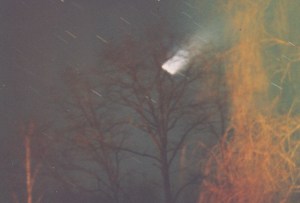
Nashotah House takes its name from the lake by which it was built. Colleagues sometimes joked about the fact that the seminary was wooded, lake-front property and implied that recreation time belied research time. It was, however, a place of intense study for the faculty. It did also offer the opportunity to experience nature. Dan drowned in a boating accident on Upper Nashotah Lake this past week. The image of that lake is etched forever in my mind. The night before I learned of my colleague’s death I was reflecting how I stood on the shore of that very lake late one night to photograph comet Hale-Bopp burning in the western sky. I had been reading about comets and that night by the lake stands out in my mind as a numinous moment. The lake, it seemed, had always been there.

After I left Nashotah House I let my colleagues fall into the safe mental compartments of memories. A few of my students kept in touch, but in general I heard from my colleagues only very rarely. Some may assume I spend more time on Facebook than I do. There are painful memories associated with the seminary. Now one more painful memory is added to the rest. I ate with Dan and his wife. Talked with him. Attended chapel with him. We had that distance that always separates clergy from laity, but I considered him a man that could be trusted. A priest with integrity. We went through quite a lot together in that small community on the lake. The death of a colleague comes with a guilt for not having kept in touch. A sadness for an opportunity missed. A life of kindness extinguished is a shocking grief.


Domesticity

One of the truly disturbing aspects of religion is its tendency to become domesticated. What I mean is that it becomes so much a part of the everyday scenery that you forget it’s there. I recently read a story about priests in the Church of England who don’t want parishes in poor neighborhoods. The reason given? They don’t want their children educated among the poor. That took me back a step. As someone with more than a passing familiarity with the Episcopalians, I wasn’t surprised that they didn’t want poor parishes. Of establishment Christianity, Anglicans are on the economical high end of the scale. I knew a few future priests like that at Nashotah House. Stylish worship and excess cash go together. But not to want your children educated with the poor? Is there fear of contagion?

I grew up poor. When I visit my hometown I’m reminded that although it featured in an X-Files episode, it will never be an affluent place. The people there, as a whole, struggle financially. I didn’t know any rich people growing up (I had to become an Episcopalian for that to happen) and I don’t think anyone rich lived in our town. Education, however, was a different thing. We went to school together and we learned. Some of us, despite not attending the finer establishments, managed to move through the educational system and on to college, seminary, and graduate school. Ironically, some of us even came to teach Episcopalians in seminary. A poor boy instructing the rich. But quite apart from that, it’s impossible to read the Gospels and not notice the concern for the poor in the founder of Christianity.

Image source: Julius Ejdestam: De fattigas Sverige, Wikimedia Commons

Early Christians weren’t Episcopalians. They were actually Jewish. Although a few of them had means, this new religion appealed primarily to the poor. As one of the earlier believers in the movement is said to have said, the rich receive their reward here. More and more Christians are coming to believe that this world is the locus of receiving rewards. Heaven isn’t so much on the radar anymore. We’ve been to outer space and it’s not there. Rather than put ourselves at risk among the poor, it’s better to blend in with the establishment. We can still rail aloud that the church is important and shouldn’t be ignored. But paying customers only, please. The poor? They’re a dime a dozen. And when we come to think of people that way, religion has become domesticated.


Ned Ludd and Company

I’m sure you’ve seen them too. Maybe in the movies, or on a newsreel, or maybe on a filmstrip in school. I’m referring to those scenes, usually in some foreign location, where bicycles, ox-carts, cars, buses, and pedestrians all crowd the same streets in a holy confusion of conflicting human intentions. Some can afford no transportation at all beyond their own feet. Others can own, and use, automobiles. On a scale like this I’d put myself around either the bicycle or ox-cart-driver level. I’m referring to technology, of course, and not actual transportation. At a recent family discussion I was left completely in the dust and exhaust fumes of new technology, trying hard to comprehend the words that other family members were speaking so fluently. Software names, devices that do things I can’t divine, and what is a dongle anyway? I’ve fallen behind not only on my movies and books, but on technology as well.

Tech develops quickly despite how slowly the rest of the world moves. Some members of my family don’t have computers or use the internet. Others have devices so advanced that they might’ve been salvaged from Roswell, and I wonder how all this happened when I thought I was paying attention. I’m a late joiner when it comes to tech. Although I’d been warned, I made it through my Master’s degree having barely touched a computer. When I took a decidedly low-tech job teaching at a medievalizing seminary, we couldn’t afford television service and we haven’t really watched TV since. Now I hear that you don’t need to pay for the privilege. If you have the time, black boxes, sticks, and even software downloadable on your phone can be your television. I look at our flatscreen at home and wonder where the on/off switch might be. How have I fallen so far behind the times?

The real problem, from the view on my bicycle seat, is that in order to maintain some level of expertise in my field of study, I have to dedicate quite a bit of time to it. While others tickle their devices on the bus, I’m reading my books made of genuine paper. I’m thinking such activities will make me better informed. Most of these books address the past. If I want to upgrade from to an ox-cart, however, I have to learn a whole new language and the nouns that accompany pieces of hardware that look an awful lot alike to these antique eyes. Perhaps we have become cyborgs after all, and I just missed the introductory session. I wouldn’t know; I’m too busy trying to keep this bicycle out of the path of that speeding lorry.


Eclipse 2017

It’s the day after the eclipse. Perhaps it’s because of the internet, but the excitement about this somewhat common event reached a fever pitch. Maybe it was because we all wanted something other than Donald Trump to talk about. Maybe it was because we hoped that the eclipse might have brought about some profound change. In the days before science was a thing, eclipses were divine events. The sky doesn’t darken at noon. It is an uncanny, an eerie thing. The last eclipse—alas, only partial—that I experienced was at Nashotah House. My wife was still a student in Illinois at the time, and without her to remind me, I went about my classes as usual. When I stepped outside the eclipse was already in progress. Nashotah’s quite rural, but the birds and insects were silent. The light was weird. The shadows of the leaves were scooped crescents on the ground. I could understand why pre-scientific people trembled.

These days we know there’s nothing more to life than scientific formulas and a bit of sloppy chemistry. So why do we bother getting bothered about eclipses? The fact is they remain religious in our minds. This is nature acting in a way not normal. Apocalypses generally include the sky growing dark. One of the plagues of Egypt was darkness. In the ancient mind the sun did not so much cause light (the moon could give light too) but it lived in the realm of light. If something blocked the sun that was one thing. If something invaded the realm of light, that was another. An eclipse was such an invasion. Even as monotheism began to take hold, people thought of the sun as a deity. It, after all, directs our lives.

In New York City I wasn’t sure what to expect. I went to street level with a couple of colleagues about 10 minutes before maximum coverage (about 71%) began. Knots of people stood on the corners on the eastern side of Madison Avenue—those who build skyscrapers don’t think of eclipse viewing on the streets below. What struck me most, however, was a kind of peace and awe. Strangers sharing various viewing devices with each other and looking up expectantly. Clouds had begun to move in, and I found myself talking to complete strangers, sharing out the eclipse-viewing glasses my wife had given me. We were participating in a moment of transcendence. Such moments are rare today. No, an eclipse is more than simply the moon moving in front of the sun. It is a human event as well. And one which, in the absence of the sun, brings out the best in us.