Indigenous Gods

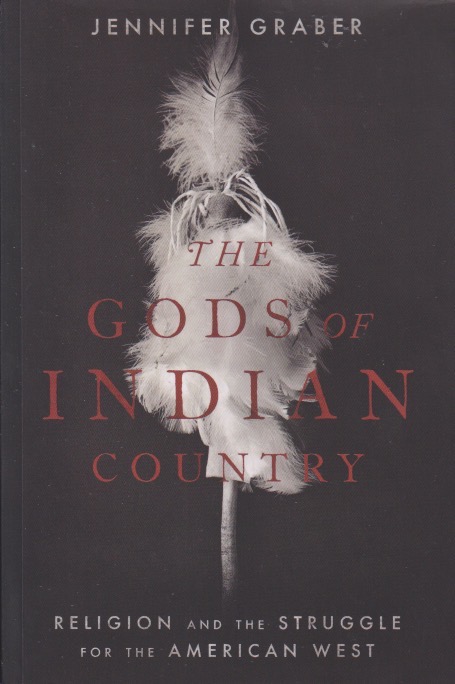
Engulfed by capitalism, it is too easy to ignore the indigenous population of this country.  I grew up thinking, in some way, that American Indians were extinct (this was small town America, after all).  Then we visited a place—in upstate New York, I think, but the recollection’s hazy—where there were real Indians.  This was before exoticism was a bad word, and I thought them quite exotic.  Maybe it was the way I was raised, but I’ve never thought of myself as better than anybody else.  Certainly not on the basis of race or gender, or even personal worth.  In any case, there were still Indians.  I’ve always been an admirer of their culture.  Jennifer Graber’s The Gods of Indian Country is an informative monograph on, as the subtitle says, Religion and the Struggle for the American West.

My interest in American history is relatively recent.  Growing up, I always found European history of greater interest, and then, for many years, the ancient history of the states along the eastern coast of the Mediterranean.  It was the antiquity of it all.  History feels safer when it’s at a great distance.  American history is not old.  When hearing that some of the events discussed by Graber took place in the 1910s, I kept thinking, “were we really that naive just over a century ago?”  Or was our nation willfully blind to the plight of the people who lived here before the Europeans arrived?  The narrative has changed.  And if it hasn’t, it must.  How would we like it if, say, aliens landed and assumed the right to take over capitalistic America?  It’s only our arrogance that prevents us from treating Indians better.

Religion, particularly Christianity, fueled many interactions with the Indians, as Graber ably demonstrates.  The assumption was that Indians had to assimilate to capitalistically-fueled Christianity.  Private ownership.  Free trade.  Otherwise the cultures could not share the land.  Treaties were broken because the “Christian” rules of the new overlords demanded it.  Graber also explores some Native American religious practices as well, chiefly among the Kiowa.  Since the book is fairly brief, it doesn’t include any kind of comprehensive coverage of Indian religion, nor, of course, of early American settler religion.  What happened is that religion and politics joined forces to justify stealing what belonged to someone else.  Those who study the history of religion recognize this pattern.  It isn’t a rarity, unfortunately.  Although my interest in American history is recent, it is growing.  What happened in your own backyard determines so much of how we’ve become who we are.


Borrowed Land

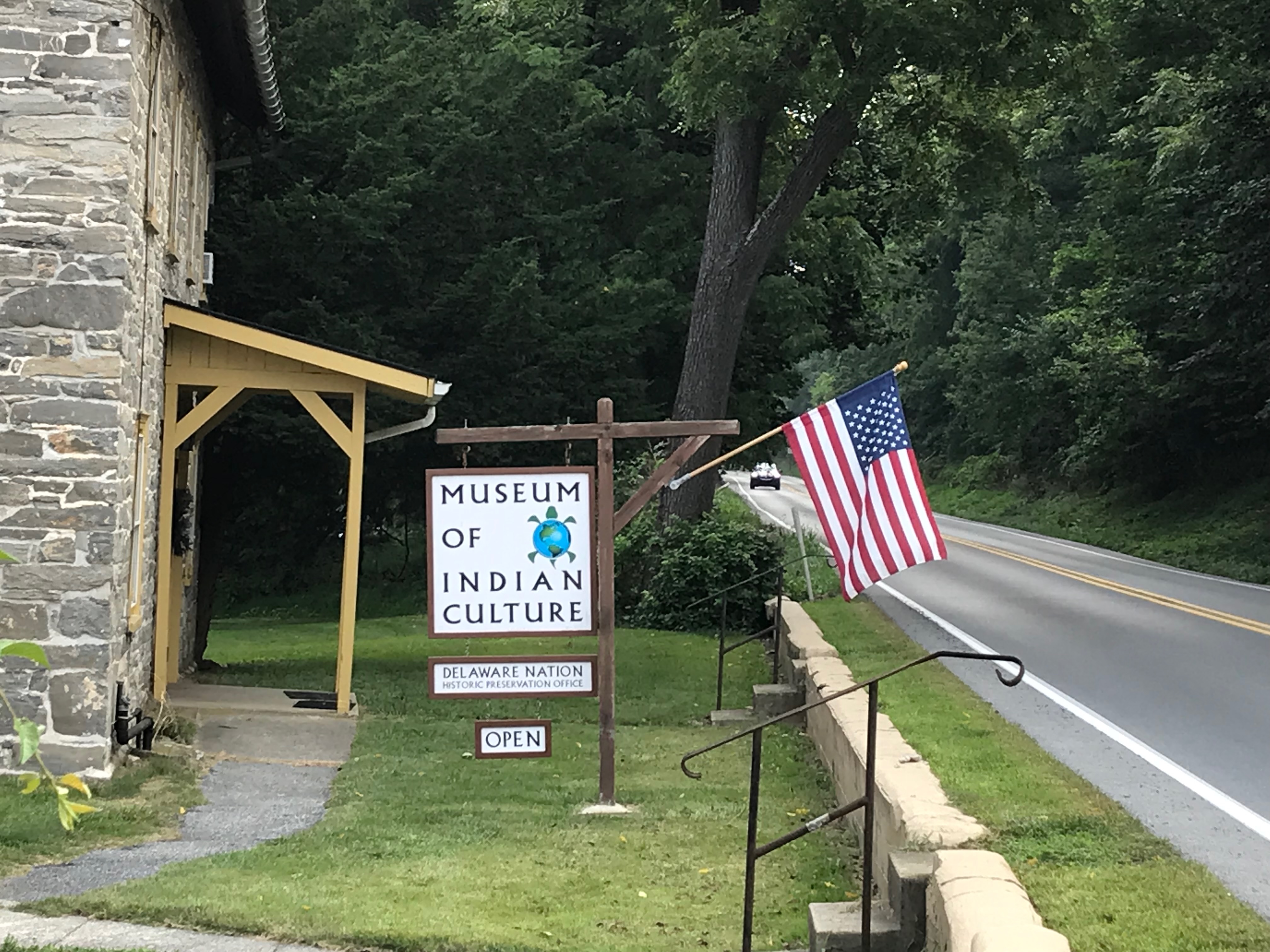
The thing about local attractions is that residents seldom have time to visit them.  Weekends are busy with the tasks you can’t accomplish otherwise with a 9-2-5 and being a “homeowner” is more like being owned.  Nevertheless, one Sunday afternoon we ventured to The Museum of Indian Culture, just south of Allentown.  I’d known about it for a few years, but wasn’t sure what to expect.  Occupying the house built by the Bieber family (not the singer, but the local bus-owning company that died during the pandemic) way back, the museum is small, but intimate.    The docents are unstinting with their time.  This is Lenape tribal land and the museum houses some local, and some national, pieces.  It also has a very extensive library.  

Often it’s difficult to feel proud of being of European extraction.  So many crimes were committed during the period of colonialism (and are still being perpetrated) that you just want to apologize over and over when you meet an American Indian.  The thing is, every native American I’ve met has been gracious and kind.  They still feel connected to the land in a way that seems foreign to Europeans.  Colonialists (and present-day capitalists) saw (see) the land as for exploitation.  We are slowly, hopefully, coming to realize that the indigenous way of living with the land is far more sustainable than the conquering attitude that metal smelting and gunpowder gave.  I kept thinking, what would it be like if people we didn’t even know existed showed up and just started taking everything for their own?  And claiming an all-powerful deity had given it to them?  Wouldn’t we fight back, just as the first Americans did?

I was especially hit by the hypocrisy of it all.  The code talkers helped win the Second World War.  As our docent said, at the Carlisle Indian School Indians were severely punished for speaking their native language.  They were being Christianized, of course.  Then, during the War the military realized we have a treasure-trove of languages that nobody else in the world speaks.  Suddenly their languages were an asset to be exploited.  Native Americans proudly served (and serve) in the military.  It is actually their land they’re defending.  We spent an educational hour in the small museum not far from property we “own,” according to a law code of “right behavior” drafted by others.  You might be able to leave places like this small museum, but they don’t leave you.


Showing Gratitude

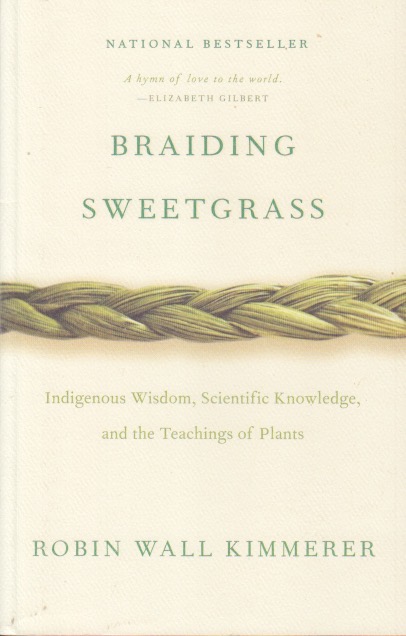
Stealing is something that we all, except some capitalists, know is wrong.  I think quite a lot about the land that was stolen to make America possible and I know that simply giving it back isn’t an option.  Nevertheless, I do believe that we should listen, and listen attentively to those who’ve been here longer than Europeans.  Robin Wall Kimmerer’s Braiding Sweetgrass is an important reflection of this dilemma.  Kimmerer is Potawatomi and she’s also a professor of Environmental Biology.  The book is a series of essays that focus mostly on plants and what we can learn from them.  It also brings in indigenous teaching, contrasting the outlook of gratitude against that of greed.  By turns sad, funny, and profound, Braiding Sweetgrass contains a message that is vital to counter climate change.  To correct our attitude before it’s too late.

There’s so much in this book that it’s difficult to know what to touch on in this brief notice.  Throughout, Kimmerer notes that the First Nations viewed life as a gift.  The earth is constantly giving and the native way was to be thankful and to accept the responsibility of being given a gift.  Seeing how the European attitude was “take until there’s no more to take,” she points out that taking what you need and leaving for others is a way out of our current dilemma.  She does this, most strikingly, by the story of the windigo.  The windigo has become popular among monster fans as a consuming beast, but Kimmerer shows how the story has a profound point.  If all you do is consume you become a monster.  You stop a windigo by showing gratitude.

Perhaps the most striking thing, to me, was how Kimmerer describes her own experience becoming a scientist.  How standard academics refused to believe they had anything to learn from Native American outlooks, especially when borne by a woman.  How she was told she couldn’t be a scientist, not with that outlook.  And how she learned the European way but didn’t give up her native understanding.  How she brings two worlds together and does so with a sense of urgency and hope.  Things have gone too far simply to turn back the calendar and say that our ancestors had it all wrong, but it’s not too late to learn from those who lived for millennia on this land and were untainted by ideas of private ownership.  Those who knew how to live sustainably with nature.  Those who knew, and still know, how to defeat monsters.


The Future of Consciousness

Consciousness is unexplained.  We’re born and we become aware.  Raised by parents or guardians, we learn where we belong.  The decisions of one generation affect the futures of the next, often without conscious consideration.  I’ve been thinking about how, with our limited resources, we’ve pressed on, reproducing beyond what our environment can sustain and each of us is born conscious.  Some of us—many, in fact—in difficult circumstances.  Instead of working together to figure this out, we keep on, not quite sure of what we’re doing or where we’re going.  Heath Ledger’s Joker may’ve been speaking for all of humanity when he asked, “Do I look like a guy with a plan?”  Do any of us?

During a discussion the other day the topic of the severe western drought came up.  There have been general drought conditions in the western half of the country (the northwestern coast has been spared) for well over half-a-century.  I wonder why the cities in such regions continue to expand and then I realize that each generation is a kind of reboot.  We tend to think we belong where we’re born.  My thoughts turn toward the ancestors of the first nations and how they knew that moving was necessary for life.  When the ice sheets start descending you really don’t have many options.  Perhaps our sense of place is an evolved trait, brought on by the changed circumstances of invaders’ senses of ownership.  Capitalism certainly doesn’t help.  Those born in drought-ravaged areas soon come to think of it as normal.  We can adjust to just about anything.

Settled existence is necessary for a life that defines meaning by ownership.  For me, I have a difficult time imagining my life without my books.  What we read tends to define us.  What would I do if the ice sheets began descending again?  Such change takes time, of course, but our complex society doesn’t seem to be very good at advanced planning.  My consciousness tells me where I belong geographically, psychologically, and even religiously.  I was taught such things as a child and even if I unlearn lessons that were wrong, I will always still feel that they were right.  If I flee the coming ice sheet I simply have to accept that my reality has changed.  Until that ice sheet’s at my back door, however, I can continue to deny it’s a problem.  Consciousness is a funny thing.


Ithaca Musings

Ithaca may be the ultimate hippie town. Open and accepting of diversity, it’s a place where anyone can speak out against what’s going on in the government and not worry about finding any objectors. Yesterday when I was in Buffalo Street Books, customers openly vented their frustrations with the way Washington’s handling things, and others joined in. There’s a sense of righteous anger here that hasn’t been fashionable since the days of the biblical prophets. You have heard it was said Watergate was a bad thing, but verily I say unto thee something much worse than Watergate is here. And although winter is still holding on in upstate New York, nobody doubts global warming is real.

From my first visit here, I knew that I wanted to live in Ithaca, but it is one of those places you can’t afford to live. Amazing how the liberal cities are the places people want to reside. Places where you can’t just turn off the realities of a diverse world just because some things make you uncomfortable. Places where if you notice that other people are different you are reminded that you, in their eyes, are the different one. There is no static, monochrome, cookie-cutter American. Why is this an idea so hard to sell? Capitalism leads to and fuels the desire to own. And owning leads to the desire to own more. I’ve often noticed this since being out of higher education—even within your own company others want what you have. The basic civility of the socialist is missing. That’s where the “me first” attitude leads.

In upstate New York, as in many parts of the nation, the very names remind us that others “owned” the land before Europeans arrived. Native American concepts of ownership were so different from the capitalist ones that forcefully landed on these shores that those views were forced, under firearms and steel, to assimilate to the foreigners’ ways. Capitalism takes no prisoners. Turnabout, they used to say, is fair play. We no longer feel that way as a nation. The interlopers have taken over. We’ve made the country in our own image. And it certainly isn’t any more noble for it. Being in a place like Ithaca always makes my spirits ebullient. The very concept of ownership is an odd one, I realize. Mere mortals can never really own anything. We can pretend to, or perhaps we can take a more enlightened view. We are all borrowing things here. And I would love to borrow a piece of real estate here in Ithaca.


Amityville Revisited

Remakes, standard wisdom holds, are seldom as good as the originals. When the original wasn’t great to begin with, the bar should be lower. Should be. I’ve been curious about the Lutz haunting in Amityville, having just read the book that started the phenomenon back in the late 1970s. I saw the movie first. That was several years ago now, but I do recall that even as horror movies go it had its failings. Some of that goes back to the book (presuming that anything happened)—nobody had a solid grip on whether this was a ghostly haunting or a demonic infestation. What the movie did do well is show how fragile family relationships can be, especially when under the pressures of supernatural supervision, not of the positive kind. Although, as is to be expected, the book was scarier.

Overcome by curiosity I finally watched the remake from 2005. Clearly I’m not the only one still curious about this alleged haunting, alleged hoax. I also have the alleged burden of looking for religion in horror. Only on this final count was it not disappointing. Well, that and in featuring burgeoning scream queen Chloë Grace Moretz. Although Father Callaway’s role is late in the film and brief, early on religious ideas are implicated. If the movie hadn’t tried so hard to be The Shining these themes might’ve been developed to good advantage. Instead it introduces Rev. Jeremiah Ketcham (also late in the film) as the first owner of the house in 1692 (did the real-estate agent’s mention of that date make you shiver?). Ketcham was a sadist to the Indians under his care, torturing them to death in the house. No time is left to explore the sinister minister’s motivation as the family implodes in its attempt to escape the house by boat.

As is frequently the case with the supernatural, we’ll likely never know what happened at the Amityville house. The story Jay Anson told is now generally classified as a novel. The preternatural can be judged neither in the courtroom nor the laboratory. The best that we can do is make celluloid adaptations to make some money on the deal. The DeFeo murders happened in living memory. The Lutzes left the house in a hurry shortly after purchasing it. Anson’s Indian “asylum” was never really there—and there were no such Native American practices in any case. What the remake left out was demons. Although the movie attempted other religious scares, the house just isn’t the same without them.


Ocean Blue

I suspect with Trump in office Columbus Day will get a boost. After all, it’s the narrative of the white man coming to America and improving on what anybody else had done. Making America great, one might say. That wobbly narrative has been justifiably under fire for some time. Not least for historical reasons. We know beyond reasonable doubt that the Vikings were here before Columbus. Ironically, the savage Vikings appear the more benign of the two. A friend recently sent me a story from Realm of History that asks “Did The Irish Reach The New World Before The Vikings And Columbus?” The story by Alok Bannerjee tells of St. Brendan, a sixth-century Irish monk who may have made the voyage even before the Vikings. And don’t get me started on the Bat Creek inscription or the Kensington Runestone.

The problem with early history is that it’s early. Evidence, when it exists, is rare and often perishable. We know that the technology to cross the Atlantic existed at least as early as the Phoenicians. And we know that no matter how crazy others tell us we are, people are insanely curious. And those who go down to the sea in ships might even make it into the Bible. Objections to anyone making it to the “New World” prior to the Vikings tells us something of the nature of orthodoxy. Yes, historians and scientists have it too. Orthodoxy is where evidence crosses the line into belief. And belief, as I’ve often said, is difficult to dislodge.

So, am I throwing open the doors for any who wish to claim they were here first? Hardly. Well maybe. My own opinions aside, when unorthodox evidence arises, what should we do? The traditional response of “when in doubt, throw it out” may not serve us well. Perhaps we should have a shelf, or locker somewhere. A receptacle in which we might store the stories. When I was a kid learning about Columbus, teachers doubted Vikings had made it this far. Orthodoxy has had to back off on the Norsemen, of course, since archaeology now backs them up. Vineland was a reality, it seems. Even before the purported Irish or Phoenicians, the first nations were here. Where is their federal holiday? We don’t like to think about that. Far too much investing in “superiority” has gone into it. It’s Columbus Day and most of us are at work anyway. Some of us dreaming of new worlds all the same.


Majority Report

In your mind’s eye, picture American 500 years ago. What do you see? Even those of us who’ve studied history have trouble envisioning the past with so different a set of parameters. At least if we’re honest with ourselves. 1516. The Salem Witch trials are almost two centuries in the future. The landscape is occupied by Native Americans. There are some European settlements. Protestantism is something new. In fact we’ll need to wait another year for Martin Luther to drag out his hammer and nails, theses in hand. The America we see then, not called “America,” let alone “United States,” is a diverse—some might say “wild”—world of decidedly non-European sensibilities. Global warming wasn’t an issue, and King James hadn’t even been born yet, let alone been commissioning the most famous Bible in English ever. So why am I asking you to look back?

luther_at_erfurt_-_justification_by_faith

This presidential campaign has largely been a waspish one. During the turmoil, books have been published proclaiming the end of “white, Christian America.” In an interview on PBS one of the authors of such a book, Robert Jones, talks about how America has changed. He notes that what he really means is that white Protestants are, statistically speaking, no longer the majority. Just a few centuries ago that was also the case. Think about Protestants a minute. They’re the ones who invented the Bible as we know it. Oh, the book had been around, in some form or other, for a couple of millennia (well, a millennium and a half, back then). Other than scholars in need of more fresh air, few spent much time with it. The church told Europeans what God demanded and the majority of people just got on with their daily lives not worrying about what some book they couldn’t even read might say. How things have changed!

We worry about the end of our majority. I like to look back and see that this world we’ve built is one based largely on a book that was mainly the invention of those who had some discussion points with the church. Not quite a hundred of them, even. They were largely Anglo-Saxons. If they knew about “the New World” their knowledge was hazy and imprecise. From that perspective it doesn’t seem like much is being lost in the changing religious demographics of this country. Back in the old world, if one wished to feel nostalgic for such things, they would’ve taken their complaints and found the nearest church door. Now we nominate candidates who think this country was ours in the first place, without ever even reading the Bible used to support that myth. What a difference a few centuries can make.


Two Thoughts

I recently read that efforts are underway, by some parties, to teach Arabic to Israelis. My limited experience of Israel led me to believe that most people were already bilingual, judging by the roadsigns. Like our progressive neighbor to the north, I supposed people were expected to know both languages passably well. Having forgotten more languages than I care to remember, I am a believer in language education. There’s no better way to get to know how people think than learning their language. In my hometown, which was small and not especially prosperous, there was only one language taught in schools. I suppose that was “practical” since we had no hispanic population and not even one ethnic restaurant.

Israel, in the modern sense, is a state formed where other people (Palestinians) had been living. I wonder if the conflict might’ve been somewhat ameliorated had the new neighbors spoken the same language as the residents. Thinking over the long and sad history of colonialism, I suspect that many of the world’s woes would have been less deleterious if those invading stopped to learn to speak to the locals. What would it have been like if, instead of taking their land and forcing them to assimilate, early American colonists learned to speak Indian languages? What if local schools were required to have been bilingual with the local nations? I can’t help but believe that things would’ve turned out much better for everyone involved. I can’t listen to the rhetoric of the right supremacists without seeking a safe place to throw up. Nobody is better than anybody else by virtue of their race. As they might say in Canada, “vive la différence!”

I’m not naive enough to believe that simply learning languages would solve the Arab-Israeli conflict. Nor do I think it would’ve stopped European imperialists with too much gold on their minds from taking the land that belonged to Native Americans. I do think that if people took the time to learn what their neighbors were saying, in their own words, we be less inclined to suggest that our program is the only way. Or to build walls. Or shoot unarmed citizens. We’ve lost the interest in learning to talk to one another. Language is more than just a bunch of words. Let the linguists argue about syntax. The rest of us might benefit simply from learning to listen, and to understand.

img_2969


Swamped

The word “venerable” is often applied with the connotation of age. Although the word in its own right really means to “adore,” or “worship,” objects of extreme age evoke that response. Perhaps the fact that “time-honored” is used as a synonym helps create that impression. As human beings, many of us experience an awe at being in the presence of something much older than ourselves. When I read about the Great Swamp Oak, then, I knew I would eventually need to see it. Reliable indications of a living tree’s age are difficult to assess for a non-botanist. Websites don’t give much thought to checking out the oldest tree in the state (although I did discover The NJ Big Tree Registry), but there are those who give that honor to the white oak of Basking Ridge, not far from the Great Swamp Oak. Others seem to indicate that the swamp denizen is older—somewhere in the range of 700 years. In the state of New Jersey, where things are constantly being reinvented and reconstructed, it is a source of comfort to find something so old leaving peacefully in a swamp.

DSCN6148

Now that I’ve used the words “tree” and “worship” together, I am inevitably brought back to the conceit of Asherah. As my academic writings have adequately demonstrated, I have doubts about the goddess’s association with trees. Nevertheless, there is something venerable about an ancient tree. If the Great Swamp Oak is 700 years old, it was already alive well before the “Age of Exploration” began. The only people to know of it, when there was as yet nothing to know, were First Nations inhabitants of the region. It was a time when, to American Indians, Europe did not even exist. Meanwhile across the ocean the plague could have been raging. A century or two later, Europeans would bring their plagues to these shores, forever changing the landscape. And not in a good way.

Trees, without human interference, can have tremendous life spans. In our short-sighted way, however, we have often understood them as nuisances in the way of some great shopping mall or industrial site. The “lungs of the planet,” trees have been wantonly destroyed in the name of progress. It is amazing that, especially on the East Coast, a few of them managed to avoid the axe and saw. Looking up into the branches of this great oak, I marvel at the changes that have taken place that, in its own way, this tree has “seen.” The world outside this swamp would be completely unrecognizable. Whether an asherah or not, I find myself reacting to the venerable nature of this sentinel of the ages. If only we could learn to keep our hands off young trees that nature plants, who knows what wonders future generations might experience in places even more unlikely than a swamp.


True Natives

StarPeopleI have long been fascinated by American Indian folklore. In fact, the first book I read this year was a set of Indian tales. Just this week I finished a most unusual book by Ardy Sixkiller Clarke entitled Encounters with Star People: Untold Stories of American Indians. Clarke, who is herself Indian, taught at Montana State University and collected stories from various tribes concerning Star People. Mainstream western science has already made up its mind that Homo sapiens are the most advanced species ever to grace this universe, and so any discussion of visiting non-terrestrials is off the table. What Clarke shows us, however, is that just because there’s no such thing doesn’t mean that all worldviews agree on that point. In many interviews with indigenous peoples of the Americas, belief in Star People emerges as perfectly normal. As does not talking about it because white people will ridicule and belittle anything that doesn’t fit into their limited cosmos of technology and money.

Reading these stories felt like absorbing wisdom from those who observe nature more carefully than those of us of European stock are inclined to do. With eyes pressed to microscopes and telescopes, it is sometimes possible to miss the big picture. We crowd into cities and have no idea how to live under the stars. We can’t even see the stars most of the time. Have we lost our ability to wonder?

Purely from an academic point of view, I wonder why aliens can’t be taken seriously. I try to think of other topics that are simply laughed out of discussion before examining the evidence. To me it seems that human pride is at stake in this case. We are a very proud species, enamored of our own accomplishments. If we can’t reach the stars, nobody else can. This to me is troubling. Aliens, after all, don’t fall into the category of “supernatural” unless we mythologize them into yesteryear’s angels. If they are real, they are as natural as we are. They would have a technology that we haven’t replicated yet, and anyone who doubts interstellar flight should consider the impossibility of carrying a computer around in your pocket or on your wrist only thirty years ago. No, if there are Star People, they are natural. Whether or not they might exist is simply a matter of belief.


Entitlement

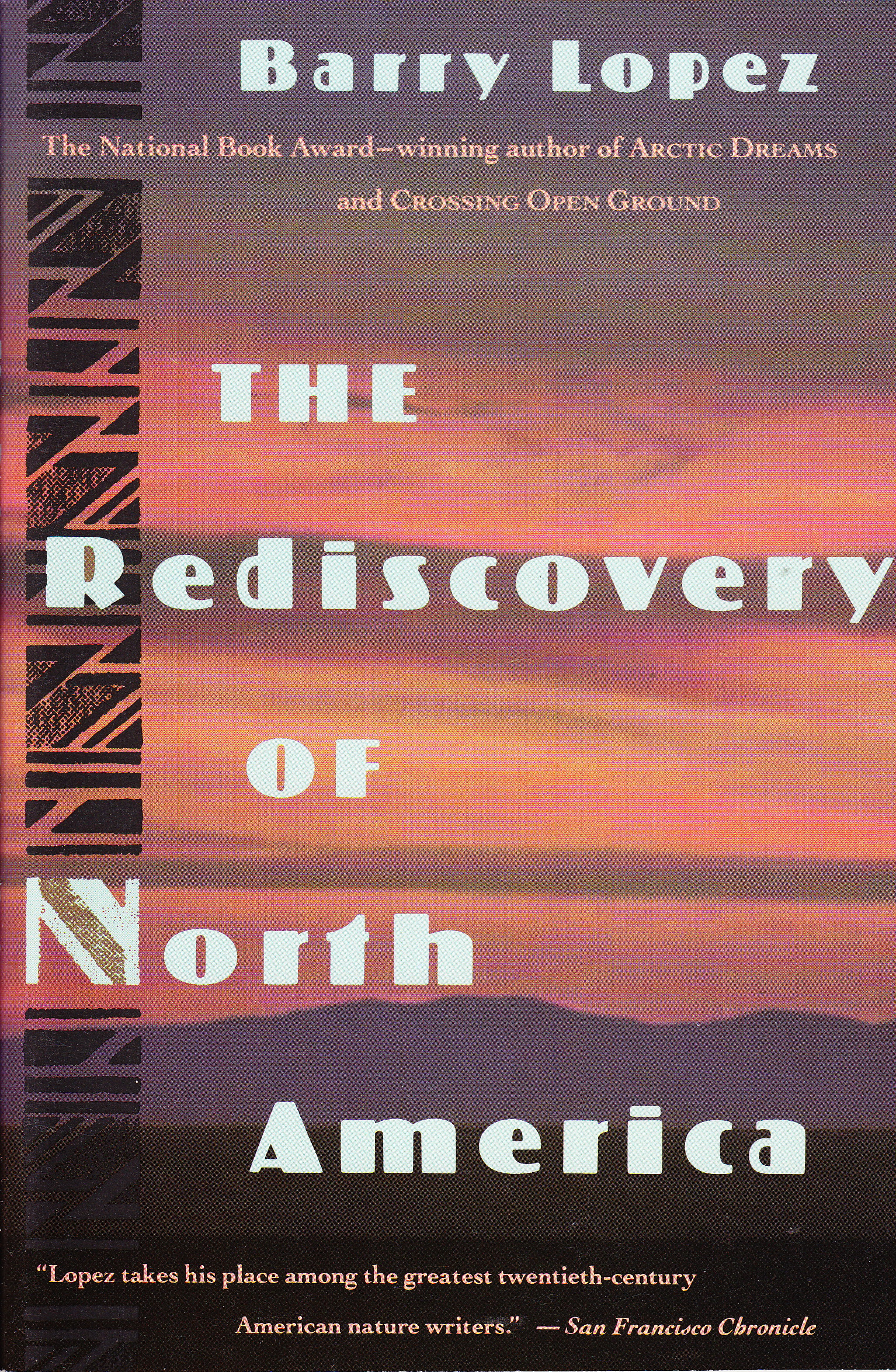
LopezNorthAmericaAs winter begins to settle in, I recall reading Barry Lopez’s masterful Arctic Dreams many years ago. That book left such an impression that when I saw his The Rediscovery of North America—a very small book—I thought it was worth the asking price. Lopez is one of those nature writers who can transport the reader into the world he observes. This brief volume, however, takes the reader to a very different kind of world—the world of European interaction with North America. As children we (and I speak for myself, or perhaps my generation) were still taught that Columbus was a kind of hero. He ventured into the unknown and discovered an entire new world. That world became the everyday place we inhabit with our comforts and our toys. Things only got better from there. Of course, I learned to distrust this view by the time I was an undergraduate, and my perspective has turned a bit more serious since then. These events, viewed from the perspective of the Native Americans, have a completely opposed outlook. Lopez tries to capture a sense of how to rectify these wrongs in his Thomas D. Clark lectures that make the basis for this book.

Greed, no doubt, drove the early explorers of the new world. And a sense of entitlement that has not diminished with the passing centuries. While it is not as simple as tracing this sense of ownership back to Genesis, clearly the Bible plays some role in it. Religions that teach their adherents that they have the sole truth will inevitably lead to entitlement. Monotheism, as I’ve noted before, possesses the tendency to make absolute claims. One God, one Church, one Truth. And non-believers become expendable. To the Catholic Spaniards setting out for the new world (or actually, old world, but tripping up on the new along the way), as Lopez points out, were driven by lust for gold. And spices. And fornication. Things that, if one took it seriously, would be decried by the church as vices. Still, taking advantage of the gullible and helpless is a time-honored practice among many religious bodies, and we know that genocide ensues.

Somehow history has taught us that some genocides are worse than others. Those inflicted on native populations, perhaps because they weren’t always intentional (in the case of diseases) are sometimes still given a silent assent. Yet, as Lopez makes clear, the intention to murder was there already. The conquistadors had already decided that the natives did not deserve the same rights as the God-blessed new arrivals. What saddens me—and I think Lopez too—is that this same sense of entitlement, instead of tempering with time, has continued to increase. Tea Parties and American Values often include removing those who disagree. Inconvenient indigenous populations that aren’t mentioned in the Bible except as Canaanite stand-ins. And should we care to make right what was perpetrated, perhaps we ought to consider rediscovering North America.


Thank You

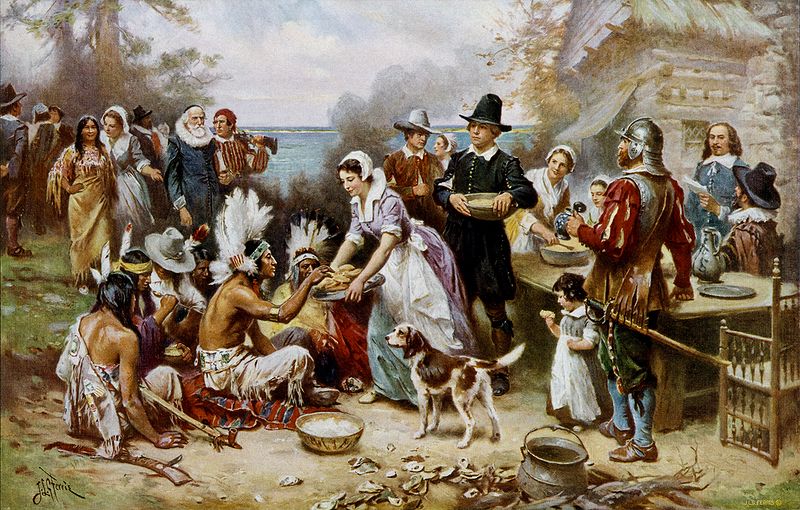
Comments being rare on this blog, I do read them when they come along. Recently I had a reader comment, in the form of a question (as sometimes happens): “Do Native American Indians do ‘Thanksgiving’?” Although I’m fairly certain this was intended as a rhetorical question, I was raised a literalist and couldn’t help trying to formulate an answer. Although I can make no claims to know Native American culture well (I wish I did) it led me to ponder the concept of Thanksgiving. No doubt the idea had at least informal religious beginnings. Even with the early European settlers, a religious diversity was already appearing. Still, although the Native Americans lost pretty much everything, they were still involved, at least according to the early accounts. The great spirit they thanked was not likely conceived of in the way that the god of the pilgrims was, and yet, thankfulness is a natural human response. Writers, often fully aware that their work deserves publication, frequently thank an editor for accepting it. It’s a deeply rooted biological response.

800px-The_First_Thanksgiving_cph.3g04961

For some of us, Thanksgiving is more about having time to recuperate after non-stop work for about ten months. The standard business calendar gives the occasional long weekend, but after New Year’s the only built-in four-day weekend is Thanksgiving. It is that oasis we see in the distance as we crawl through the desert sand. Time to be together with those we love rather than those we’re paid to spend time with. To rest and be thankful.

Among the highlands of Argyll, in western Scotland, is the picturesque Glen Croe. Years ago, driving with friends through the rugged scenery of boulders and heather, the little car struggled with its burden of four passengers. We stopped at a viewpoint known as “Rest and Be Thankful.” The name derives from an inscription left by soldiers building the Drover’s road in 1753, at the highest point in the climb. The Jacobite movement and the Killing Time had instilled considerable religious angst to the Scotland of the previous century and led to the calamity of Culloden less than a decade before the road was laid. These religious differences led to excessive bloodshed throughout a realm supposedly unified by the monarchy. Even though no natives protested displacement, religion led to hatred and mistrust, as it often does. Is not Rest and Be Thankful, however, for everyone, no matter their faith or ethnicity? And in case anyone is wondering, yes, this rhetorical question contains a metaphor to contemplate. Rest and be thankful.


Dry Nation

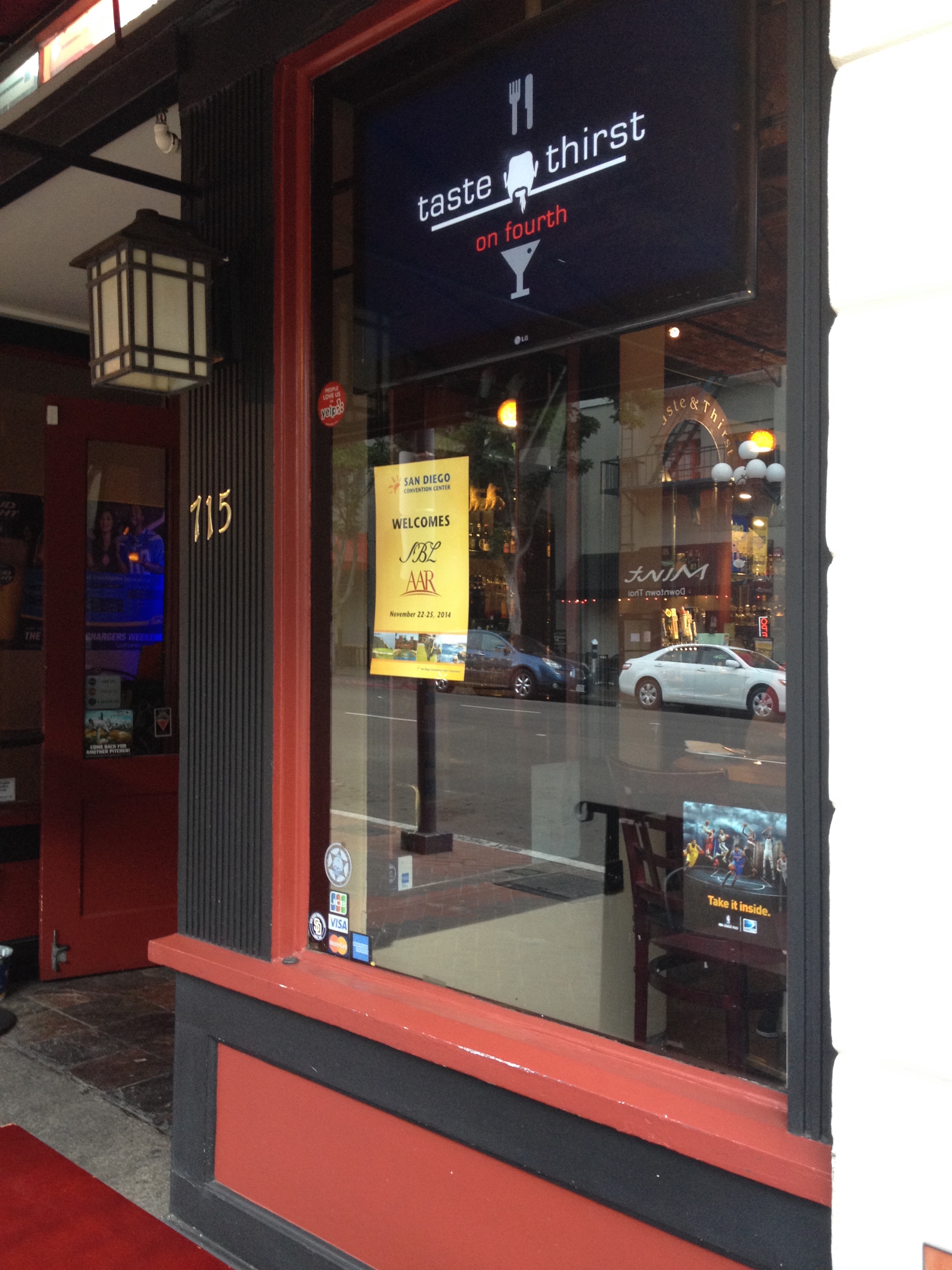
The American Academy of Religion and Society of Biblical Literature annual meeting is a big thing. It draws a myriad (literally) of scholars together every year and invades a fair sized city that may or may not be a religious haven. San Diego feels like a pretty Catholic city to me. My cab driver from the airport was a Muslim, but many of the churches and place names around here reveal a natural comfort with Catholicism. My first night in town, on my own and somewhat weary from awaking at 3:30 on the other coast to get ready to catch my flight, I wandered through the Gaslamp District looking for some authentic Mexican food. It is surprisingly tricky to find, although I’m only twenty miles from Tijuana. Along the way I passed a bar that had a welcome AAR/SBL poster in its window. Now here was a vender that recognized their client!

IMG_1814

Many of those outside the profession assume such conferences as this are like higher education Sunday schools. Undoubtedly, there are those who wish they were. For some, perhaps, the annual meeting allows for the indulgence of personal peccadillos far from watching administrative eyes. Others are more sanguine about it all. Religion scholars are just as human as the next guy. As I looked at this bar window, I reflected on how Christianity (in particular) came to regard alcohol as an evil. Wine and beer were known from ancient times, and even the New Testament has Jesus presented as an imbiber. Temperance, however, grew out of American Fundamentalism that seemed to have forgotten its scriptural roots. I remember learning, as a child, that the wine Jesus drank was really only grape juice with a little kick. Who wants an inebriated God running around the Middle East?

Still, I realize that drinking has its consequences. As the child of an alcoholic, I know the damage that this can do. On the other hand, I know many religions view “controlled substances” as gateways to alternate realities. Other planes of existence. There are even cases where Native Americans have been arrested for using their traditional ceremonial substances in a nation not quite Christian, not quite not Christian. Even on my way to the Gaslamp District, I was saddened to see so many homeless about the city. I knew that as evening fell and the scholars arrived, the bar would come alive. And I knew that when the rain came, some would get wet while others stayed nice and dry.


True Literalism

Biblical literalists make strong claims for selectively obeying the Bible. It isn’t so hard to do in the short term, as numerous books on people “living biblically” have shown. You can get by for a year without trimming your beard or going out on a Saturday. You can even survive without eating pigs. Still, the moral codes that political literalists cite tend to have their own empowerment in mind: prevent women, gays, or those of other races from getting ahead. Stone adulterers and sassy kids. The Bible will set us straight! The finer points of the law, however, have likely never been observed. Even biblical scholars will confess that Leviticus can be a tough go. It sometimes helps to make diagrams as you read along to try to follow the intricate rules. Still, since Leviticus is the only place to find anti-homosexual rhetoric in the Hebrew Bible, we’d better go on reading it, right? It is worth it to feel better about ourselves. Superiority rules!

I was thinking about Leviticus 25 recently, the chapter about the sabbaths of the land. The concept may have sound environmental principles encoded in it: after working the land for six years, you leave it fallow on the seventh and live off of what you’ve stored up during the presumably bumper-crop years. The same principle lies behind rotating crops—the land needs a rest. There’s no evidence, however, that this was ever really put into practice. It is notoriously difficult to feed everyone in a subsistence economy, and deliberately not growing food for a year will almost certainly lead to disaster. Read a little further though. Every fiftieth year, Leviticus 25 mandates, that which you have bought from your neighbor should be returned. “Ye shall not therefore oppress one another” is one of the more easily overlooked rules in the Good Book. Any land sold is only on loan for, at most, forty-nine years. I’m still waiting for the book entitled My Fifty Years of Living Biblically.

The biblical term for this collective lack of selfishness is called Jubilee Year. Ancient Israel was, at least on vellum, an egalitarian society. Each person had promised land allotted to them. Economic hardship (such as sending a child to college) might necessitate selling all you have. Fear not—hopefully before you die—what you sold will be retuned to you and the system will even itself out again. It is a profoundly beautiful idea. It has, of course, never been taken seriously. So as we see the literalists massing as candidates begin gearing up for another cycle of elections, I think it is only fair to ask to see their mortgage papers. A visit to the county records bureau might be in order. I think maybe somebody has been holding out on land I’m biblically owed in upstate New York. Just don’t tell any Native Americans about this, for it seems maybe they have the most of all to benefit from taking the Bible literally.

580px-Warm_Springs