Dogs, etc.

From Wikipedia

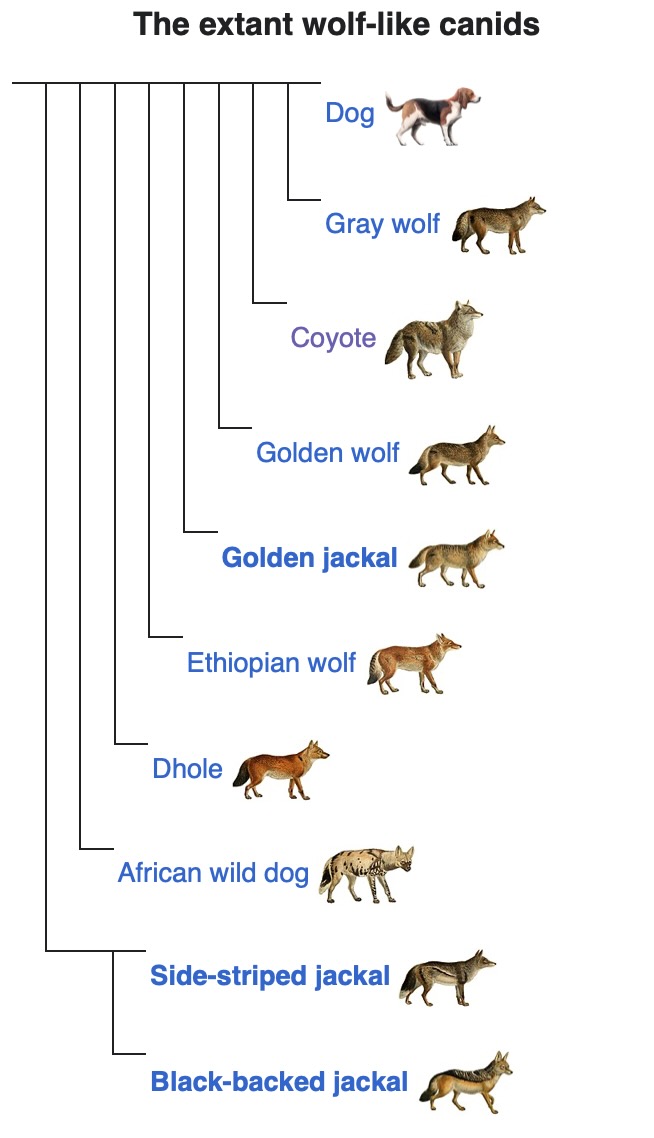
An incidental mention of jackals in a book made me curious.  Where did they come on the canine family tree?  I looked it up and was surprised at the results.  Based on DNA studies, they are further removed from the dog than the gray wolf is.  The lineage is quite ancient.  Quite clearly, this is a successful form of predator.  They’re actually omnivores, but they do hunt.  Just a few days ago I saw a red fox while out on my early morning jog.  As I watched it, and it watched me, I was thinking how like a dog it is.  Foxes are, however, still further from dogs on the family tree of life, falling into a separate phylum.  (I use that word advisedly, since since high school it seems that cladistics have become so complex—not that they were ever easy—that you need an electron microscope to tease similar creatures apart.)  When I see coyotes on the jog (quite rare), it seems they are a step further from dogs than wolves.

I grew up with dogs.  Our first lasting one was a good part beagle, and, in my opinion the best dog ever.  We don’t have pets now.  My wife tends to be allergic and pet care complicates travel (when we can afford it), but I often marvel at how well dogs have adapted to us.  And vice versa.  People now take their dogs into grocery stores and other shops.  While in an outdoor goods store recently, I was surprised to see a dog and its human pet stroll by.  The dog was as high as my chest.  (Or at least rib cage.)  And yet, in the wild, a jackal could well attack you.  And they’re biblical.  So biblical that they got picked up as the “father” of the Antichrist in The Omen.  Dogs, in the biblical world, were considered unclean.  I suspect people kept them as working pets anyway.  That’s why our species domesticated them.  The jackal, on the other hand, is a wild animal.

If I saw a jackal while jogging I’d probably mistake it for a dog.  Depending.  Only long hours of studying have taught me to distinguish coyotes (which I very rarely see) from dogs.  Since jackals aren’t native to the Americas, the coyote fills much the same ecological niche.  Since about 2016 they can be found in any area of the continental United States.  They even adapt to city life.  I guess the jackal is the country cousin.  Coyotes attack humans more than gray wolves do, probably because there are many more coyotes.  And they are just about everywhere.  And the reference to the jackal I was was, I assure you, truly only incidental.


More Rocks

Another thing about rocks—I warned you!—is the matter of scale.  When I go out jogging, it’s on pea gravel.  Some of these tiny stones are interesting.  Or, if you’re the romantic type and gave or received an engagement ring, that diamond is likely not to be massive.  I’m always reminded of this when I go to a mall, say, which has a floor full of fossiliferous limestone.  I think of the hours I’ve spent poking around creek beds and cliff faces for fossils, and here, laid out for thousands of square feet, is polished flooring floating with fossils.  Or when I walk into a bank, say, and see a counter made of labradorite.  I carry a small labradorite piece in my pocket that my brother once gave me.  I love the way it catches the light and reflects a beautiful blue color back to me.  Here it is in massive form where I’m trying to make a modest withdrawal.

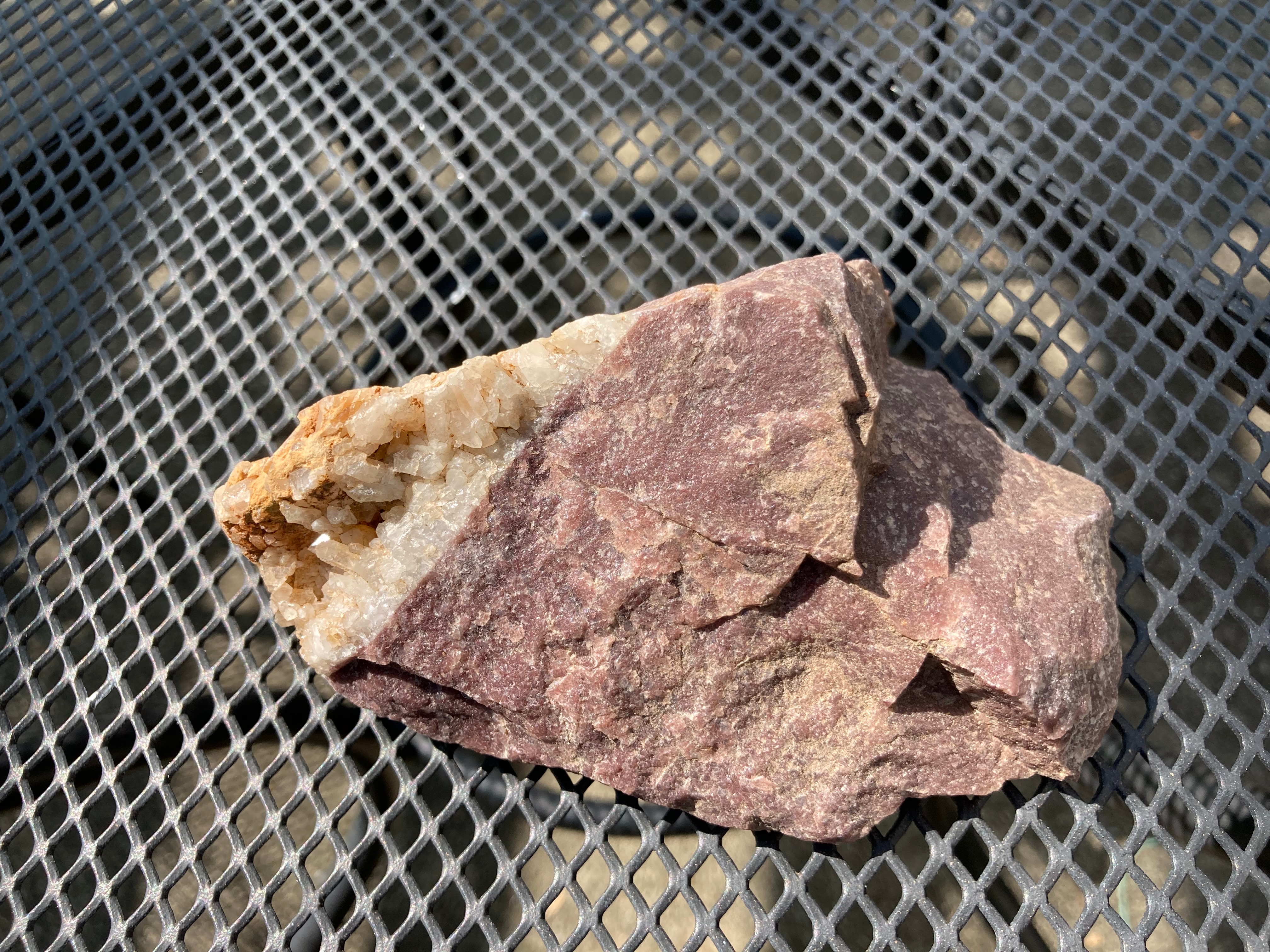
Once in Wisconsin we went to Devil’s Lake for the purple quartzite of the region.  If you look among the tumbles you can sometimes find clear quartz crystals.  I’ve noticed that on rockhound YouTube channels that collectors are chuffed to find nice, if small quartz crystals.  They’re collectable.  But they’re also small.  Size is one of the reasons for not letting rock collections grow too much.  I’ve tried my hand at making small sculptures out of significant rocks.  I can see some of them on the landing window ledge from where I’m sitting at the moment.  They’re small, but heavy, and if we ever move, will require careful wrapping.  I’m not even sure what kind of rock they’re made of.

Wisconsin quartzite with quartz crystals

Rock identification is hard work.  I have a Moh’s scale set.  A streak plate.  A hand loupe.  It’s hard to use the acid test (vinegar will do) because the pieces are so small.  Identification is often destructive.  This might not be an issue if I had a ton of similar rocks to dispose of.  No, but when you have just a handful, and these had to fit in your luggage along with your clothes, making TSA agents scratch their heads, you’re reluctant to damage them just to figure out what they are.  So identifying the small rocks I have is difficult.  Online forums tend to be unhelpful in this regard.  Not even the color can give you certain answers.  Once I collected some jasper in a creek.  I could identify it because a large boulder clearly had jasper intrusions and I could compare.  The piece I took home, of course, was quite small.  Small, however, does not mean insignificant.


Going Some Place?

I recently had to drive to the Philadelphia Airport to drop off/pick up some folks.  Here in the Lehigh Valley I’m roughly an hour north of the city of brotherly love.  Like most sentient drivers, I’ve come to rely on GPS navigation.  Dropping off my parties turned into a nightmare of congestion.  The GPS solidly insisted that the turnpike, 476, was the “fastest” way.  One thing AI doesn’t understand is how people behave.  The flight required dropping off a couple hours before that known as “rush.”  476, once yet get near Philly has several pain points where traffic merges on from several ramps onto an already crawling stream of traffic.  That’s human behavior—never considering that the “longer time” route might actually be quicker.  Or at least a touch easier on the blood pressure.  Of these thousands and thousands of people, relatively few were going to the airport.  Once I got home from a journey that Al told me would be two-and-a-half hours, round trip (which was actually three-and-a-half), I began looking for alternate routes for pick up.

Pulling up the usual map app on my laptop, the only route shown was the turnpike, clearly not designed for this volume of traffic.  Not being native to Philadelphia, I don’t know my way around very well.  Then I began to lose trust in Al.  Interstate 95 also goes right by the airport.  I force-dragged the route over that way.  The estimate? Maybe fifteen minutes longer than the turnpike.  AI doesn’t understand that people who know the turnpike is a bad idea at this time of day will take it anyway.  It is the “fastest” way to where you’re going.  And who wants to waste time?

Me, I’d rather not shave off so many years of my life.  I’m not so foolish as to suppose I-95 would be much better, but with the “real-time” facts added in, it might very well save some time, and gray hairs, to go the somewhat longer, slower route.  Al didn’t even want to tell me that was an option.  Who could possibly want to go on at a slower pace, for mental health reasons?  Even en route it will try to reroute you back onto “the fastest” way that it clearly misunderstands.  I remember driving in Newark, Seattle, Boston, Chicago, Milwaukee, Pittsburgh, and, briefly, New York City.  Those who write algorithms are missing something basic.  Human psychology plays into this in a major way.  Al is not human nor does it “think.”  It calculates.  As for me, I calculate that the slower way may just be what the doctor ordered.


Naming Birds

I’m no Jane Goodall, but I grew up loving animals.  I still do.  I’d spend many hours poring over animal identification books.  When I was young I could tell a crab from a lobster from a crayfish.  I knew moths from butterflies.  Megafauna?  I had it covered.  One thing, however, eluded me.  Bird identification.  Now, I can tell the obvious ones apart, but ornithology seems to delight in making the trade difficult.  For example, I was on a walk with a couple friends in May.  We spotted a small bird—smaller than finch size but larger than a hummingbird.  Short tail.  Its coloration was an unusual shade of brown.  We got a good look at it.  Back home I pulled out my bird identification books.  Nothing like it.  I tried online, even Cornell’s famed ornithology lab website.  According to all the specs what we saw doesn’t exist.

The problem with birds is that they come in different colorations.  Most bird identification books and sites focus on the males.  They tend to be more colorful and their identification is easier.  Not only that, but young birds’ plumage often changes as they mature.  This is such an issue that some bird books warn the would-be watcher not to try to identify by the color.  You should look for things like eye-rings, beak shapes, and that tiny spot on the tip of the tail, when seen in flight.  Right.  After a couple of days of searching in my spare time, I gave up.  Given how small it was, this was likely a juvenile.  Which sex I have no idea.  It bothers me when I can’t identify what I see.  The world is full of such wonderful things!

Many years ago in Scotland, some friends willingly crawled to a cliff’s edge with us on a rainy day in the Orkney Islands.  We’d come here to see the puffins.  Puffins nest on cliffs overlooking the sea.  They have colorful bills and are similar in looks (but not physiognomy) to penguins.  We were rewarded with a view of a cliff-full of sea-birds, including puffins.  I often ponder, living inland now, why the bright, colorful birds tend to hide.  I know, I know—predators.  But still, I can count on one hand the number of times I’ve seen an adult male oriel with their bright orange plumage, despite living in an area where they’re listed as common.  Birds can be so coy.  Maybe that’s why dedicated bird watchers have such passion.  I love animals.  The problem with birds is, despite hours with books and websites, some of them I just can’t identify.


Rocky Ground

When I begin to lose my sense of wonder, the natural world grounds me.  I’ve been an amateur rockhound for many years and I sometimes wonder if it’s because I grew up poor.  The idea that you can just pick up something valuable on the ground has a treasure-hunting aspect to it.  Movers, I’ve discovered, dislike rock collectors.  My collection is quite small, and most of it not on display.  The danger is that I’ll be wanting to pick up more interesting rocks.  Like much of nature, rocks are amazing if you look closely at them.  And when the mania hits, it takes all my attention.  We all know that gemstones tend to be small, but perhaps it’s the fact that they look very little like their finished state in the wild makes them intriguing.

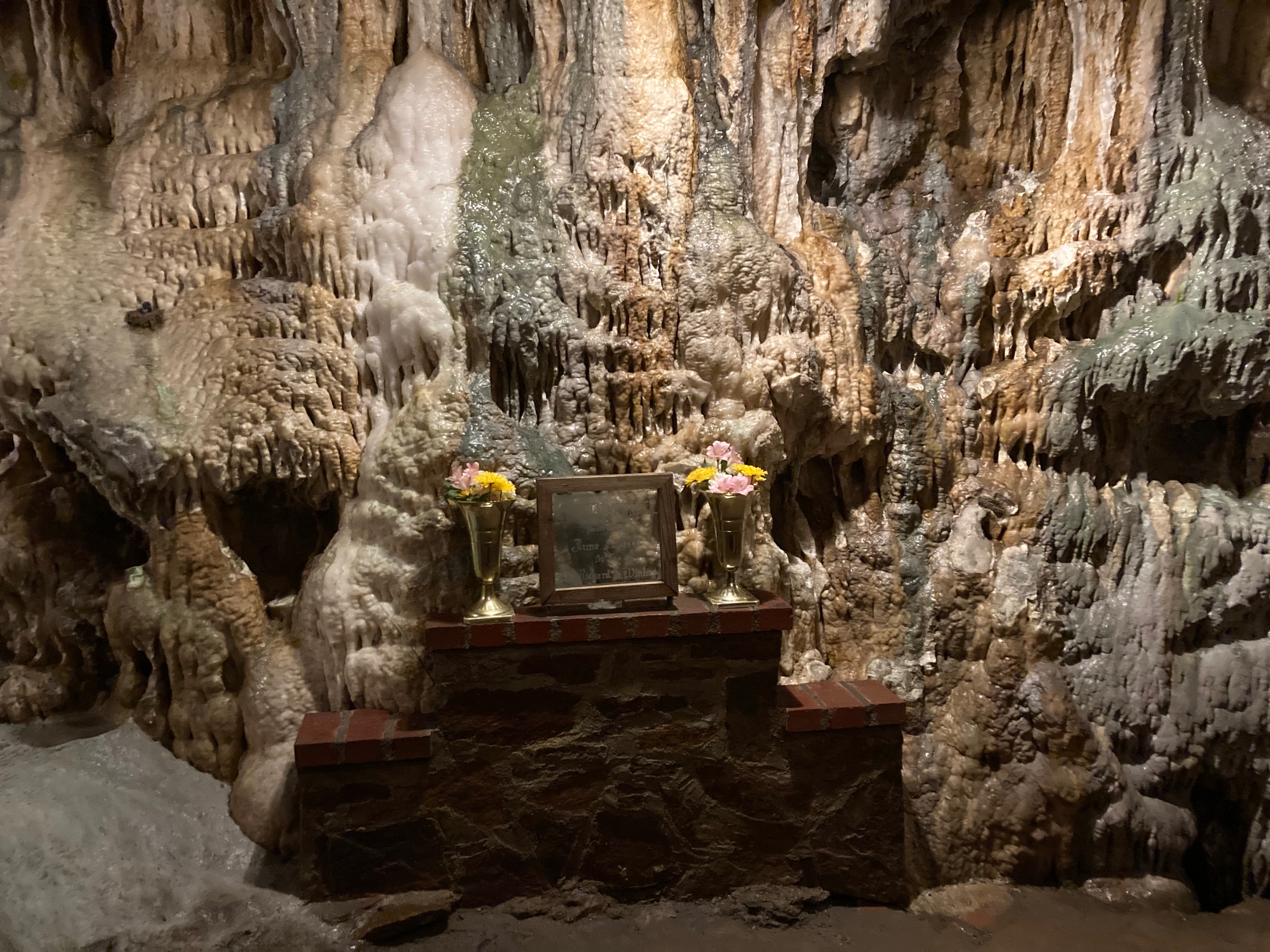
This interest was recently rekindled by a visit to the Lehigh Valley’s local cave, The Lost River Canyon.  As with most local attractions, it takes some time to get around to them.  We decided to go during the recent heat wave since caves maintain a constant temperature, generally in the fifties, and during the height of the wave the outside air temperature was double that of the cave thermometer.  Caves often have rock shops associated with them because being in a cave will trigger the rock-hounding gene.  And I suspect I’m not the only one to whom this happens.  Like many preserved caves, Lost River Canyon was an accidental discovery and was later purchased by a family that has been running it as a tourist attraction ever since.  I left inspired to find my rock tumbler and get it rolling again.

It’s difficult to say when or how such obsessions originate.  When my daughter was really into dinosaurs I started looking into geology.  The next thing I knew I was a member of the Wisconsin Geological Society and was going on field trips to collect.  When I lost my job at Nashotah House I seriously considered enrolling in a geology degree program, put off by the fact that calculus and chemistry were pre-requisites.  I was a hopeless humanities major and advanced math just doesn’t psit well in my psyche.  Part of me wonders if the fascination doesn’t go back to Genesis.  Geology was the science that tolled the death knell for any kind of literal six-day creation.  When this rock madness hits other interests can, if I’m not careful, be shunted aside.  It’s important to feel grounded.


Hopeful Weeds

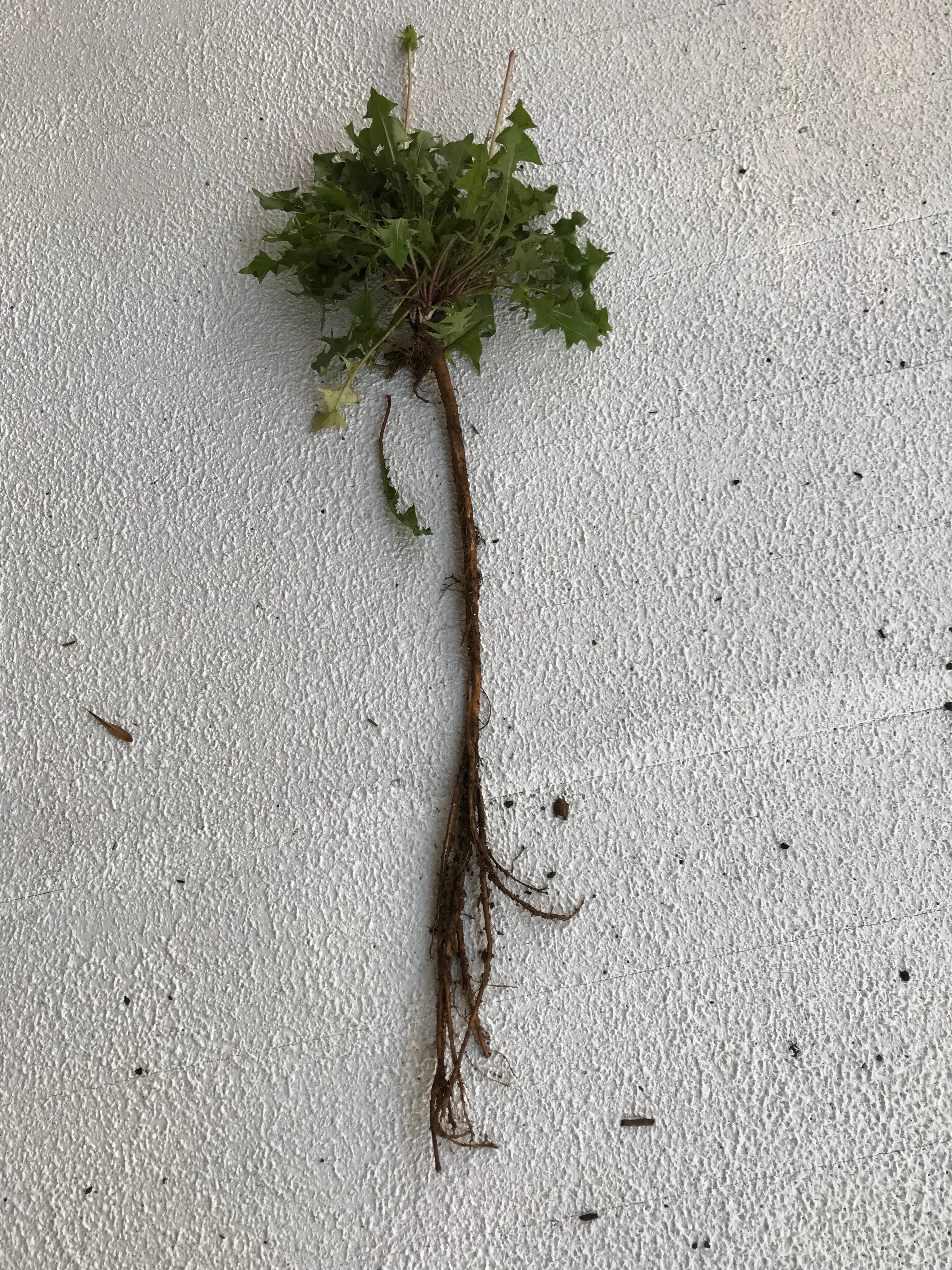
Our approach to our front garden has been to buy the perennials we can afford and hope the beauty of nature does the rest.  Nature, we quickly learned, loves weeds.  Tough, tenacious, even if not always pleasing to the eye, weeds may be the ultimate symbol of hope.  A friend of mine, now departed, used to say that a weed was just a plant where we didn’t want it to be.  To put a more lexical sounding spin on it, a weed is “a plant considered undesirable in a particular situation” (according to Wikipedia).  Opportunistic plants, but those with a strong desire to survive.  I have noticed, in our eight years in this house, that each year different weeds predominate.  We have a front lawn that is difficult to finagle a mower onto, so we put down ground cover and mulch and planted several store-purchased non-weeds.

Some of these survived, and others haven’t.  Some hung on for a few years and then died.  It’s difficult to say if we just don’t have green thumbs or if the brutal, full summer sun did them in.  Weeds, however, thrive no matter what.  And they find any location with the smallest bit of promise.  Tired of wrestling the lawn mower down the front steps, a couple years back I put weed-blocking ground cover on the verge.  I went to the hardware store and bought many bags of sand and gravel and some paving stones.  First the sand on top of the ground cover.  Then the heavy paving blocks.  The gravel covered the sand, and I pushed it off the paving blocks to make a somewhat pleasing, if simple hop-scotch track.  (I’m delighted whenever I see kids using it that way.)  I hadn’t realized that weeds don’t mind sand.

That first year was good.  The second summer, however, weeds had begun to sprout and grow, tenaciously.  Instead of mowing, I was now kneeling on paving blocks and pulling weeds.  Mowing took less time.  Still, the weeding can be done every few weeks rather than the weekly ritual with the mower.  I decided for our front garden that any non-spiky plant that was shorter than what we’d planted would be left alone.  There aren’t enough hours in a weekend—even a three-day one—to weed properly, not with books to write and a 9-2-5 breathing down my neck all the other days.  Not to mention the mowing and grocery shopping and other errands that eat up weekends like popcorn.  Still, fresh in from pulling the latest batch of weeks I have to confess that they give me hope.  All it takes is a place to settle down, no matter how marginal, and the will to survive.


Thorough

It was a warm summer’s day, sometime in the mid-eighties.  I was living in Boston and some friends asked if I’d like to go to Walden Pond, outside Concord.  I’d read Henry David Thoreau’s Walden, so yes, please.  I knew Thoreau was an early Massachusetts Transcendentalist, mystic, and nature lover.  That particular day we were the only ones at the site where his cabin in the woods once stood.  I suspect that, being there with friends, it wasn’t as contemplative a trip as it would’ve been had I made it alone.  Still, here we were, nearing a century-and-a-half after his death, remembering him.  My wife and I recently watched the PBS three-part documentary on Thoreau, and I learned a lot about him.  He was admirable in a way that few public figures are today.  What’s more, it’s clear that he’s widely appreciated as a visionary and believer in freedom.

Image credit: Benjamin D. Maxham, public domain (via Wikimedia Commons)

Writing in the nineteenth century, it seems, got you noticed much more than it does now.  Thoreau had profound things to say.  He had strong convictions about abolition and being shuffled into an existence of work, forced from being free.  He was able to live the way he did largely because he didn’t need many things.  He also had famous friends, Ralph Waldo Emerson, for one, who gave him a place to stay when he had none of his own.  The documentary makes the point that, despite being a hero to many, we’ve gone ahead and built the world Thoreau most feared.  Few, or at least a few of us, find that work doesn’t define us.  Writing, it seems, still helps with that.  Those of us born to write do so, and long days “in the office” must be endured to come to life when writing is again possible.

If you think deeply about it you start to realize that we’ve allowed ourselves to be hoodwinked by economics.  If you have a mortgage you know this to be true.  Or if you have a medical condition—you can’t afford not to have a job without insurance.  Thoreau, it seems, lived with the tuberculosis that ultimately killed him pretty much all of his life.  And he died too young, we feel, because he had so much to say.  So much to say that was worth listening to.  Such writers are rare today because, like everything else, writing has become a business and some readers even prefer things “written” by AI.  And yet I remember that warm summer’s day and think of a placid time still earlier when one might’ve met Henry David Thoreau in the woods.


A Day for Earth

Sometimes things come just when they’re needed.  Although it was earlier this month, the Artemis II mission was a celebration of Earth Day.  It was also a much needed shot in the arm during difficult times for the environment.  Human arrogance is quite often checked by nature.  The series of very hot April days followed by extraordinarily cold April days reminded us around here that nature is firmly in charge.  Our comfort, or expectations, are secondary to the vast world around us.  And we love our world for it.  We are guests here and we couldn’t survive without it.  We may set up a base on the moon or Mars, but such places will still rely on our home.  It helps that those who’ve ventured further away than humans have ever gone sent back photos to remind us of how small we are on a fairly small planet.  Pictures of home.

Photo credit: NASA, public domain, FD06_high priority pao

From our daily perspective it’s difficult to believe that outer space surrounds us.  We’re so caught up with our own little problems, generally of our own making.  I write this after a day of shivering in a chilly house as electricians replaced the breaker box and the conduit, from service head to basement mounting.  It was a sunny day but temperatures hadn’t really recovered after a nighttime low in the twenties.  I reflected on how much we’ve come to rely on being able to shut nature out.  How difficult it would be to survive without shelter, and a little heat.  With the electricity off the furnace didn’t know to kick on, and windows had to be open to snake wires through.  For all the wonders of a household electrical system, the Earth itself is so complex we are still only beginning to understand how it works.  We love it.  We fear it.

Our dependence on things we’ve constructed makes me feel fragile sometimes.  When we first noticed our electrical issues I walked to a local shop run by an Earth-loving owner to see if their power was out too.  “Water and electricity,” she said, “are the two things we can’t do without at home.”  She was correct.  We rely on the grid.  Nature could take us with both hands behind its back.  As the replacement process stretched beyond the scheduled finish time, I had visions of a cold night without power.  No way to cook dinner, no way to keep food safe in the fridge.  I thought of astronauts a quarter-million miles from home, protected by a shell made here on Earth.  And looking back to lovingly snap a photo for Earth Day.


Easter Flowers

Easter is our springtime holiday of hope.  Flowers are starting to bloom and the cold spells, when they come, don’t last too terribly long.  Of course, as a moveable feast Easter can come earlier than this, but here we are, in April with brave flowers making themselves vulnerable.  The weather’s fickle, as is typical of spring, with the lovely warm days often coinciding with when you have to be at work, reserving rain and chill for weekends.  Around here, anyway, it felt like winter lasted quite a long time.  It got cold early and was gray and gloomy for much of the time.  And for around here, we had a lot of snow.  Spring was reluctant to show up.  The timing of Easter was good this year.  The older I get, the more I appreciate the flowers.

As a kid, I appreciated the bright colors, but flowers were too delicate to play with and you could surprise a pollinator with a stinger, which seldom ended well.  As an adult I see that each flower is its own world.  For perennials, a resurrection.  Last year I somewhat clumsily dug up the daffodils that some previous owners had planted where nobody could see, and transplanted them in our attempts at a front garden.  Having already sprouted, they did not like that, and they withered and disappeared.  I hoped I hadn’t killed them.  This spring they showed up, reminding me that life is persistent.  It keeps trying.  That resurrection is possible.

We could spend a lifetime studying a flower and still not comprehend it all.  We see it for what it offers to us without thinking it exists for its own purposes.  All of nature interacts and we are connected, that flower and I.  We share the planet with insects for whom it is a source of life.  And other flowers with which it communicates in ways we can’t even understand.  We have to humble ourselves if we would let them be our teachers.  Our constant narrative of being on top of nature is misguided, you can almost hear them say.  There are riches here that money cannot buy and flowers would exist even without us being here to see them.  Nature carries on.  It urges us to acknowledge that we are part of it.  Easter is a holiday enfolded within hope, inseparable from its flowers.  They may be delicate but they are also wise.  We can learn from them.


Unexpected Thoughts

The unexpected changes things.  We in the western world live under the false assumption of permanence.  We build something and it remains.  Well, any homeowner knows that constant maintenance is required, but still.  Then something unexpected happens and everything changes.  And it can be in the middle of a work week.  A death can lead to quick decisions and changes of a usual course of actions.  I wrote some funereal thoughts earlier, but a hastily planned drive all the way across Pennsylvania was organized just as a bomb cyclone hit our area.  We were thankfully spared feet of snow, but I had to deal with shoveling before driving early the next day.  After the funeral, a kind family member had invited us to her home, which we’d never visited before.  My wife and I drove there the night of the funeral.  The next day we had to cross the state of Pennsylvania again.  And then back to work on Thursday.

Something has fundamentally changed in my life, but still work expects the same Steve who was somewhat unexpectedly out of the office on Tuesday and Wednesday.  Thursday nothing has fundamentally changed at work, but in my life.  Even my usual morning routine feels off as thoughts constantly wander back to the intense previous two days.  And Monday’s stressful weather.  How the weekend before all plans had to be cancelled to, as the song goes, “let it snow.”  My mind, which operates largely on a routine schedule, has been shaken.  Jarred.  And yet, work persists.  Readjusting on a Thursday is difficult.  It’s as if I’d forgotten how things were usually done.  How did I use to sleep?  How did I use to drink so much water?  How did I jog before sunrise?  It was all routine last Friday.

Last Friday.  It was a work day, but I could jog.  The snow had melted.  We knew the drive was coming, but the weather painted a huge question mark over it.  It seems, this year, just when that illusory normalcy has once again been established, winter rudely intrudes.  Some Good Samaritan plowed all the sidewalks on our block on Monday, relieving a bit of the pressure.  But not the anxiety.  February in Pennsylvania is anything but predictable.  It is the poster child of change.  Back home on Thursday I was remembering how to jog on the streets—my usual trail still hasn’t melted—wishing this winter would finally end.  I reached our house where I noticed something where the snow had melted while we were gone.  The daffodils I transplanted last year were beginning to push through the soil.


The Storm

I suppose it would be a fool’s errand to post today on anything other than the storm.  You know the one.  The snow/ice storm that has been affecting the greater part of the lower 48 for the last couple of days and is now set to target the most populous region of the country.  Power outages are expected (so if this blog goes utterly silent, you’ll know why).  Good thing FEMA has been dismantled by the Trump administration.  In any case, we’re all waiting to see what the outcome will be.  I guess we should ask AI.  In any case, our lives have become so completely tied to a constant source of electricity, we barely know how to get along without it.  I have to admit to being a bit puzzled myself.  Without electricity, the heat goes off.  The water pipes freeze up and burst, and a personal apocalypse ensues.

As my wife is fond of saying, the weather is still in charge.  A storm like this shows how fragile our infrastructure can be.  Especially since the last ten years of US history have been dealing with Trumpism or its aftermath.  And one thing that our elected officials don’t do well is deal with reality.  Nation-wide storms do occur.  Democrats do not control the weather.  The “woke” don’t have some great machine buried somewhere generating all the hot air that ultimately leads to global warming which, we all know, is really real.  And so we sit here waiting for the silence to come.  Funnily, having grown up in the Great Lakes snow belt, I remember these kinds of snow amounts not infrequently as a child.  Our house was little more than a shack and it was heated by a  single furnace in the living room, vented mainly by the leaky roof and drafty windows.  Besides, my step-father drove the borough snow plow.

Today things seem much more brittle.  What would we do without Netflix for a day?  And snow days from work are a thing of the past.  Offices never close because they never have to.  As long as the juice flows.  That is reality here in the world of 2026.  I can envision a different world.  One that might be a little more sane and focused on protecting one another instead of one percent of the richest one percent getting even richer.  A world in which snow is pretty instead of some insidious threat.  A world where being human is sufficient for the troubles of the day.


Orkney

The Orkney Library and Archive was one of my first followers on Bluesky.  (I tend to follow back.)  I’m not sure why they followed me, but I am grateful.  I’m grateful to all followers on social media.  Or at least those that aren’t out to scam or stalk me.  In any case, seeing the Orkney Library posts always takes me back to the two vacations I took to the Orkneys and I thought it’d be nice to plug a little tourism with personal recollections.  

My wife and I lived in Scotland for a little over three years.  As grad students we didn’t have a lot of money, but we did have the presence of mind to realize that as we got older and settled into family and career that just picking up and going somewhere would become more complicated.  I’ve also been a firm believer that travel is a form of education and that people who go places learn by doing so.  Hopefully they learn to accept difference rather than to fear it.  In any case, after my wife began to work and figure out the British tax system, we found out we had enough money to go somewhere exotic.  The Orkney Islands.

The Orkneys are the antiquities-rich, once Viking-inhabited islands north of mainland Scotland.  You can either fly or take a ferry to get there.  Since we’d had a small windfall, we flew.  That was a mistake, given my history with small planes, but I recovered once we landed.  One of my fond memories was hiring (renting) a car in Kirkwall, the largest city.  When I went to unlock it the dealer said, “It’s open.  Nobody locks doors.  We live on an island.”  That comment has stayed with me all these years.  Orkney represented what happens when population size (the islands have only about 22,000 inhabitants) doesn’t grow to the point of creating natural stresses that lead to “big city problems.”

No place is perfect, of course, but Orkney impressed us so much that we returned, with friends, a few months later.  This time we took the ferry and, thankfully, they drove.  We visited antiquities, met locals who were open to outsiders, and saw some of the most spectacular scenery that the British Isles has to offer.  Seeing the posts of the Orkney Library and Archives on Bluesky always takes me back to a happy place.  It’s one of the good things social media has to offer.  And since I check it in the morning, it starts my day off well.


Stories in the Snow

Birds are quite capable creatures, but some have learned that by hanging out around human dwellings, some of our species give handouts.  For me, the sight of a cute little junco shivering outside the window leads me to break up the hardened bread slices that I save for them and toss them outside when things are either buried in snow or ice.  This year we’ve had a bit of ice and some snow on top of it, which makes a kind of canvas for seeing who’s come to visit our crumbs.  My daughter pointed out to me that we had some feather prints as well as footprints, so I thought I should go ahead and record them.  If this were mud and a few million years had passed we’d perhaps have ended up with fossilized feathers.  And nature’s canvas is endlessly beautiful.

I imagine people tend to be partial to birds because they look so delicate and fragile.  Well, at least the little ones do.  Our natural sympathies make us feel sorry for them when nature makes finding food difficult.  The survivors among them, however, are tough.  Birds skirmish over food and can be quite aggressive around both a bird feeder or a crumb pile.  They were, after all, once dinosaurs.  And around here winter locked in before Christmas and has stayed around for quite some time, temperatures barely rising above freezing for many days in a row.  And I look for feather prints in the snow.  Try to find the beauty in the starkness of harsh weather (while looking askance at the energy bills).  Our animal companions can teach us much about life.  Their stories leave traces for us to follow.

Our species has often tried to advance itself at the expense of others.  I think of the tremendous environmental damage that we’re willing to inflict to enable AI.  What pollution we’re willing to dump out for using fossil fuels.  How much forest we cut down for our own use.  We drive vulnerable species extinct.  This makes me think of those creatures that have adapted to us.  Who speaks highly of rats, pigeons, or cockroaches?  Even sparrows, which can be quite aggressive, or even mean, reflect our attitudes toward the rest of nature.  I’m sure some sparrows come for the crumbs, even though I put them out with the juncos in mind.  Those that appear here in winter have likely migrated from even further north.  They handle cold I have difficulty tolerating.  And they leave art in the ephemeral snow.


Flighty Thoughts

Life, domain, kingdom, phylum, class, order, family, genus, species.  My apologies if I’m bringing back bad memories of high school biology, but I’m doing an experiment.  It has to do with the class level.  (I have to confess that this has become more complicated since high school since there are a lot more of them than I remembered.)  Specifically, I was thinking of those of us with backbones (which seems to exclude many congressional Republicans these days), namely fish, amphibian, reptile, bird, and mammal.  I read somewhere—I can’t recall where; I seem to be reading all the time—that the only other order of animals that human beings see every single day, apart from other mammals, is birds.  I suppose some of this depends on location, but it seems to be true even for landlubbers who don’t work in zoos.  I’ve been watching, however, to see if I do see birds every day.

I work in an office with two windows, one facing south and another facing west.  There are trees outside the west window and during spring, summer, and fall birds are abundant.  Yes, I see them every day.  Winter, however, is a bit more dicey.  Songbirds famously either migrate or retreat into more sheltered places for the season.  The other day, during a cold snap, I got to thinking I hadn’t seen any birds at all.  The only thing that rescued the allegation was that I remembered I saw some birds that I startled out on my jog, before it was fully daylight.  The rest of the day I keep my peripheral vision on alert for any motion outside my windows.  Late in the day I saw a crow dart between two trees.  I do see birds most days, but I’ll be keeping a watch this winter for birdless days.

It’s not that I want to prove this author wrong—I can’t even remember who s/he was.  No, this experiment is driven by pure, naked, curiosity.  I’m pretty sure that the author wasn’t writing in a literalist tone (that’s more of a problem with my wiring).  The point that was being made is that people pay special attention to birds since they are so prevalent in our world.  They’ve adapted from conditions of arctic to desert and they can get around many obstacles that might prove troublesome to our class, even bats.  I know that I rarely see amphibians, reptiles, or fish.  Certainly not on a daily basis.  So birds do seem to be top of the class, and, so far, I have seen at least one every day since reading this from a fellow mammal.


House Spiders

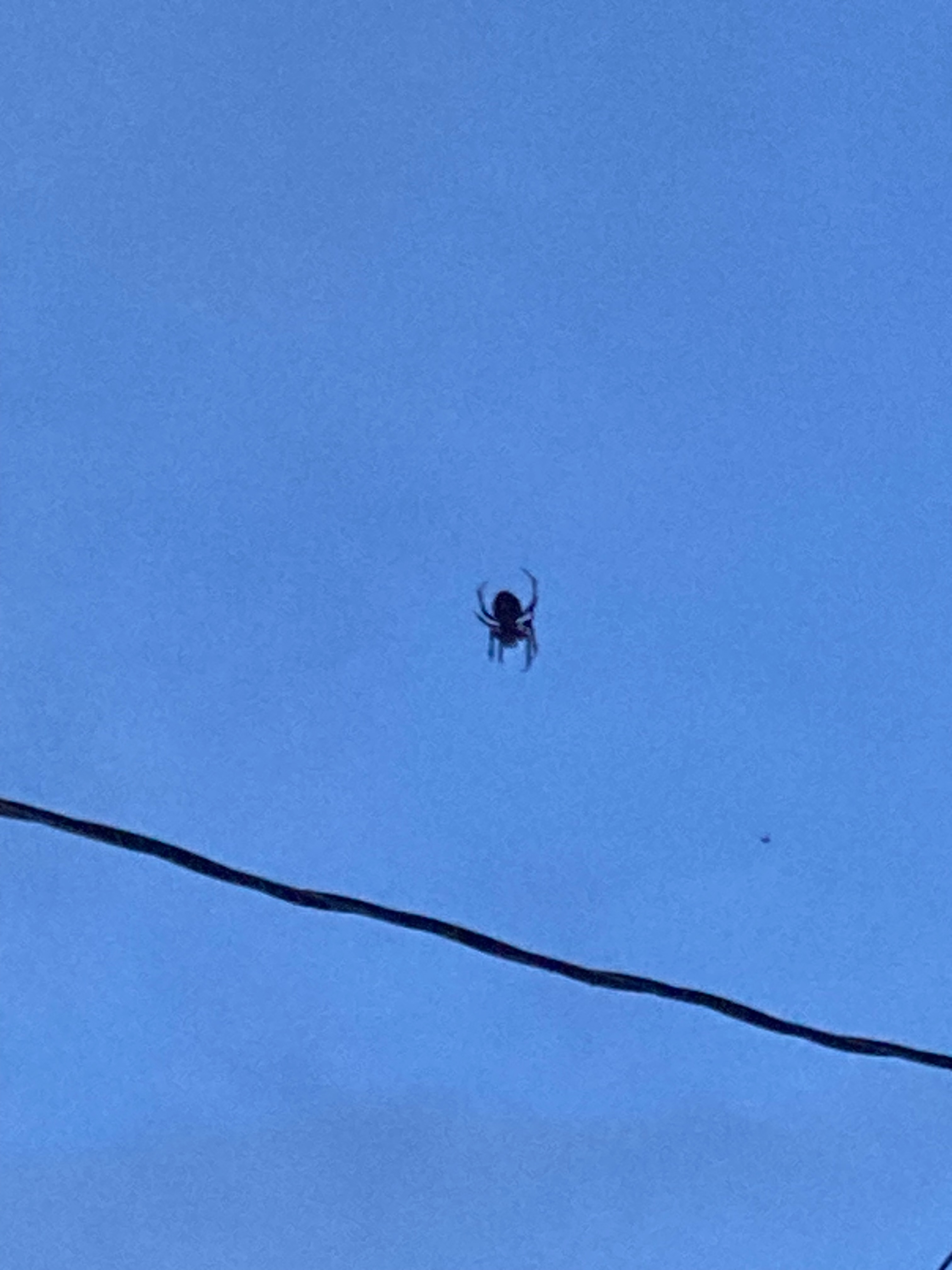
I give them names, the spiders who choose to live in our house.  That’s how I named Henry, shown in the photo.  I grew up with an almost debilitating arachnophobia, and as with most of my fears, worked hard to overcome it.  So when a spider moves in, I let them stay.  Unless they’re too big.  Here’s where it becomes interesting.  Like quantum mechanics, there seems to be an arbitrary point when something is “too big” for the rules to apply.  What is that tipping point?  The other day I bumbled into the kitchen early to get some water, having given up coffee years ago.  There was a spider that I could see from across the room.  It was very large.  It’s a sign of how much I’ve overcome my phobia that I was able to walk around the counter and to the sink to fill up.  I kept a wary eye across the room, however, in case Octavian made any funny moves.

The spider held very still, as arachnids often do when they know they’ve been spotted.  I sometimes wonder if they know how scary they are to other creatures.  I searched around for a jar large enough to catch and release, without pinching any legs, and crept over.  Turns out Octavian was faster than I am first thing in the morning.  And, honestly, I was still recovering from a vaccine that had knocked me out the day before.  At least I can blame that.  I wonder if that’s one of the reasons fear of spiders is so widespread—they’re fast.  Or is it something inherently menacing about those eight legs?  I’ve never experienced any kind of octopus phobia, so I can’t think that it’s merely the number.  The jointed legs?  That seem disproportionate to the body size?  Whatever it is, days later I’m still cautious in the kitchen.

I have a great appreciation for spiders.  I don’t like to be startled by them, but otherwise, if they keep their distance, I’m fine with them.  I do wonder what they think, living in a world of giants.  Some insects, in the same size range as arachnids, seem ignorant of the human threat.  It’s not unusual for an ant to find its way inside and walk right up your foot and leg, oblivious to the danger.  They seem to have no fear.  Spiders, however, do.  They’re very good at running and hiding.  I like to think they know our house is generally a safe space, until the vacuum cleaner comes out.  When I’m behind it, I always try to give Henry and his friends a chance to get out of the way.