Do Not Enter

“Sign, sign, everywhere a sign, Blockin’ out the scenery, breakin’ my mind,” so runs the chorus of Five Man Electrical Band’s only hit, “Signs.” It is hard to imagine a more righteous hippie classic. When I was a younger man, I believed in signs. It made sense that if the world were unfolding according to a divine plan laid out for good, Christian folk, signs should be scattered throughout the world, pointing us in the direction we should go. I used to look for them assiduously. As I grew a bit more cynical with the years, and learned a bit more about science and probability, the idea that coincidences bore anything more than incidental meaning became a fixed paradigm. Every now and then something happens to make me question my assessment.

On my way into New Brunswick recently, I passed a sign. I used to drive this road several times a week when I was teaching at Rutgers, but I hadn’t been this way in a few months. I knew there had been construction going on, but a new road sign caught my attention:
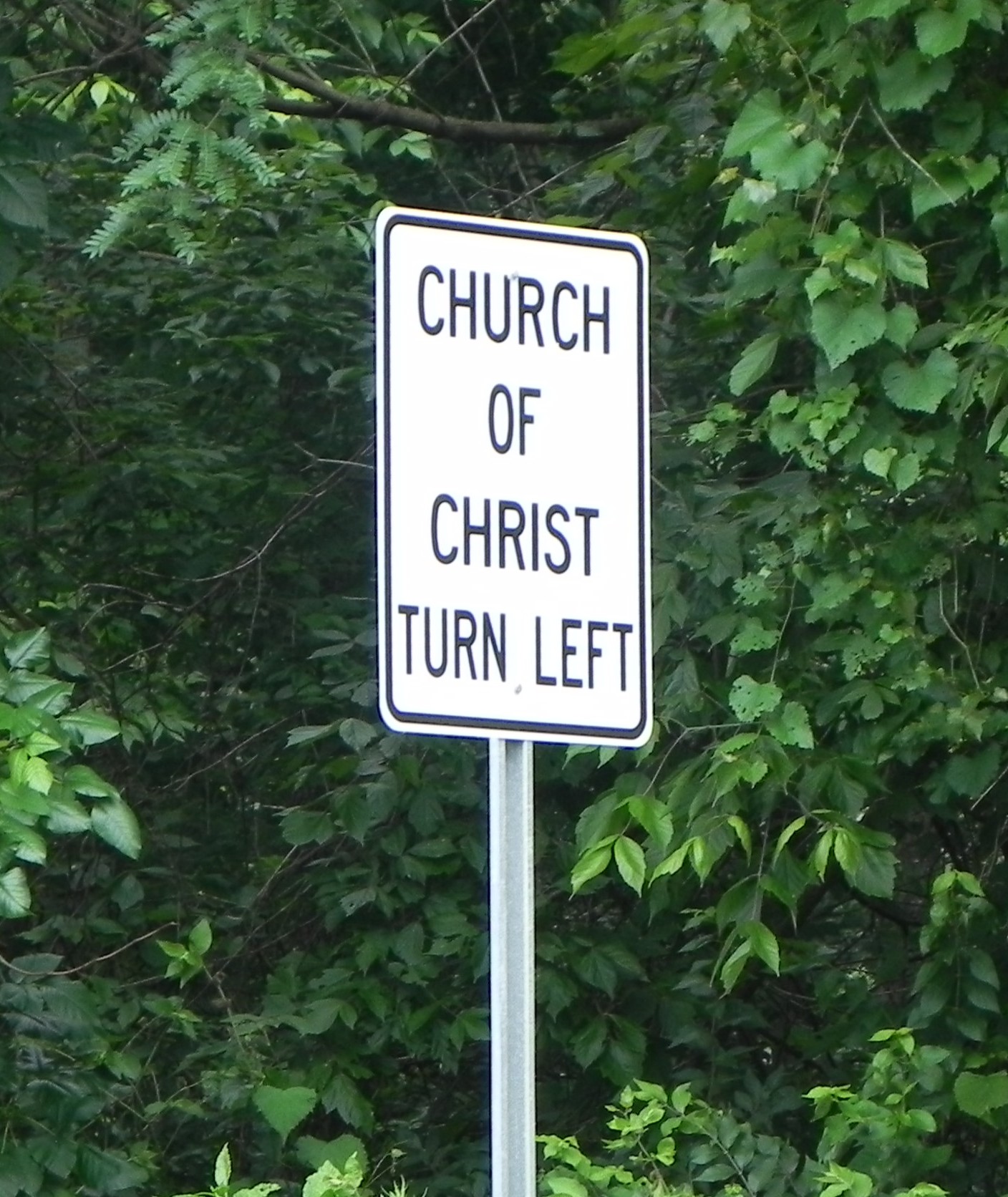
Now, I’m one for finding the significance of buried statements. Here was a bold-face declaration that seemed to come directly from the almighty. In a day when Christianity is portrayed as an intolerant, bigoted institution, the simple truth of a road sign might actually bear considerable significance.

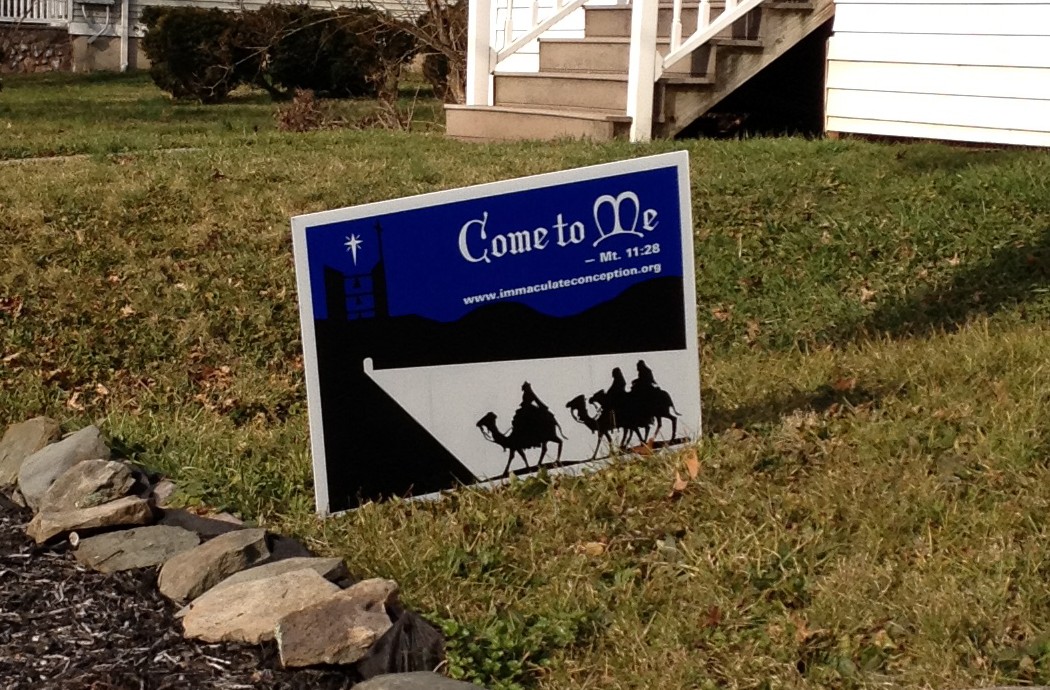
Throughout my life I’ve taken road signs a little too literally. When I worked at Nashotah House and I spied an orange sign on the road toward the seminary reading “Detour Ahead,” I knew that it was personally meant for me. The fundies from my college days frequently exploited the One Way signs liberally scattered across our nation, pointing their arrows into the mythological air. Anybody, of course, can make good use of a stop sign. A sign miraculously appearing that spells it out: Church of Christ Turn Left, can be nothing other than a divine message for a weary world. At least for those who still remember hippie bands with a certain fondness, and who don’t take themselves too seriously.
Blazing Forest

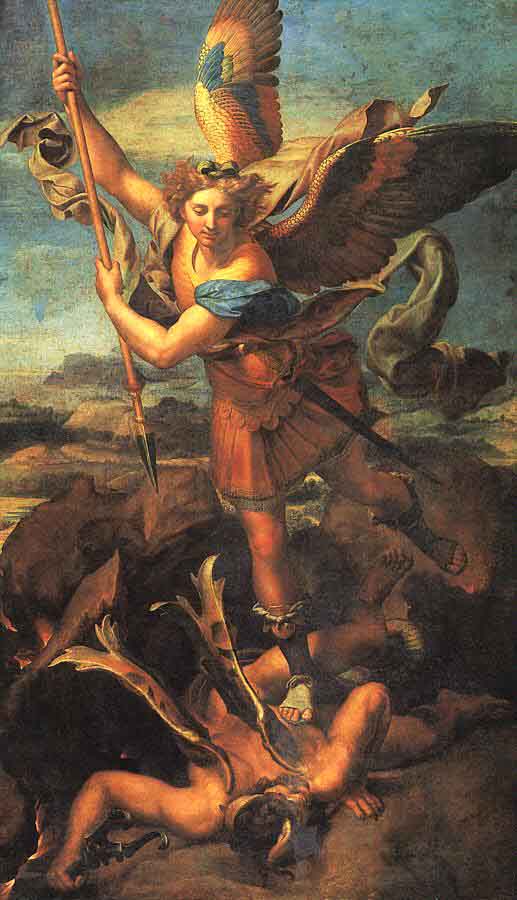
Back in 1996 an angel was on the big screen. In a manner of speaking. Michael, starring John Travolta as the archangel Michael, may not have been an instant classic but it did have a memorable line or two. The image of a smoking angel had been contrived by Van Halen over a decade earlier, but the idea of the prince of the army of Yahweh being a guy just like the rest of us was strangely refreshing. No Park Avenue deity this. When the reporters first meet Michael and wonder if he’s the real thing, one suggests tugging on his wings to see if they’re real. Michael responds by asking if he should pull the reporter’s privates to see if they’re really attached. His companion comments, “An angel that says ‘pecker.’” While the very idea of “bad words” is an unusual one, it is well-nigh a universal. In just about every culture there are words or phrases that just aren’t uttered in polite company. Those who can’t control their mouths, suggests the book of James, can’t control their lives. So it is with a kind of perverse wonder that I read about the bullying bravado that issues from the lips of New Jersey’s governor.

Don’t get me wrong. I never fault anyone for speaking like they were taught. I was raised in a blue collar family and at times the talk could get pretty blue as well. I would, however, point out that you’ll not find a student I taught over my two decades in the classroom that every heard me cuss in class. It is a matter of standards. Emotions, those great clawing monsters inside us, rage to escape. The building blocks of society—restraint and control, and dare we even wish? subtlety and refinement—are signs of civilization. Some of us were taught to leave name-calling on the playground. I am profoundly saddened when politicians believe they are the best America has to offer when in reality they reveal themselves coarse, vulgar bullies. Enter Chris Christie.

In a public venue on Wednesday New Jersey’s governor called the chief budget officer for the Office of Legislative Services, “idiot,” “jerk,” and “numbnuts.” Here’s where we see Tea Party values incarnate. Belittling others, especially in a public forum, reveals a nature that should make all civilized civilians hang their heads in a surfeit of collective shame. America has come to this? Admiring bullies and slashing and burning services for those who need a little communal support? And he has been posturing for a vice presidential nomination. And angels will be smoking cigarettes in the wings. A President/Vice-President who says “numbnuts?” America deserves far better than this. Where is Michael when we need him?

Take that, you #!@&$!


Children Shall Lead Them

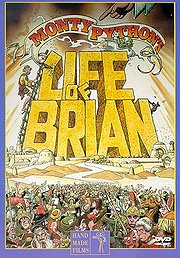
One of the perks of moving to New Jersey was landing in a town with strong support for the arts. Every time I attend a middle or high school concert, I consider how the old image of painful evenings of parents patiently pretending to enjoy the music has ended. The kids in this town could be professionals. If I close my eyes, I forget they’re all under nineteen. Last night at a school concert one of the pieces was “Always Look on the Bright Side of Life,” Eric Idle’s chestnut from the Life of Brian (now featured, I hear tell, in Spamalot). I first saw the Life of Brian with some trepidation while in seminary—I had been sounded warned that it was a profane movie, making fun of Jesus. Considering that all the actual references to Jesus in the movie are quite positive, I eventually realized what all the fuss was about. The movie doesn’t make fun of Jesus, it does, however, show the laughable nature of those who follow a religion blindly. This, I gather, was the real root of the problem.

Next to this fun piece, the concert also included several pieces taken from originally sacred contexts such as Mozart’s Dies Irae and settings of Veni, Sancte Spiritus and Ave Maria. Spirituals, likewise, are a perennial favorite. Performed along next to these pieces of religious origin were also decidely secular pieces such as “Scarborough Fair” and the Beatles’ “Hello, Goodbye.” In concert the sacred and profane blend beautifully. Perhaps there is a paradigm hidden in plain sight here. Religions need not be defensive and unbelievers need not attack them. The world is surely big enough for differences of opinion.

Music has a power that sometimes frightens me. I don’t often address it in my blog because of how much it affects me. Theorists often note that music is part of nearly every religion ever invented—we know that something special is going on when we hear it. And music has the ability to move large groups of people simultaneously. I’ve not attended many professional concerts (the last one was Alice Cooper in Atlantic City back in 2008), but no matter how secular the artist the experience is profoundly spiritual. I’m not sure I can adequately define what that means, but when it is felt there is no mistaking it. So maybe that’s why school concerts have such power. It seems that schools that support the arts also tend to have excellent academic records as well. The truth is hidden in plain sight.


Living with Art

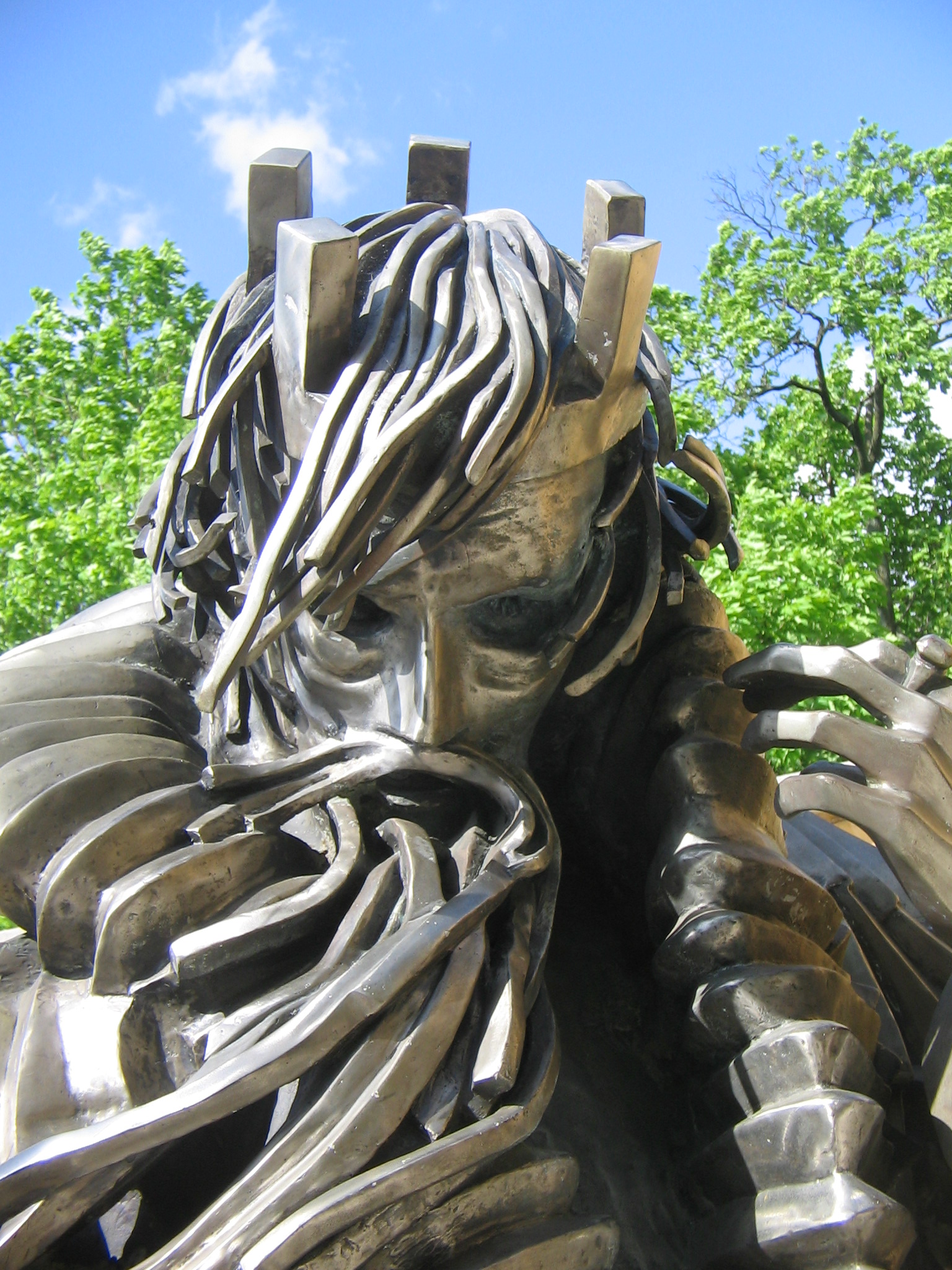
A day spent among art can be more spiritual than a month of Sundays. Few become rich by being artists—in fact the opposite is society’s expectation. The masterpieces artists leave behind then become among the most valuable of all human creations when their often tragic lives end and it is recognized that no more genius is forthcoming. As a lifelong dabbler in the arts, I know that nothing like a perturbed state of mind serves to bring about the pieces I like best. Seeing the art of others, however, is a deeply satisfying experience. In a pre-Mother’s Day celebration, we met friends yesterday to revisit Grounds for Sculpture in Hamilton, New Jersey. We’ve grown accustomed to gray skies this spring, so the fact that it was sunny and warm came almost as a divine sign that this was a day to spend outdoors among the artwork of both humans and nature.

As rational as we strive to be, emotion remains our main motive force. Psychologists and neuroscientists, approaching the human mind rationally, inevitably conclude that emotion and reason are hopelessly entangled in the psyche. Not only does this explain the persistent draw of art, but also of religion as well. If possible, pull back and try to listen to someone, anyone, describe their religion in rational terms. How quickly it breaks down! And yet, reactions against a purely scientific—and doubtlessly empirically correct—explanation of the origin and development of life on earth lead to very hostile reactions. For many such explanations are not emotionally satisfying. We need a little more magic in our imaginative diet. Art allows us to indulge without embarrassment in our need for emotional expression. In the art galleries I’ve seen, whether Edinburgh, London, Paris, New York, Milwaukee, Corning, or Hamilton, there have always been hundreds of others seeking something there as well.

What we are seeking can’t be purchased with money, and it can’t be grasped by greedy hands. It can only be held in receptive and hungry internal places—the space pre-scientific individuals called the soul. And there it will remain. The first time I saw the Mona Lisa and the statue of winged Nike will never leave me. Yesterday, wandering the acres of art called Grounds for Sculpture, once again artistic expression claimed another willing victim. In our money-fevered world where “real life” is squandered chasing material goods to outstrip everyone else, art, the spiritual quest, lies quietly awaiting the weekend. The time people value most. And those who spend that time among art will be the most blessed of all.


Disputed Territory

Revisiting a childhood home can be a bittersweet experience. As my wife reflects on the first house she remembers going up for sale, we are glad that we spent the holidays there one last time a few months back. In my case sentiment is a little harder to find. The three residences I recall from a fractured childhood all bear the same distinction: they were torn down after we left. All that remains of my youth is three parking lots. Things are a lot more level now than they were back then. Whenever I visit the area, however, I still slow down the car and remember. Memory, whether singular or collective, makes a geographic location a sacred space. We rented when I was growing up, so those spaces that I think of as mine were occupied by others before and after us. (The razing did not take place immediately after we closed the door for the last time.) Whether those others—strangers to me—consider the place special I have no way of knowing.

Holy, holy, holy?

In other cases the sacral nature of a place is hallowed by tradition. Say “the Holy Land” and most people will know that you’re referring to what is now Israel/Palestine. I only traveled there once, but was privileged to stay for about six weeks. Working on an archaeological dig is a rite of passage for young biblical scholars (for such I was at the time), and weekends were spent visiting the places I’d read about since I could first remember. One of the most jarring aspects of the holiness was the evidence of violence. Cars burning by the roadside. Bombs going off in a post office in Jerusalem. Sounds of heavy artillery lobbing explosives through a blue sky during the sunny afternoon. A place so sacred as to be continually baptized in blood. Humans, human memory, are what make a place sacred.

All of this comes to mind with the political posturing of New Jersey governor Chris Christie visiting Israel. God knows New Jersey has enough problems of its own, but it is a relief not to have him hanging around for a while. Nevertheless, what has Trenton to do with Jerusalem? One thing the Middle East doesn’t need is one more bully. Pushing, shoving, crusading, shooting, and bombing haven’t worked for that elusive peace. What value can our dauntless leader add to this unholy mess? Maybe I’m just old fashioned, but I thought governors were supposed to take care of their own problems at home and leave international schmoozing until they got to the big offices. Maybe the race for a GOP nomination isn’t over yet. The most sacred space in this country is a white house that gets sold to the highest bidder every four years. At times there is more wisdom to be found in a parking lot.


Renters, All

Ownership is an odd concept for mortal creatures. With limited time to spend on a finite planet, we devise rules that give exclusive rights to some while denying access to others. I have never owned property (tellingly called “real estate”)—the life of those who stumble into higher education doesn’t really lend lenders any confidence of one’s ability to repay debts. I spent too much income, I guess, on my education. In any case, the concept of ownership seems to be endemically human. In most societies we want that thing that we found, that we picked up and moved with us, to remain where we put it so that we can access it again. That particular stick or stone that caught our eye for utility or beauty—it is that we wish to own. Soon humans are building vacation homes in the regions of stunning natural beauty that dot an industrialized landscape, vacation homes where they can get away from it all. Humans owning nature.

Recently I read a story in the New Jersey Star-Ledger about beachfront property “owners” in New Jersey suing over beach reclamation. Now before bursting out into peals of laughter, please be aware that those who claim New Jersey lacks natural beauty have never visited the state in the spring. Once outside the urban sprawl surrounding New York City, Jersey is, for the most part, very pleasant. Many of the beaches are pristine. Of course, pristinity invites affluence. The wealthy like to settle where the views are nice. And so when the state tried to prevent beach erosion by building dunes the rich cried foul and began to sue. It looks like the state will have to pay out. The very state that I, along with countless others who can’t afford a single house, support by our taxes. That money is now being piped into the pockets of those whose summer homes now have a slightly diminished view. My heart bleeds.

One of the facts of life on the Atlantic coast is hurricanes. Another is nor’easters. Both of these storms erode beaches at a terrifying rate. And when the beach is gone, whose house will be in the ocean? Those who wanted the dunes removed. Money is just distilled ownership. Those flimsy pieces of paper have no inherent value. It is difficult even to believe in money when you never see it. Electrons zipping through the Internet are the only sign that I’ve been paid. Yet we value it above all else. I’m not sure how this fits in with a gospel that condemns money and a Jesus who suggests the only way to heaven is to give it all away. Well, maybe it all fits, as long as you don’t block my view of the ocean. After all, owning part of a planet entitles you to some feeling of self-importance. Or so I suppose.

Who's really in charge here?


Tattered Dreams

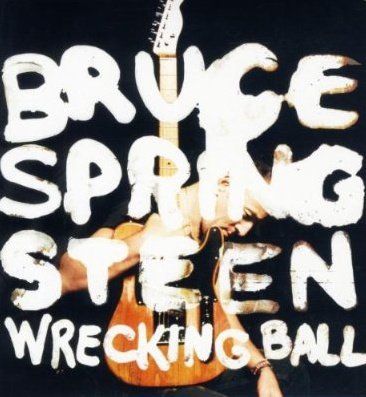
If I sometimes wax rhapsodic about Bruce Springsteen, it is partially because the world is sorely in need of believable prophets. I’m not the only one to notice this phenomenon. Writers on American culture and religion frequently cite Bruce, and his message has been called everything from a prayer to a gospel. The fact is he, like the best of prophets, is one of us. To those of us who grew up in working class families, Bruce seems like the torchbearer who encourages us to keep going. We may end up still in the darkness, but we’ll be a little closer to the light. Sunday’s paper has a review of Bruce’s latest concert tour kickoff, and there is some sadness there at those who’ve been lost. Although I haven’t yet had time to listen to Wrecking Ball, I did read the tribute to Clarence Clemons in the liner notes. It reads like a secular liturgy.

The word “liturgy” means “the work of the people,” or some such concept. And that is what Springsteen has always projected, the honor, the angst of the working class. There is trouble in paradise, from Cadillac Ranch down Thunder Road to My Hometown. Through it all, despair is always tinged with hope in, for lack of a better word, resurrection. In times when many artists focus on the escape, Bruce reminds us that hardship is real. Escape may be a possibility but even Born to Run still ends in New Jersey. Unlike many, the Boss is not willing to give up on this humble state. Perhaps the most diverse mix of people in the country, New Jersey is the American dream, scars and all.

Although his music has brought him fame and wealth, Bruce has not forgotten whence he came. Social inequality has been highlighted throughout his oeuvre, from the late 70’s on, and guess what? We’re still there. Like children of alcoholic parents we’ve grown used to promises being made that will never be kept. After reading what contenders for the presidency are saying, I cower, shivering with fear. I’ve never been one to believe a good beating is the way to solve anything. How is it possible that we’ve come so far only to have left so many behind? The American dream is indeed tattered, a mirage thrown to those slowly dying of thirst. If we’re going to make it through difficult times, we’re going to have to do it together. I guess that’s why I keep coming back to Bruce. In a world where lies are the coin of the realm, the words of true value can still be found, even in New Jersey.


Love, Factually

Whet has Jerusalem to do with Trenton? As marriage equality is debated in New Jersey—with a governor as compassionate and reasoning as Captain Ahab determined to stop it—three local religious leaders have the courage to lay their cards on the table. When Bishop Beckwith (Episcopal, Newark), Bishop Riley (ELCA, New Jersey), and Rabbi Gewirtz (Millburn) penned a piece entitled “Religion shouldn’t sway Trenton in this debate” in the New Jersey Star-Ledger, it almost restored my faith in religion being capable of some good. The three leaders, from different theological perspectives, agree that the Bible can’t be used for a one-to-one correspondence to modern society on this issue. They correctly point out that theologians disagree and that the remit of the government is not to uphold the view of any one of those traditions. When church leaders start making sense, I begin to tremble.

Politicians are never among the most astute of theological thinkers—and I would include those clergy elected to public office in that number. The rare public official who is qualified to think about such things intelligently frequently has trouble swaying his (almost always his) colleagues who have visions of pork barrels dancing in their heads. Marriage is about commitment, not sexuality. Studies have indicated many sexless marriages exist, yet we applaud them for their consistency. For those with a different orientation, we outlaw formal recognition and call them sinners. In the name of a government sworn not to uphold any one religion. It is time our legislators awake from their snoozes and realize that many mainstream religions have gotten over homophobia, and their religion is discriminated against by such petty power plays.

I applaud the efforts of religious leaders to point this out to a governor who has gone on record saying he’s not one “who changes positions with the grace of a ballerina” (propriety forbids me from finishing that thought). If that chunky ballerina, however, has ended his twirl facing the wrong direction, doesn’t the audience expect him to hike up his tutu and correct his error? I note that our Roman Catholic compatriots did not sign the letter. If ever a church showed the signs of centuries of sexual neuroses, would we trust it to make informed decisions on who might sleep with whom? Is that what marriage has been reduced to in the minds of the celibate clergy? It’s all about sex? Maybe if politicians and unenlightened theologians could pry their minds out of other people’s bedrooms and learn to treat them as complex, descent human beings we might actually see New Jersey leading the world in the right direction for once.

What's love got to do with it?


Don’t Let Them Frack You

One of the consequences of having been born into a post-industrial society is the sense that others have managed to set the parameters even before I became aware of them. In the summer of 2010 I learned about the Deepwater Horizon accident. Prior to that, I had no idea that semi-submersible, deep-water drilling was even possible, let alone already happily lining billionaires’ pockets. I felt violated. This is my planet too. That same year, while attending a FIRST robotics competition in Trenton, the high school kids were greeted after the event by a lone protestor wearing a sandwich board warning of the dangers of fracking. In New Jersey it is very easy to find people protesting. Sometimes their nemeses are purely delusional. “What’s fracking?” I asked one of the kids (all of whom are arguably smarter than me). He didn’t know. I looked it up once I got home, and once again had the feeling that somebody was messing up my planet without me knowing.

Sure, human habitation has a tremendous impact on the environment. It is part of the curse of consciousness. Nevertheless, at some level we must know that our actions threaten not only other species, but also our own existence as well. A story on CNN about fracking, back in my own oil-industry state of Pennsylvania, demonstrates the dangers all too clearly. I grew up in the shadow of a petroleum refinery—Pennsylvania is where the oil industry began. Unfortunately it also has a history of poisoning its own environment. The CNN story highlights the dilemma of Dimock, a tiny town with water contamination caused by fracking. Not even a hundred miles away to the south lies Centralia, still slowly asphyxiating from its fifty-year old mine fire. Our lust for fossil fuels—and more importantly, the wealth they bring—has bankrupted our sense of responsibility to our planet and to each other.

I am certain free-market entrepreneurs would characterize what I sense to be injustice as mere complaining. But there comes a point at which we have to ask if the extra energy is worth the cost. Maybe we could do with a little less. I know that’s blasphemy in capitalist ears, but it is a truth whose scars scrawl across the landscape of this nation. Just about 150 miles southwest of Dimock lies Three Mile Island, a testament to our love of power. Over on the western edge of the state sits the ghost town called Pithole. An oil boom town, it ran out of steam when deeper pools were discovered elsewhere. When I stand in its deserted streets, returned to nature after the many decades of neglect, I realize that it is a silent symbol of human ambitions. We should not give up on our earth, lest it give up on us. It is not too late. Yet.

Borrowed from the National Fuel Accountability Coalition


Exposed or Expelled

I live in a relatively small town. Having grown up in communities of 10,000 or less, I am used to the ways of those who live close to their neighbors. Even in small towns people live secret lives. Returning to my small town from Iowa, the headlines for New Jersey’s largest newspaper feature a coaching assistant at Immaculata High School, the Catholic school in my town. Patrick Lott, Assistant Principal at another local school, is an assistant football coach at the aptly named Immaculata. He is accused of videotaping boys in the shower. As if not disturbing enough, this is the third Immaculata individual to be arrested for sex crimes in the last twenty years. While each individual instance is bad enough, it is the long-term pattern that is even more disturbing.

The setting of a Catholic school has long been a trope for abuse of power. In this respect it mirrors ecclesiastical history. Such is the way of human institutions. When they are placed on a pedestal and proclaimed divine, trouble starts. The problem arguably began as long ago as Augustine, and before him with Paul, the architect of Christianity. Both men spewed many negative words about sexuality, with or without abuse need not matter. Their views—which one might be tempted to call perverted were they not from religious men—perceived sex as a bizarre form of divine punishment. Funnily, neither one has much to say about why a good God designed such a sinful system for animals to propagate as well.

Sexual predators, of course, are not limited to Catholic schools and parishes. It does seem, however, that those religious institutions that most vocally castigate sexuality are the ones most often caught with their metaphorical pants down. Why such things happen is better answered by psychologists and sociologists than it is by theologians. What is always interesting is observing the response by religious leaders. The shock and distress may be real enough, even when one school claims a hat-trick of the sexual kind. I have no answers to proffer, merely some lay observations. If religions dropped their pretensions instead of their pantaloons, the world might quickly become at least a more honest place. If individuals with problems sought medical help rather than theological forgiveness, we might actually begin to make some progress.

Is this the right message?


Feeding the Multitudes (on a Budget)

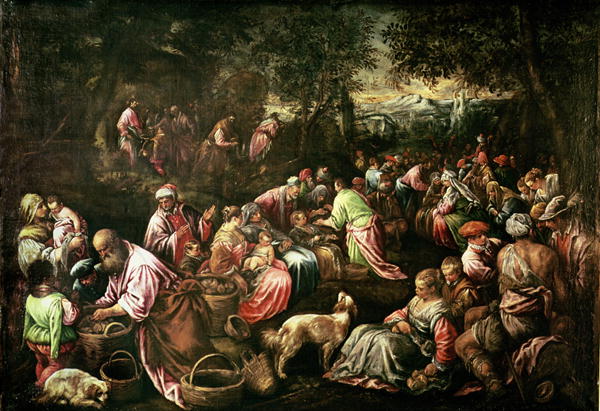
Commuting to New York City by bus can be an epiphany. When an hour-and-a-half scheduled ride stretches into two-and-a-half (I spent three-quarters as much time commuting as I did actually at work yesterday) you have plenty of time to look at the scenery. In New Jersey this translates into several towns and cities of differing socio-economic viability. The bus is a great leveler of people: corporate, business types sitting next to those who can’t afford a car or bicycle. As we trundled through Plainfield yesterday I spied a restaurant called Two Fishes & Five Loaves taglined Soul Food for all occasions. The name, of course, is borrowed from the story of the miraculous multiplication of food from the Gospels. This story fits particularly well in this setting.

According to the Gospel writers—this is the only miracle to appear in all four of the Gospels—a crowd following Jesus in a lonely place grew hungry. Instead of sending the crowds away, Jesus took the five loaves of bread and two fish they had with them and fed the crowd of 5,000 with that little morsel. When I was a student it was customary to interpret this story as one of a human-dimension miracle. The crowd, seeing Jesus sharing the food he had, each offered to share with their neighbors. Once the idea caught on, those without food had enough and those who’d brought extra had the right amount. They even had leftovers. This naturalized version of the story illustrates the message of Jesus quite nicely, although those who prefer supernatural intervention naturally reject it.

Plainfield is a town with stunning wealth and abject poverty. This situation is not unique to this location; indeed, it is a hallmark of capitalism. Those who have do not willingly give it up for the sake of those less fortunate. The free market is not really free. Today most readers like to see the story of the feeding of the five thousand as divine intervention. That matches our bail out mentality. When our circumstances make us too selfish, God comes to the rescue with conjured seafood and crumpets—or Tea Partiers—and the rest of us look on hungrily. By the end of the day, enduring that long bus ride home, I too was hoping for a miracle. Instead, as we crawled by Two Fishes & Five Loaves, loaded with people of every status, I was living in a Gospel story.


Tomorrow Ever After

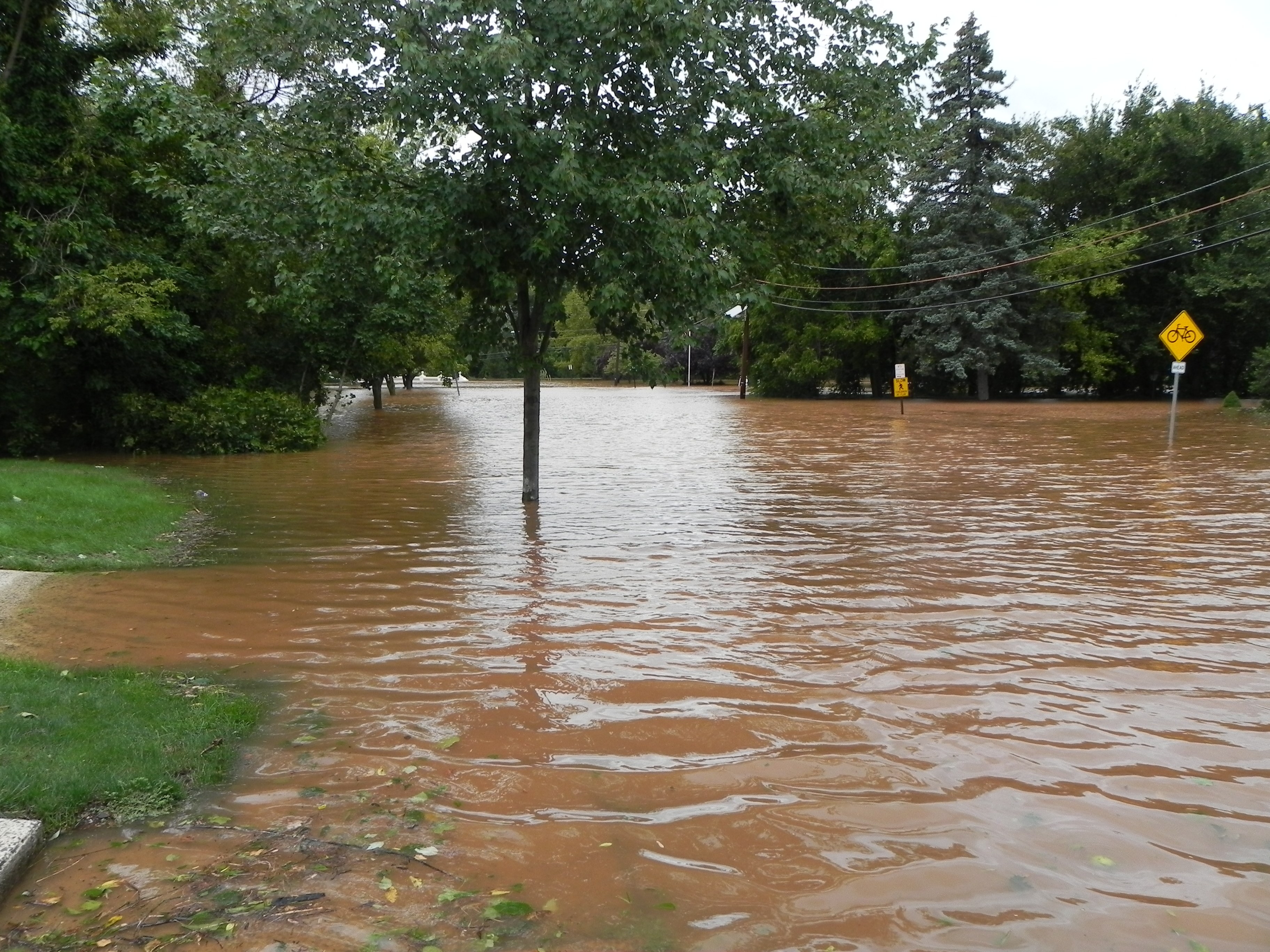
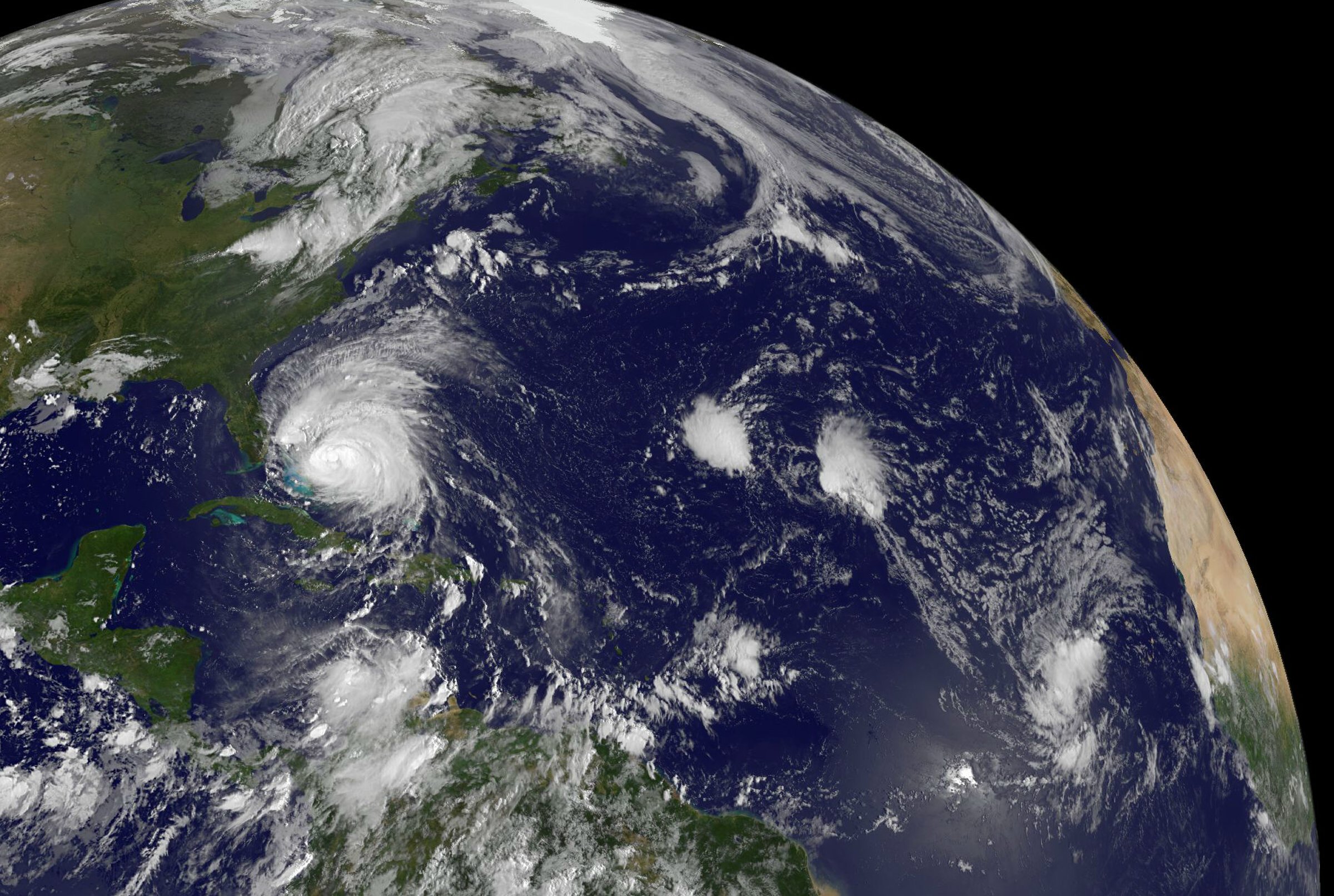
Last night as we said goodnight to Irene, my family decided to watch The Day After Tomorrow. Beyond The Perfect Storm and Twister we didn’t have any other weather-related disaster movies on hand. I became convinced long ago that weather was somehow key in the conception of divinity. Working at a seminary that required attendance at chapel twice daily where we would lugubriously and laboriously recite every verse of every Psalm according to the unforgiving schedule of the Book of Common Prayer, I began to notice the weather. Among the more common images used in the “hymnal of the second temple,” weather was seen as an essential aspect of divinity. Religions with celestial orientations frequently view the sky with a sacred aura. I began to compile all the Psalm references to the weather and eventually brought them together into a book, still unpublished. What became clear at the end of this exercise was that ancient people had no way to interpret the weather other than as a divine phenomenon. Listening to all the hype about Irene, it still seems to be the case.

In The Day After Tomorrow, our ill-fated teenagers are trapped in the New York Public Library as a super-chilled tropospheric wind freezes New York City. They build a fire and when you’re in a library, naturally, you burn books. I kept looking at all the furniture they spared as they consigned the books to the flame. A minor character called Jeremy is shown clutching a Bible. A girl named Elsa asks if he thinks God will save him. Replying that he is an atheist, Jeremy says that this is a Gutenberg Bible, “This Bible is the first book ever printed. It represents the dawn of the Age of Reason. As far as I’m concerned, the written word is mankind’s greatest achievement. You can laugh, but if Western Civilization is finished I’m gonna save at least one little piece of it.” This little dialogue represents the full circle of the celestial god. Jeremy doesn’t believe in this god, and the Bible requires human protection. Instead of being the instrument of war and political badgering and tea parties, it is seen as a symbol of enlightenment. It represents the first steps toward reason.

As Hurricane Irene still gusts outside my window, dropping rain as if New Jersey were a desert receiving its first drink in a century, the Tea Party is busy crafting ways of getting the Bible back in the White House. Their Bible is the antithesis to the Age of Reason. It is the symbol of superstition and prejudice and authoritarianism. It is the means of political power. The god of the Tea Party is a white-bearded man living in the sky, sending his fury against the liberal cities of the East Coast in a mighty wind. He is the punishing god of the Psalms. As the helicopter lifts off over a frozen Manhattan, the teenagers saved by a flawed father who walked from Philadelphia to New York to find his son, the camera pans across Jeremy as he hugs the Bible to his chest. I was in Boston for Hurricane Gloria back in 1985. Watching the waves crash on the beach at Winthrop I felt the power of fierce nature at the beginning of my own journey to, I hope, enlightenment. When it was over, however, there was not yet a Tea Party threatening an even worse, unnatural disaster to follow.

Irene, the early days


Red Eye Religion

It is a slow news day when Bigfoot makes the front page of the New Jersey Star-Ledger (without a body being found, of course). Not even halfway through the article the word “supernatural” shows up. This illustrates once again my contention that paranormal and religion often share mental space. A few months back I posted on the recent book Paranormal America by Christopher D. Bader, 
F. Carson Mencken and 
Joseph O. Baker. The authors, sociologists by trade, expressed a revealing connection between religious belief and willingness to accept the paranormal. One exception stood out, however; professionals who engage the hunt for sasquatch often toe the line of science and disparage the popularizing notion that their quarry is supernatural. There’s no doubt that Bigfoot has a growing clientele. Whether mythic or biological, there can be little doubt that the big guy’s here to stay.

Appearing in the newspaper as a bit of New Jerseyana, the local tradition about Big Red Eye—the north Jersey version of Bigfoot—suggests instant comparison with the Jersey Devil, a tactic the paper takes. Similar to responses presented when religious behavior turns criminal, adding a light touch helps to ease the tensions. Both religion and the paranormal thrive in the realm of belief. As I waited all morning in the garage for car repairs yesterday, the incessantly chatty morning talk-show hosts were going on about some quote that the Tea Party had been compared to terrorists. One of the gambolers stated, in rather self-righteous tones, “they are entitled to their beliefs-the constitution protects our right to believe what we want,” or something to that affect. Belief is a very powerful motivator. Even those who thrive on science alone secretly imbibe.

The physical reality of a phenomenon is not the sole indication of its significance. People are meaning-seeking creatures. Our concepts of what life means range from nihilistic, to simple, to complex. Even those who claim life has no meaning arrived at that place after the search. The significance of the unseen, the unknown, is that it provides an Ebenezer for meaning. Does Bigfoot exist in New Jersey? I can’t say. If so, it would still not rank as the strangest thing I’ve seen here. Nevertheless, among the fervent critics and uncritical adherents a common bond exists. Belief can’t be measured in any laboratory (yet) but only the most naïve would assert that it doesn’t exist.

Do you want to believe?


Cross Swords

Occasionally the symbol of the Prince of Peace is used as a weapon. A current case playing out in New Jersey revolves around a Livingston man and his convictions. Originally erected for Lent, the homeowner in question placed a wooden cross within a municipal right-of-way zone where signs and potential distractions to drivers are prohibited. When informed of the violation the owner removed the original cross and placed a larger one just within the right-of-way zone. When asked to remove it he contacted the Alliance Defense Fund—a group of Christian lawyers (which sounds apocryphal to me) who advocate the spread of the Gospel. This bizarre case is now being cited as a test of a land-use law that protects religious expression. A few inches would have resolved this entire mess. Had the homeowner placed his second cross beyond the restricted zone, no fuss would have been made.

I don’t really feel safe in a world where bands of renegade Christian lawyers rove about seeking to support the violation of public safety ordinances. Instead of friendly persuasion the cross is here used as a cudgel. Perhaps wearing one’s religion on one’s sleeve ought to be accompanied with a measuring tape. Certainly there are those impressed by the masculine chest-thrusting implied in defying laws to assert one’s particular take on religion. Pushing such issues to the point of public funds being spent to enforce a law throws the action into sharp relief.

Some varieties of Christianity (and other religions too, I’m sure) thrive on the fiction of persecution. Is the quality of life of the homeowner affected deleteriously by not being allowed to place a cross in a no-sign zone? Is it not rather an attempt to set, in H. Richard Niebuhr’s phrasing, Christ against culture? What friends (besides lawyers) does it win to the cause? Having gone through a phase myself where PDR (Public Display of Religion) was considered the only way to be authentic about belief, I think I might understand the original intent of the homeowner. A clergyman, however, long ago set me straight with a frank discussion of subtlety. What I came to realize is that shoving only leads to shoving back. Perhaps moving the cross six inches would be the equivalent of turning the other cheek? But when the other cheek is turned, lawyers don’t get paid.


Reverend Sanders?

According to the Associated Press yesterday, Yenitza Colichon was sentenced to 18 months’ probation for child neglect and cruelty. The charges stemmed from a 2007 religious ceremony in which her seven-year-old daughter was made to watch a chicken sacrifice in New Jersey, and the girl was fed the animal’s heart. The practice is part of the Palo Mayombe religion of central Africa. This whole incident highlights the vital question of when religion crosses the line into child neglect. Many of us bear scars—some psychological, some physical—from our religious upbringings. It has been concluded by psychologists that children do not possess the level of abstraction necessary to deal with religious concepts until they are about the age of twelve. Parents, often fearful of eternal consequences should their children depart the one, true faith (whatever that is), begin religious instruction early, often passing their children off to others who are in no real sense an expert in the religion itself.

The United States embraces, on paper, the concept of freedom of religion. Rightly, it seems, the strong arm of the state will step in when a child is endangered or neglected. The unanswered question is at what point does this neglect or endangerment occur? Authorities turn a blind eye if the faith is time-honored, and, especially, if it is of European/American extraction. Typically of the monotheistic variety. What is standard practice for other religions, as this case demonstrates, may be called into question. Sacrifice is also at the heart of the Judeo-Christian tradition. Sublimated into different forms for both political and theological reasons, those of us in that tradition have abstracted sacrifice to bloodless words on a page. When we see red, child neglect and cruelty are cited.

Religions frequently make extreme claims over the lives of their adherents. Most religions relax such claims for children, but others continue ancient practice that is tacitly condoned. Sometimes those permissible rites cause real physical pain and scars. If under the hand of a moyel, okay; if scarification in African tradition, not okay. Religions denigrating personal achievements of the young, setting them onto a path of failure, okay; religions ritually killing animals, as even the Bible demands, not okay. Without making any judgment on specific religious outlooks, the reality of lingering effects remains. Are the terrors of Christian nightmares inspired by tales of Hell any less cruel than watching a domesticated animal die? Is eating a chicken heart any less unusual that fish on Fridays? Is being unfamiliar with a religion grounds for dismissing its authenticity or claim for equality? Some of us find animal sacrifice distasteful, but if we proclaim a tidy sacrifice each Sunday, and share it with our children, that particular rite/right is protected by law.

What would (wiki-commons) chickens do?