Zombie Friday

New Jersey is known for its zombies. Last October Asbury Park gained admission to the Guinness Book of World Records for the largest zombie walk (exception is made, of course, for daily life in Washington, DC). The movie zombie, in its now classic form, was reborn in western Pennsylvania, but New Jersey is the place where strange afterlives appear to gravitate. Yesterday Stephen Finley was sentenced. Finley, a mortician, had been convicted of selling the healthy organs of his dead customers to earn a little extra on the side. Given that the governor, Chris Christie, might rival Vlad the Impaler in his zeal for chopping, this really does not surprise me at all. Is it not the ultimate triumph of the free market to consider human beings commodities to be packaged, used up, repackaged and resold? Moral rectitude is on the side of the strong arm.

As someone who has been on the receiving end of the chop more than once, and reduced to a zombie-like state of perpetual job-insecurity, I think I know how the undead feel. Not having a place in the normal world of the living, but not quite dead, the zombie wanders about looking to feed on brains. This idea of brain-lust seems to stem from the cult classic The Return of the Living Dead, although, not being a film specialist, I would welcome correction on this point. Nevertheless, like the modern zombie I hail from western Pennsylvania and nothing satisfies me like a good brain (metaphorically, of course).

The idea of harvesting the organs of the powerless dead also suggests the endlessly referenced Soylent Green. Here the staunch NRA promoter Charlton Heston fights against the establishment that is turning (spoiler alert) people into Soylent Green, the ultimate solution to food shortages! For, after all, are people not just commodities? America’s thirst for zombies reflects our growing sense of victimization: the zombie is primarily a creature without a will, brought back by powers beyond its control. In the original vodun context the zombie was a source of cheap labor. Is it any surprise that West African slaves brought the concept to the New World with them? Today, of course, those with the cash may simply purchase the organs they desire, cutting out the middle man and going straight to the source.


Bread Alone

The sad story of the death of an eight-year old girl from Irvington, New Jersey bears uncanny echoes to a case a year and a half ago of a mother who starved her children believing God would provide. The current case of Christiana Glenn’s death is heart-wrenching and the outlook is not improved when it appears that the girl’s mother had religious motivation to abuse her child. Christiana died from untreated physical wounds and malnutrition, prompting columnist Kathleen O’Brien to write about how food and religion often come together in unusual ways. As O’Brien points out, religions generally safeguard children from food privations, but less scrupulous leaders of what are frequently termed “cults” do not have the same strictures. The only real difference between a religion and a cult is society’s attitude toward it—religions tend to be larger and with finer pedigrees, but beliefs are beliefs. When religions seek control over believers’ lives, they often delve into the practice of deprivations, generally mild. More extreme groups take the idea to fatal limits.

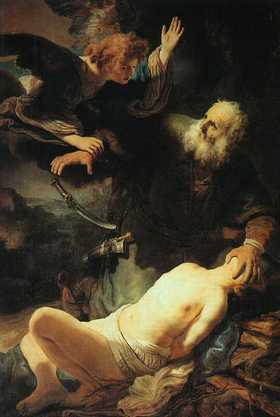
Even the Bible records from near the very beginning that deprivations are part of the religious expectation. One of the most complex and frightening stories from Genesis is that of Abraham’s near sacrifice of Isaac. No matter how theologians wash it, this story retains its stain of an adult—whether directed by God or not is a mute point—attempting to harm a child in the name of faith. The story, many centuries later, still sent Søren Kierkegaard into a tailspin that came out as Fear and Trembling. What kind of deity asks for a child to be harmed, even in jest? For Christiana Glenn, there’s no taking it back. The Bible tells us nothing of how the interior life of Isaac responded to this episode.

Food and religion are among the most common elements abused in American society. For our bifurcated (if not bipolar) outlook, one sustains body and the other sustains soul. While science still lacks evidence for the soul, the body remains the only basis upon which we have to base our ethics. Even biology dictates that care of one’s own young is an evolutionary imperative. It is tragic indeed when a religion overrides what all cultures respect as the ultimate “should” —take care of your children. In a world overpopulated by religious experts the street value of the soul will never face a recession. Believers, characterized my many religions as sheep, will go wherever their leaders tell them to go. As a culture suspicious of funding the study of religion, it may not be food that is reaped at the end of this harvest.

Thou shalt not...


I Can Haz Edukashun?

Myths are alive and well. One of the most pervasive myths, along with the one that says clergy only work on Sundays, is the concept that educators take the summer off. Undoubtedly some do, but the summer is traditionally the time for professors to conduct research without having to break up their concentration with several classes a day. Those were the halcyon days. This morning’s newspaper slapped me like a fistful of razors as I read the story of Rutgers University’s president’s resignation. I knew about the resignation, but being fumblingly employed part-time by his mighty university, and having to take annual ethics training for the pittance I’m allowed, I blanched as I read these two sentences: “McCormick earns $550,000 a year as president and is eligible for a $100,000 yearly bonus, though he hasn’t taken the money in recent years due to the university’s budget troubles. Ralph Izzo, chairman of the board of governors, said he thought McCormick would be worth his [continued] $334,000 professor’s salary.” A few pages later the headline tells how Chris Christie, New Jersey’s cut and bleed governor, took a state helicopter ride to get to his son’s baseball game. Also, he wants to prevent state employees from making a viable living.

In this twilight zone of an educational nightmare, a guy with professional ethics training just wants to close his eyes and make it all go away. For what are we educating our young if not for greed? What professor is worth more than 100,000 dollars to any university? In the old days, back with ethics had intestinal fortitude, the term for such folks was “sell outs.” Is there really any drive for excellence at such pay scales? It is no wonder we are raising the “entitlement generation.” Actions used to speak louder than words. State-mandated ethics training has now corrected that little oversight. Higher education used to be about ideas; today it’s “show me the money.”

The truly sad part of all this is that we keep pretending. We preach the myth to a public easily pacified and crucify those who beg to differ. Back in my Nashotah House days a trustee once hushed me so that the board might listen to a student with “fire in his belly.” My belly’s a blackened cinder by now. Is anybody listening? Mythology, particularly in the Greek world, revolves around the concept of hubris. It is a concept with which modern university folk are clearly unfamiliar. It goes something like this: like most people I think I am better than others. In order to prove it, I’ll increase my blandishments until there is no longer any doubt. Is that Olympus straight ahead? I might as well take that as well!

I’d love to stay and lecture some more, but I’m apparently entitled to more state ethics training.


Science of the Bible

It should be a local decision. Science, that is. This straight from the mouth of America’s darling Chris Christie. New Jersey’s governor does not wish to weigh in on this one. His children attend private school. Yes, even New Jersey is under the anti-evolution gun. In the light of the inevitability of Creationism trumping real science, I’ve been working on a sample syllabus for high school science teachers. The way I see it, this new focus in American education should teach science the way the Bible does – no holds barred, no punches pulled. No picking and choosing like Creationists do – Hey! Put that cell phone down, it is a device of black magic! (This will need to be followed up, supernaturally, by a course on how to handle witches in the classroom.) My proposed syllabus looks something like this:

Astronomy: study of that mysterious dome that encircles our earth. It seems to have holes poked through it, or so it looks at night. Science can change depending on the time of day. The sun and moon live in that dome as well, as our astronauts can attest. (Their views that the earth is round, without four corners as the Bible instructs, are, of course, heretical.)

Meteorology: study of the windows of the dome. When God opens these it rains. When God is angry he sends fire down from the dome. The loud sound that follows that is his angry voice. So play nice!

Geology: study of the very center of the cosmos. Our flat earth home, with its four corners and steady pillars reaching down into Sheol, is the exact center of everything. There are no such things as dinosaurs (or cats) since they are not mentioned in the Bible. The layers that you see here and there were all caused by the flood in a matter of about 150 days. The whole thing took only 6 days to make.

Biology: study of the separate kinds God created. Let’s be honest here: the chihuahua and the mastiff share a common ancestor? Preposterous! God made each kind separately and they’ve stayed that way for the past 6000 years. Oh, and yes, animals have telekinetic abilities – that’s how they knew to show up at the ark on time. And when the flood was over the marsupials all knew to swim to Australia. Koalas are surprisingly strong in the breast-stroke category.

Humanology: study of human beings (which are not animals). We were created after the animals (unless you read Genesis 2, where we were created from dust before the animals) and are therefore superior to them. Our natural lifespan is about 600 years, but if you are really wicked you might make it almost to 1000. Reproduction is by means of men planting seeds in women. Females contribute nothing to new children except a womb of their own. We teach these new generations by using the science of miracles, and since there are no schools in the Bible, what are we doing here anyway?


Dukes and Serfs

Once upon a time in a land far away, a man and woman worked a fertile garden, blessed by God. That garden was in the incredibly rich, black soil of Savoy, Illinois. The zucchinis harvested were of biblical proportions. Some of them miraculously grew to the size of my calves seemingly overnight. The broccoli and carrots my wife and I grew had so much flavor that we couldn’t believe just how much leeched out while vegetables sat in the back of a truck or on a grocery-store refrigerated shelf. Even with their periodic mistings. It was as if Bunnicula had visited them at night. So long ago, the garden. It seemed obvious in those days why the writers of Genesis compared paradise to a garden. Ours was no Eden – it was hard work – but my wife and I had a lot of fun with it.

James Buchanan Duke, namesake of Duke University, owned a considerable estate outside Hillsborough, New Jersey. Having established both a tobacco monopoly and an electric company, Duke was enormously wealthy. He left his Hillsborough farm (not the tobacco farms which were in his native North Carolina) to his daughter Doris, making her one of the wealthiest women in the world. Her estate now consists of a socially conscious Duke Farms Foundation that has offered gardening plots to the plebeians of the region. So yesterday I found myself once again back in the garden. Sharing a plot with a friend, we arrived for opening day and were greeted by one of the organizers of the garden. Her name, of course, is Eve.

New Jersey planting requires more manure than the black earth of the Midwest. Yesterday I found myself shoveling horse manure, not for the first time in my professional life, while Eve supervised the garden. It seemed strangely biblical. Dodging between my summer classes this year, I will be emulating the first profession of our mythic father Adam. In the afternoon, after cleaning up, we headed to Rutgers Day, the university public-relations festival that shows off the tremendous wealth that cannot afford to hire full-time faculty any more. As I kept a weather eye on the clouds, worried about the seeds I’d just planted, the future continued to look stormy to me, even on the campus that has at times been my only source of barely sustainable income. Perhaps I should have changed my shoes, because it seemed to me that the smell of horse manure still hung heavily in the air.

I wonder if this is how Adam got started


Take Your Medicine

Sanofi-Aventis is a local pharmaceutical company. I drive by their massive campus on my way to Montclair a couple times a week. The facility is immense: it has its own three traffic lights on a state highway. Nestled in the center of this large sanctuary to engineered improvements to natural life is the Sri Venkateswara Hindu Temple (it too has its own traffic light). The first time I saw this temple – it is still under construction – I almost drove off the road. It is a stunning structure to see in the edges of rural New Jersey and it is a testament to the religious diversity of the state. Being small-minded in matters of zoning and construction (I’ve never owned property or a house), I wondered how this fascinating building came to rest in the center of a major pharmaceutical company’s strip.

As I considered this juxtaposition, it occurred to me that I was seeing a living metaphor. In our country of (admittedly uneven) advanced healthcare, an industry driven by science and its wonders is still penetrated by a religious institution. A temple to ancient Indic gods surrounded by a temple to human accomplishment. We can lengthen life, if there is cash on the barrel-head. Being technically unemployed, I do not receive healthcare benefits. According to bravado wafting from the governor’s office, other state employees may soon be joining me. Yet it is the cost of healthcare that has consistently caused the stagnation of some sectors of the economy. According to this month’s Harper’s Index, since the year 2000 Massachusetts has allocated $1,200,000,000 (yes, one-billion, two-hundred-million dollars) to decrease class sizes and to increase teacher pay. Of that amount, 100 percent has gone to cover rising healthcare costs. Kali have mercy!

Those of us in central New Jersey, like our Hindu temple, are surrounded by pharmaceutical companies. I have, because of my robotics avocation, been inside some of the facilities of a couple of these companies. Their visitor lounges surpass any faculty lounge I’ve ever witnessed in both opulence of appointments and sense of wealth. Yet I know that legislators refuse to tap these shoulders when it comes to taxes. Those wealthy beyond compare have already paid their dues. Besides, these guys have the keys to life: bad heart? Overweight? Sexual malfunction? All can be cured, given the cash-in-hand. Yet in the center of the capitalism’s campus stands a temple for a time-honored religion. Where your heart is, there will be your heart medication also.


Born to Shun

Being of rather slight build, I have always held a natural antipathy toward bullies. I’ve always liked to believe that, were I in any position of power, I would care for those under my authority. Emulating this ideal as much as possible in the classroom seems to have made me a popular teacher. The message we send our young, however, shouts at decibels I cannot hope to achieve that throwing your weight around is the only proper way to govern. And some governors carry considerable excess weight. New Jersey used to pride itself on its educational system, a system that is currently being gouged in nearly every possible way by an insatiable governor. And now he is taking shots at Bruce.

I seldom write about my admiration for Bruce Springsteen because it is a very personal matter with me. Having grown up in a working-class family, I discovered Bruce at a fairly young age and I suspected his concern was authentic. That suspicion has grown over the years as he has campaigned for the common worker, never forgetting where he began. Now Chris Christie is attempting to besmirch the Boss. Using the newest entry in the Neo-Con lexicon of swears, Christie has leveled the “L-word” at New Jersey’s native son. Seems liberal is always a bad thing. Good thing Jesus – the original liberal – isn’t here or the Neo-Cons would nail him as well.

I'll see you after school

The Neo-Con movement delights in out-shouting the competition. Shut down National Public Radio because if reason is broadcast on the airwaves some people might end up looking ridiculous. Let us have no dissension here! If you leave the wealthy alone, they will leave you alone. Seems that “conservative” social responsibility was crucified some two millennia ago. Instead of Christ we now have Christie. The devil himself, however, would make a more compassionate governor, if we could ever get him away from the endless tea parties of perdition that occupy all his time.


Ice Father in Heaven

The Internet can be a window into the collective consciousness of a nation. In a world where even the Weather Channel invites comments on its forecast page, the outlook of many Americans is laid bare. This latest shot of winter weather on the northeastern quarter of the country is an excellent example. It is still March, the tempestuous month of the war god, so a little snow in the northern latitudes should come as no surprise. An unnamed dean at a state school here in New Jersey had just sent out an email blast the week before stating, with decanal authority, that there would be no more weather delays this year. Yesterday there was still snow on the ground after the storm. Frustrated citizens cursed – actually cursed – the winter on weather.com.

For years I have maintained that the weather is key to understanding the human perception of the divine. From ancient Sumer’s An and Enlil through classical Greece’s Uranus and Zeus, the gods unquestionably in charge are the sky gods. The guys who control the weather. In Israel Yahweh took that job description from a reluctant Hadad – aka Baal – and many people considered this a serious mistake. Don’t mess with the weather god! As the snow begins to melt once more, even those of us in the enlightened twenty-first century should be reminded that our sense of what the world should be is an illusion. Nature evolved our brains, and now our brains think they have the right to take over.

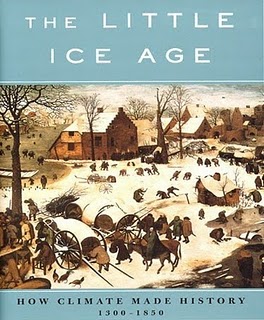
Once, back in Wisconsin, I stepped outside on a chilly June morning and saw flecks of snow in the air. It wasn’t “snowing” – it doesn’t snow in June – but there was definitely a frozen sort of precipitation hanging tentatively in the air. I was teaching at the most self-righteous of seminaries at the time, and it became clear to me, once again, that we are not in control. Among the scariest books I read in Wisconsin was Brian Fagan’s The Little Ice Age. I was at work on my book on weather language in the Psalms (still unpublished) and the unsettling truth drifted around me like this winter’s snows: if a new ice age settles in, there is nothing we can do to stop it. Geologists still can’t state what triggers these periodic events, or even what their timetable might be. If earth’s ice caps again begin to grow, however, I am certain that we will also see a dramatic increase in religiosity. For the gods, we all know deep down, are in the skies.


Frippery or Faith?

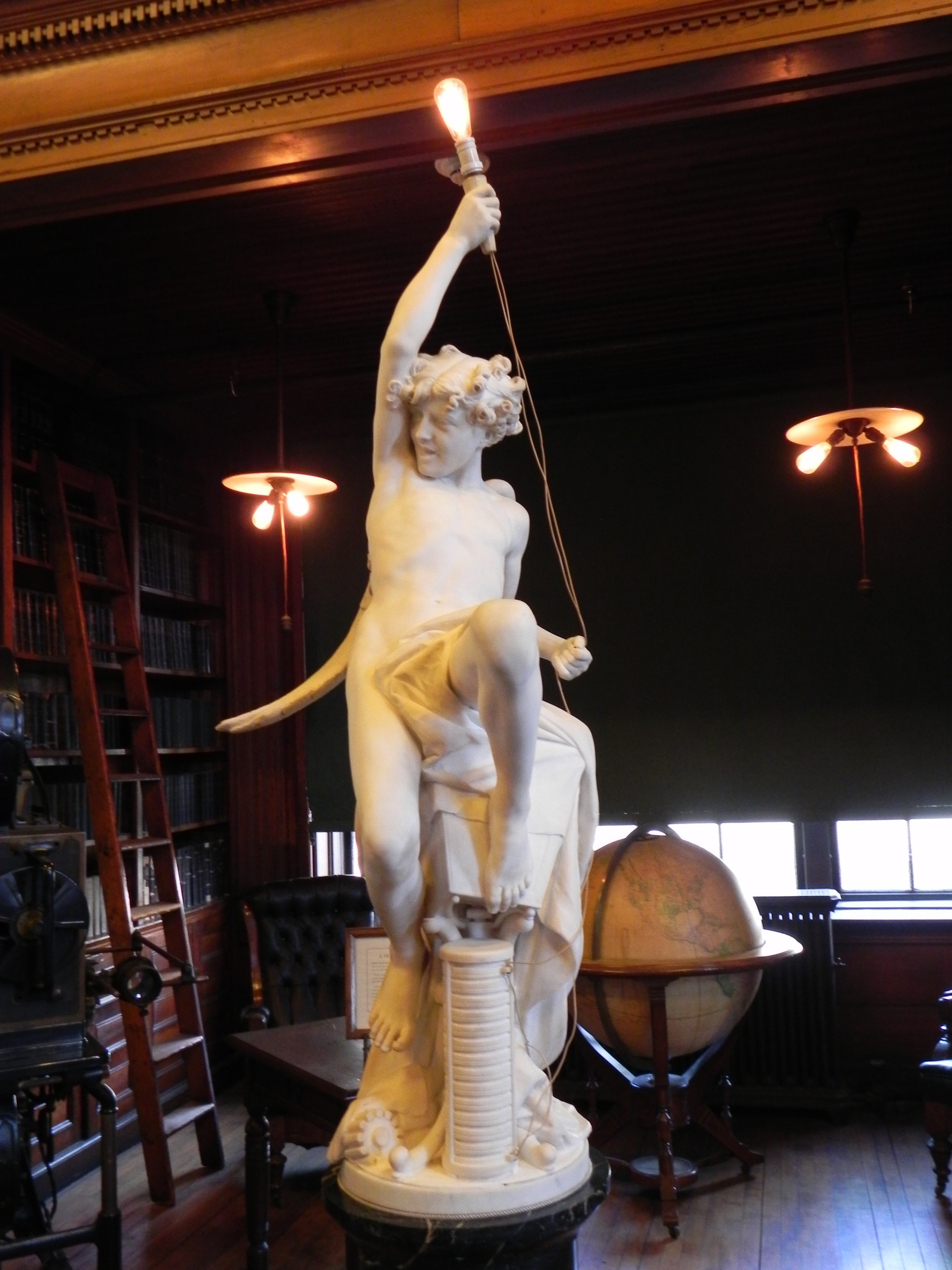
A lesson quickly learned in New Jersey is that the state has housed its fair share of geniuses and that inspiration takes many different forms. From Albert Einstein to Thomas Edison, these thinkers have changed the complexion of not only the state and country, but also of the entire world. While on a visit to Edison’s final factory and laboratory in West Orange yesterday, his devotion to thinking could not be overlooked. With little formal education, Thomas Edison taught himself what was necessary to become one of the most prolific inventors in the history of the world. The key to what he believed to be purpose of human existence is, sadly, under fire from politicians who’d rather keep the populace in the dark while they (the politicians) make the important decisions. “The man who doesn’t make up his mind to cultivate the habit of thinking misses the greatest pleasure in life.” So Edison said. Bully governors would rather turn out the lights.

As politics and conservative Christianity become even more intimate – if that is even possible – those who do not share their views are considered dangerous outsiders. As a religion specialist, it is difficult to gauge how sincerely such politicians take their religion. As their lifestyles clearly indicate, what they practice is as far from what they preach as the east is far from the west. Manipulating sincere, if misguided, believers into marks that will propel them into seats of power, they talk the talk. “Faith, as well intentioned as it may be, must be built on facts, not fiction – faith in fiction is a damnable false hope.” So said Edison.

If we measure the religion of the Religious Right in terms of action, it clear that their principles have far less to do with what Jesus said and did than with securing personal gain. Women are placed in subordinate positions; the poor, minorities, those who work to keep the economy afloat while the wealthy suck in more than they could possibly use, these people become targets rather than neighbors. Roman emperors knew the society was dissatisfied and provided bread and circuses. The Religious Right is perfectly capable of learning the more insidious lessons of history. If they had been around in Edison’s lifetime, no doubt they would have tried to turn off the lights so that we’d all remain in the dark. In such a situation it might be wise to leave the final words to Edison: “Religion is all bunk.”

Let there be light!


Jane Who?

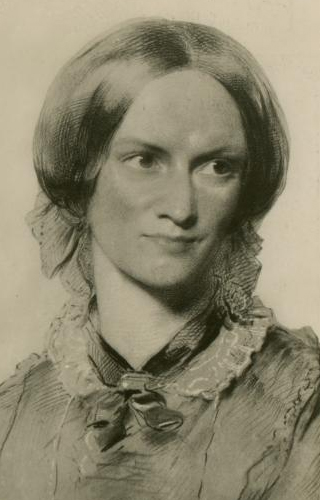
“Conventionality is not morality. Self-righteousness is not religion. To attack the first is not to assail the last.” So states Charlotte Brontë in the preface to the second edition of Jane Eyre. I am inclined to believe that the lines were widely ignored by clergy and politicians, for public leaders in nineteenth century Britain were not likely to take the advice of a young lady who only had one real credit to her name. Politicians and clergy of twenty-first century America can hardly be expected to have read Jane Eyre, for how would this woman know the harsh realities of how to assert one’s own will on the masses? In the stewing tea pot of the Religious Right, conventionality is morality. Self-righteousness is religion. George Santayana might well have saved his cramped fingers from writing, “Those who cannot remember the past are condemned to repeat it.”

As politicians oil their moving parts in preparation for next year’s great race, they know that many constituents will gladly accept conventionality as morality without asking about the origins of such practices. Schoolyard bullies who seek their own aspirations praise the great darkness that has settled over New Jersey where education is simply a commodity with which to bargain. Jane Eyre? Who’s she? If she’s a constituent, I’d better spin this slashing of education funds to her liking. Without an educated public, it is much easier to bolster one’s personal authority.

For years educators have been watching in dismay as other developed nations soar past American expertise in science, math, and even geography. Our response: let’s cut education funding. Conventionality is morality. Education teaches children to think for themselves. Is it not better to show them that self-righteousness is religion? We can put other religions on trial (thank you, Mr. King), while conveniently forgetting our founders were largely religious dissenters. To know that, however, you have to read a little history. We are far too busy plotting how to shortchange our future in order to feather further already overly plush nests.


In the Beginning FIRST

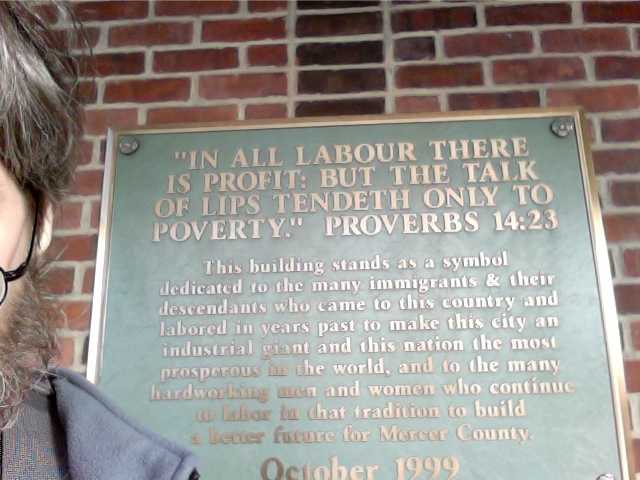
Robots can be strangely emotional. Partly it’s that Colosseum atmosphere of a FIRST Robotics event, partly it’s being reminded of the vitality of youth, partly it’s hope for the future, and partly it is being part of something larger than yourself. Sounds religious. All that and lack of sleep. Yesterday was the culmination of the New Jersey Regional competition of this year’s FIRST Robotics season. As a non-scientist/engineer wannabe parent, I attend the competitions I am able to and I always leave deeply conflicted. There is a strange disconnect between science and religion that maintains an uneasy peace in many educated minds. My malaise began when I saw the following plaque, quoting the Bible, outside the Trenton Sun National Bank Center. In a state where labor is constantly under attack by its aristocratic government, it was a poignant reminder that such events as this celebration of science would not be possible without the efforts of laborers.

Bible lesson before the games

Emulating sports events, FIRST Robotics begins its events with a ritual. This in itself goes back to classical religions where competitions were dedicated to the gods. As a local speaker stood before the crowd of several hundred youth, mentors, and advisors, he reiterated the commitment the FIRST program has to service. To make his point, he began speaking about what he’d learned in church. It was here that the conflict settled home. For many years I taught (still do, in a less direct way) those who were training for careers in the church. I am committed to teaching them that religious reactions against a scientific worldview are misguided and bound to collapse. And yet here was a highly educated scientist simply accepting the teaching of a minister. There is a deeper issue here.

I know many clergy, perhaps too many for the good of one layman. And I know that many of them are far too busy to sort out the detailed intricacies of how science and religion interact. In fact this may be the only truly honest way to engage our world. As I listened to excited kids making announcements about the millions of dollars available for budding science students in college, I reflected on our treasure lying where our hearts are. Looking around at the mess the world is in, I see religion often taking a leading role in violence and distrust, reaping the benefits of science for evil purposes. I see scientists attempting to instill a rational worldview on societies deeply mired in unreflective religion. And I find them mixing at the fringes. I salute FIRST Robotics, but I wonder if we can ever truly escape the wrath of the gods.


Sanity Plea

How far up the chain of command does an insanity plea go? Back in 2005 Boyce Singleton Jr. admitted stabbing his girlfriend to death because “God told him to do it.” An appellate panel has just decided that the guilty verdict must be thrown out because the jury had not been instructed in insanity plea etiquette. “But, the appellate panel said [Judge] LeBon should have told jurors that they could acquit Singleton by reason of insanity – even if they found Singleton knew killing Michelle Cazan was wrong – if they believed he felt God compelled him to act,” according to the New Jersey Star-Ledger. A former colleague at an institution plagued with insanity once told me, “humor the mental.” That may be the best advice a weary nation might hope for. While political rulers from the privileged caste whittle, hack, and bludgeon away at the meager benefits of their underlings (previously known as constituents), those who refuse to pull back hands and feet endanger a digit or two. In the name of God, why doesn’t somebody do something?

There was a time when saying God made you do something evil was considered blasphemy. In today’s America it is an open justification for just about any war crime or personal vendetta you may want to implement. You see, God is freely available for those who know that a mere human committing their heinous acts would be clapped in irons. Long generations of televangelists have given the public the divine American Express card number. Do you hate this particular group? So does God! Do you want to declare war on that country? So does God! Do you want to stab your spouse? So does God! The rhetoric is so normative that a president can declare a personal quarrel a national crusade because God told him to. No one even bothers to look up from Facebook.

It is time to remove God from the equation. When I was a child Flip Wilson ratcheted up the laugh meter with his catch phrase, “the Devil made me do it!” Classic transference was funny because everyone knew it was a bogus excuse. Not long after Flip’s demise the catch-phrase spread to the White House with only a simple title change. Are not the Devil and God interchangeable? Once a president claims divine precedent, doesn’t it trickle down to those lower in the social order? That’s the way of democracy, and God has been very democratized. Who needs an insanity plea when you’ve got the creator of the universe in your back pocket?

Where did you say this boat stops?


Devil’s Ethics

It’s that time of year when state employees (even part-timers) are subjected to ethics training. Each year the irony of the situation becomes thicker and more viscous. You see, those of us who have part-time engagements are often on the receiving end of ethical violations, and we know better than to make ripples since we are disposable. I’ll say nothing of the well-known (almost infamous) ethical history of New Jersey, but today’s headlines suggest an even higher power when it comes to unethical actions. An Associated Press story bears the headline “U.S. biological horror stories brought before commission.” The report concerns official United States studies conducted on its own citizens by exposing people to and deliberately infecting them with various diseases. This may come as a shock to many, but already in the 1980s it was documented that America’s guinea pigs were its own citizens.

Leonard Cole’s Clouds of Secrecy: The Army’s Germ Warfare Tests over Populated Areas, published in 1988, exposed many documented incidents of biological agent testing on non-consenting, and unsuspecting citizens. The testing was done in the name of national security (for which you may now be groped by any TSA official whose hands are not otherwise engaged). As this report demonstrates, our own government has viewed those of us not in positions of power as manipulable, expendable, and somehow less valuable than those elected by schemes they devise themselves. Democracy, it seems, is not free.

We are expected to heave a sigh of relief (come on now, everybody, it’s okay) since the history exposed is between 40 and 80 years old. That’s ancient history, right? An industrial-military complex today would never violate the rights of citizens. At least not officially. At least not as long as the Freedom of Information Act ensures that citizens have access to records (several years after the fact), and as long as it is not deemed a matter of national security. The color of your underwear and the shape of what is beneath are government assets. Also, so is your immune system. Otherwise you are free to live your life uninhibited. Unless, that is, you are a state employee with an extensive ethics background. Excuse me, but I’ve got to get back to my ethics training.


Devils and Mooncussers

New Jersey is an easy state to caricature. Some of the most remarkable aspects, however, are those that seldom find their way into the popular media. An unseasonably warm spell led my family to a sudden awareness of cabin fever that sent us seeking diversion over the weekend. We ended up at Tuckerton Seaport. To get to the museum from our location meant a long drive through the pine barrens. This unique ecosystem is impressive for its size (over a million acres) as well as for its unique plant-life and relative lack of population. And, of course, the Jersey Devil.

A relatively harmless Jersey Devil

Even serious museums such as the Seaport can be expected to play up the heritage a bit. In a corner of the wildlife diorama is tucked a little sculpture of the Jersey Devil. The diabolical aspect comes only from the folklore of its birth as an accursed child. Far more dangerous were the human elements in the maritime history. Mooncussers were those who set out false lights for ships, hoping to lure them into the shore where the vessels would run aground, leading to easy plundering. The lighthouse has long been a religious symbol, a metaphor ready-made for illumination, safety, and solidity. This very reputation led the way for mooncussers to steal the signs of security to enhance personal gain.

The devil of personal gain unfortunately haunts more than the remote pine barrens of New Jersey. Those who use religion to attain that gain are the modern mooncussers who draw the unwary too near to the rocks and shoals. And mooncussers encourage others to participate in their sham, as long as there are gullible captains who are uncertain of the shore. The early church liked to compare itself to a ship. This image inspired many a nave ceiling to be designed as the hull of an upturned boat. Unfortunately, the hull often appears to have been capsized and the mooncussers appear in the role of diabolical captains set on wrecking the very vessel they command. Who needs a devil when human greed is far more than adequate to lead even the upright to opt for easy gain at others’ expense?


The Triumph of Baal

“Snow weariness” is no strange phenomenon even to those of us who were reared in the legendary snow belt of Lake Erie. Although Buffalo consistently topped our records, months of deep snow burying all the familiar features of our landscape in northwestern Pennsylvania were regular expectations of winter. Snow weariness generally settled in around March when we longed for green pastures and unstill waters. As an adult in generally snow-deprived New Jersey, the weariness sets in much quicker. Attempting to drive on highways with sneophytes is a challenge; before I had my license I had driven in plenty of snow, otherwise I’d have had to hibernate from December through April of each year. Digging out from New Jersey’s third major snow-plop of January, however, the magic seems to have vanished.

Baal was a god who controlled the weather. Some years back I finished a book (still unpublished) on weather terminology in the Psalms. Many psalms are notable for containing archaic imagery and phrasing, leading some scholars to suggest they might have been new, revised “Canaanite” versions of songs originally dedicated to Baal. Perhaps so. The Psalms frequently note the wonder of weather, even occasionally of the snow. Psalm 147 contains the lines:

16 The one giving snow like the wool,
he scatters hoarfrost like the ashes,
17 throwing his rime like crumbs,
before his cold who will stand?

Originally a paean to Baal? Who knows? It’s just that we’re all shivering down here. And Israelites didn’t have to shovel a path to their cars to turn over reluctant engines to get a modicum of warm air circulating before they actually arrived at work.

Once Israel’s monotheism set in, Yahweh took control of the weather, thank you. Even a glance at the Psalms demonstrates the superiority of Israel’s divine weather-maker. From the view down here, however, it looks like maybe Baal has a few tricks still to play. Would Yahweh ever cause a Bible class to be cancelled because of inclement weather?

Dawn in the new snow Baal