Saint Francis

With the death of the most saint-like Pope in living memory, it feels a little like fate that I’d seen Conclave just three days before.  Francis was the only Pope I’ve seen, and am likely to see.  He cared for people more than dusty doctrines that still repress.  He laid hands on the sick and genuinely loved human beings.  Given the reactionary world of politics, I suspect his successor will be conservative, but I would be glad to be wrong.  All this seesawing on the way to progress makes me a bit seasick.  And Francis was a man who, from a humble background, understood the necessity of moving forward rather than pretending things always stay the same.  I already miss him.

It was on the rare occasion of being invited to a New York City church to offer a program that I saw him.  Since I’d be staying a couple nights in Manhattan, my wife joined me.  On the way to meet her after work on that Friday, I saw large crowds along 34th Street in Herald Square.  The buzz indicated that the Pope would be going this way on his way out of town.  The police refused to confirm that, but it seemed like a good bet.  I asked Kay, “Do you want to see the Pope?”  We found a place in the crowd (this was pre-pandemic, of course) where we had a good view of the street and eventually the motorcade rolled through, Pope Francis in his trademark Fiat, the window down, waving at the crowd.  And then he was gone.  

In New York City you see motorcades.  I’d seen President Obama’s go by once, on the way to the United Nations, I think it was.  But still, seeing the Pope was incredible.  Not shielded behind bulletproof glass, his care for the nameless crowds felt genuine.  I empathize with those raised in humble circumstances who manage just to survive, let alone become the head of the largest branch of Christianity.  I like to think he was a reluctant Cardinal, and a reluctant Pope.  Conclave is fiction, of course, but the idea of choosing someone who really doesn’t want the job is immensely appealing.  How different from world leaders we’re now burdened with!  Men (almost always) who see themselves as God’s gift to us, clawing at power.  At the same time, Francis, who was a divine gift, actually remembered what Jesus said and did.  The world is poorer for his death but richer for the lessons he taught by example.


Cloistered

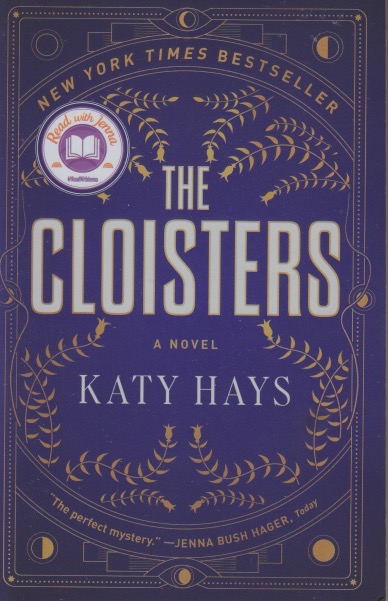
Free will.  I’ll go on the record as a proponent.  Any kind of determinism gives me the willies.  At times, however, it does feel as if we’re merely pawns.  Katy Hays deals with the concept of fate, and the occult world of tarot, in The Cloisters.  The writing is quite compelling and the story moves along at a good pace.  It follows Ann, a graduate from eastern Washington who wants to get away from the town where her father was killed.  She accepts the offer of a summer program at the Met in New York City, but because of a mix-up ends up at the Cloisters instead.  I’ve never actually been to the Cloisters, but this novel makes me want to go.  At this museum of Medieval and Renaissance art, Ann works with Rachel, another assistant, Leo, a gardener, and the curator, Patrick.

Rachel has been at the Cloisters for some time and Patrick, her boss, has become enamored of tarot decks and their history.  He’s been seeking perhaps the oldest complete deck known and has come to believe that perhaps the cards do have the ability to tell the future.  Ann befriends Rachel.  The two begin to make discoveries, particularly Ann, but Rachel, who is independently wealthy, manipulates her, taking advantage of the fact that Ann never wants to return home.  Then Patrick is poisoned.  I won’t reveal whodunnit here, but the last half of the book has several twists that make you reassess whatever conclusions you may have drawn.  It’s a fascinating story, well told.

This novel is another example of dark academia.  Much of it takes place in the library of the Cloisters and Patrick holds a Ph.D. while Rachel is a graduate student.  Ann is about to enter a doctoral program.  All of them have some fairly dark secrets in their lives.  And all of them are driven.  The story has elements of social commentary as well, particularly concerning how life in New York City will drive people to extremes when the competition makes this necessary to survive.  Although three of the four commit crimes, they are all likable people.  Three of them are academics as well.  All four are quite intelligent.  I was drawn into this tale from the start and even as the darkness was revealed couldn’t bring myself to dislike any of the characters.  Some novels have antiheroes that you just can’t feel for.  The Cloisters moves in the other direction, and it does make you wonder just how much choice you actually have and how much is left to fate.


Local Haunts

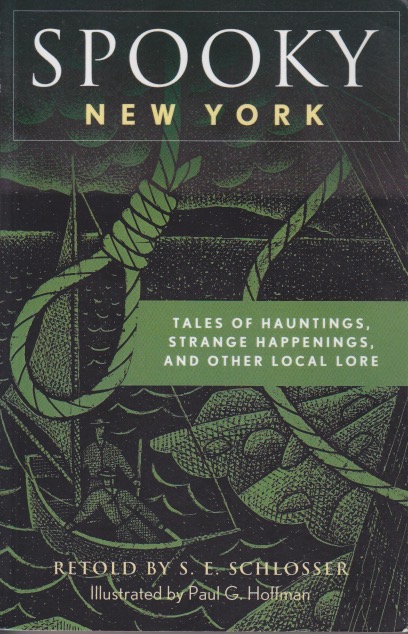
Local color.  It’s what makes travel so much fun, even if not to someplace exotic.  I’ve lived in five different states and two different countries and one thing each place had in common was local lore.  Since I’ve been a stranger in most places I’ve moved, I’ve picked the lore up primarily from books.  Fortunately there are as many people willing to write them for the also many people like me who are willing to read them.  S. E. Schlosser is a storyteller.  We have Rutgers University in common, but her book, Spooky New York, focuses on the state next door.  The book contains retold stories, or as the subtitle states Tales of Hauntings, Strange Happenings, and Other Local Lore.  New York isn’t unique in having such stories, and some of them are clearly regional variants—I heard some of them set in Wisconsin, for instance—but there’s a guilty pleasure in reading such accounts.

Although most of us are raised being told “there’s no such thing as ghosts,” that “truth” doesn’t stick for all of us.  I don’t know if any of the ghosts in this collection are real; folklore deals with that—shall we say—twilight zone that lies between quotidian existence and the weird.  Strange things do happen, but not on any kind of scientific schedule so they can be anticipated and quantified.  And some of them have been seen and reported by many different people.  These stories include such tales.  While they range the length of the state they concentrate in the east.  I’m sure, however, that if you spent enough time talking to the locals you could scare up ghosts from across the Empire State.

Many of the tales are set in New York City.  Having commuted into New York for about seven years, one thing became clear to me.  Even with the tall, modern towers and sophisticated, wealthy trappings, it can be an eerie place.  Around this time of year I would arrive in Manhattan well before sunrise.  Walking the predawn streets to the office showed Gotham in a different light.  Even the few times I went for lunchtime strolls to clear my head, I sensed there were millions of untold stories here.  Some gothic, some haunted.  Schlosser tells several such New York tales.  She includes some from literature but most of those probably go back to stories told by the locals before having been fixed onto paper.  This book will help set the mood, even if you live in the next state over, or anywhere that ghosts roam.


Small Big World

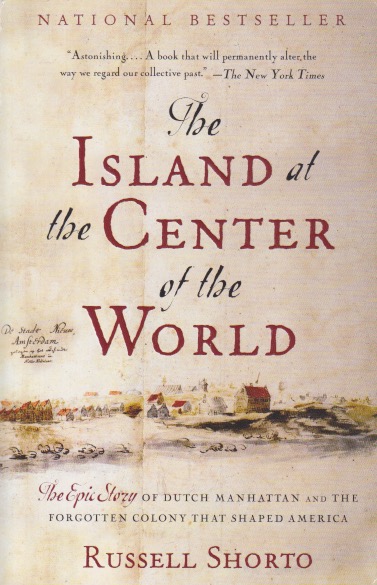
Serendipity may have been over-used in the eighties, but the idea of finding something by chance that turns out to be really good is real enough.  My wife found The Island at the Center of the World, by Russell Shorto, by chance.  You see, used bookstores are places of serendipity.  This one happened to be in Trumansburg, New York.  Subtitled The Epic Story of Dutch Manhattan and the Forgotten Colony that Shaped America, this is the story of an early European incursion into North America.  These days it’s difficult to feel good about any of that, but overlooking the misery we’ve caused for a moment, the early Dutch settlement was, comparatively, not as detrimental to the American Indians as later colonies were.  The Dutch were mainly interested in trading, and unlike the Puritans who settled to the north, they were tolerant of difference, even religious difference.

Shorto chronicles how the settlement of Manhattan from the beginning was one of diverse peoples having to get along and accept one another.  The Dutch, like the Puritans, had been infected by Calvinism, but they took a more practical view.  People get along better if you don’t force them all to think the same way.  The book suggests that this was impressed on New Amsterdam from the beginning, and it remained when it became New York.  It’s a fascinating story partially because it begins the narrative before the point where we’re generally instructed in school.  Europe was warring, at the time, of course.  But it was a Dutch idea—that peace could be the default state, instead of war—that allowed for real civic progress.  Those scrambling for empires, however, continued to squabble, even as they still do today.

There are plenty of unexpected insights from this book.  The Dutch in many ways molded the die that would become European America.  Having built a successful trading colony in Manhattan, they had to surrender it when the English, after the Cromwell debacle, decided to take it by force.  The people of Manhattan did not want to fight a clearly superior army and lose all that they’d gained by their tolerant way of life.  And so New Amsterdam became New York.  The story is filled with colorful characters and incidents that, if you’re like me, you’ve never heard of.  I’m not one of those people who has to read everything published on New York City.  Working there for many years was sufficient for me.  But still, this is one of those books that I’m glad my wife serendipitously found while looking for nothing in particular in a used bookstore.


Dutch Treat

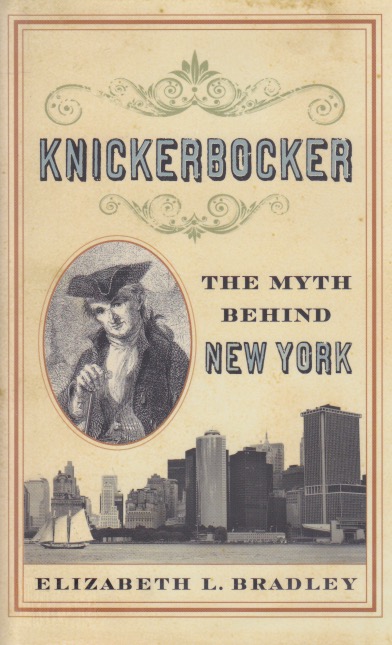
It was back when I was researching my first religion and horror paper that I learned it.  Since the paper was about Sleepy Hollow, I’d been reading about Washington Irving.  I knew little about him beyond that he’d written this story and also “Rip Van Winkle.”  I had no idea that he was the one responsible for the nickname Knickerbocker for all things New York.  Since then I’ve been quite curious about Irving and his world.  A glance at the books noted on this blog over the last few months will demonstrate this.  I found out about Elizabeth L. Bradley from an interview about Sleepy Hollow during the heart of the pandemic.  Irving was first sent to Sleepy Hollow because of a yellow fever outbreak in New York.  It led to his introduction to the lore and folk of the region.

Bradley’s book isn’t about that, however.  She’s writing about how Knickerbocker went from Irving’s nom de guerre to essentially a trademark for Manhattan, and New York City more broadly.  Knickerbocker graces hotels, sports teams, and once upon a time, a brand of beer.  And much more.  All of this is because of a volume I’ve never read, A History of New York by Diedrich Knickerbocker.  Irving was a satirical writer and this history is an extended satire.  He wasn’t Dutch, but he was born in Manhattan and cut his writing teeth there.  An older sibling to America’s other fledgling writers, he gained fame enough to be able to retire near Sleepy Hollow.  That particular story, along with Rip, made him a household name.  Of course, he wrote much else but it’s not talked about so much.

This book is a brief tour of the city and its love affair with Irving’s pseudonym.  Even having commuted to New York for about seven years of my life, I feel I only know very little about Irving’s hometown of Manhattan.  I do know that on my walks across midtown hurrying either to the office or to the bus, I found a quirky little view of the city emerging.  Little sites of significance only to myself—plaques on a seldom-used street, a church nestled between towers for capitalism, a quiet restaurant that made you forget the millions of others just outside.  It gives me hope that a writer can make such an impact on an ever-evolving entity like New York.  And this quick introduction contains much to help one reflect on the enormity of it all.


Hypersensitivity

Tell people you’re hypersensitive and the first thing they’ll say is “I’m sorry.”  The way I use the term is, however, somewhat literal.  Some of us experience sensory input in especially intensive ways.  Psychologists say that those of us who do often stop and assess in new situations.  We can become overstimulated and sometimes “shut down” if too much is going on.  It doesn’t mean I’m going to burst into tears if you insult my haircut.  (It’s homemade, we’re in a pandemic, after all.)  The reason I bring hypersensitivity up at this point is two-fold.  The first fold has to do with the fact that I no longer get out much, which means much of the “ordinary” now seems new.  The second fold is that I wonder if hypersensitivity had a role in leading medieval people into monasteries and convents.

Back to point one.  If sensory stimuli can overwhelm one, going back into TMI territory can be almost traumatic.  I commuted into New York City for about seven years.  Manhattan is difficult for a hypersensitive person to take.  Over time I became accustomed to it, and familiar environments are more easily navigated.  The pandemic, however, has me spending about nine or ten hours a day in the same small room at home.  Actually, working remotely had already done that, but I used to get out on weekends.  We recently took a safe weekend trip, stopping only at places with few people and staying with family.  Less than 24-hours out from home I realized I was feeling overwhelmed.  Too much interaction.  We had stopped at a town I’d never visited before.  The trees were spectacular.  I soon regained my bearings, because no matter how late I stay up, I still awake early to write.

This leads to the second point.  I suspect things moved much more slowly in Late Antiquity and the Middle Ages, but I can see why certain individuals might like to cloister themselves.  While I disagreed with the theology, I taught for fourteen years at Nashotah House, a cloistered seminary.  You saw the same people day in and day out.  The campus was suspicious about this thing called “the internet” for quite a long time.  You ordered books through the mail and waited a month or more for it to arrive.  In some ways this was a comfortable existence.  Of course, it blocked me from much of what was happening in the wider world.  The pandemic has, in some measure, brought me back to that space.  I wonder if, historically, they might be connected.  But right now it’s time to get to my ten-hour room and work.


Who’s To Blame?

Back at Nashotah House Episcopal Seminary, we were a closed community.  Well, not completely closed, as much as some may have desired it.  When a communicable illness came to campus it quickly spread.  No wonder—we were required to all gather twice daily in the chapel, and there was the passing of the peace during mass.  And the sharing of a common chalice.  The germs of the Lord were readily spread.  One of the faculty members would refer to the vector of the illness as “Typhoid Mary,” a rather sexist remark in the mostly male environment.  Still, Mary Mallon came to mind as the current crises has settled in.  “Typhoid Mary” was an asymptomatic carrier of typhoid fever.  A working-class girl from Ireland, outbreaks of typhoid followed her in the various houses in New York City where she worked.

Photo credit: National Institute of Allergy and Infectious Diseases (NIAID), National Institutes of Health (NIH), via Wikimedia Commons

The current coronavirus outbreak in New York City seems strangely similar in some regards.  Although COVID-19 is less likely passed by asymptomatic carriers, according to what I’ve read from the World Health Organization, it is still a possible vector.  While out getting necessary supplies in the area I recently noticed store employees without gloves or masks, both of which I had on.  One of us was underdressed.  I went home, washed my hands thoroughly, and pulled my copy of The Andromeda Strain from the bookshelf.  Self-medication can come in several forms.  Some people still look at me funny for wearing a mask, but many other customers are now doing the same.  The Center for Disease Control recommends it.

Before I’d ever heard of Nashotah House, I worked in a grocery store.  I was a college graduate with facial hair that had to be removed.  “Customers don’t trust a man with a beard,” I was told.  Back then if you walked into a store with a mask on there would’ve been trouble.  Contagion can drive you crazy.  Nobody wants to be a “Typhoid Mary,” and yet it’s difficult to be out in public with a mask on.  “Who was that masked man?” they used to ask of the Lone Ranger.  From the theater and psychology I’ve studied, I know that hiding behind a mask can be a liberating experience.  Aware that nobody knows who you are, you are free to act most any way you please.  But this is different.  Maybe it’s because my mask is made of a paisley-ish bandana,  the kind old westerns show outlaws wearing.  Or maybe it’s because of the guilt a religious upbringing so generously left with me.  After all these years the old cliches are coming back to life.


Green Dilemma

It’s a dilemma.  I face it every year.  I don’t have green to wear and it’s St. Patrick’s Day.  For your average run-of-the-mill citizen, this might not be an issue—but I do have an Irish heritage (in part), and so it’s a heartfelt concern.  The reason I don’t have green has less to do with fashion (consider the source!) than with my clothing purchasing practices.  First of all, I like to make my clothes last.  Fabrics can be quite durable.  They aren’t mechanical and therefore don’t break down often.  I don’t live a rough-and-tumble life, so tears aren’t really a problem.  The end result is that I keep my clothes as long as they’re functional.  When they begin to wear out I go to the store and examine the clearance racks until I find something in my size.  That means color selection is often a matter of very limited options.

Once in a great while I have landed something green.  I still remember a green shirt I had in college.  It served me well for more than four St. Patrick’s Days.  It long ago succumbed to overuse, however, because I wore it on other days as well.  And let’s face it, when I make one of those infrequent trips to the clothiers’ shops, this particular holiday’s not on my mind.  Unless, of course, I go shopping in March.  Back when I lived in Boston it was easy to get your Irish on.  I bought a bright green silky (I don’t know if it was real silk) tie with white shamrocks on it.  It was probably down at Faneuil Hall.  It had been a bit outlandish to wear to work in New York City, though.  Indeed, at work staid dress was by far the most common code.  Consequently it hung unused in my closet for years.

When we moved a couple summers back, I noticed my green tie had faded to bronze.  I thought it went the other way around.  In any case, my last truly green clothing article was no longer green.  Yes, it still has shamrocks, but I’d feel even more ridiculous trying to rock a bronze tie and pass myself off as Irish.  It won’t even pass for gold.  Of course, I work from home.  I’ve practiced social distancing long before it was a trend or a government mandate, whichever it is.  The only people to see my lack of green would be my wife and daughter, and perhaps a Jehovah’s Witnesses that might stop by.  But still, even minor celebrations are anticipated at times such as this.  Although I won’t be going out today I’ll probably be spending some time in my closet and reflecting on the true heritage of my Irish forebears.

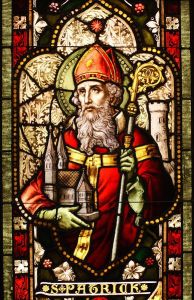
Perhaps St. Pat shops like I do?


Book Magic

Something happens to you on a long bus ride, reading a mind-blowing book.  Part of the transport—literally—is that you’re captive for an hour or two and your book is your boon companion among snoring strangers.  Another aspect is the earliness of the hour.  Days like yesterday, when I have to commute to New York, involve awaking at 2:30 a.m.  The day is cast very differently when your timing shifts back by a few hours.  It’s almost mystical.  The largest portion of the transformative experience, however, is the book itself.  I’ve begun commutes with a book that I quickly realize is a mistake, but since I’m not a quitter, I soldier through it to the end anyway.  On yesterday’s commute the book was one of those that caught my imagination and flew it like a kite from the rear of the bus.  Arriving in Manhattan before six a.m. added to the feeling.  The city’s a very different place that time of day.

Not everyone enjoys reading, I realize.  My late stepfather once had a job as an elevator man.  Not the kind dressed in livery at a big-city hotel, but as an operator in an antiquated building in Oil City, Pennsylvania, where you had to pull the metal gateway  physically across the door and wait until the floor leveled before opening it again.  I didn’t get along with my stepfather, but one day I went to visit him in the elevator.  It wasn’t a busy building.  He sat on a stool, staring straight ahead.  For hours at a time.  Not a man prone to meditation, I knew he had to be bored.  I asked if I could bring him something to read, at least.  He declined for fear of missing someone’s call signal.  It was one of the most frightening scenarios I could imagine.

The clock in the Port Authority read 5:49 when we pulled in.  The day seemed full of possibilities.  I caught the 4:30 home, but the magic was gone.  The book had moved on to more technical things.  Traffic was bad, and there’s a world of difference between reading while the bus moves and trying to do so when it’s caught in traffic.  The commute out of New York City is normally a nightmare, and yesterday traffic didn’t flow freely until we were nearly through New Jersey.  My book was still my companion, but rather more like when a conversation ebbs after an intense discussion.  There was the worry of getting home, taking out the garbage, and trying to stay awake until a reasonable hour.  The book would still be there tomorrow, but I wouldn’t be the same.


Early Light

There are times when the Internet’s asleep.  Okay, well, so maybe that’s overstated, but if you have my hours you’ll quickly find the things you can’t do online well before 9 a.m.  For example, just the other day I wanted to check out one of my accounts that I only vaguely understand.  It’s with a company my employer contracts with, and it has an innocuous name that tells you nothing about what it really does.  Still, I had to check in.  After looking up the password, and going through the usual 18-step confirmation of my identity (it didn’t recognize my laptop), I landed on a page stating that it was the routine maintenance period for the website, and would I be so kind as to check back in later.  This is not an isolated incident.  In fact, I often awake around 3 a.m. to find that my laptop’s also doing routine maintenance, although I’m using it nearly every day at that time.  Smart tech, indeed.

You see, the ultra-early riser has a different view of time than the rest of the world.  After about 4 p.m. I don’t have the sharpness that was evident twelve hours before.  Oh, I can still function, but it’s on auxiliary power.  No warp drive that late in the day.  I realize I’m the weird one here.  After visiting friends and family and staying up to the obscenely late hour of 10 p.m., I’ll take an entire week to get back on track with days passing in a fuzzy haze of timely confusion.  I’ve been trying to break the habit for over a year now, but I still occasionally have to go into New York City, and those days require ultra-early awakening.  Knowing such a day is coming up, my body doesn’t want to be vulnerable to that shift.  So I wake up naturally when many others are just getting to bed.

This is mid-day for some of us.

The problem with this is that if you have to get some business done before work hours, many websites are undergoing their maintenance.  They don’t want to be interrupted when I’m actually alert.  There’s a lot of talk about diversity these days, but the person trapped in the early rising net is not a protected category.  It is frustrating to have people say “why don’t you just go back to sleep?” when you can’t.  I’ve gotten used to all that.  The early bird, they say, gets the worm.  That depends, however, whether the worm is on the Internet or not because, believe it or not, the Internet slumbers in the middle of the night.


Permanent Change

Maybe you’ve experienced it too.  The sense of change in a large city like New York is palpable.  Although I don’t commute in much any more, I noticed it when I made daily treks to the city—change is constant.  If the skyline’s forever evolving, on street level things are more than keeping pace.  In the seven years of my daily commuting I saw buildings built and razed in the same location.  Scaffolding is a constant hazard.  Public art pieces are placed and then replaced.  Change.  I was reading about Yijing, better known as I Ching, the other day.  One of the spiritual classics of China, this “Book of Changes” reflects a worldview common in eastern Asia that is quite at odds with that that developed in ancient Greece.  Many Greeks believed permanence was reality, those in China who read the spiritual masters believed that change was reality.  The older I get the more I think the author(s) of Yijing got it right.

I’m not an expert on the religions of southern or eastern Asia, but I have studied the major ones.  To those outside the field of religious studies, it may be surprising that the field is as large as it is.  In the United States alone there are an estimated 40,000 denominations, and that’s just within Christianity.  To be an expert in any one takes years of study.  Add in the many religions of other locations, such as Africa and Asia, and you’ve got more than one lifetime’s worth of work lined up.  A common—the most common, in fact—course in collegiate religion curricula is “World Religions.”  I’ve taught it myself.  The problem is nobody’s an expert in all of them.  Still, I found reading about what used to be called “eastern religions” (with that poisonous cultural bias that the unchanging west is the correct vantage point) full of surprises.

Scientists well into last century liked the idea of a steady-state universe.  Permanence.  When Edwin Hubble noticed other galaxies were moving away from ours (and, by the way, first noticed that there were other galaxies), the Big Bang theory developed to explain this motion.   Change, it turns out, is constant.  It may be slow at times, and at others it’s like the skyline of a major city like New York, shifting several times in a single lifespan.  I’ve read some of the spiritual classics (in translation) and I always come away with a new sense of wonder about the many ways of understanding the world.  And I ponder what it will take to change the attitude that religions aren’t worth studying.


Whose Bus? Omnibus!

The long-distant commute is an extended social experiment.  Although some of the people on the bus know each other—from overheard conversations while in line it’s clear that many of these commuters go to New York daily—they want to sit alone.  The idea behind a bus, short for omnibus (Latin, “for all”), is essential equality.  When I commuted daily from central New Jersey, I was a passenger from the originating city on the route.  By the time New Jersey Transit buses got to New York it was rare for a seat to be empty.  Now I take TransBridge, a bus line that operates out of Bethlehem.  The buses are much nicer, but I’m no longer from the originating town.  By the time the bus arrives at 4:30 a.m., it’s already half-full.  (Half-empty if you’re an optimist.)  That’s not a problem, of course, but the way people claim territory is.

Typically those who get on at the initial stop sit in the aisle seat, place their bag in the window seat, and do their best to fall asleep before reaching my stop, which is only 15 minutes away.  When you go to get on, in other words, there are almost no seats and the happy, dreaming commuter knows you don’t want to wake him or her to get them to move their bag and let you in.  Like most people I’d like to have two seats to myself—who wouldn’t?  But the fact is the bus will be full and these people who do this every day should know that.  But still they try to block others out.  As a social experiment, it is worth some consideration.  If you put your bag in the aisle seat it’s easier to accommodate the person who’ll inevitably sit next to you.  But this is Trump’s America—everyone for himself.

I’m a fairly quiet person, and I don’t want to disturb anyone’s slumber.  Many people not only sprawl out like they’re in bed at home, but they wear dark glasses and headphones so that you have to nudge them to get their attention.  Then they act as if you’ve insulted them.  Or they’re doing you a favor by letting you sit in “their” seat.  I suspect the fact is that none of us wants to have to go so far to work.  And I know that sitting next to a stranger can be less than ideal.  When I buy my ticket, however, I know that I’m opting for an omnibus, and those who do so should be clear on the concept before handing over their money.  Or maybe I’m just dreaming.


Night of the Living

The New Yorker view of the world, so the joke goes, sees the five boroughs in great details, then a very thin New Jersey across the Hudson with a vague California somewhere out west.  Having worked in New York City for nearly a decade now, I know that such a view is exaggerated, but has a small glimmer of the truth.  We can only pay attention to so much and things are constantly coming at you in Gotham.  I sometimes forget, now that I’m in Pennsylvania again, just how diverse my home state is.  I’m not from old Pennsylvania stock—neither of my parents were born here and neither of my mother’s parents were born in the same state she was.  Still, when you’re born in a place it’s natural to feel that’s where you belong.  You inherit the outlook.  I inherited Pennsylvania.

Pennsylvania is a bit unusual in being a commonwealth divided in two by a mountain range.  Laid out with an horizontal orientation, it’s about 280 miles across, and once you’re over the Appalachians, you’re into a different subculture.  On our way into Pittsburgh, signs for Evans City reminded me that among its many contributions to American culture, the Steel City also gave us zombies.  Now from a history of religions point of view, zombies came from Caribbean religions that fused indigenous African beliefs with Catholicism.  A religion that arose among people commodified as slaves.  A zombie was a body with no will.  It took George Romero, living in Pittsburgh, to give us the movie zombie with The Night of the Living Dead.  Pittsburgh, among some, is glad to claim the title of zombie capital of the world.  Its zombie walk is a thing of legend.

Ironically, the western end of the state, beyond the mountains, tends to be more conservative than the side closer to the seaboard.  (Pennsylvania is the only of the original thirteen colonies not to have direct Atlantic Ocean water frontage.)  Yet it has adopted the most egalitarian of monsters—the living dead.  Romero tapped into the universal fear of unsettled death to make what were later to appear as “zombies” the unnamed monsters of his most famous film.  Everyone has to die, and no matter our religious outlook (or lack thereof) the question of what comes after is asked on both sides of the Appalachians.  And even by those across the Hudson in New York City.  There may be even something between the two.


Truth Is Marching On

A funny thing happens to human minds when they’re in a crowd.  They begin thinking collectively.  We’ve all heard of “mob mentality” and dismiss it as so common that we don’t stop to think how remarkable it is.  Maybe we’re afraid to.  Yesterday I attended my third Women’s March, this time in New York City again.  Being an introvert, I find the prospect of putting myself into a large crowd daunting, and with a winter storm warning posted, worries  about getting home provided a convenient excuse.  My wife knows me well enough, however, to sense when my enochlophobia kicks in and tries to kick out that part of me that’s passionate about social justice.  You see, women are still not counted equal citizens in this “land of equality.”  The Equal Rights Amendment has never passed.  Pay is still based on gender rather than qualification.  And we have an unrepentant misogynist in the White House.

Once I’m in a likeminded crowd, supporting social justice, it’s clear that my thinking is influenced by the activity of all those brains around me.  Scientists know this happens in nature.  Ant colonies, for example, “know” more than a single individual does.  Recent studies have even suggested this “hive consciousness” can exist beyond a lifespan, creating an archive of learning that exceeds the lives of an entire generation.  If only we could teach Republicans to do that.  In any case, being in the crowd of bright, intelligent, hard-working women found me in a good head-space.  The men in DC are certainly doing nothing to make the male gender proud.

Although crowd estimation isn’t an exact science, the media has consistently underestimated the sheer numbers of these marches.  The National Park Service, on duty in Washington in 2017, estimated 1.3 million had shown up for the march.  It’s still not unusual to see the number cited as 500,000.  Regardless, with the sister marches it was the largest single-day protest event in U.S. history.  We have to keep marching as long as men continue to elect the most ignorant of their gender to high office.  There’s nothing controlled about the chaos in the White House.  Fake news, alternative facts, a revolving door of staff, and Fox News’ nose so brown you could grown corn on it is not the way to run a democracy.  I may have been part of a hive mind for a few hours yesterday, and it was a far better mind than those that abound in the federal government seeking only their own glory.  Let’s hope the collective mind outlives this generation.


Reflecting on Light

Now that we’re approaching the winter solstice, light is pretty much on the minds of those of us in the northern hemisphere.  Or lights.  The use of Christmas lights and Hanukkah lights may have symbolic value to the religions that promote them, but both also reflect the pagan use of sympathetic magic to bring back the light.  Human beings tend to be visually oriented, and many of us feel the increasing darkness deeply.  Days are brief enough to be awake for the entirety of daylight’s duration, and then you still have to get home after work.  After dark.  All our enlightened hours are spent for the benefit of the company.  It takes its toll.  And so we string holiday lights, bringing cheer into the preternaturally long hours starved for illumination.

Although the snow hasn’t stayed around here, I did notice an interesting reflection of light outdoors the other day.  The windows of a house were casting a light-shadow on a fence that had the look of a cross.   It took some convincing to assure me that this was pareidolia—the assigning of intentionality to random “signal.”  We see faces where they don’t really exist, and when we see crosses in this evangelical haven of America we have to assume they’re intentional.  Sometimes, however, they’re simply a trick of the light.  The sun has a low angle this time of year, and the light that is otherwise scattered back into what is wonderfully termed airglow—the natural illumination caused by sunlight as its luminosity brightens the daytime sky—is focused lower.  Light takes shape and sometimes it seems religious.


In New York City, where repeated patterns are pervasive, such reflections often appear on neighboring buildings as “X-Files” symbols of Xs in circles, giving the city a mysterious look.  Out here, however, they appear as crosses.  You see what you want to see.  Or, sometimes you can’t help seeing what appears utterly obvious to credulous eyes.  I’ve had people insist that crosses like this are intentional.  In reality, they’re a natural result of rectangles reflecting the morning light when the sun follows its low profile ecliptic during the waning of the year.  That doesn’t mean that it can’t be read for something else, of course,  Religion is all about interpretation.  Light forms patterns and seems strong enough to banish darkness.  And given how many hours it’s dark these days, I’m willing to take what help I can get.  The solstice will soon be here.