Odd One Out

The older I get, the more I realize I’m the one that’s weird. Go ahead and say it, “You’re just now figuring this out?!” This epiphany came to me on a stiff breeze. To understand you have to get the idea of commuting on New Jersey Transit. Although twice in one week my route was blessed with a brand new bus, the general operating procedure is to use the oldest, least reliable buses on my route. It is one of the longest routes the company runs into New York City, which means that it is one of the most expensive. You’d think they’d use their best buses, but then you’d be thinking like me. Breakdowns aren’t as frequent as they had been for a while, but other discomforts are fairly common. Just this past week, for instance the heat was stuck on high. Add about 50 bodies to an enclosed, overheated space, and well, let your imagination go.

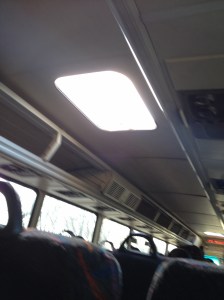
Now interstate buses aren’t like the school species. The windows don’t open. There are, however, two escape hatches in the ceiling. When I got on board I noticed immediately that it was a sauna bus. The last time this happened (and yes, this wasn’t a unique situation in my experience) passengers opened the escape hatches to create a breeze. Problem was, it was winter this time. The day was struggling to reach 40 degrees outside. As we hit the highway the wind was blowing full against those in my row and I learned what wind chill really can be. There wasn’t much traffic, so the bus was tooling along at about 65. I could feel my left eye beginning to freeze up. My book pages were flapping wildly in my blue-tipped fingers. The personal nor’easter cut right through my winter coat. In my row we were lined up like eskimos, all bundled up. There were no free seats to which we might move. I couldn’t reach the hatch to close it. Nobody said anything.
Here’s where the weirdness comes in. As I child I was raised being taught that true believers think of others first. Other people may not see it, but I consciously try very hard in subtle ways to make sure others get what they need before me. I’m learning not everyone necessarily thinks that way. If I had a degree in fluid dynamics I might be able to describe airflow on a speeding bus. Instead, let me put it this way: the guy who opened the hatch was sitting in the row in front of it, out of harm’s way. The icy blast didn’t hit him, but it did everyone behind him. Passengers tend to think of themselves first. I’m sure I do, too. Just trying to get home after a trying day of work is, well, trying. It’s just that some folks try not to do things that cause others pneumonia, no matter how warm they feel. But then, I’m the odd one, I know.
Spoiler Alert

I work in a cubicle. That’s just one word shy of the famed “six word novel” challenges. I’m wondering what qualifier I should add. To understand this dilemma you have to realize a few things. My first professional job (professor) included a three-room office to myself. Also, I am a middle-aged man amid a work-pool of mostly twenty-somethings (everyone else my age has their own office). My cubicle has walls six feet high, so I can’t see, but can hear my just-out-of-college neighbors. Very few people talk to me at work. In fact, I can go an entire week without anyone saying anything to me, right here in the largest city in the country. The office is generally very quiet. You can hear everything. This leads to my concern with a very specific peril regarding work in a cubicle.

Much of the meaning in my life comes from what I read. In addition to all the books I review here on this blog, I have quite a few fiction projects going at any one time. I happen to be reading a book just now that was recently made into a movie. The reason I know it’s been made into a movie? My unseen, 20-something colleagues began talking about it yesterday morning. Complete with spoilers. Now, they couldn’t see the contortions on my face, hidden in my cubicle. The people who sit next to me work in a different department than mine and I have no reason to speak to them—they don’t even know who I am. Should I, like the voice of God, thunder unseen from my cube, “No spoilers!”? Or should I just continue to sit here with my fingers jammed firmly into my ears and hope that when I pull them out I don’t learn anything more about what I haven’t read yet?

I know it’s just me. I don’t read the blurbs on a book before reading the book itself. I don’t read reviews of movies before seeing the film. Guys my age appreciate the craft of story, building up to the reveal, not getting it in Monday morning water-cooler talk. I finally got up and walked away from my desk. There’s nowhere private to go on my floor, so I went to the stairwell and pointlessly climbed to the top floor and back down again. I returned to my desk and they were still talking about it. Not only was it Monday morning in a New York City where nobody had spoken to me in the three hours since I arrived in town, but there wasn’t even a spoiler warning for one of my favorite pastimes. Such are the perils of cubicle life.


Great Communicators

Perhaps you’ve encountered it too. You’re in a major city. You’re in a hurry. The person in front of you is plodding along, staring at the device in his or her hand and you can’t get around him or her. You’re being held up by technology. I just want to get to the Port Authority before my bus leaves. The late Jonathan Z. Smith called cell phones “an absolute abomination.” I wouldn’t go quite that far—my bus pass, after all, is on my phone, and I’ve been saved from embarrassing conversations on the desk phone in my cubicle by being able to walk away and find a quiet corner in a corridor where I can talk freely—but I do see his point. While technology has had many benefits, in real life it can slow you down.

A news source I recently read said that heavy smart phone users are more prone to psychological problems than, say, those people who live raw in the bush of southern Africa. Phones isolate as well as connect. Instead of asking somebody for directions, you can turn to your monotoned electronic friend and find out. What you lose is the nuance of human communication. On my first interview in New York City—I was still living in Wisconsin at the time—I was disoriented. Which way was Fifth Avenue? I asked a stranger on the street and learned something in the process. New Yorkers weren’t the rude people I’d been told to expect. In fact, I quite frequently see strangers asking others for directions. I’ve never seen someone refuse to help in those circumstances. Although I’m in a hurry if someone asks me “which direction is Penn Station?” I’ll stop and try to help. It’s a people thing.

One of the distorting lenses of a large city is the acceleration of time. Many of us depend on public transit in its many forms, and none of it is terribly reliable. Being late through no fault of your own is part of the territory in a city like New York. It’s become harder to stay on time because of smartphones, however. A few years back I saw it with the Pokémon Go release. Groups of phoners wandering around, slowing the flow of foot traffic on sidewalks that are somehow never wide enough. If only I could communicate with people! How does one do that when they’re riveted to the device in their hand? I wouldn’t say they’re an absolute abomination, but I agree with the dear departed Smith that there are hidden costs to being so connected that we can’t talk to one another. I would say more, but I think my phone’s ringing.

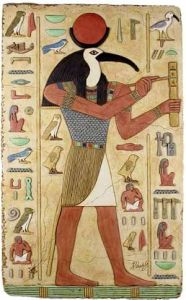
Even Thoth can’t help walking and texting.


March On

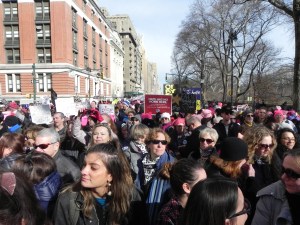
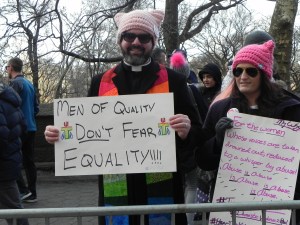
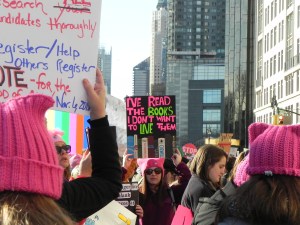
The day after the government shutdown, Women’s Marches were held across the country. Unlike the shutdown, these marches had been planned and anticipated in advance. They marked the anniversary of the Women’s March on Washington that spurred millions of people across the world into action just last year. I count it as a privilege to have been able to march with my sisters in DC last year, and yesterday again, in New York City. Religion gets a lot of bad press these days, but one of its truest aspects is that it invites you to participate in something greater than yourself. These marches are like that. They are all about social justice of the most basic kind. Not what divides us, but what brings us together. There may be historical reasons that women were kept from positions of leadership, but if we learn nothing from history’s mistakes we can call nothing we do progress.

It takes a lot to get me back to New York City when it’s not a work day. Nevertheless, the anticipation built along the way. Waiting for the train in Newark, we started to see pink hats at 8 a.m. on a Saturday. At Penn Station in New York they were everywhere. Strangers on the subway started conversations about the march, whether they were going or not. As usual, the program ran a little long and those who were near the stage grew impatient as they’d been on their feet for a couple of hours. Still, the messages were important to hear. Whoopi Goldberg was the star of the show this time, some might say, but all who stood up outside Central Park and gave voice to equality were stars.

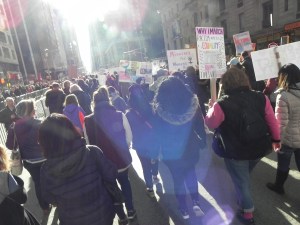
The march itself lasted only a few blocks down Sixth Avenue, but the crowds were enormous. Although I held no clever sign, I knew that simply by being a body to march was significant. You see, the Women’s Movement isn’t about excluding anybody. It’s all about redressing institutionalized wrongs that insist “somebody else” is of less value than a white man who’s been able to exploit his way to the top. This system is corrupt and dehumanizing to all. Women see that. Woman say something about it. Women march. Yesterday thousands across the country marched for equal rights. Our government, controlled by one party—the white men’s party—couldn’t even figure out how to keep itself open. The differences between these two views of the world couldn’t be more obvious. I’m humbled and honored to be included on the women’s side.


Street Clearing

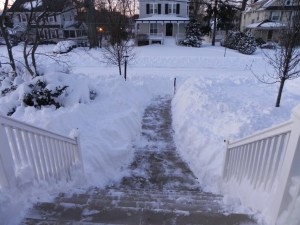
Not driving to work definitely has its advantages. Although studies suggest commuting takes a great toll on hapless riders, the stress of driving in traffic—more often just sitting in traffic—also takes its pound of flesh, and more. A recent snowstorm had me reflecting on this. Once in a while I like to demonstrate that the male of the species is worth keeping around, so after the Bomb Cyclone that closed schools and offices in the trial-state area a couple weeks back, I went out to brush off and start the cars. It’s not that women can’t do this, but it’s more the fact that nobody wants to do it that motivated me. Besides, I have a secretly fond memory of the years of enforced, Dr. Zhivago-esque labor on our Lake Erie snow-belt blessed driveway. My stepfather’s shack sat atop a long, unpaved driveway. Ironically, although he drove the borough snow plow, he insisted that we boys do the shoveling at home. Maybe that’s where I get it. A poor family, our winter coats were substandard and aching fingers and toes, not to mention frozen faces, were pretty typical. I hated every minute of it. Or did I?

Bundled up against the arctic winds that had brushed a noticeable breeze past my face the night before (in the present-day) when I climbed into bed, I stepped out in first light. Immediately the cold found the small gap between my gloves and sleeves and began to work it’s chilling magic. Before the powdery snow was even off the car my fingers were numb and painful, reminding me of an unfortunate frostbite episode as a child. Unconsciously I found myself smiling. I’m no longer forced to do this. Kindness is a far better motivator than hate. At least as a renter I didn’t have to shovel the drive.

Afterwards, inside an apartment that we all habitually decry as too cold, I quickly warmed up. There’s a pleasure in doing something so that someone else doesn’t have to. I miss that, working in New York City. Focused on getting to work, it’s far too easy to step past those for whom even a glance is a blessing. Those who sleep in cardboard boxes on nights like that through which I felt an annoying draft, although secure inside. I see the police “evicting” tenants of paperboard towns even as I glimpse Trump Tower in the distance. The storm they called a Bomb Cyclone. We clear the streets quickly so that we might get back to work and make more money for the one percent. Studies show commuting is killing us. It seems the cold is doing so as well.


The Grind

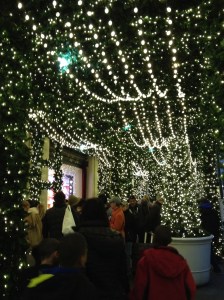
I’m headed back to New York City after a staycation of almost two weeks. Even shifting standard arising time back only an hour from 4:00 a.m. seems cruel and unusual punishment this morning. New York is a very different place to go for work than it is for play. Serious New Yorkers, of which I am not one, tend to avoid the fun places visitors go. Times Square is simply a venue from which the hike to work begins. Most of the buildings are gray and dedicated to the making of money. My thoughts go back to my one transgressive trip in over the holidays to see a show. How different New York was then! Ethereal lights, sublime music, and the magic of story. Today it will be unsmiling crowds surly to make cash flow again. The concrete underfoot today will be much harder.

When I come in with family I feel less cold. New York can be very lonely for such a crowded place. Indeed, it isn’t unusual for me to go for days with no one at the office saying a single word to me. That’s the kind of place Manhattan is. Too many humans to be humane. Unless you’re here to play. Such play is, however, costly. Magic never comes for free. The holiday lights will still be up here and there. Warm memories of the past few days will linger for a little while. Soon the steel and cement will be the only realities once again. Soft skills meet the cold razor of cash with predictable results.

It seems to me that I’m yearning for boyhood once again. Those first tentative years of learning about life are all misleading. Suddenly it dawns on you that good will is reserved for the holidays and the remainder of the year is dedicated to money and things others deem as important. The bus is approaching, but the last time I was in the city was for fun. Today I won’t even glance at the theater district as I dodge cars to get out of Times Square as quickly as possible. There will be the all-too-familiar lines at the Port Authority during rush hour this afternoon. I’ll leave work wondering how a city can possibly be so schizophrenic. Yes, I’ve been profoundly happy in New York City. I’ve also been ground down to the very nub by the exact same place. Such is the nature of a world where money reigns.


Let the Memory

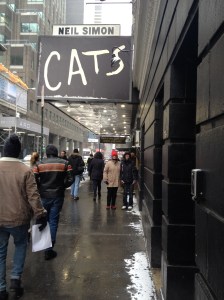
One of the rare and long-anticipated treats of being near New York City is the prospect of a live show. For practical reasons we don’t go to shows very often—years separate the occurrences—but once in a great while we manage to afford such a boon. Yesterday we attended the penultimate performance of the Cats revival on Broadway. The experience was transcendent. I’ve seen the movie version a number of times, and over the years I’ve caught a few live performances here and there. For whatever reason, this musical speaks to me. Although it doesn’t really have much of a plot—it’s more a series of vignettes—it is about redemption and being comfortable in one’s own skin. T. S. Eliot was a poet who knew spirituality intimately. Andrew Lloyd Webber, no one needs me to say, writes stirring music.

Cats, unlike many shows I’ve seen, requires athleticism as well as vocal ability. The performers are in nearly constant motion as they play out their roles, often with acrobatic flourishes. Most of the parts are for the young, while those dwelling on the experience of older characters—Gus, Grizabella, and Old Deuteronomy—tend to be recollections of youth as a commodity that slips away leaving as residue the wisdom that comes with age. It’s quite biblical in that respect. Even the old can appreciate back flips and double cartwheels and the grace of ballet. For this particular production the lighting stood out as an integral part of the story. Illumination, I might add, is a powerful metaphor.

In our family discussions afterwards, comparison with other versions dominated. Although my wife and I saw a community theater production long ago (placing us, I reluctantly suppose, in the ranks of the older characters), our main introduction was through the filmed adaptation. Again, like the Bible, we tend to think of canonical versions. This is how it should go. Because of both its running time and its demands on the players, not all vignettes are included in each production. The character who narrates the story may change. Choreography is adjusted. Each show, as is the case with live theater, is a little different. Standing in the snow on a cold, New York City December afternoon awaiting the opening of the doors, we wondered what would be changed. The original Broadway run had ended while we lived in the Midwest, so this was both our first exposure but also our fourth rendition over the decades. None, it turns out, could be called canonical. That, however, took nothing away from the inspiration of the event unfolding before our very eyes.


In Control

Those who know me know that I treat my workdays like clockwork. I leave the apartment every day, catch the same bus, and leave work at the end of the day, all according to schedule. Traffic is a variable, of course. Yesterday as I came out of the Port Authority Bus Terminal at 7:15, blunted with my reading on the bus, I noted we were a bit late for my liking. I got to work before 7:30, though, and was interrupted by a message from my brother, asking if I had made it out of the Port Authority okay. I was a bit confused—weather delays do happen, but what could have made today any different than any other Monday? It was then I learned about the bombing. It happened five minutes after I left.

Now, I’m not trying to over-dramatize this. I was above ground and the bomber was below. I didn’t even hear it go off, although there were a lot of sirens on my way to work. The only serious injury was to the bomber himself. What really got to me, when the idea had time to settle in, was how close I’d been. So were thousands of others at the time. Over the summer I went to Penn Station just after what had been assumed to be a terrorist attack. Jackets and personal effects lay scattered on the floor. People had dropped things and ran. In that case it had been an innocent tazing of an unruly passenger that had set off the panic. I’m not a fan of fear on the commute. I don’t think, however, that we should give in to the rhetoric that our government will surely use to describe all this.

Millions of people live and work in New York City. Such things as these disrupt the flow of our daily lives, but we can’t let the agenda of fear control this narrative. I felt a tinge of it when I headed back to the Port Authority at the end of the day. Police barricades were still up on 8th Avenue. Reporters with cameras were at the scene. A potential killer had been here just hours before. This is New York. Without the overlay of fear, this was simply business as normal. Any city of millions will harbor potential killers. If terror controls the narrative, it has won. If politicians use this fear to win elections, the terrorists win them too. I’m doing what we must do to defeat the fear. I’m just getting back on the bus.


Popularity for Purchase

I only watch the Macy’s Thanksgiving Day Parade with one eye. Since my office is just two blocks from the store, it’s a little too much like work. Still, I can’t help but hear the music and announcements. Is it just me, or are most of these floats and balloons trying to sell me something? Okay, so it takes a while for the light to dawn—it is Macy’s parade, after all. This is the kickoff to the holiday shopping season. Santa Claus is the greatest shopper of them all. We are a nation that defines itself not by what it can produce, but what it can consume. Conspicuous wealth. Showing what you’ve got. I’m afraid I just don’t get it.

Those of us who grew up poor, so the thinking goes, should want to display our accomplishments like a peacock. We should want to show others that we’ve made it. That we can play the spending game just like everybody else. We’ll always have the poor with us, so why not demonstrate to them the vapidness to which they can aspire?

An old-fashioned guy, I check my email on a computer. Gmail divides my messages up into three tabs so that I can pay attention to people who actually want to contact me. The third tab is reserved for those seeking my money. Sitting in a waiting area, I decide to check my email on my phone. It says I have close to two-thousand messages. It’s that third tab. I tend to ignore it since I already know what everyone wants me to play. The messages in tab three build up to biblical proportions while I try to figure out how to handle all the other things I have to do.

Not only did I grow up poor, I was also a small guy. That meant when teams were being picked in gym class I was always among the last selected. I’m not aggressive. The indigent know their place. My religion taught me that this was about right. Seeking for one’s self instead of for others is wrong. Although I’ve been through advanced training since then, those early lessons remain with me. When those who have goods to offer discover my email address, they crowd it full, hoping that I’ll be one of many to spend the little I earn on them. Instead, I remember standing on the vacant lot while the neighborhood kids are dividing up into teams. The lines are getting small, and I’m awaiting someone to notice my potential. Of course, they’ll have to wait until I get through all of this email because, in reality, I’m obviously quite a popular guy.


Eclipse 2017

It’s the day after the eclipse. Perhaps it’s because of the internet, but the excitement about this somewhat common event reached a fever pitch. Maybe it was because we all wanted something other than Donald Trump to talk about. Maybe it was because we hoped that the eclipse might have brought about some profound change. In the days before science was a thing, eclipses were divine events. The sky doesn’t darken at noon. It is an uncanny, an eerie thing. The last eclipse—alas, only partial—that I experienced was at Nashotah House. My wife was still a student in Illinois at the time, and without her to remind me, I went about my classes as usual. When I stepped outside the eclipse was already in progress. Nashotah’s quite rural, but the birds and insects were silent. The light was weird. The shadows of the leaves were scooped crescents on the ground. I could understand why pre-scientific people trembled.

These days we know there’s nothing more to life than scientific formulas and a bit of sloppy chemistry. So why do we bother getting bothered about eclipses? The fact is they remain religious in our minds. This is nature acting in a way not normal. Apocalypses generally include the sky growing dark. One of the plagues of Egypt was darkness. In the ancient mind the sun did not so much cause light (the moon could give light too) but it lived in the realm of light. If something blocked the sun that was one thing. If something invaded the realm of light, that was another. An eclipse was such an invasion. Even as monotheism began to take hold, people thought of the sun as a deity. It, after all, directs our lives.

In New York City I wasn’t sure what to expect. I went to street level with a couple of colleagues about 10 minutes before maximum coverage (about 71%) began. Knots of people stood on the corners on the eastern side of Madison Avenue—those who build skyscrapers don’t think of eclipse viewing on the streets below. What struck me most, however, was a kind of peace and awe. Strangers sharing various viewing devices with each other and looking up expectantly. Clouds had begun to move in, and I found myself talking to complete strangers, sharing out the eclipse-viewing glasses my wife had given me. We were participating in a moment of transcendence. Such moments are rare today. No, an eclipse is more than simply the moon moving in front of the sun. It is a human event as well. And one which, in the absence of the sun, brings out the best in us.


Miracle on 34th Street

It smelled like Christmas. I was out of the office for a rare lunchtime errand, and I had just turned the corner from Madison Avenue onto 34th Street. It hit me like childhood—the scent of pine. I couldn’t believe it as I looked ahead. Wreaths lay piled up on the sidewalk. At least a dozen newly harvested trees were leaning on a makeshift frame along the street. Long disused store windows from B. Altman’s were fully decorated with Christmas scenes. Five minutes later, after my errand, I walked through the scene again. Tourists were snapping photos to paste on Instagram, Snapchat, or Facebook. Clearly the people responsible were getting ready for the holidays extremely early even for money-grubbing New York. Of course, it was all a set for a television shooting. Working in Manhattan is like being on a movie set most of the time.

It isn’t at all unusual to walk through the line of trucks and trailers parked along one of New York’s lesser used cross streets on my way to work. I see set artists working to make a store front look as if a fire had recently broken out there. Famous people lurk inside their trailers until handlers can get them out and away from hoi polloi. We’re all actors here. This isn’t an authentic existence. As I walk through today’s Christmas set, I step past the homeless with their grocery carts full of their worldly possessions. They’re the only ones on this street who aren’t actors.

I’ve been working in Manhattan for six years now. The dizzying extremes of wealth and poverty juxtaposed hard up against one another is disorienting. We would rather live in a fantasy world than help those who are suffering in real time. Yes, there are people who dwell in hells of their own making. I’m not naive. I also know that we create hells for those we don’t like. Those who “underperform” or who don’t value mammon as much as a red-blooded American should. We cast out those who have mental problems and politely ignore them as they rage on the street corner. We do, after all, have to get to work. New York is an experiment in which the virtues and vices of humanity are concentrated and magnified. We then project it onto the silver screen for all to see and covet. But just off the set there are hurting people. They won’t appear on the camera, but they’ll be there after the crew is gone. If we wanted to, amid all these trees and wreaths, we could find a way to help them. We could make this world a better, more authentic place. It’s my Christmas wish that we will.


Bull

Bulls have long been symbols. If I write “that’s bull” your mind will likely fill in the missing implied word. In ancient times the king of the gods, El, was known as “bull El”—probably for a very different reason than the veiled scatological reference above. Bulls were powerful and, to those in settled, agrarian societies, necessary for life. Of course, they can turn on you and kill you with little thought. Even in our high-tech, urbanite world, we keep our bulls at hand. “Charging Bull,” a golden calf if there ever was one, is a famous Wall Street statue erected to the glory of mammon and greed. On May 7, to celebrate International Women’s Day, a statue called “Fearless Girl” was placed in front of “Charging Bull.” Our symbols require some reevaluation. In a kind of Trump-up, another artist placed a statue of a dog lifting its leg on the girl, according to the Washington Post.

We creative types can be sensitive about our work. Apart from writing I’ve dabbled in drawing, painting, and sculpting, although few have seen the results. I know that the space around an artwork is part of the art. I’ve posted before about Grounds for Sculpture, one of my favorite places in New Jersey. The idea of a sculpture park is that the context of the image is important. Statues show up fairly frequently in New York City. The ever-changing art along the pedestrianized part of Broadway in Midtown keeps the walk to work interesting. Interacting with art is performance. At the same time, the respectful viewer knows, artists are making a statement. Placing a girl before a charging bull says so very much.

“Fearless Girl,” unlike the great lummox she faces, is temporary. Nevertheless, the statement she makes is loud and clear. Wall Street might more aptly be named Ball Street for the amount of testosterone that surges through the place. Men erected a system to keep women out of positions of power. And even when a small symbol of female resistance is placed, some man has to have a pug pee on her. I wonder what our society’s become. We’re hardly agrarian any more, yet we still feel “bullish” about things. When’s the last time anyone used “girlish” as a compliment in a business context? “Fearless Girl” will be allowed to stand until February. The pug is temporarily gone, but will be back. When the girl goes the pug will follow. All that will be left in Bowling Green Park will be bull.


Earth vs. the GOP

They used to call her “Mother Earth.” Now she’s simply a commodity to be liquidated into cash at the country club where rich white men play. That’s why I’m spending Earth Day on my third protest march of the year. Of all the things the Republican Party has done to show its true colors the clearest has been to participate in the destruction of the world we all share. There’s only one word that answers the question “why,” and it used to be considered one of the seven deadly sins. Greed. These acts of planetary terrorism are carried out by men who believe lining their own pockets is the highest possible good. Even moderate Republicans have locked in their goose step to keep in the good graces of madmen who want to cram as much lucre into their coffers as they can before they die. When the planet’s a smoldering ruin their grandchildren will surely thank them.

Son, behold thy mother.

Don’t knock tree-hugging unless you’ve tried it. Trees tend to be much better company than Republicans anyway. Never have I had the feeling that I’ve had to celebrate Earth Day with such a blend of angst and anger. That one that your teacher always warned you about—the one who ruins it for everyone—now has control of the country. Immediately he insisted we start dumping coal waste into our streams and rivers. Burn more coal so he can play a few more holes with what passes for a clean conscience in a filthy soul. I march because I must. We can’t sit silently and let the darkness fall. If you can see through the coal dust you’ll understand that the planet weeps. It’s her that we celebrate today.

Matricide used to be considered a heinous crime. Now it’s just good business. If we were an honest species we’d admit it’s been bad business from the beginning. We’d never elect a businessman with inherently conflicting interests to the White House. The goods of the few outweighs the good of the many. The commodification of nature is the worst kind of unnatural selection. Here science and common sense agree—in order to survive we must preserve our planet. I confess that I’m unapologetic in this regard. So, although I’ll be spending this Earth Day in the artificial environment of Manhattan, marching in the cause of science, and if push comes to shove I’ll be the one hugging a tree.


Ode to Hubris

One-hundred-five years ago today, one of modernity’s great achievements sank alone in the icy waters of the chilled North Atlantic. While the ultimate cause of Titanic’s demise may have been an iceberg, the proximate cause was surely much more common. Human arrogance, we’re reminded daily, never learns its lesson. Despite what elected officials tell us, arrogance at the top will always lead according to its surfeit of self-confidence. After all, there are no icebergs this far south so late in the year. It seems that we’ll never forget Titanic and the hundreds of needless deaths, but somehow we’re not very good at transferring the lesson to other media. Let me give just a small example.

Yesterday I was in New York City. My family came during the day to celebrate my wife’s birthday. One of the benefits of New Jersey Transit is that after 7 p.m. on a Friday, a monthly bus pass also works on the train. I can meet up with my family after work and we can ride home in comfort instead of taking the bus, such as I usually do. We didn’t know that at 3:30 that afternoon a train had broken down in one of the limited number of tunnels under the Hudson. (Governor Chris Christie had famously stopped work on another set of tunnels to ease the commute.) About twelve-hundred passengers sat for an amazing three hours with no lights, air conditioning, or announcements. No trains could make it into New York’s Penn Station. When we arrived, oblivious, just before 7 p.m. there were people pouring out of the station. Coats and clothing were strewn all over the steps, as if the homeless had been raptured. The police told my wife and daughter not to go down. A few minutes later they said, “Definitely no shots were fired.” When we got to the platform all the monitors read about half-past five. Discarded clothing was everywhere. It was only when we finally got on a train that we learned that in the anxious terminal where crowds were restless, Amtrak police had tazed a man. People thought shots had been fired, and panicked. The video taken by those in the station shows people running, dropping clothes, luggage, and shoes in their haste to flee. Just after this, we’d arrived.

Titanic, it seems to me, is about building something so massive that it can’t be controlled. Human arrogance is like that. This week we heard about United Airlines security beating up a passenger to make room for company employees who needed to be on an oversold flight. Just a couple weeks back another New Jersey Transit train derailed in Penn Station, disrupting for days the insane commute some of us undertake daily. Who’s the captain of this ship? Oh. But we don’t have to worry. There are no icebergs this far south this late in the year.


Jericho

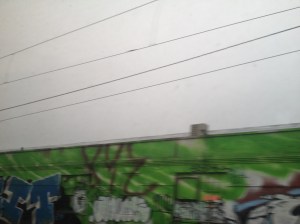
Those who think walls actually keep people out have never ridden the train through North Philadelphia. Or into Newark. I have to admit that I’ve always found rail-side graffiti aesthetically pleasing. Some of these vandals are real artists on a scale that is truly impressive. Speeding trains are, of course, dangerous. And in urban areas they are fenced off to keep people out. Thing is, walls don’t work. Riding to Washington DC for the Women’s March a couple weekends ago, I was watching the graffiti on the way into Philly. Vast, colorful, and with a flair for design, it makes the usual visual fare for railway riders much more interesting. Buildings, we know, have facades to be public facing. If you go around to the back of the strip mall, things look a lot more spartan indeed. I’ve spent my fair share of time in employee break rooms. Executive washrooms they’re not.

The thing about facades is that they’re fake. Like in those old westerns where we see them jutting up higher than the actual roof of the store or saloon, making them look bigger than they really are. Or even a small town boy who works in Manhattan can see it. Walk down the avenues of Midtown and the glitz is never-ending. Once you get to the minor cross-streets you see the service entrances and smelly trash bags stacked in the alleys. Would you want to enter that store if you knew what was coming out the back? We prefer our self-deception. We prefer to call our lies alternative facts. We can sleep better at night that way, knowing that our heads of state are so so brutally honest. Just don’t wander behind the cameraman. Things aren’t what they seem.

img_3171

To get to New York City from where I live, you have to change trains in Newark. The graffiti along the way is intense. Long ago I noticed a signal hidden in the noise. “Paint the Revolution” it reads. Or read. I don’t know if it’s still there. Graffiti’s often the bare truth. The thing is, it’s difficult to photograph. Trains move fast and phones focus slowly. Things look blurry and those in power can tell us the words of hoi polloi are ugly and defacement of property. Have they ever walked behind the building to where the workers come out? It’s easy to find. If you smell the piles of garbage you’re getting close. Executive washrooms they’re not. But the back door is far more honest than any facade.