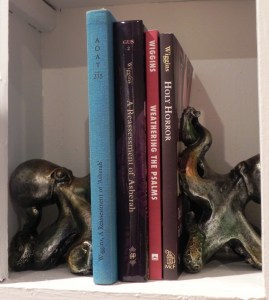
Speaking of X

The project that ultimately led to Holy Horror and Nightmares with the Bible was an article.  Intrigued that the quasi-horror Fox series Sleepy Hollow was so solidly based on the “iconic Bible” in its first season, I wrote an article on how the Bible functioned in it.  After that was published I realized that there was plenty of material for a book on how the Good Book appears in horror films.  That book, of course, appeared late in 2018.  Nightmares with the Bible was a kind of sequel, but moving in a different direction.  It looks specifically at how ideas about biblical monsters (demons) are mediated through horror films.  This post isn’t all an introspective about past projects; in fact, it’s about present watching.
At one point in my research I noted that the X-Files wasn’t as biblically based as Sleepy Hollow.  I stand by that assertion, but my wife and I’ve been rewatching the X-Files on weekends for several months now.  Nearing the end of season two I’ve noticed just how often the Bible appears in it.  Unlike Sleepy Hollow, where the entire story was premised on (largely) the book of Revelation, the X-Files has multiple episodes that focus on religion.  What we might call New Religious Movements feature in some of the vignettes while others posit older, hidden religions.  The Good Book appears visually many times, or, and it’s often quoted, even if not shown.  Although some of the episodes are lighthearted, many of them are played as straight horror and address the question of the reality of evil.  I hadn’t been alerted by Sleepy Hollow the first time we made our way through the X-Files, but if I had more time, and if anyone were still interested, there’s a book in this.

Ironically, even in the light of a political party that takes its energy from a religious base, universities are no longer interested in the study of the subject.  I have no reason to believe that these two television series are isolated instances that I’ve just stumbled across.  American culture is biblically based, no matter how secular it may be.  To my way of thinking, when something like the Good Book has such a strong influence, the response of the rational should be to try to understand it.  I know what biblical scholars do all day; I used to be one.  Only in recent years have some of them begun to turn toward the concept of the iconic Bible and to consider how it influences American thinking.  I can only do this on a small scale, in my free time.  What I see, however, like a good X-File, defies explanation.

Poe’s Demons

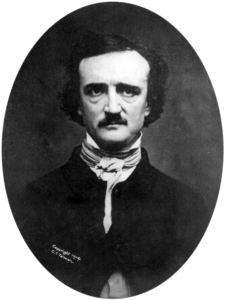
In Nightmares with the Bible I use an idea penned by Edgar Allan Poe as one of the threads holding the book together.  One early reader complained that Poe didn’t write about demons, so the use of the great man was inappropriate.  That reader misunderstood me.  Today is Poe’s birthday.  As I think about the influence a writer can have on a young mind, I come back to this reader’s comments.  I can’t think of my book without Poe.  No, Poe did not write about demons, but he set the stage for what I’m trying to do in my book.  I’ve read analysts who claim Poe wasn’t a horror writer.  Certainly in the modern sense that’s probably true.  Still, he, like many others, was brave enough to suggest the tenebrous side of life was worth exploring, even if you only had a candle.  

Poe’s monsters were often interior.  They were psychologically probing, and although Sigmund Freud had not yet been born, it’s not inappropriate to say that Poe explored psychology.  Writers, I suspect, often deal with things they can’t name.  This is the way knowledge moves forward, even with fiction.  Especially with fiction.  As I’m reading books by academics who’ve done well for themselves, I often reflect how their legacy will remain within their field only.  It’s the rare nonfiction writer who manages to reach a cultural status that will find readers from other disciplines.  Most of us, however, will admit to reading a novel or two now and again.  Fiction writers, such as Poe, can claim things without backing them up with footnotes and citations.  That doesn’t mean they were any less astute at observing the world than academic writers are.  Often they’re more so.

I didn’t put Poe into Nightmares to show off.  His work has long been in the public domain.  I don’t cite him to claim that he would have agreed with my use of his insights.  No, I cite him because even if he wasn’t a horror writer my early encounter with him started me on a path of exploration.  Poe had trouble getting along in a literary world where rejection was endemic (it still is, I know from personal experience) and making a living as a literary person was unheard of.  He nevertheless knew that fiction was more honest than the alternatives, at least for some of us.  If we wish to face the world with integrity, we should admit that our heroes may have been made so in our own minds.  That doesn’t make them any less authentic, just because we’ve appropriated them for our own purposes.  We borrow what we find meaningful.


Strange Powers

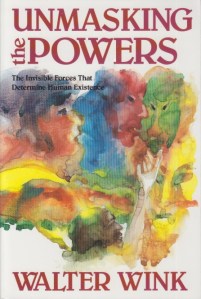
Some books take you to strange places.  Not all of them are fiction.  I began Nightmares with the Bible as a way of understanding the many, disparate ideas of demons I encounter in popular culture.  (I can’t tell you too much about my conclusions, otherwise you wouldn’t be tempted to buy the book!)  One of those nagging questions is: what does “based on a true story” mean?  I’ve known of Walter Wink’s powers trilogy for many years.  Because of my research I’ve now settled down to read Unmasking the Powers (number two, for those keeping count).  This book will take you into strange places.  Wink was very much a Christian in his outlook and orientation.  At the same time, he raises questions I’ve had other Christians put to me—were the “gods” of other nations, as in the Bible, real?  That word real is slippery, and Wink tries to hold onto it.

Unmasking the Powers is a kind of systematic exploration of the various “spirits” found in the universe we inhabit.  One of these is the Devil, and although Wink doesn’t see him as necessarily a “being,” neither does he find the Bible making him entirely evil.  Indeed, one of the great conundrums of monotheistic belief is theodicy; how is it possible to justify the goodness of a single, all-powerful deity in a world with so much suffering?  Wink approaches this question from an angle we might not anticipate.  He then deals with demons.  Since this is my subject in Nightmares, I found his discussion apt.  And yet again, strange.  Powers emanate from the institutions we create (you might have correctly guessed this was the book I wrote about on Tuesday).  Wink is willing to challenge materialism and take such powers seriously.

Finding a new perspective when we’ve been reared in a materialistic one, can be difficult.  For those of us raised religious, there was an inherent schizophrenia involved.  Our teachers told us of a mechanistic universe, but had Bibles on their desks.  (Yes, this was public school, but let’s not kid ourselves.)  While physics taught us everything could be quantified, church taught us that spirit couldn’t.  At least not by any empirical means.  Wink will unblinkingly take you there.  He offers both scientific and spiritual points of view on these entities, although he tries to refrain from calling them such.  Still, he records many people who have seen angels.  And although quantum entanglement wasn’t really known when he wrote this book, if it had been, Wink would’ve been nodding his head.


Hereby Resolved

Photo credit: chensiyuan, Wikipedia Commons

New Year’s resolutions have never been my thing.  Having had a good Calvinistic upbringing, I’m a natural self-corrector.  If I’m aware I’m doing something wrong, I attempt to change my behavior right away.  This makes annual reviews at work exceptionally uncomfortable for me.  I’d much rather have my boss point out foibles as they happen so that I can stop doing them right away.  I realize my mindset here may be weird to those who were raised in more normal ways, and employers love process.  So I sit here in Ithaca on New Year’s day, preparing to drive home to face all kinds of unfinished business from 2019.  I’m still doing research for Nightmares with the Bible, thus it’s not ready to go back to the publisher or series editors yet.  I’ve started a new round of queries to agents about one of my novels, but I haven’t sent them yet.  And don’t even mention projects that need to be done to the house.

Life is busy.  I’ve taken on some new duties at the church I attend, exemplifying that old saw “If you want something done, ask a busy person.”  As the pressures from that obligation mount, I start to think that most people don’t have any idea just how all-consuming writing a book can be.  I work long days and although I don’t commute much any more, most of the rest of each day is taken up with writing and reading so as to write some more.  I hesitate to call myself a writer since I make laughably little lucre from it.  I can’t stop myself from doing it, though.  And although it’s the season for resolutions, I don’t plan to stop.  I know from work that graphomaniacs can be a problem.  Anything can be overdone.  On days when I don’t have to work I have to be pried away from my computer.  Otherwise I’ll write all day long.  It’s an issue, I know.

Perhaps because life on the national scale is so depressing, writing about things like horror movies is a great release.  I’ve been so busy lately that I haven’t had the chance to write pieces for venues like the excellent Horror Homeroom.  I used to contribute to Religion Dispatches.  That time has been sucked into getting my books that nobody will read finished.  Having written that self-disparaging remark I have to remind myself that one of my alumni magazines published a notice about Holy Horror without me having to send said notice personally.  That self-disparaging thing requires some fixing, I guess.  And were I not too busy already in 2020, I’d start on it right now.


2019 Books

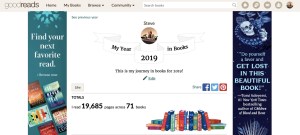
  Goodreads is always a little eager to put the tally on a year’s worth of reading.  This year, however, since I’ve been engaged in some larger books, they may be on target.  According to their count I’ve read 71 books this year.  (I re-read two, so my personal count is 73.)  New Year’s Eve, for me, is a time to reflect about what I’ve learned in the past year.  Much of that involves books I’ve read.  A good deal of my reading has been for Nightmares with the Bible.  To write a book you need to read books.  Frequently it means taking them on regardless of your mood—and I tend to be a mood-driven reader.  So what books stand out from 2019?  (They all have individual posts on this blog, in case you missed them.)

My first nonfiction book of the year was Christopher Skaife’s The Ravenmaster.  Animal intelligence always makes for good reading and this was reprised in Jennifer Ackerman’s The Genius of Birds.  I’ve fallen behind in my Frans de Waal reading, though.  Of the many research books on the Devil and demons, Jeffrey Burton Russell’s Mephistopheles stands out.  Russell’s clear thinking and wide view make him a pleasure to read even on unpleasant subjects.  Other books in that category didn’t quite rise to his level.  Monster books, on the other hand, rocked.  I loved James Neibaur’s Monster Movies of Universal Studios, Mallory O’Meara’s Lady from the Black Lagoon, and Kröger and Anderson’s Monster, She Wrote.  These were all excellent.  Tipping toward the unusual, Guy Playfair’s This House Is Haunted and Jeffrey Kripal’s The Flip gave me pause for thought.

Perhaps because I was reading longer books, this year didn’t have fiction in the numbers I usually strive for.  Most of it was quite good, though.   David Mitchell’s Cloud Atlas was memorable and Italo Calvino’s If on a Winter’s Night a Traveller (strangely similar to Mitchell) became an instant favorite.  My young adult fix came through Christy Lenzi’s Stonefield and Lois Lowry’s The Giver.  Victor Gischler scored with Vampire a Go-Go and Cherie Priest made a fine impression with The Toll.  I mentioned Neal Stephenson’s Fall yesterday, but it will stay with me into 2020.

A couple of memories/biographies also made deep marks on my mind.  Anne Serling’s As I Knew Him brought me close to Rod Serling and Barbara Taylor Brown’s Learning to Walk in the Dark found me where I live.  America’s Dark Theologian by Douglas E. Cowan isn’t really biography, but it was thought-provoking (as his books always are) and increased my resolve to read some more Stephen King.  The books I read make me more myself.  At the end of each year I think back over it all.  And this year I pondered what got me through a difficult 2019.  I have ended the year more myself than ever, I suspect, and I looking forward to a reading through the new decade.


Writing Prophets

So I was sitting at a table with two writers I’d just met.  It was at the Easton Book Festival and since I’m new to the area I was very aware that I didn’t know anybody.  I was also aware that my book, Holy Horror, wasn’t on anybody’s radar screen, despite it being mid-October.  As we were talking my two interlocutors mentioned the advances they’d received for their books, one of whom was able to buy a house with said advance.  As I listened I kept my mouth shut, because that’s polite, even though my jaw was slack.  The other person hadn’t been able to buy a house, but after writing on a topic so obscure I can’t remember it, had been able to do something noteworthy with the advance.  My royalties from Holy Horror wouldn’t have covered the cost of this dinner.

In the weeks following the festival—always busy with AAR/SBL looming, then Thanksgiving, then December—I began some soul-searching.  What was I doing wrong?  I also did some web-searching.  One of the articles that came up, written by a business writer, suggested pulling up your socks and getting to it, demanding money for your writing.  I don’t see anywhere to put a coin slot on this blog, which is more of a labor of love than anything anyway.  Then the kicker came.  This business writer cited Hosea 4.6, “My people are destroyed for a lack of knowledge,” as the basis of why people would pay for content.  Now pardon me for taking things a little literally, but I doubt Hosea was in the business of giving business advice.  The knowledge people lack, in context, is knowledge of Yahweh.

Now here I was back on familiar territory.  I’ve taught classes on Hosea, and this intriguing prophet was commenting on Israel’s lack of knowledge of God’s ways.  There were some folks akin to prosperity gospelers back in the pre-Gospel days, suggesting that if you kept God happy rewards would roll your way, but history had other plans.  Israel fell to the Assyrians shortly after Hosea’s time, his writing advice apparently unheeded.  As I revise Nightmares with the Bible for publication—the reviewer felt it was too tradey—I have to wonder about my conversation back in October.  Neither book of my conversation partners was one of broad appeal.  In fact, the second was rather technical.  They had, however, been paid for their work.  Academic publishing is built on the paradigm that the writer already has a university job and doesn’t need the money.  Hosea also said, if I recall, something about what happens if you sow the wind.


Seasonal Reading (Not)

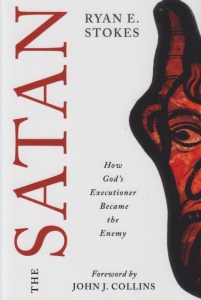
I might excuse writing a post on Satan on Christmas Eve by positing that I misread the title of this book as Santa.  After all, as Ryan Stokes explains, the Greek form of the title is ho satanas, which clearly contains the first of the canonical tripartite “Ho, ho, ho.”  The reality, however, is that work on Nightmares with the Bible continues despite the holidays, and there’s so much reading to do that not all of it can be seasonal.  I’ve known about Stokes’ book for some time, even as I’ve known his name through his various articles about the Satan.  This book, while not exhaustive, is certainly comprehensive for the time period covered and lays considerable groundwork for future discussions of the Devil.  What becomes obvious working through it, however, is that many different ideas about the Satan are represented in the Bible and related literature.

Long ago, as far back as my dissertation, I realized that it’s a problem for modern readers to systematize what ancients viewed disparately.  The Bible has no single idea of the Devil.  We’re quite accustomed to saying that “Satan” (which Stokes shows may not be a name in the Bible) and “the Devil” and Lucifer are all synonyms.  That’s not really the case.  Ancient peoples had many names for beings that caused problems, but not all of these entities were evil.  Belial, Mastema, Melchiresha, Beelzebub (and the list could go on) were designations used by different groups at different times.  These entities are sometimes agents of Yahweh, doing God’s will.  At other times they seem to be enemies of God, adversaries.  “Executioners,” is Stokes’ emphasis in these roles.  In early (and more recent) attempts at systematization, readers have tried to roll these various images into one.  With but limited success.

Ancient peoples didn’t feel the necessity that more modern ones do to make everything fit “scientifically.”  After all William of Ockham hadn’t shown up yet to suggest complicated ways of explaining things should be simplified.  We get the sense from reading ancient texts, including the Bible, that lots of ideas were floating around as to who these nasty beings might’ve been.  And their nastiness was really the result of human perceptions of who they were because often they were in league with the Almighty.  Theirs was not a simple, binary world of black and white.  It was more like a photo that we would still designate by that term but which is really grayscale.  Grayscale shades from white to black with the chiaroscuro preventing simple explanations.  Although it’s not about Santa, this book is very informative and will raise any number of questions at any time of year.


To Be Continued

I’m about in the middle of Neal Stephenson’s Fall: Or Dodge in Hell.  I’ve also just about finished Walter Wink’s Naming the Powers.  At the same time I’m revising the draft of Nightmares with the Bible, which will become my fourth published book.  While doing all of this at the same time (and working about nine hours a day), it occurred to me that to really “get” an author you should theoretically read her or his oeuvre from start to finish.  Ideally, to trace the arc of thought, you shouldn’t leave anything out.  The reason that this is as important as it is futile is one of the nagging problems that came to me while working on my doctorate: how do you know what a source you’re citing is really saying?

Pardon my nihilism, but this is an important matter when it comes to academic practice.  Academics cite many sources, and often miscite them.  I’ve seen it regarding my own work.  One scholar argued the exact opposite of what I published in an article and even made the point that he was building on what I’d stated.  Clearly he was digging where I’d been building or vice versa.  We were going in opposite directions and what I’d written was to undermine what he was arguing.  The thought came to me now because both Stephenson and Wink are the writers of many volumes.  I need to cite my sources, but it’s clear that the books are merely slices of lifetimes of thought.  Academia wants you to show your work, but its dated even before you press the “send” button.

I’m not knocking scholarly process.  It’s the best system we’ve come up with for getting near to the truth.  Since no one person has the entire truth, however, we get closer still if we follow a writer from start to finish.  Those of use who use pseudonyms in order to keep our day jobs only complicate things.  Our works (which we hope will outlast us) are only fragments of a larger world of thought that goes on behind the writing of books.  And what about weblogs, or “blogs”?  The million-plus words on this one are a stream of consciousness that weave within, behind, and outside of the books, articles, and stories I write.  Some writers make bold as to attempt biographies of other writers.  Some try to read everything said writers wrote.  Even so they’re only getting part of the picture.  To understand where a writer’s coming from requires more commitment than we’re likely willing to spare.  Now, if you’ll excuse me, I’ve got some books to finish.


Honest Labor

When an artisan begins a new job, s/he must acquire the tools of the trade.  During a period of unemployment I seriously considered getting certified as a plumber.  I’d done some plumbing repair and, unlike many people, I wasn’t afraid of it.  (I am, however, terrified of electrical work.)  When I was looking into it, it became clear that there would be a significant outlay of tool purchasing up front.  While all of this may seem obvious, people are often surprised to learn that writing books also involves tools acquisition, although it generally pays far less than plumbing. The tools used to be made of paper, but they can wrench pipes apart and rebuild a bathroom from scratch.  I’m referring to books, of course.  In order to write books you have to read books.

Long ago I gave up on trying to read everything in an area before writing.  There’s just too much published these days.  When I was teaching and actually had a modest book allowance I would attend AAR/SBL only to come back with armloads of books that I needed for my research.   Of course I had the backing of the seminary library as well, so I could find things.  As an independent scholar doing the same work, however, you have to do a lot more tool acquiring since no library will back you up.  Nightmares with the Bible came back from peer review with a standard-issue academic who wanted me to “show my work.”  (I.e., document everything.)  Apart from slowing the book down (it is written), this also means acquiring tools.  AAR/SBL always reminds me of just how much is being published these days and that my toolbox, although already quite hefty, isn’t nearly big enough.

As I’m going through Nightmares rewriting and adding footnotes, I’m discovering more and more material that could be included.  As an editor myself I try hard to keep to assigned word counts, and the entire allotment could easily be taken up by bibliography alone.  I am very modest in my spending at conferences now—independent contractors have to be.  Nightmares will likely be my last academic book; I can’t afford to keep going like this.  I don’t plan to give up writing, of course, just academic publishing.  Both this book and Holy Horror were written for non-specialist readerships, to showcase my non-technical way of explaining things.  Both ended up with academic presses and are slated to be among those specialist tools that the beginning artisan covets but for which s/he has to budget.  And when this house is finished it will have an impressive, if most unusual, private library.


Author Revise Thyself

Monster fans may have noticed that, despite the season I haven’t been writing much on the topic.  One of the reasons for this is that I’m in that dread stage known as “revision.”  As an editor I often see book proposals—or even entire books—that have never been revised.  You can tell.  I learned this while writing Holy Horror.  If you’re one of the people who took out a second mortgage to buy a copy, the book you purchased was based on a manuscript rewritten thoroughly at least five times.  The idea is that like rocks in a river, all that pouring over a text smooths the words like stones over the millennia.  Few rocks emerge from volcanic or sedimentary situations as smooth and round.  That takes revision.

My peer review report for Nightmares with the Bible came in a few weeks ago.  Nightmares had been revised a couple of times, at least, before I submitted it.  I understand the review process very well, as I deal with it daily.  Sometimes single blind (the writer doesn’t know the reviewer’s identity), other times double blind (neither reader nor writer know the other’s identity), the process is meant to provide feedback on a manuscript.  Having written many more manuscripts than have seen publication, I know just how useful peer review can be.  Like anything, however, it can also be treated legalistically, as if the reviewer knows more about a subject an author has just spent years researching.  No matter your impressions about this, once the reports come in, revision is in the cards.

Self editing is difficult.  And occasionally embarrassing.  You read again what seemed to make sense to you at the time, but even after you hit the “send” button you’ve continued reading.  New information comes to light.  Monographs are a very expensive form of dialogue.  Well, not so expensive as all that.  Many people are happy to pay out the cost of a monograph for a dinner out, which lasts an evening.  A book, mutatis mutandis, lasts much longer.  Like that meal, it’s taken internally and digested.  You can read the same book twice, however, without having to pay the second time around.  It’s a good idea, then, to revise before sending it to a patron’s table.  Ironically, revising a book on monsters takes time away from writing about monsters.  I also have essays awaiting revision, circling overhead like planes at Newark’s Liberty Airport.  And then there’s work, which has nothing to do with my own writing at all.  There’s a reason Nightmares occurs in the title.


Local Hauntings

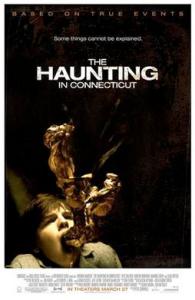
In my on-going research (as I think of it), I watched The Haunting in Connecticut.  I recently wrote about A Haunting in Connecticut, distinguished from the theatrical version by an indefinite article.  Both claim to be based on a true story and the story itself is disputed because it doesn’t fit into a materialist paradigm.  Ah, but that’s another can of worms.  Regarding the movie, it abandons the base story to add an entirely fictional subplot that drives the horror.  Or so the writers and director think.  The tale ends up jumbled and the confusion it generates is not the kind borne of intelligent planning.  The Campbell family, struggling to pay the bills against a case of childhood cancer is real horror.  In our healthcare system that is a true story.

According to the diegesis of the movie, Matt Campbell can see the dead because he’s close to death.  In case you don’t know the story—the family has to move to be closer to the hospital where Matt is receiving his treatment.  Once ensconced in their new house they learn it used to be a funeral home and hauntings ensue.  The writer of the original book claims to have made much of it up, while interviews with witnesses make the claim that much of it actually happened.  Matt ends up in a mental hospital.  In the movie a subplot of necromancy and a young boy medium are added.  Souls whose bodies have been bound are trapped in the house until Matt figures out how to break the spell with the help of the medium’s ghost.  Instead of Ed and Lorraine Warren investigating, a local minister is added.  Also suffering from cancer, he figures it out too, but too late to help the Campbell family.

In Holy Horror and Nightmares with the Bible I do not treat made-for-television movies.  A large part of the reason is that they often lack the cultural impact of a theatrical release.  (Although Game of Thrones and The Walking Dead may have reached a point of familiarity with numbers to rival big screen efforts.)  In the case of the cinematic treatment of the Snedeker (“Campbell”) family, however, the television treatment might well have been scarier than the big-budget studio effort.  Whether fictionalized or not, the Discovery Channel show stays closer to the book (In a Dark Place, by Ray Garton).  Using the Usher-like ending of destroying the house doesn’t seem to offer any release in the big-screen version.  Sometimes reality is scarier than the tales we tell after dark.


Book Signing

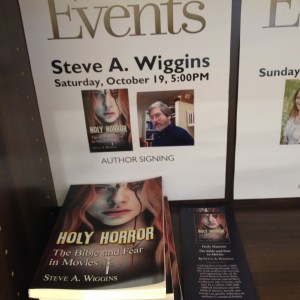
Okay, so I’ve got a book signing for Holy Horror coming up at the Moravian Book Shop in Bethlehem.  And they’ve advertised it in the local paper.  I’m humbled and honored by this, especially since I have no local following.  When I go to the website of the newspaper, The Morning Call, ads pop up on the top, bottom, and center of the page, obscuring the event.  I take this as kind of symbolic.  Life is crowded.  We seem to have turned the corner to autumn around here with nights being distinctly chilly.   After the languorous heat of summer when even thinking about winterizing seemed to add another layer of insulation over already too warm body, now we suddenly have to try to fit it in among an already crowded schedule.  At least I don’t have to commute too much any more.

I’m trying to get ready for the book signing, but I don’t really know what to do.  Perhaps I should try to get some business cards printed up.  Maybe I should think of some catch-phrase to use if anyone actually buys a high-priced book.  What should I wear?  Working at home can make you feel like a recluse sometimes.  I don’t have enough money to be considered eccentric, but I don’t get out among hoi polloi much either.  If most people have as much trouble as I do clicking off the ads to get to the event underneath, those who swing by the table are likely to be few.  Still, I’m looking forward to meeting local horror film fans.  They are, in general, a surprisingly cordial bunch.

After Nightmares with the Bible I’m going to focus on trying to find more mainstream publishers.  The reason is simple: academic publishers tend to be overpriced.  I’ve worked in publishing long enough to be able to decode pricing schemes.  There is a logic to them, even if at times it feels like you’re being overshadowed by pop-up windows.  To get a wide readership you need a pretty big platform, and getting a following on any form of social media takes the one thing I don’t have enough of.  Time.  You see, just the other day it was summer and we felt like we were baking.  Now the equinox has plunged us into the days of getting the furnace cleaned and operational and looking at the prices of insulation and shaking our heads.  Somewhere under all of these pop-ups are ideas waiting to be written down.


Ghouls and Dolls

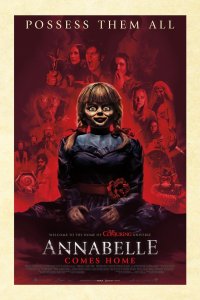
It was my plan—as if plans ever really work out—to see Annabelle Comes Home on opening weekend.  July got away from me but I finally found my way to the theater yesterday.  My current book, Nightmares with the Bible, deals with demons in cinema.  One of the chapters covers The Conjuring universe, and since this is the sixth film in that diegesis (with one tangentially attached spin-off) watching the movie was as much research as it was fun.  While the demon utilizing the doll Annabelle is clearly the main villain, the film, as in most of the franchise, interjects any number of entities.  Ed and Lorraine Warren, in real life, kept a museum of occult objects in their house.  This room contained items that had figured in their cases—they maintained demons didn’t possess objects, but people—including the doll Annabelle.

The new film maneuvers three girls (Judy, the Warrens’ daughter, her babysitter, and a friend) into the house alone.  One of the girls releases Annabelle from her blessed case, and a nighttime of terror ensues.  The demon behind Annabelle animates several of the haunted objects, so the girls have to deal with many ghoulish threats.  The film knows it is following tropes such as a car breaking down by a cemetery at night, and the idea of a babysitter being attacked by monsters, and at times it gives a slow wink to fans of the genre.  Still, there are plenty of genuinely creepy moments and a few jump startles.  It also shows the clearly demon in its “true form” at the climax of the film.  When it does so, it matches traditional renditions.

Set to become the highest grossing horror series of all time, The Conjuring universe mixes films that claim to be “based on a true story” and others, such as Annabelle Comes Home, that use real settings but without claiming to follow actual events.  What I found engaging about this particular movie was the fact that the youngest girl, Judy Warren, was the one who figured out how to re-capture the demon.  There are holes in the plot, of course, but featuring a young woman not requiring a man’s help to trap a demon is somewhat unusual in a Catholic diegesis.  True, she doesn’t perform an exorcism, but Judy does contain the evil without a priest, or even her father’s direct help.  As this diegesis wends its way into American folklore, moments like this are increasingly important.  Even though there are demons here, the women don’t require men to do the heavy lifting. 


Fearing Errata

Well before I became an editor, I noted mistakes in books.  I go through phases of marking up books as I read them—in pencil only, please!—and not doing so, but I used to mark mistakes when I found them.  At that point I hadn’t realized the complexity of the process of book production and I had no idea of the many ways in which errors might creep in.  I’m a bit more forgiving now.  In any case, errors are a regular part of book publishing.  Older books used to carry pages with incantational-sounding titles like “errata” and “addenda et corrigenda.”  Errors, in other words, were considered inevitable because every time you have another set of eyes look over the manuscript it adds to both the costs and time for the production schedule.  Then I started writing books.

Now, before I get too far I should explain that many book editors don’t line edit submissions.  The standard “editor” is an acquisitions editor, which means you sign up books for your press, but you don’t necessarily (if ever) actually edit them.  I still have the sensibilities of a copyeditor, however.  That’s the main reason I fear to read my own books after they’re published.  I’m afraid I’ll find mistakes.  I do take the proofreading stage seriously, but often a writer has little control over when proofs arrive with a tight turnaround time.  You have to drop everything to get them returned by the deadline.  I’m always worried that errors might’ve crept in.  For example, with Holy Horror, I corrected with website copy for the book.  The errors, however, remain online.  They’re minor, but as the author you’re always considered culpable for such oversights.

Now that I’m working on a presentation to give for Holy Horror, I find myself facing my fears.  I need to go back to a book already published and look inside.  Since writing it I’ve completed another book, Nightmares with the Bible, and my mind can’t help mixing up a little in which book I said what.  To make sure I don’t tell potential readers the wrong information, I need to go back and reread parts of my own work.  What if I find errors?  Will I have to mark up my own copies like I used to do to those of others?  Will I need to compile an errata sheet?  I tend to be a careful reader, especially with proofs.  But facing possible errors is nevertheless a terrifying prospect, even if it’s a regular hazard for those who attempt to write books.


Best If Used

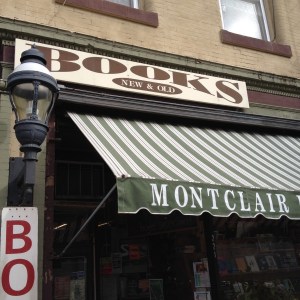
Used bookstores are like a box of books—you never know what you’ll get.  I perhaps overindulge this particular vice, but it doesn’t feel too sinful to me.  Part of Modern Mrs. Darcy’s reading challenge for the year is three books by one author.  I decided since I’ve been on a Kurt Vonnegut kick that he would be the one.  I figured (mostly wrongly) that his books would be all over the place in used bookstores.  I always found a plentiful supply at the now mourned Boston Book Annex.  At a used shop in Easton I asked where they might put Vonnegut.  “In science fiction,” the owner promptly replied.  I don’t think of Vonnegut as a science fiction author.  Some of his work does fit, but this little exchange got me to thinking about genres again.

Writers, unless they’re strictly commercial, don’t think of genre.  We write.  The novel I’ve been trying to get published for the last decade doesn’t fit into any neat category at all, and that’s probably part of the problem.  Neither fish nor fowl—what is this thing?  I’ve noticed this with my brother-in-law’s books.  Now, I’m holding out on retirement to dig into Neal Stephenson’s books because they require more time than I have in my workaday world, but they aren’t always science fiction.  Still, that’s often where you find him in bookstores.  I was in a local shop in Bethlehem the other day and there he was, in sci fi.  Although I understand why booksellers (and critics) want to use genres, but it seems to me that they limit human creativity.

The past couple of non-fiction books I’ve written aren’t really in genres.  They’re not academic books, but academics (once guilty, always guilty) have a hard time convincing publishers they can do anything else.  Non-fiction may be a more difficult gig than fiction after all.  Holy Horror and Nightmares with the Bible don’t comment on horror necessarily, at least not directly.  They’re not religious books either.  When I try to explain them in one sentence, it quickly becomes run-on.  I began both the same way—I noticed something and began writing about it.  With a little structuring and a little time, you’ve got an entire book.  It may not find a publisher.  It may not fit a genre.  Nobody on Medium is going to come looking for your advice.  And if you’re lucky you’ll find yourself put on a shelf with others who don’t conform to genre expectations either.