Don’t Know Much

Pennsylvania does not come immediately to mind when “big states” are mentioned. When you have to drive the breadth of the state, however, you start to get a sense of the beast. Despite its abundant natural beauty, Interstate 80 manages to keep it to a minimum, so driving home yesterday we listened to the first disc of Kenneth C. Davis’s A Nation Rising in audio-book format. Mostly known for his Don’t Know Much About — books, Davis is a popular historian with a sense of what makes the past interesting. I can’t speak for the entire book yet, but the unabridged reading of A Nation Rising certainly was an educational experience for the first hour or so I’ve heard. The book focuses on the initial fifty years of the nineteenth century (1801-1850) in the United States. Of particular interest to me is the religious angle. In the introduction Davis states that it will become clear how the concept of America as a Christian nation is a myth. Other than my usual objection to “myth” being equated with falsity, this premise does look very interesting.

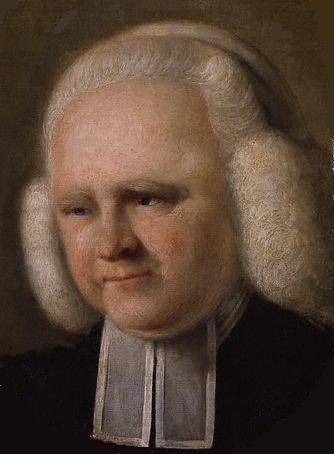
Stepping back before the nineteenth century, Davis spends several minutes (which I assume translates to several pages) describing the ancestry of Aaron Burr, one of America’s bad-boy politicians of the period. Burr was a grandson of the reformed minister Jonathan Edwards and this circumstance leads Davis to recount a bit about the Great Awakening. The first major religious revival on American soil, the Great Awakening spread throughout the States in the 1730s and ‘40s, setting the reputation of the young nation as a bastion of Reformed Christianity. Although many denominations became involved in the show, the origin and orientation of the Great Awakening was Calvinistic. Reacting against enforced Catholicism in much of Europe, many colonials flocked to America to practice their stripped down, Bible-based, generally intolerant religion in the New World. Particularly interesting in Davis’s rendition is George Whitefield. Viewing the preacher from hindsight that includes a distorted religious view of American history, Davis notes that Whitefield was as much performer as preacher.
Trying to figure out the next hot trend

Whitefield was an Anglican priest who helped set the mold for John Wesley’s success in bringing what would become the Methodist Church to America. “Whitefield pioneered the development of multiplatform marketing strategies,” using the media and staged events to draw attention to his evangelistic efforts, according to Davis. Whitefield knew that religion alone could not sway the masses. They had to be entertained. Davis notes that even the Tea Party has corollaries in early American history. What the mainstream has been slow—perhaps too slow—to realize is that entertainment works. In casting the die for American spirituality, preachers like Edwards and Whitefield knew the value of the gripping sermon vividly illustrated. The antics of many Tea Partiers reveal that they learned the lesson well. Showboating will garner more votes than substance any day. How else can we explain Ronald Reagan, Sonny Bono, Jesse Ventura, and Arnold Schwarzenegger? This is America’s truest legacy: entertaining with religious faith will take you where intellectual depth just can’t go.

I will have to wait for another car trip to hear more of Davis’s interesting perspective on American history, but in the meantime I wonder how long it will take intelligent Americans to catch on. Don’t Know Much About History is a frighteningly prescient title for those who continue to ignore religion as a political force.
Eyre the Apocalypse

Finishing Charlotte Bronte’s Jane Eyre last night proved timely from the point of view of today’s much anticipated apocalypse. (I hate to leave a book unfinished as the final trump begins to sound.) As I stress to my students at Rutgers (when I actually have a class), the Bible surrounds them whether they are aware of it or not. Quite aside from the present rapture-envy—that one’s just too easy—reading literature of the nineteenth century is an excellent way to show the Bible’s influence on western culture. Jane Eyre is suffused with biblical allusions and direct references, even with the faulty theological notions that the Scriptures had hatched in that century. Of course, the Bronte sisters, all successful novelists, were the children of a clergyman, but other writers of the period demonstrate an equally biblical worldview. In fact, much of the dramatic tension in the present novel revolves around distinctly biblical issues.

Interspersed with my reading of classical novels, I read many more recent literary explorations as well. A couple of weeks ago I completed Stephen King’s It, not a particularly favorite novel, but one that at times demonstrated that even masters of the macabre frequently draw on the Bible. For modern literature the Bible is the ultimate foundation. It would be interesting to live long enough to see if it still has any relevancy at the end of the present century. Jane Eyre, perceptive as most nineteenth century novels are, also pressed directly the wound that currently afflicts much of our nation. Cast upon misfortune, Miss Eyre is mistaken for a beggar. Miss Bronte observes, “Prejudices, it is well known, are most difficult to eradicate from the heart whose soil has never been loosened or fertilized by education,” a line that should be emblazoned upon the door of public officials who feel it is their right to withdraw funding from public education. You want an apocalypse? That’s the recipe right there.

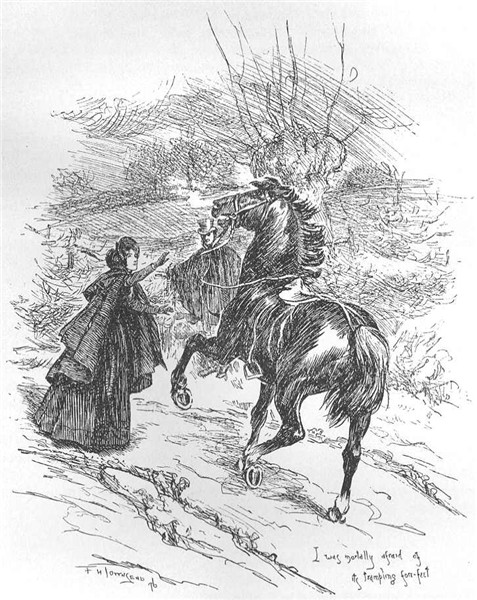
Nevertheless, Miss Eyre presses on until she reclaims the man who had once “stood between me and every thought of religion,” dodging an impassioned missionary along the way. In revealing the manipulations of the cousin who dies on the mission fields, enriched by Miss Eyre’s beneficence, once again Charlotte Bronte displays her perception of how the church may ultimately rob a soul of its true potential. Upon learning of his death, the now Mrs. Rochester ends this penetrating novel with his words, strangely appropriate for this day of fictional endings: “’My Master,’ he says, ‘has forewarned me. Daily he announces more distinctly—“Surely I come quickly!” and hourly I more eagerly respond, —“Amen; even so come, Lord Jesus!”’” Of course, St. John is here quoting Revelation 22.20. Since I am scheduled to run a 5-K in a couple of hours, if the second coming is about to happen, it would be convenient should it transpire before I end up exhausted in my own personal apocalypse.

Jane Eyre stopping one of the horsemen of the apocalypse?


O Tannenbaum

Today we put up our Christmas tree. As we drove home with it strapped to the roof our car yesterday we felt like pariahs since everyone else in New Jersey seems to have collected their tree a week or two before Thanksgiving. I have spent too long among Episcopalians to appreciate such eager chomping at the bit. At Nashotah House Christmas trees were discouraged until about Christmas Eve, since a hearty Advent celebration was considered a sign of true piety. Well, with a small child in those days, we didn’t care to deprive our daughter of the childhood anticipation of Christmas, so we received the ugly stares due to those so uncouth as to set up a tree a week in advance. Now people think we procrastinate to wait until the weekend before Christmas to set up our interior conifer.

A few years back I wrote a book on holidays for teenagers. I haven’t found a publisher yet, but I did quite a bit of research that I’d rather not waste. Sometime soon I will post the Christmas section under Full Essays. It is chock-full of traditions and facts and impressions about Christmas and what it has come to mean to us today in the United States, but since today is tree day for us, I thought I’d start out with a little of the story of the humble Christmas tree:

The modern use of Christmas trees can be traced directly back to Germany in the 1500s. The earliest written reference comes from 1570 when a fir tree was set up in guild houses and decorated with apples, nuts, pretzels, and small things for kids. On Christmas Day the kids of the guild members could come and take the hanging gifts. The apples may go back to plays in the Middle Ages with Adam and Eve; sometimes plays of the Garden of Eden had apples hung on a fir tree. A tradition says that Martin Luther, the monk who started the Protestant movement (the Reformation) was walking home one winter night when he saw the stars twinkling through the branches of the pines. He set a tree up in his house, the story goes, lit with candles, to try to recreate the effect.

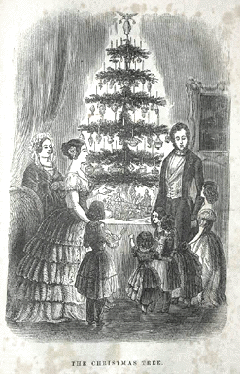
We do know that the Christmas tree (originally Tannenbaum) was a German invention. Until the 1800s it was almost completely limited to Germany. Candles were used to light the trees – talk about your obvious fire hazard! Royalty from other European countries were presented with Christmas trees as a novelty in the 1800s. Soon other well-to-do families started to set them up. An engraving of Queen Victoria in England with a tree from her German husband Prince Albert captured the public imagination and Christmas trees became the rage in England. Charles Dickens took over and the rest is history.

A Christmas Tree primer