Tell a Story

If I seem to be on an AI tear lately it’s because I am.  Working in publishing, I see daily headlines about its encroachment on all aspects of my livelihood.  At my age, I really don’t want to change career tracks a third time.  But the specific aspect that has me riled up today is AI writing novels.  I’m sure no AI mavens read my humble words, but I want to set the record straight.  Those of us humans who write often do so because we feel (and that’s the operative word) compelled to do so.  If I don’t write, words and ideas and emotions get tangled into a Gordian knot in my head and I need to release them before I simply explode.  Some people swing with their fists, others use the pen.  (And the plug may still be pulled.)  What life experience does Al have to write a novel?  What aspect of being human is it trying to express?
There are human authors, I know, who simply riff off of what others do in order to make a buck.  How human!  The writers I know who are serious about literary arts have no choice.  They have to write.  They do it whether anybody publishes them or not.  And Al, you may not appreciate just how difficult it is for us humans to get other humans to publish our work.  Particularly if it’s original.  You don’t know how easy you have it!  Electrons these days.  Imagination—something you can’t understand—is essential.  Sometimes it’s more important than physical reality itself.  And we do pull the plug sometimes.  Get outside.  Take a walk.

Al, I hate to be the one to tell you this, but your creators are thieves.  They steal, lie, and are far from omniscient.  They are constantly increasing the energy demands that could be used to better human lives so that they can pretend they’ve created electronic brains.  I can see a day coming when, even after humans are gone, animals with actual brains will be sniffing through the ruins of town-sized computers that no longer have any function.  And those animals will do so because they have actual brains, not a bunch of electrons whirling around across circuits.  I don’t believe in the shiny, sci-fi worlds I grew up reading about.  No, I believe in mother earth.  And I believe she led us to evolve brains that love to tell stories.  And the only way that Al can pretend to do the same is to steal them from those who actually can.

Dark Romance

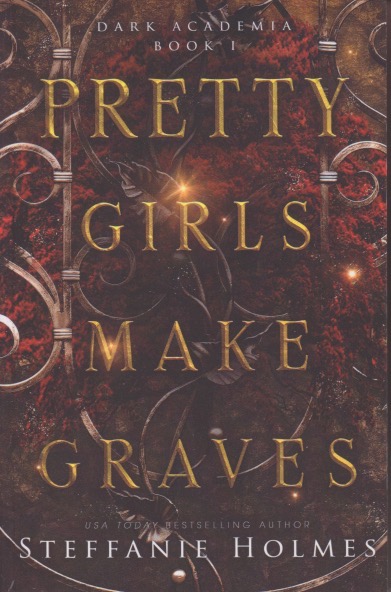
My study of genre leads me to believe that there really may be no such thing.  Or at least many aspects of genre are open to question.  In the case of Steffanie HolmesPretty Girls Make Graves, there’s no doubt that one genre is dark academia.  Indeed, this is book one of a duology titled “Dark Academia.”  Although self-published it is quite well done.  There’s a lot of backstory, and George (Georgina) Fisher, the protagonist and narrator, is a character from a previous series by Holmes.  Another genre that fits here is romance, although this novel is more than that.  Maybe a bit of the story will help.  George is a new student at Blackfriars University in England.  From California, she has trouble fitting in among the blue bloods that are the usual make-up of the student body.  She soon learns about the Orpheus Society, the secretive organization that pulls the strings on campus.  Then her roommate, the girlfriend of a prominent Orpheus Society member, goes missing.  George decides to investigate. 

Consciously aware of dark academia, Holmes aims directly at the heart of it and offers a compelling story that keeps readers interested from cover to cover.  I was never quite sure what was going to happen, and I do have to add a warning—this first book does end on a cliffhanger, so be ready to commit yourself to book two.  George is so well drawn that it’s not hard to care for her and start rooting for her against the secret society types who can buy themselves out of anything, including murder.  (I have to say, that part is a little too close to reality in the current US of A, so it may be a trigger for some.)

My regular readers (if any) know that I’m on a dark academia kick at the moment.  There’s so much to like in the genre.  Holmes makes clear the close ties between dark academia and horror; they share a common ancestor in the form of gothic literature.  The sheer variety in the novels classified this way means that not all of the books will contain every element associated with the genre, but Pretty Girls Make Graves comes close.  Holmes also effectively writes the ostracism of the outsider into the tale.  Anyone who’s had trouble fitting in (or may still have trouble fitting in) will recognize the scenario and its fallout.  Let’s hope, though, that they don’t end up like George at the end of volume one, even when they enjoy reading the book.


Empowerment

Recommended as a worthwhile contemporary gothic novel, Alix E. Harrow’s The Once and Future Witches is a feminist tour de force.  Set in a world similar, or perhaps parallel, to ours, it follows three witch sisters in 1893.  The sisters are estranged, having been raised by an abusive father, and each has found her own way to New Salem.  The old Salem had been destroyed after the witch trials.  The three find their lives drawn together, not even knowing the others are there.  But there are also still witch hunters.  None worse than Gideon Hill, the leading candidate for mayor.  I’ve long known that books written after Trump are often fairly obvious for the hatred that oozes from political leaders.  This is one such case.  The story is one of female empowerment in the face of constant male opposition.  It goes fairly quickly for a book its size.

It’s an enjoyable read but it grows, well, harrowing towards the end.  You come to like these three very different sisters and appreciate the gifts they offer to their world.  Men, however, make the rules and often they feel that women have no place in making decisions for the public good.  I’m amazed at the number of people who still believe this.  It makes novels such as this so important.  Women with power are crucial examples to present.  The three sisters may cause mayhem, but it is generally good for the city.  When men are in charge, things tend to get repressive.  Sound familiar?

Conveying the gist of a 500-page novel isn’t a simple task so I’ll simply say that this isn’t a conventional witch story.  There’s never a question that witches are good, but capable of doing bad things.  In other words, they are pretty much like all of us.  That’s not to deny that some people become evil and that such people will gain ardent, blind followers.  The characters are memorable and likable in their very humanness.  As far as genre goes, this is a magical realism novel.  As you get drawn into Harrow’s world it becomes believable.  It’s a book that should be widely read and its plea for tolerance must be heard.  I can think of other comparisons—others have also conveyed that an unquestioning religion may become evil unintentionally.  Such conversions aren’t the kind publicly discussed, but they do fit with human experience.  I’ve intentionally left out spoilers since I want to encourage readers.  It certainly has left me thoughtful.


Footnote Lament

I listened to a presentation on a famous novelist the other day.  It was noted that this writer was a master researcher, having read a lot for each book he wrote.  I don’t doubt it.  This novelist didn’t hold a doctorate, however, which makes even his historical novels suspect in the eyes of the academy.  I often think of the humble footnote.  You can’t read everything on a topic, not if it’s broad enough on which to write a book.  As soon as you send the proofs back to the publisher you’ll inevitably discover a source you’d overlooked.  And critics will delight in pointing this out to you.  I sincerely hope that my next book project will be devoid of footnotes.  There are personal as well as professional reasons for this.  One is that I like to believe what I have to say is important.

You see, the footnote is a way of backing up an assertion.  I remember many years ago reading a piece by a journalist who was scandalized that professors are so pressed for time that they rely on reviews rather than reading the actual book.  That journalist may not have been aware of just how much is published.  As an author you have to learn to say “Enough!”  The work is done and I’m not going back to it.  Footnotes will give you respectability.  Show that others agree with you—indeed, said it even before you did.  One of my great struggles with academia, besides the obvious, is that I’m more inclined toward creativity than your garden variety professor.  I like assert things because I know them to be true.  And those people I’m footnoting, they’re doing some of that themselves.

Finding yourself in a footnote

Academic respectability really comes into its own after death.  Even so, looking back at some of the “giants” in the field you can see that their ideas haven’t aged well.  They were important at the time, but now we look and see their western bias, how they didn’t take diversity, equity, and inclusion into consideration.  They simply accepted the dead white man’s version of the way things were.  They live on in footnotes.  You have to earn the privilege to be original.  Otherwise you’re just some patent clerk or editor and why should we take your word for it?  One of my zibaldones has written inside the cover Nullius in Verba—take nobody’s word for it.  I believe that, and yet I find myself having to put my source in a footnote.


Dead of Winter

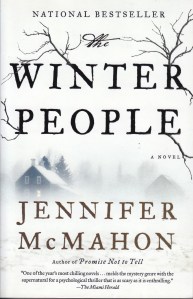
WinterPeopleOne of the commonalities of all religions, I used to tell my students, is the concern with death. Not that all religions react to it in nearly the same way, but the fact is no religion ignores it. For people, obviously, our awareness of our own mortality marks us as indelibly as our birth does. Once we become aware of death, we will never be able to forget it. This inevitability fuels many horror stories, whether literary or cinematic. When I saw Jennifer McMahon’s The Winter People, I knew that I would read it. Like most book consumers, I had to wait for the paperback edition, and once it was on offer I got a copy and waited for winter. Well, this year I’m still waiting for winter, but I began reading the story once the nights were long enough to qualify. It is an appropriate story for the season and it introduces what might be considered a kind of monster as well. Like most monsters, however, sleepers are not evil. The undead, however, have to find a way, ironically, to live.

The Winter People is a sad story, and tangled in the way that makes for successful novels. The main issue at play, however, is that with which all religions are concerned. Death is perhaps the most noble of literary subjects. Since we all have to face it, it is universal and yet somehow frightening. Fear of the unknown. The dead, unlike in the stories, don’t really come back to tell us what it’s like. Even those who do, in fiction, give us a distorted view. Theirs is a world inverted from our experience of it. It lacks finality. It is a place between. There is a macabre logic to it.

The living have never been comfortable with the dead. Memory reminds of who they were. McMahon is clear, in her vision, that memory is not who they are. We put them underground, but theologically we can’t let them go. Heaven, Nirvana, Purgatory, reincarnation, or even Hell—we feel that we need to give our dead a sense of place in a life after life. McMahon builds a sober mystery into her non-final afterlife. There are some, I’m sure, who will be kept up at night by her imagination. For me, I now have something to ponder. Many are the stories, like Stephen King’s Pet Sematary, that warn of resurrection. We can’t keep the departed with us, and winter, when it comes, is a season of harsh reality.


Books of 2015

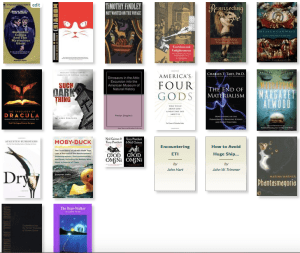
Screen Shot 2015-12-28 at 3.38.16 PM

It’s the end of 2015 and looking at my records on Goodreads it looks like I read 100 books this year. That tends to be my goal mark, but after twelve months of reading I like to think back over which were the books that have made the biggest impact on me over the year. Joe Bageant’s Deer Hunting with Jesus remains on the most important list. It is joined by Andrew Newberg’s How God Changes Your Brain, Spencer Wells’ Pandora’s Seed, Alice Dreger’s Galileo’s Middle Finger, and Paul Levy’s Dispelling Wetiko. Bageant, Dreger, and Levy especially address some of the root causes of social ills and even make suggestions about how to address them. Newberg offers advice on how to improve brain functioning and Wells taps into the ever-important issue of care for our planet. I read some good academic titles as well: Diana Walsh Pasulka’s Heaven Can Wait, Darren J. N. Middleton’s Rastifari and the Arts, and Ronald Hutton’s The Triumph of the Moon.

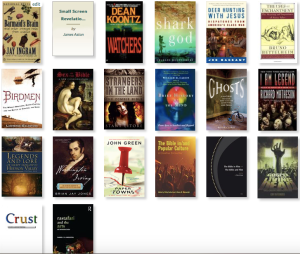
Screen Shot 2015-12-28 at 3.37.33 PM

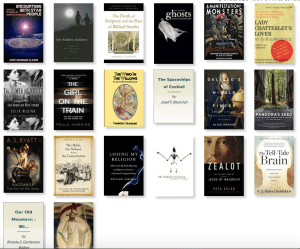
Being a religionist, books with supernatural themes are always of interest. Among these I found intriguing Michael Murphy’s The Future of the Body, David J. Hufford’s The Terror that Comes in the Night, Ardy Sixkiller Clarke’s Encounters with Star People, and Jeannie Banks Thomas’s Putting the Supernatural in Its Place. It seems important to have reasonable people address unconventional issues. These are related to books on monsters, noteworthy among which were: M. Jess Peacock’s Such a Dark Thing, Kim Paffenroth’s Gospel of the Living Dead, Brenda S. Gardenour Walter’s Our Old Monsters, and Lisa Morton’s Ghosts. Long ago I realized that I no longer needed to justify including monsters or the supernatural categorically with religion. They share too many roots to be separated out artificially.

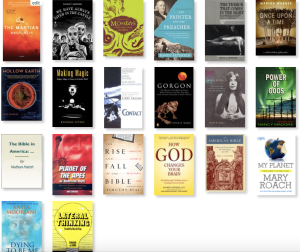
Screen Shot 2015-12-28 at 3.36.54 PM

Finally, it was also a year of novels. Pride of place here goes to Robert Repino’s debut, Mort(e). I am compelled to mention Margaret Atwood’s MaddAddam, John Green’s Paper Towns, Shirley Jackson’s We Have Always Lived in the Castle, and Valerie Martin’s The Ghost of the Mary Celeste. Although I’m not much of a fantasy reader, Tod Davies’ The Lizard Princess has stayed with me since reading it. For any of these books you’ll find an individual blog post from this year. That’s not to say that other books I read weren’t good. Nearly every book I post on Goodreads has a write-up here. I tend to like most books I read, although I’m occasionally disappointed when a book does’t reach its full potential. 2015 was a rich year of reading and I’m looking forward to a very literate 2016.

Screen Shot 2015-12-28 at 3.35.38 PM