one of many

It’s been some time since I’ve read about the Jehovah’s Witnesses.  There are so many religions that I need to refresh my study on them periodically.  So it was that I received a mailing from the local Kingdom Hall.  You see, the very last people at my front door before the pandemic was declared were bearing the Watchtower and telling me the end is nigh.  We knew about Covid-19 at that point and were being urged to keep social distance, although the authorities were still dithering about masks.  They knocked nevertheless and we stood several feet apart on the porch as they tried in vain to convince me of their truth.  So now, a year later, they’ve reached out by mail.

You’ve got to have a soft spot for a religion that has its origins in Pittsburgh.  Well, maybe that’s the case for those who grew up where it was the nearest big city.  And I do admire that pioneering spirit that says “established religions just aren’t doing it for me.”  The great swath of NRM—New Religious Movements—shows that you shouldn’t feel lonely if this applies to you.  Even today’s Christianities bear little resemblance to the teachings of the carpenter of Nazareth.  He who said even to look upon a woman lustfully was to commit adultery, but whose followers support a president who recommends grabbing them by the, well, where the originator said not to look….  Religions evolve.  The literalism many associate with Christian belief is really only about a century old.  We have no business castigating religions just because they’re recent.
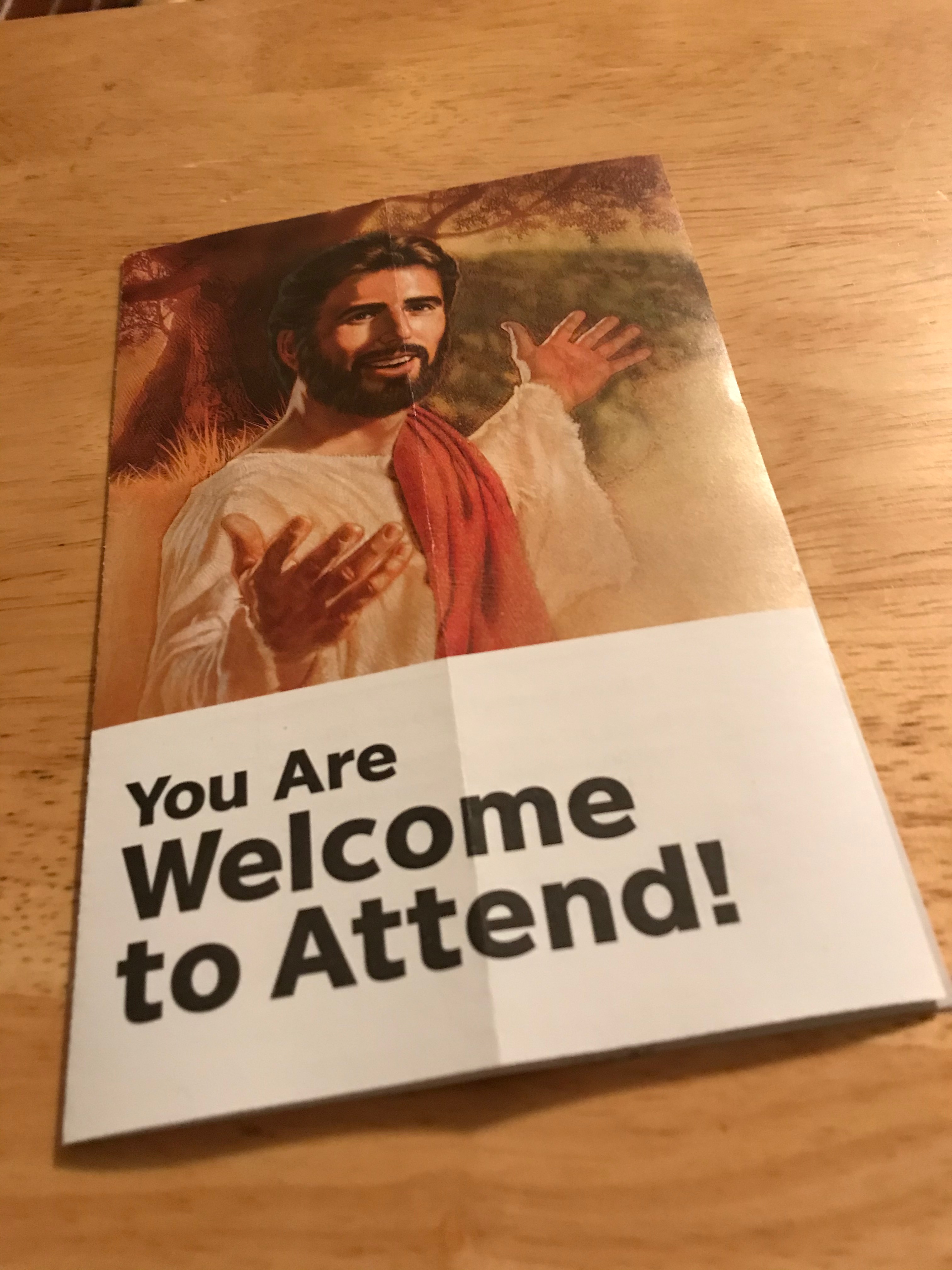
My mailing from the Witnesses included a personalized (somewhat) letter inviting me to a virtual commemoration of Jesus’ death.  Due to the pandemic it’ll be held on Zoom, of course.  The expected flyer with its Anglo-Jesus contains the details.  I did attend a Witness service back when I was in college.  Those days of heady explorations never really ended for me.  You have to settle into a tradition to get to know people, of course, but there’s a world full of ways of looking at our spiritual side and there’s more being propagated just about every year—even Jehovah’s Witnesses have splinter groups.  I suppose missionaries are something we’ll always have to put up with as long as people are convinced that their way is The Only Way.  Trust that others have perhaps quietly, perhaps deliberately, perhaps with a great deal of thought and reflection, have found their own way seems never to be good enough.  Still, an invitation is an invitation and those have been rare during a pandemic.

Mystery Religions

Religion.  What is it?  Those of us with many years—or decades—of experience in it find ourselves asking that often.  A Raëlian I know pointed me to the documentary The Prophet and the Space Aliens, by Yoav Shamir.  Shamir is an Israeli film-maker who was recognized by Raël some years ago as being in sympathy with the principles of Raëlianism.  The result is this film, released about a year ago, and available in its entirety in the context of an interview on Vice, housed on YouTube.  It is well worth the watching, although be warned, it is NSFW (not safe for work), as they say.  I found the post-viewing interview of Shamir to be quite enlightening as well.  Shamir’s film itself is, of course, worth pondering.

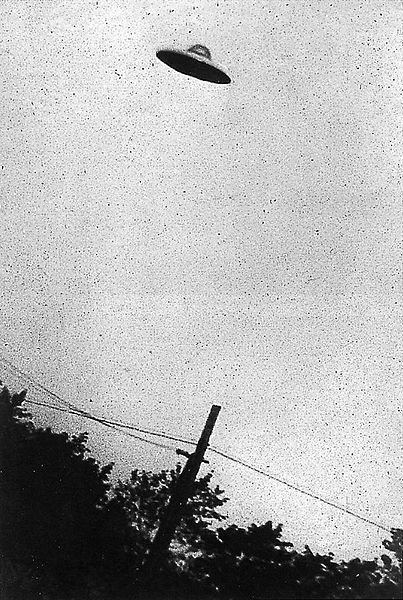
Image credit: George Stock, via Wikimedia Commons

Raël, born Claude Vorilhon, began his career in France as a singer and then a journalist for a racecar magazine he founded.  In 1973, after a close encounter of the third kind, he founded Raëlianism, a movement of which he is still the leader.  While Shamir is not a Raëlian—indeed, he’s a non-religious atheist—his documentary treats Raël respectfully.  After giving an overview of the movement at the present time, following Raël as he goes about his daily activities and interacts with his followers on his estate, it then gives his biographical story and interviews some of the people he knew as Claude Vorilhon.  The documentary is balanced and addresses issues such as the movement’s proactive outreach to Africa and respect for African religions and its unconventional views on sexuality.  The issue of cloning, which came to a head in 2002 with the claim that a human, Eve, had been successfully cloned, is also covered.

What it truly striking about The Prophet and the Space Aliens is that it intentionally raises the question of how religions begin.  An originator, a prophet, gathers a band of followers.  Its beliefs are distinctive from other people and tend to outlive the death of the founder.  If it is strong enough the religion will go on to become a fixture in society, sometimes gaining influence and respectability.  One of the points Shamir makes is that if religions survive long enough they simply become part of the cultural fabric.  One of the most interesting scenes in the documentary is an encounter between Raël and Mormon missionaries.  Mormons are one of the more recent, successful New Religious Movements that has become mainstream.  When a member receives a major political party’s nomination for president, it’s obvious that the candidate’s religion (if any) has become accepted.  This documentary will make you think.


Starting Something

Starting your own religion, I’m told, just takes patience.  You may have to die before it gets off the ground,  but if it’s a religion you’re starting you get to make the rules.  Well, until somebody else starts interpreting what you wrote.  I grew up thinking a religion had to be ancient to be real.  There’s a certain comfort in untestablity—you can’t verify the facts, so you accept them.  It took many years before it dawned on me that new religions rely on the same premises as old: someone has received the truth (at last!) and is willing to share it with the world.  Followers emerge—true believers.  And then they begin to change things.  “The founder meant this,” they argue, and really they’re starting their own sub-branch of the religion.

Not everyone is convinced by this ancient religion paradigm.  Zarathustra, for example, set out to create his own religion, according to tradition.  Jesus, it seems, was trying to reform Judaism.  The process never stops.  A couple of weeks ago in New York City I saw an adherent of a New Religious Movement.  This one had started in the 1930s.  The man appeared a little older than me, so his life may well have overlapped with that of the founder, or they might’ve missed each other by a decade or two.  Already, however, the religion had grown into its own entity, and it doesn’t seem to worry adherents that the truth was being revealed, for the first time, maybe in their lifetime.  You have to start somewhere.

So, if I were to start a new religion, what would it be?  For a variety of reasons I think I’d call it Moby.  The connection with Melville is palpable, but that wouldn’t be the reason for the name.  (Religions must have a sense of mystery, otherwise they can be analyzed until they look illogical.)  Like Unitarian Universalists, I think the religion would be more about what you value than what you believe.  Belief can be shifting sands.  New information can lead to new results—this is one of the weaknesses of religions developed when the earth was still the center of the universe.  Heaven is now outer space and Hell is earth’s iron core.  Moby would avoid such a doctrinal morass by not having doctrine.  It would need rituals and ceremonies, of course—no matter what Mr. Spock wannabes say, we need emotional engagement and ritual has the goods.  All of this requires patience, because who has the time to develop a new religion when there are only two days in a weekend?