Space Rocks

The thing from another world.  No, not the movie, but an artifact.  My recent post about the asteroid sent me looking for something.  When we lived in Wisconsin, we purchased a small piece of a meteorite while on a visit to the Yerkes Observatory.  It is, quite literally, a thing from another world.  The problem is, I can’t find it.  Our house isn’t that big but the fragment is quite small.  I’ve been told our house is like a museum—there are curios pretty much everywhere, and they each have some significance.  But the meteorite: where could it be?  I find that moving is one of the most disruptive activities known to those of us in the “developed” world.  As much as I wanted an organized move, the fact is that you can’t have such a move without taking at least a month off work in advance.

There are things (from this world) that I haven’t found in the six-plus years in this house.  Most often they’re like the meteorite in that I don’t think of them often, and when I do I wonder where I might’ve packed them.  Knowing where they might’ve been packed gives a clue to where they might’ve been unpacked.  And no matter what, some things get lost on every move.  There’s a book I had in New Jersey that is simply not here in Pennsylvania.  I’m sure I packed all our books.  One, at least, did not make it over the Delaware.   The fragment of meteorite, which is unique, is only about the size of a small ladybug.  Where might I have put it?  

That small fragment of rock traveled through the solar system.  It likely came from distances no human has ever gone.  Unimaginable distances.  Only to get lost in a house in Pennsylvania.  If it’s here at all.  Back when it was legal to pick up petrified wood, a family friend gave us two chunks from the petrified forest (for now, a National Park in Arizona).  One of them came to me and I treasured it for years.  I haven’t seen it since we moved to Pennsylvania.  There are boxes that haven’t been fully unpacked.  The squirrels make a mess of the garage every winter and I can’t go in there without feeling I should clean things up first, before emptying out the remaining boxes.  To a squirrel the thing from another world is just one more thing to ignore.  It has no value except for to an aging guy who remembers buying it at the very spot where Edwin Hubble worked and Albert Einstein visited.  Only to mislay it when moving fifty miles from state to state.

Not my meteorite. Image credit: Meteoritekid under the GNU Free Documentation License, via Wikimedia Commons


Space Ads

So, I’ve got enough stuff to worry about down here—the chimney needs some attention, that backyard gate still doesn’t hang right, and Giant keeps on running out of the cereal I buy—to have to turn my attention to space.  I love outer space, although, unlike some people I’ve never been there.  One of the simple pleasures in life is to be outdoors at the lake and watching the night sky where there’s no light interference.  Then I learned about space advertising.  You see, as an editor you get to read about all kinds of topics, and this came up in a proposal one time.  I had no idea that companies had been proposing billboards in space to fly across our nighttime skies.  It’s hard enough to use the internet anymore without hacking your way through a jungle of ads, and now they want to clutter our view of the nighttime sky so there’s no escaping capitalism.

“Space, the final frontier.”  This is a mantra that many of us grew up with in the sixties.  Most of us can’t afford to, and really have no desire to, go into space.  Born down here, we’re content to stay down here.  That doesn’t mean we can’t look at the sky with wonder.  Already you can’t go to the beach or a stadium event without planes flying banners trying to draw your mind back to the commercial world.  Even in remote forests you can find litter stamped with some company’s logo, trying to sell you more.  It’s enough to make you want to get to space to get away from it all.  Now that companies can afford to fly people to space as tourists—this is pretty strictly limited to the top one percent, of course—they feel they have the right to clutter the nighttime skies so that you’ll have that midnight urge to go buy a Tesla.

The original space advertising?

At this time of year we look to the nighttime sky in hopes of seeing a special star.  People with too much money cause so many unnecessary problems for the rest of us.  This has been apparent throughout history, but has been brought into sharper focus in the days of late capitalism.  Having too much only makes you want more, it seems.  And since other people have some you need to flash your company in their faces constantly.  From what I’ve read the only reason space advertising hasn’t really taken off is that it costs millions to get your ad up there.  Despite inflation it seems that these kinds of costs always come down.  And yet you can’t even get a contractor to come out and do something about that deck that’s falling apart.  And I do hope that they’ll have my cereal at the store this week.


Goblins out There

From Wikimedia Commons

You step away from the telescope for a few months and see what happens.  That may sound like a recipe for some kind of cosmic soup, but as we find ourselves so busy with earthly matters it’s hard to keep up with the heavenly.  I’ve just been reading about the discovery of “The Goblin”—appropriate as we tiptoe into October.  The Goblin is officially a dwarf planet named 2015TG387, which falls trippingly off the tongue.  For those of us who never even saw Pluto before it was demoted as a planet, the distance of this planetoid boggles the mind.  It also makes space feel somehow less empty.  In fact, our solar system’s much more crowded than it was when I took astronomy class in college.

The universe—space—is close kin to our ideas of religion.  “God,” however defined, is “up there.”  As Galileo encouraged telescopes turned outward we began to discover mundane, if complicated, ways of explaining the universe.  Nobody looked through the eyepiece and saw the deity waving back.  Space was cold, dark, and largely empty.  Then the idea eventually grew that it was full of dark matter which, like spiritual entities, can’t be seen.  Unlike spiritual entities, however, it can be hypothesized.  Calculated, even if not measured.  And since it isn’t supernatural, it’s just fine to keep in our cosmic soup.  The problem with any recipe, however, is that it seems that each time you make it the results are slightly different.

It’s somehow appropriate that our new space neighbor is called the Goblin.  The idea of a cosmos devoid of any intelligent life—supernatural or no—is somewhat scary.  Looking at the headlines of what we’re doing to one another down here, and nobody willing to take the reins of reason, we increasingly hope for something beyond mere nature in the cold, dark reaches above.  And that we’ve found such a thing as a goblin—a supernatural entity if there ever was one—is telling.  In fact, all our planets are named after gods.  We can blame the Greeks and Romans (and even the Mesopotamians) for that.  Still, the tradition continued onto the worlds they couldn’t see: Neptune and Uranus and, for a while, Pluto.  We can’t escape the idea that what’s up there is more powerful than our minuscule human troubles.  Our slowly eroding atmosphere is all that keeps us alive down here.  And now there’s a goblin circling all around us, so far away that few will ever even catch a glimpse.


Animal Rains

We may have been to the moon—if not personally, collectively—but we still don’t control the weather down here.  It’s probably not news that the eastern part of the country has been getting a lot of rain lately.  One of the factors that led me to write Weathering the Psalms was the overwhelming tendency for humans to attribute weather to the divine.  It used to be that we couldn’t reach the sky, so placing deities there seemed a safe bet.  Now that we’ve shot through the thin membrane of atmosphere that swaddles our planet, we’ve discovered beyond a cold, dark space liberally sprinkled with stars and planets but mostly full of dark matter.  The deity we thought lived beyond the sky somehow wasn’t anywhere our probes flew and recorded.

Still, down here on the surface, we live with the realities of weather and still think of it in terms of punishment and pleasure.  When we don’t get enough rain, God is destroying us with drought.  Too much rain, and the Almighty is washing us away with flood.  The true variable in all of this is, obviously, human perception.  Sure, animals experience the weather too, and they sometimes look to be as disgusted as humans when it snows too early or too late, or when the rain just won’t stop.  I have to wonder if somewhere in their animals brains there’s the seed of an idea that the bird, or squirrel, or woodchuck in the sky is angry at them for some unspecified faunal sin.

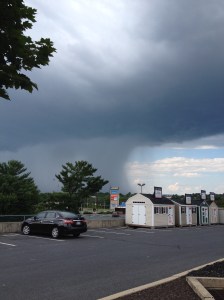
While heading to the store yesterday, after weather reports assured us the rain was finally over for the day, the skies told a different story.  The vistas around here are never what they were in the midwest—or what they are in Big Sky country—but the approaching storm was pretty obvious.  An opaque drapery of precipitation was coming our way and although a rainbow would cheekily show up afterward, knowing that we’d been caught away from home with our windows open felt like punishment for something.  Perhaps the hubris of buying a house when all I really require is a corner in which to write.  Somewhere in my reptilian brain I translated a natural event into a supernatural one.  When we got home to discover the storm had gone north of us, it felt like redemption.  I spied the birds sheltering in shadows from the sun’s heat.  Were they thinking it was some kind of divine avian displeasure, and hoping for some rain to cool things off for a bit?  If so, was our religion correct, or was theirs?


Meaning What?

An occasional reader will contact me to say that something I’ve been writing about for years has appeared in a major media source. Not the story I wrote, mind you, but in an episode of convergent explication somebody better connected has drawn the same conclusions I’ve been muddling over since the 1980s. So it goes. One such story appeared recently in the New York Times. Despite the title “Don’t Believe in God? Maybe You’ll Try U.F.O.s,” the piece is really about finding meaning. According to the Times, and I’ve been saying this for years, meaning is something that the facts don’t always give. Religion gives purpose to life. Most academics, naturally, ignore it.

The use of UFOs in this story is clearly an attempt at demonstrating the irrational. Those who see such things are the laughingstocks of the “sophisticated” crowd. Anyone who’s attended an editorial board meeting where a book mentioning UFOs is raised will know immediately what I mean. Laughter all around, no matter how serious the treatment may be. After all, only crazy people see them, right? That having been said, the Times article is quite correct that UFO religions are on the rise. Increasing numbers of earthlings are looking offsite for meaning. And who can blame them? Traditional religions often suggest that the beyond, however defined, is much more interesting than the mundane we find laying around all over here. Ironically, this can be a one way street.

What is that?

“Believers” in UFOs often resist the association with religion. After all, isn’t it the religious who are really crazy? As long as people see things in the sky they can’t explain (and this has happened for millennia) there have been Unidentified Flying Objects. Despite Project Blue Book they’ve never been studied in a serious way by science. The few bona fide scientists who’ve dared admit an interest have put their academic or industry jobs at risk. If you wonder why all you have to do is attend an editorial board meeting. We like to laugh at those more gullible than ourselves. As someone once said, indignation feels good. Nothing raises indignation like feeling superior to others. And we feel superior when their intellects are obviously so feeble as to believe in things like religion. Oh, I’m sorry! Were you expecting me to write “UFOs”? Well, go ahead and make the substitution. I won’t be offended. After all, I’ve been saying this stuff for years.


The New Neighbors

Apartment dwellers often ponder new neighbors. If anything gives the lie to being in control of your own destiny, renting your domicile does. Still using the old, aristocratic terms landlord or landlady, we know that we are under someone else’s authority. “As long as you’re under my roof,” my bully of a step-father liked to huff, “you’ll obey my rules.” When you rent, you can’t choose your neighbors. Those who own the property have final say. If they play the stereo too loud (“game” is probably the modern equivalent, but I was born before Pong even came alone) and won’t listen to your plea for a more monastic setting, you throw yourself on the mercy of your lord or lady. We got new neighbors this week. Not just us, but the whole galaxy. Seven new earth-like planets—surely ruled by Trump-like dictators—have been discovered. Let’s hope they’re early to bed, early to rise types.

During the Bush administration I often fantasized about the aliens landing on the White House lawn. I thought, with a president so obviously lacking intelligence, what would our new neighbors think of us? Would they complain to the landlord? You’d think that after that long trip across cold, vast interstellar space they’d maybe have the right to expect to find the brightest and the best in charge, right? Mission accomplished. The sign says so right there. Or to put it in a modern key, “Earth first, Earth first.” If they’ve got their intergalactic television on, I hope it’s switched to a different channel.

15207890820_d855b341e3_z

Contact, the novel by Carl Sagan, suggested the first contact from the aliens would be of Adolf Hitler. Among the first poisoned radiation this planet flung off into space was the fascist propaganda of 1930s Germany. Earthlings, not yet tempered by the Trump brand, were shocked. Surely this is a sign of hostility! Unless, of course, you control both the legislative and executive branches. Then you can just decide not to show up at the town hall and tell everyone you’ve got more important things to do. So, what will our new neighbors think? Do they just want the bodies of their compatriots from Roswell back, or is it a more serious discussion to be held behind closed doors? After all, African slaves were merely chattels in a negotiation between a more powerful culture and unhuman indigenous dullards with nothing better to do. On the spaceship back to their extraterrestrial slave mines, I do hope they have the common decency to keep the music down to a reasonable level.