Supernaturally Selected

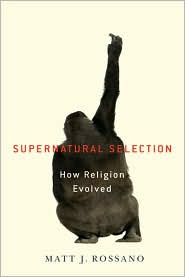
Things are seldom as simple as they seem. Religion, for example, is frequently cast as the villain or the hero of human society, when, in truth, like most human institutions, it is a little of each. I’ve read many theories on the origin of religion, and none has been completely convincing but most contain persuasive aspects while I’m reading them. After having read several books proclaiming the end of religion in the last several months, I just finished Matt J. Rossano’s Supernatural Selection: How Religion Evolved. Many books with a similar goal begin with the suggestion that religion may have had some biological utility for people at one time, but that we’ve outgrown our need for it and we should classify it with other obsolete, arcane concepts that have no further purpose. Rossano suggest that religion grew out of the need for social bonding and that we could not have become human without it.

Basing his ideas on genetics and anthropology, Rossano notes that even with our genetic similarity to chimpanzees there remain striking differences. Mostly they are social in nature. Many of the differences are reflected dimly in our primate cousins, but the human penchant for gathering in groups with ritual behavior to offset overwrought emotions applies only to us. That ritual behavior includes healing rites, something that Rossano suggests might be the earliest, shamanistic, religion. Back in my teaching days I’d been telling students that the earliest evidence for religious behavior dated to the paleolithic period. This is something I’d reasoned from the artifacts found in pre-historic communities. I was happy to find confirmation in a more competent scholar than myself.

While I’ll no doubt revisit some of the fascinating hypotheses of Supernatural Selection over the coming days, one point especially stood out on my initial reading. Religion is a communal phenomenon in what is a largely individualistic society. In other words, religion itself continues to evolve. Even the hermit in his or her cave is only considered religious in comparison with his or her less dedicated, secular compatriots living la vida de fe. Since religion is communal, Rossano suggests, it is impossible to argue someone out of their religion—based on perceived relationships as they are. Indeed, it seems that his hypothesis predicts a behavior we find only too evident when we prepare to line up at the polling booths, but which will immediately fall into the background again once the level is pulled.

Loaded Symbolism

Perhaps it’s all the politics in the news, or perhaps it’s the very long nights of January, but death comes to mind during the winter. One of the enduring preoccupations of religion is the issue of death. Christianities teach of wonderful rewards or horrendous punishments after the sloughing off of this mortal coil. Many eastern religions suggest the even scarier idea of reincarnation—we are doomed to repeat this sideshow over and over until we get it right. Since the universe has billions of years to go, that’s plenty of time for errors. When we finally depart, however, we leave our loved ones with the dilemma of how to handle our remains. Burial goes back to the Paleolithic Era—simple, effective, little fuss. Nature reclaims what we have borrowed for a century or less. This is the preferred Christian end, for, believing in the resurrection of the body, a body must remain. In some form. Other religions, noting the cleansing power of fire, prefer cremation. Those original Zoroastrians still prefer exposure of the dead to carnivores. It is, however, generally our religion that dictates our final disposal.

Enter the entrepreneur. The corpse becomes a commodity. You’ve got a problem and you’ll pay well for a satisfying solution. Some years back I saw ads for a company with the scientific, yet romantic concept that, as carbon, our corpses could be pressurized into diamonds. It is a costly procedure, but you could wear your beloved around your neck or on your finger as a chunk of the hardest substance on earth. A few weeks ago I found a more affordable solution on the website of Holy Smoke. Once you have made the decision to go with cremation, what do you want to do with that urn of ashes? Holy Smoke offers a solution: you can have your loved one’s remains loaded into ammunition shells. Taking care to handle the ash with profound respect, Holy Smoke will place the remains into either rifle or shotgun shells (one pound of human ash fills about 250 shotgun shells). You can then be shot toward eternity by loving relatives at their convenience. Gunpowder-propelled toward Heaven itself. Holy Smoke is located in Alabama.

Welcome to eternity

The problem of human remains is perhaps the most religious one of all. Our faiths give us the hermeneutic we need to face that great portal. As we consider the number of useless deaths brought on by Bush’s personal war in the Middle East, a kind of macabre closure can be seen through the smoke. After all, the NRA endorses the Republican Party. So does the Religious Right (unless, of course, they nominate a Mormon). Perhaps if we loaded our guns with our dead instead of live ammunition, the symbolism might finally hit its target. Holy Smoke could be offering a valuable service here to be shared between religious enemies. Instead of the kiss of peace, well, use your imagination. Perhaps it’s the very long nights of January, or perhaps it’s all the politics in the news.


A Summer Fright

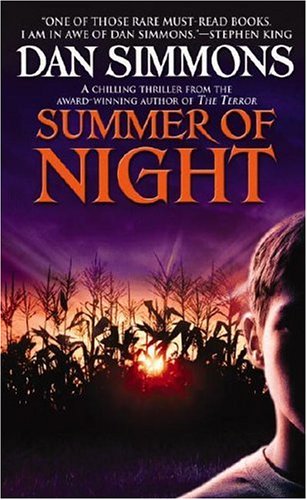
Although primarily known for his science fiction, Dan Simmons has also strayed down the dark path of horror fiction as well. During the depths of winter I found Simmons’s A Winter Haunting a moody and appropriate concomitant to the season. Not realizing that it was a sequel, when I saw his Night of Summer while at a Borders going out of business sale, I wondered if the same effect might work in warmer times. Both books rely on Egyptian funerary cult to move the story along, although in Night of Summer it is difficult to determine if the real menace is Osiris or the Judeo-Christian devil. Simmons has characters refer to Osiris as the power behind a haunted bell, but the climax of the story bears little resemblance to Egypt and quite a bit to standard monster flick tropes. “The master” of the reanimated dead is not explicitly identified. The use of Anubis in A Winter Haunting is quite effective, but the infernal characters were intermixed a little too much for my liking in Night of Summer. Better the devil that you know…

Perhaps it is simply that summer represents a time of relative ease and recovery from the frenetic pace of the remaining three quarters of the year. Although the heat and high humidity often make the season feel unbearable, the blush of abundance is all around. It is not easy to be afraid. When the air begins to chill and nature seems prepared to shut down production in the autumn, we naturally turn towards the desolate and constant struggle that will see us through the winter. Ancient people needed reassurance that warmth and relative ease would return. New Year’s rituals frequently marked autumn or spring, sometimes both. The death or life of the crops symbolized things to come.

Osiris, the god of the dead, also served as a god overseeing the renewal of crops for the ancient Egyptians. Death and life were knotted so tightly together that to unravel them was to fray the essence of the divine world itself. Among the cultures of the ancient world the Egyptians boasted the most developed concept of an afterlife. Even Paleolithic human burials contain grave-goods, demonstrating a belief in some kind of continuity beyond death. Simmons plays on that primal fear by resurrecting the dead in his novel. Beliefs about death and what might come thereafter have been one of the constant identifiers of religion from antiquity to the present. When evil pollutes the process the genre shifts to horror: witness the current fascination with vampires, zombies, and other undead entities. Religion and death are inextricably bound. Although Night of Summer may not live up to its sequel, the correlation between religion and fear meets the expectations of the genre, even during the long days of relative ease.


Sects Sells

Once again the headlines tell the story of a child molested by a “celibate” priest now suing the church as an adult. That money dropped in the collection plate goes to cover the cost of sin. The disclosures continue to find the light of day not only in the Catholic Church, but across the religious organizational spectrum. It is an extremely unfortunate situation, but I can’t help wonder if religions are naturally susceptible to sexual expression.

Sexuality and religion go back a very long way. I have suggested elsewhere on this blog that some of the earliest evidence for religion, all the way back to the Paleolithic era, is sexual in nature. One of the blatant aspects of our own cultural conditioning is that we can no longer see the connection. We inhabit a post-Victorian world, a world that strenuously repressed sexuality and removed it from the sphere of human discourse. One of my favorite examples of this is when the standard classical Hebrew-English dictionary (Brown-Driver-Briggs, for those of you who need to know!) makes reference to sexual activity in the Bible (and it is abundant), the editors delicately slip from English to Latin, so as not to offend the sensibilities of clerics and other gentleman-scholars reading the entry. This antipathy to the human condition can be traced even further back to the Greeks who felt that the physical body was much more base than the spiritual, or intellectual aspect. Sexuality was a source of embarrassment and perhaps even shame.

I’m not a psychologist, but it is pretty clear what occurs when strong feelings and drives are repressed for a long time. The early Christians who believed Jesus’ second coming to be imminent did not wish to be caught in flagrante delicto. Sexuality was to be avoided since time was short. When this became formalized and priests, probably very decent people overall, were forced to relinquish their sexuality, it was assumed that it would simply evaporate into the ether and harm no one. We have known for decades that this is naively wishful thinking. As the margarine commercial used to say, “it’s not nice to fool Mother Nature!”

What's Mother Nature hiding?

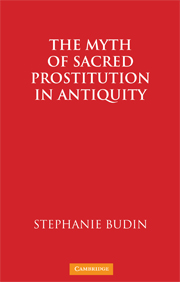
Ancient sects were not sexually depraved. Stephanie Budin (The Myth of Sacred Prostitution in Antiquity, Cambridge, 2008) has done a good job showing that the case for sacred prostitution in the ancient world has been grossly overblown. Nevertheless, sexuality had a natural place in ancient religions. Any number of nervously giggling teenagers who’ve just discovered the Song of Songs in the Bible know that! The problem arises when our religious culture refuses to acknowledge the obvious. We bottle it up and try to keep it hidden, but when it finally appears the price tag is very steep indeed.


Care of the Dead

Stretching back before the advent of writing, back before civilization itself began, people have shown reverence for their dead. Paleolithic era grave goods attest to care of the dead residing among the earliest strata of human behavior, and it is a behavior that continues to evolve to reflect the belief structures of the Zeitgeist. The idea of constructing cemeteries in a garden where family and friends might visit their departed is a relatively recent innovation. Increased population and concerns about epidemics led to the landscaped, garden-variety cemetery outside of populated areas in the 18th century. Before that graveyards could be located within the city itself, often near a church or sacred location.

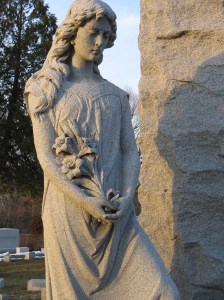
While visiting Swan Point Cemetery in Providence, my niece asked me why people left pennies on gravestones (H. P. Lovecraft’s tombstone had one on it, and others around it). My thoughts went to Wulfila’s recent blog post on the Black Angel tomb in Iowa City and the pennies scattered there. I also recalled La Belle Cemetery in Oconomowoc, Wisconsin where a “haunted statue” was always richly endowed with pennies in her cupped hands. LaBelleThe specific form of penny offerings seems to go back to Benjamin Franklin’s burial, at least in America. A few years back while in Philadelphia, I saw for myself that people still leave pennies on Franklin’s grave in Christ Church Cemetery.

Franklin

Franklin pennies (and a few nickles)

There is no universally accepted reason explaining why Benjamin Franklin should have been the first to have received such treatment — in fact, I would argue that it is much older than Dr. Ben.

Money to accompany the dead has a long history. Pennies on the eyes or under the tongue of the deceased originated in the need to placate the ferryman across the river of — what’s it called? — Oh, yes, the river of forgetfulness. The classical Greek form of this mythic character is Charon, the boatman who punted the dead across Styx. He required payment, and since coinage had been invented, it was a convenient way to pay. (Today the truly devoted might leave a credit card in the casket.) The ferryman must have his pay, as the movie Ghostship warns, but the idea is much older still. The earliest references to being poled across the river go back to ancient Sumer, the earliest known civilization. As soon as people became civilized they began to pay homage to the gloomy captain of souls.

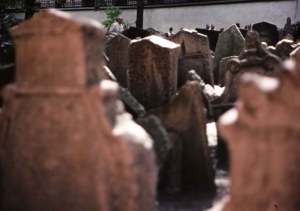
While in Prague just after it opened to western visitors, my wife and I stopped by the famous Jewish cemetery where the tombstones are so tightly packed in that they are barely legible. My wife asked why so many of the tombstones had smaller stones on top, placed there as dedications.JPrague I recalled having seen stones on tombs outside Jerusalem some years back, and I even had a student bring me a stone from Israel to keep as long as I promised to put it on her grave after she died. This practice in its recent form is associated with Judaism, but again, it has ancient roots. The building of cairns, or piles of stones, is often associated with the Celts or the pre-Celtic inhabitants of the British Isles. On our many wandering through the highlands and islands we saw several Neolithic examples in Scotland, particularly in the Orkney Islands. The practice of putting stones atop the dead also goes back to ancient times. One plausible suggestion is that it was intended to keep the dead in their graves. A more prosaic conclusion is that digging deep holes takes more work than hauling over a pile of rocks.

No matter what the origin of the practice may be, one of the surest signs of civilization is care for the welfare of the dead. Today a penny is easily left, costs the bearer little, and creates a memorable image for all who follow.