
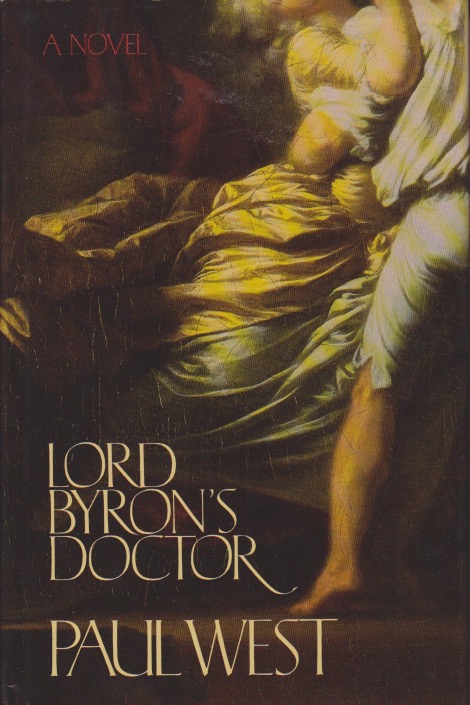
My recent fascination with the meeting of Lord Byron with Percy Shelley’s party in 1816 led me to read Paul West’s novel Lord Byron’s Doctor. In case this meeting isn’t familiar to you, it involved five English travelers gathering for a few months outside Geneva. Those present, beyond the two already named, were Mary Godwin, soon to be Mary Shelley, Claire Clairmont (her step-sister), and John William Polidori, who was, well, Lord Byron’s doctor. Polidori, when not being completely overlooked, is a bit of an enigma. He aspired to literary renown and produced a few works. His most notable piece, “The Vampyre,” was initially attributed to Byron. He wrote at least two plays and a novella, as well as some nonfiction. He had been hired by Byron’s publisher to keep a diary of their travels, which, it turns out, leaves Byron out most of the time.
It’s clear from the historical sources that Polidori was quite jealous, both of Lord Byron and Percy Shelley. They were both aristocratic and had achieved fame through their writing, but Polidori not so much. He also seems to have been jealous that Shelley received Byron’s attention unstintingly. Byron was a lord and Shelley the scion of an aristocratic family. Polidori, while not exactly what we’d call “middle class” today, did not have nobility in his family and, perhaps worse among the English in the period, he was half Italian. Paul West takes the story of Polidori and tries to flesh it out. I haven’t read any other of West’s works, but given this novel I’m unlikely to. He does do a good job of probing the inner feelings of being left out and excluded from what one really wants to do with one’s life. (Some of us know this firsthand.) He overdraws, however, just about everything.
For anyone with an idea of what happened among the English party that summer, and the fact that Byron dismissed Polidori when the summer was over, the basic shape of this narrative will be familiar. As an extended character study it seems to do passably well. Some of us, however, find trying to think like someone else might have a bit of a fatuous fictional folly. My mental image of Polidori, apart from the feeling left out part, is quite different. In other words, attempting this kind of novel is sure to put some readers off from the start. I gave it a good faith effort. Some parts of it I enjoyed. The whole, however, felt tedious and too long. It may, however, give some readers a sense of who Polidori might have been.
 Steve A. Wiggins