Officially Broken

Now that democracy is officially broken, it was with some poignancy that I stumbled upon a piece of ancient history.  Everyone has a box that contains their past life.  It used to be a physical box with papers in it, and in mine (which still has actual papers), I stumbled across a letter yellowed with age, dated 1980 from Conshohocken, Pennsylvania.  In an ill-fated career as a teenage journalist, I reported in the results of the presidential election from one of the polling places in Oil City, Pennsylvania.  The envelope held a serious letter from a state official letting me know how important my duty was.  As I looked at my teenage scrawl two things became clear: the Democrats had won in what is now a deeply red zone, and even when democracy worked it didn’t work well.  

You see, I had a number to call to report the results.  Since toll-free numbers hadn’t proliferated at that time in history, I was to make a collect call.  And since I lived in Rouseville, some three or four miles away, I couldn’t get the results in immediately.  On my way home, before making the collect call, it was announced that Reagan had won.  The ballot results, still tucked away in my envelope, hadn’t been reported, and obviously they weren’t important.  It was the first election in which I voted and I learned then that the system didn’t take all votes into account.  Now that Trump is firing those who managed to testify at his impeachment Republican senators reply, “Yes, that’s good, that’s right.  It’s as it should be.”  Democracy is dead.

These United Orwellian States displayed their predilections long ago.  I’d read 1984 about that time, before the eponymous year of the title.  I’d been deputized to report on an election whose results were declared before every vote was counted, and I lived in the Eastern Time Zone.  I didn’t vote in elections for several years after that.  When politically conscious friends asked why not, I said “what’s the point?”  You see, the reporting assignment was part of a current issues class in high school.  It was to teach us how government worked.  My teacher’s signature still graces the form inside.  As one political party has embodied massive dereliction of duty, we limp along toward November.  I don’t know if my vote will count or not, but I will be at the polls again.  Anyone who believes in democracy will have to be.  And perhaps, just perhaps, all the pre-planned cheating won’t work this time around.  Eric Arthur Blair, it is said, died a paranoid man.

All in This Together

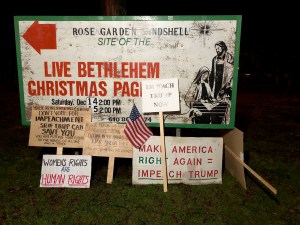
The rain falling from the dark sky is barely liquid.  The thermometer reads 33 as we step out into the early evening—this is not the kind of night I’d want to be outside, but this is important.  When we arrive in Bethlehem there are already maybe a couple hundred people lining Rose Garden Park with signs.  We park and join them.   Many of the signs are clever and to the point: “I shouldn’t have to miss Nixon,” and “Vichy Republicans—shame on you!”  This winter of discontent, crumbling democracy, we are here as warm bodies on a cold night to protest what has gone on far too long.  The impeachment vote is scheduled for today and across the country people have come out—supper hastily eaten or yet to be started when they get home—to say enough is enough.

Now Pennsylvania isn’t the bluest of states.  I wasn’t sure of what our reception would be on the busy corner of 8th Avenue and Union.  I was amazed.  Large numbers of cars, and even some commercial trucks, honked their horns in support as they drove by.  Thumbs up out windows in the cold air.  Long blasts on horns.  For sure, many drivers remained silent, but only three that I counted bothered to roll down their windows and shout support for Trump.  They were treated respectfully and cordially by the protesters, many of whom were considerably older than my wife and me.  I listened to snatches of conversations as my fingers and toes grew numb.  Vietnam vets, and even one from the Second World War.  Retirees who should be spending December nights in their warm homes.  We all had something important to do.  We had to stand and be counted.

Because of a childhood incident, I suffered mild frostbite on my fingers and toes.  It is excessively painful for me to be out in the cold to this day.  We could only stay for about an hour and a half.  It was a work night after all.  There were many stalwarts still holding signs and chanting as we headed back to our car.  Around a sign for the park where other, more temporary signs stood, a protester said, “Someday maybe we won’t have to do this anymore.”  A younger man corrected him.  This happened because we failed to be vigilant.  Vichy Republicans are a real thing and although the elections are about eleven months away, we need to get ready.  We need to get everyone out to vote.  If the signs of support we saw last night reflect the feelings of Americans, it’s time for us to become a democracy again.


Seventies

It’s pretty rare for me to be out on a week night.  Like a kid on a “school day” I’ve got to get up early the next morning.   And yawning a lot at work is bad form, even if nobody can see you.  I risked it recently, however, to meet with some colleagues from the Moravian orbit in Bethlehem.  As we talked, current projects came up, as they’ll do when doctorate-holders get together.  Demons are a conversation stopper, but I nevertheless asserted that our modern understanding of them derives directly from The Exorcist.  The insight isn’t mine—many people more knowledgable than yours truly have noted this.  One of my colleagues pointed out the parallel with The Godfather.  Before that movie the mafia was conceived by the public as a bunch of low-life thugs.  Afterward public perception shifted to classy, well-dressed connoisseurs who happen to be engaged in the business of violence and extortion.

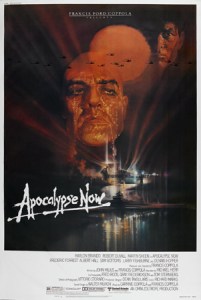
The insight, should I ever claim as much, was that these films were both from the early seventies.  They both had a transformative cultural impact.  Movies since the seventies have, of course, influenced lots of things but the breadth of that influence has diminished.  I noticed the same thing about scholarship.  Anyone in ancient West Asian (or “Near Eastern”) studies knows the work of William Foxwell Albright.  Yes, he had prominent students but after Albright things began to fracture and it is no longer possible for one scholar to dominate the field in the same way he did.  Albright died in the early seventies.  Just as I was getting over the bewilderment of being born into a strange world, patterns were changing.  The era of individual influence was ending.  Has there been a true Star Wars moment since the seventies?  A new Apocalypse Now?

You see, I felt like I had to make the case that The Exorcist held influence unrivaled by other demon movies.  We’re still too close to the seventies (Watergate, anyone?) to analyze them properly.  Barbara Tuchman suggested at least a quarter-century has to go by for the fog to start clearing.  Today there are famous people who have immense internet fame.  Once you talk to people—some of them my age—who don’t surf the web you’ll see that internet fame stretches only so far.  It was true even in the eighties; the ability to be the influential voice was passing away into a miasma of partial attention.  The smaller the world gets, the more circumscribed our circles of influence.  And thus it was that an evening among some Moravians brought a bit of clarity to my muddled daily thinking.


Read a Book

A huge shout-out to Andrew Laties for conceiving and organizing the Easton Book Festival!  Easton may not be the largest city in the state, but the Lehigh Valley is Pennsylvania’s fastest growing area.  As we discovered when we moved here almost a year-and-a-half ago, it is a region that supports bookstores.  Even before the Festival we’d explored some six or seven and after moving from central New Jersey—where keeping a small shop or two open was a struggle.  We’ve become spoiled for choice.  Writers may not be the easiest people to herd—many of us are quiet and tend to live in our own heads quite a bit—but the festival has brought some 200 of us together, and we write on all kinds of things.

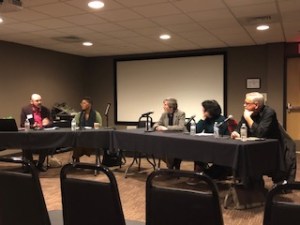
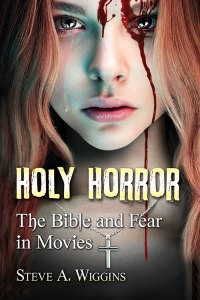
Although the panel on which I participated had religion as one of its themes, my wife and I noticed that at each session we attended religion was mentioned.  Either it was in an author’s background, or it figured into their writing, or most embarrassingly, it objected to and tried to silence them through censorship.  Although my book’s subtitled The Bible and Fear in Movies, it was evident that I wasn’t the only person who found the Bible’s effect on people scary.  And the theme continued into the evening as I attended the author’s banquet solo.  Many of the people I met had religion in their background or in their present motivations for writing, and not one of them was judgmental toward a guy like myself who’s trying to find his way.

The Easton Book Festival is in its first year.  Although by late afternoon the weather had deteriorated into the rain we can’t seem to shake around here, it was wonderful to see people walking around with festival booklets (there are enough events to warrant one) and not bothering to conceal and carry.  Books, that is.  For a moment, they were cool.  My second session is this afternoon.  As I learned both last weekend at my book signing and at sessions yesterday, a sell-out crowd is unlikely.  This is a free event and even authors who had more fingers than attendees were gracious and glad for the opportunity to explain what they were trying to do with their writing.  And they unstintingly shared what they’d learned with one another.  This was community, centered around books.  It was a small slice of what Heaven could be like, if we’d all just take an interest in each other.  Even if we’re shy and secretly would rather be home writing.


Book Magic

Something happens to you on a long bus ride, reading a mind-blowing book.  Part of the transport—literally—is that you’re captive for an hour or two and your book is your boon companion among snoring strangers.  Another aspect is the earliness of the hour.  Days like yesterday, when I have to commute to New York, involve awaking at 2:30 a.m.  The day is cast very differently when your timing shifts back by a few hours.  It’s almost mystical.  The largest portion of the transformative experience, however, is the book itself.  I’ve begun commutes with a book that I quickly realize is a mistake, but since I’m not a quitter, I soldier through it to the end anyway.  On yesterday’s commute the book was one of those that caught my imagination and flew it like a kite from the rear of the bus.  Arriving in Manhattan before six a.m. added to the feeling.  The city’s a very different place that time of day.

Not everyone enjoys reading, I realize.  My late stepfather once had a job as an elevator man.  Not the kind dressed in livery at a big-city hotel, but as an operator in an antiquated building in Oil City, Pennsylvania, where you had to pull the metal gateway  physically across the door and wait until the floor leveled before opening it again.  I didn’t get along with my stepfather, but one day I went to visit him in the elevator.  It wasn’t a busy building.  He sat on a stool, staring straight ahead.  For hours at a time.  Not a man prone to meditation, I knew he had to be bored.  I asked if I could bring him something to read, at least.  He declined for fear of missing someone’s call signal.  It was one of the most frightening scenarios I could imagine.

The clock in the Port Authority read 5:49 when we pulled in.  The day seemed full of possibilities.  I caught the 4:30 home, but the magic was gone.  The book had moved on to more technical things.  Traffic was bad, and there’s a world of difference between reading while the bus moves and trying to do so when it’s caught in traffic.  The commute out of New York City is normally a nightmare, and yesterday traffic didn’t flow freely until we were nearly through New Jersey.  My book was still my companion, but rather more like when a conversation ebbs after an intense discussion.  There was the worry of getting home, taking out the garbage, and trying to stay awake until a reasonable hour.  The book would still be there tomorrow, but I wouldn’t be the same.


Book Culturing

The other day I met one of the organizers of the Easton Book Festival.  Coming in October, this festival is something new.  It took the efforts of a couple with vision—the owners of a small, independent bookstore—to get other people on board, but now it’s going to happen.  A weekend dedicated to books.  I found out about the Festival as I was looking up area bookstores that might let me do a presentation on Holy Horror.  For whatever reason, my last book missed its projected autumnal publication date, and fall is when people are really thinking about horror movies.  Approaching its birthday in late December, it never really had a proper launch.  Priced the way it is, I don’t expect a sales boost, but I would like people to know about it.  When you spend years writing a book you’d like it not to be completely obscure.

In any case, when looking up one of the Easton shops—hey, book lovers, the Lehigh Valley has lots of bookstores!—I noticed that the Festival was still seeking participants.  Since it falls just before Halloween, the timing felt perfect.  I signed up.  Now this is one of the many new tricks for this old dog.  I tell authors all the time that self-promotion is key to book sales, even when a press is fairly widely known.  In fact, the store owner himself writes books and has to pay for his own tours to promote them.  Book culture is worth promoting.

On a personal level, it does me good to see that there are others who appreciate books.  They are a form of collective mind.  A communion.  When I’m feeling down, or uninspired, a trip to a bookstore—or even a library—often helps.  Reading books leads to a sense of accomplishment.  Every year I set a goal on Goodreads.  I don’t set the goal to make me read—I’d do that anyway—but to share with others both what I’ve been reading and what I think about it.  The Easton Book Festival will be a way of doing something similar, hopefully with those many others who feel the draw of books.  Writing, for me, is a labor of love.  I don’t know too many people personally, so meeting them through books is one of my own goals.  Just the other day I met an academic who wanted to read Weathering the Psalms.  Such things happen only in that wonderful land built of books.


AKA

“Professor?”  While not technically correct, I was surprised and not unpleased to hear the title yesterday while on the streets of Easton.  One of the greatest compliments a former teacher can receive is word from a former student.  While dressed in Saturday clothes on the way to the country’s oldest continuously operating farmer’s market, I wasn’t sure the voice intended was for me.  I’ve been out of the classroom now since 2011.  Sure enough, one of my students from Rutgers recognized me and called out.  We had an ersatz but wonderful conversation after a completely chance meeting.  Already since graduating he’s had a few different jobs, but he remembered the classes I’d taught and I recalled that he’s the person who started me reading Neil Gaiman.  Teaching is, you see, a two-way street.

I’m doing a guest service at a local church next Sunday.  In preparation I’ve had lots of emails (for me).  One of them was from the music director.  He opened by calling me “Reverend.”  I’ve never been a reverend.  The idea isn’t unappealing but I’ve gone pretty far down the path of independent thinking and any church that would ordain such as me would need to be comfortable with that.  In fact, I heard a sermon recently by an Episcopal priest and was pleasantly surprised at how welcoming and, dare I say, liberal it was.  I was never really welcome in that club, I know.  When I was still fairly fresh out of seminary and working on my doctorate the idea of being “Rev. Dr.” was still appealing.  Now I go by my first name.

Labels.  I tend to eschew them.  Like my young colleague I’ve had to learn that work doesn’t necessarily define you.  (I’ve had many employers, however, who not only beg, but insist to differ on that point.  The ideas of owning individuals die hard, apparently.)  On the weekend, though, off the clock, people are calling me “professor” and “reverend.”  I’m generally sitting in a corner with my laptop on those early mornings calling myself a “writer.”  For none of these things do I receive any pay.  (Well, perhaps some for writing, but very little and very infrequently.)  The move to our new location was a chance, I think, to try to remake myself.  A chance to figure out what labels, if any, really fit.  Better throw “telecommuter” and “remote worker” into the mix.  Those are the ones, come Monday morning, that matter most.


The Sound of Musik

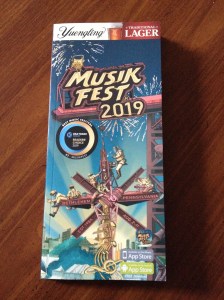
“Why is there so much people here?”  The words aren’t mine, but those of a random stranger I heard in Herald Square.  Not only was it grammatically offensive, I always find “much people” in Manhattan, but this was the occasion of the Pope’s visit a few years ago, so more of us were crowded into that area than normal.  It was a feeling that returned last night as my wife and I wandered around Musikfest.  If you’re not from around here, Musikfest is the largest free music festival in the United States, and it takes place in Bethlehem each summer.  Ten days of free, live music and tents hawking wares and all kinds of comestibles, as well as that strangely satisfying feeling of being lost in a crowd.  We ended up there more or less accidentally.

I was an experimental subject.  Those of you who know me will probably not find this odd, and you may well come up with many reasons to find me in the psychology department, some involving locked doors.  This was, however, a voluntary research project that required participants and it had been literally decades since I’d volunteered to be one of the “much people” who was not not part of the university crowd.  It felt good to be on a campus again.  The Lehigh Valley hosts several colleges and universities, and that draw is perhaps related to why Musikfest is held here.  When we got to town my wife realized we might have trouble parking.  Sections of downtown Bethlehem are closed to traffic and there are people everywhere.  I finished my experiment and we became part of the crowd again.

Music and religion, I’ve noted before, hang out in the same crowd.  They both have the ability to be transcendent and people seek out such experiences.  Since we hadn’t planned on attending—accidental musicologists we—we had no groups as targeted hearing while we wandered.  Mostly we marveled at the size of the event.  The city of steel transformed to the city of music.  And the religious feelings music brings.  As I walked from the college back to downtown, a couple strangers accosted me.  “Hi, brother,” they said.  “Heading to Musikfest?”  This, I realized was a congregation.  I was an unknown brother.  Music brings peace.  Dona nobis pacem, sisters and brothers.  Like those crowds a few years back hoping for a glimpse of the pontiff, an entire city had kicked off its shoes for a Friday night of potential transcendence.  Why is there so much people here?  Simply listen and you’ll have your answer.


Making Monsters

It’s not so much I’ve been away from monsters lately, but that life has intervened between them and me.  Life can be scarier than monsters sometimes.  In any case, the summer is when my mind turns back to haunting even as on the breaks during heat waves a whiff of autumn can be caught on the air of a July morning.  Yes, we’ve past the solstice and days are getting shorter.  Slowly, of course, but that’s what builds suspense.  And there are local signs that I need to get my haunting in gear.  It is finally time to get Holy Horror out of wraps and give the book a proper launch.  Being published around Christmas last year was poor timing for a subject so readily coded for fall.

I received the welcome news this week that the Moravian Book Shop—the oldest continually operating bookstore in the country—will be hosting a book signing for Holy Horror in October.  This is a fortuitous turn of events because when I first approached them with the idea the price of the book made the idea look unrealistic.  But we’re now thinking of autumn, and with autumn comes Halloween.  There have been a spate of horror films this summer, all of which I’ve unfortunately missed.  Time, as Morpheus notes, is always against us.  There does, however, seem to be a lively interest in the genre and the curious wonder what it has to say about what we believe.  Horror loves religion, and indeed, thrives on it.  So it’s been from the beginning.

October will also see the Easton Book Festival in this area.  I will be on the program for that as well.  While none of this is earth-shattering, these events represent the first successes in trying to build awareness of Holy Horror.  This was a book written for a general readership, but not priced for one.  Working in the academic publishing world, this is a phenomenon with which I’m all too familiar.  Many colleagues offer to read and spread news about your book.  It seldom happens, though.  Academic presses can’t afford book tours (especially if they have to price books at $45), but these self-driven presentations are opportunities to spread the interest in ideas.  That’s what those of us who write really want—to be part of the conversation.  We’re in the midst of a heat wave here.  It’s the height of summer.  Even so, those who know about monsters can feel them coming, even from here.


Refuge in Diversity

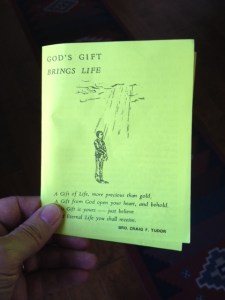
The Easton Saturday morning farmer’s market is a happening place.  Daring to spend a non-raining Saturday away from mowing, my wife and I decided to check it out.  If you’re not familiar with Easton, Pennsylvania, it has more than the Crayola factory that smells like childhood itself.  The downtown is marked by a traffic circle with an island in the middle large enough to fit, well, a thriving farmer’s market.  As usual, large gatherings attract those selling spiritual rather than material goods.  A very well dressed gentleman handed me a flier and when I got home I had to look up Refuge Church of Christ to find out what it it’s all about.  A New York City-based denomination of predominantly African-American membership, the church has over 500,000 members.  That I hadn’t heard of it before is no surprise.  There are well over 40,000 denominations of Christianity alone and it’s difficult to keep track of them all.

There comes a time in the life of anyone who takes religion seriously enough to study it professionally when s/he’s inclined to ask which is the original.  Think about it: you’re bartering with your eternal soul on the barrelhead here and don’t want to make the wrong choice.  When someone invites me to convert (I don’t know the secret handshake to show I’m already a member) I’m curious about them.  The unfortunate thing about all of this is that each tradition believes it has the truth and most, if not all, others have got it wrong.  Few are the faiths that declare, “Believe whatever, just believe.”

I once tried to make a denominational genealogy chart.  Part of the problem is that tracing things back to Catholicism isn’t quite right.  The Roman Catholic Church as it exists today is quite different than anything Paul, or Peter, or James would’ve recognized.  To say nothing of Jesus.  And that’s inevitable.  Religions don’t stay the same.  They evolve as soon as they pass from person to person.  Those who belong to denominations often do not know what the official teachings of the body are, and getting back to the original they’d find that their denomination started out believing things quite different than its own current theology.  If you’ve got only one soul with which to make that eternal decision and literally thousands of choices, well, let’s just say that you don’t want to think about it too much.  Besides, we’re here for fresh fruits and vegetables.  And it’s a rare gift of a Saturday without rain, no matter who’s responsible.


Fear of Religions

There’s a narrative of fear in Christianity that seems to have been absent at the beginning.  This is evident when driving the highways of America where you’ll see billboards (which are meant for selling things) advertising the truth of a kind of biblical Fundamentalism.  On my recent trip across Pennsylvania this fear stood out in some rather obvious ways.  And it doesn’t reflect the Christianity reflected in the Good Book.  Stop and think about it: although the persecution of early believers was probably never as widespread as the usual narrative says it was, the writings we have describe facing persecution with joy.  Believing that they would be delivered, the oppressed welcomed the opportunity to prove their faith.  The Chick tracts I read as a child, however, focused intently on how scary the future persecution would be.  Fear, not joy, was the motivation for belief.

As we stopped in a turnpike rest area, we noticed a kiosk of Christian books amid snacks both salty and sweet.  The only other reading material available had to do with tourist attractions and finding directions.  It was, upon retrospect, odd.  Pondering this I recalled the narrative I heard repeatedly in my youth—a time was coming when it would be illegal to be Christian.  There would be persecution and the only proper response was a faith borne of fear.  This was not a religion of love thy neighbor.  No, this was a religion of armed survival based not on turning the other cheek, but on asserting itself with a show of firepower.  This kind of weaponized evangelicalism has taken over the narrative of Christianity.  Paul of Tarsus, knowing he would likely be executed, wrote of his joy from prison.  In the land of plenty we tremble.

The more cynical side of my experience suggests that politicians—who have learned that fear gets them elected—found in this form of Christianity a convenient set of sheep without a shepherd.  There’s fear in these billboards.  Fear that another religion may take over.  Or that secularism may make cherished beliefs illegal.  This isn’t cause for celebration, as the sermon on the mount proclaims it should be, but rather a call to arms.  In this country we have more than enough.  Among those left out, however, this fear grows just as rapidly as among those who fear they may lose the abundance they have.  They try to convert the weary traveler whose eye is drawn to the billboard.  And even those who stop for a drink of cold water which, the Bible suggests, should be freely given.


Cool Cash

The seller’s market is the place to be in a capitalist society.  Last year, when we were looking for a house, it was a seller’s market.  Our realtor said he’d never seen inventory so low and staying so low.  We found a domicile we liked, but it was older and had obviously (only after moving in) been neglected.  The previous owners, it was clear, had simply let things go (and they were younger than us, and had no excuse).  When we asked for a new roof they had flat-out refused.  With no other options (our lease was about to expire) we agreed to take it on anyway.  We’ve been having the roof done in installments—and if you’ve been getting the record levels of rain that Pennsylvania has, you know our decision was, in a literal way, short-sighted.  Ah, capitalism!

So, just after I noticed the piles of sawdust that the web tells me are carpenter ants, the refrigerator died.  Of course.  I tried to keep cool.  We don’t have what the overlords call “liquidity.”  Our cashflow is dammed at the source, as it were.  A new major appliance was not a welcome addition to the fixer-ups that appear nearly every day.  The first warning was that my soy milk was room temperature when it splashed on the cereal yesterday.  All of this made me reflect on how much we rely on our appliances, our modern conveniences.  When talking to my mother later in the day, I realized that as recently as her generation not everyone had a refrigerator.  You could live without one.  You could also live without a dishwasher, believe it or not!  

The whole episode of packing the food in ice sent me on a Calvino-esque reverie of what we keep in the refrigerator.  There are foods that must be kept cool or they’ll spoil, foods that are better if they’re kept cool but can be left at room temperature, foods that you prefer to drink cold but can be kept anywhere, and items which are technically not food.  Considering the state of our kitchen, there are also foods that you keep on top of the refrigerator because no amount of cupboard space is ever enough.  As the carpenter ants make their free lunch of our porch, we have to throw away food for which we paid because an appliance has come to the end of its life cycle.  And since it’s a holiday weekend we’ll pay for a more expensive replacement unit because it’s on a holiday sale.  For unlike my soy ice cream, I lack liquidity.


Thunder Towers

It sounded like brontide.  The Martin Tower, the tallest in the Lehigh Valley and once corporate center for Bethlehem Steel came down yesterday morning.  Completed only in 1972, the following decade saw the collapse of the steel industry, and the building has sat vacant a dozen years.  Now it’s gone.  The reasons the building could no longer stand are many and I won’t try to explain them as if I understood.  The fall of the tower, however, put me in mind of human folly and the belief that corporate profits will only ever grow.  Capitalism is built on a set of myths that the wealthy truly believe—I suspect many others do too, otherwise the system couldn’t possibly last.  Adam Smith may have been right academically, but in reality humans are greedy, venal, and shortsighted.   At least those who “rise to the top” are.

We didn’t move to the Valley for the steel.  Having settled in New Jersey just about when the Martin Tower was abandoned, like many other displaced academics I was looking for a job.  There were cities in the Midwest—we weren’t far from Milwaukee or Madison—but there was no work.  If you’re “overeducated” your best bet is to settle near a huge metropolitan area, as closely as you can afford to.  Then hang out your shingle.  Capitalism, however, has made New Jersey affordable only for the excessively wealthy.  Besides, I was born within the imaginary lines that we call the Commonwealth of Pennsylvania.  In fact, when I got my license transferred last year the computer asked me if I still lived in Venango County, where I was born.

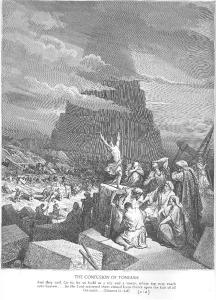
I didn’t see the tower come down.  It’s not visible from my house, but it was always right there when I drove to Lowes to pick up some necessary hardware to survive in this area.  (Weed-whacker and lawnmower—reel variety.)  My mythology of towers always takes me back to Babel.  In the biblical worldview towers were a sign of arrogance.  God seemed to think they were trying to invade divine turf, and so he made it so we could no longer understand one another.  There hasn’t been a moment’s peace since.  We build towers tall to show what we can do.  We don’t really need an angry deity to come down and confuse our language any more.  We’ve got capitalists and their excess money to lead the way.  The sound of thunder roared and I divined just where such leadership will guide us.


Bradbury’s Dream

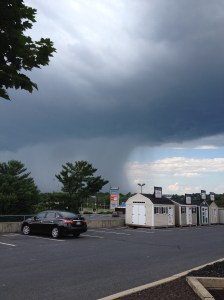
There’s a Ray Bradbury story—I can’t recall the title, but with the Internet that’s just a lame excuse—where explorers on Venus are being driven insane by the constant tapping of rain on their helmets.  They try to concentrate on discovery, but the distraction becomes too much for them.  Living in Pennsylvania has been a bit like that.  I grew up in the state and I knew it rained a lot.  Here in the eastern end we’ve hardly since the sun since March.  And when you’ve got a leak in your roof that only compounds the problem.  If I were weathering the Psalms, mine would be a lament, I’m afraid.  You see, the ground’s squishy around here.  Mud all over the place.  Rivers have been running so high that they’re thinking about changing their courses.  And still it rains.

There’s a lesson to be taken away from all this.  The fact that we use water for our own ends sometimes masks the fact that it’s extremely powerful.  Not tame.  The persistence of water to reach the lowest point contributes to erosion of mountains and valleys.  Its ease of transport which defines fluidity means that slowly, over time, all obstacles can be erased.  It’s a lesson in which we could stand to be schooled from time to time.  Rain is an artist, even if it’s making its way through the poorly done roofing job previous occupants put into place.  Would we want to live in a world without valleys and pleasant streams?  And even raging rivers?

There’s no denying that some of us are impacted by too much cloudiness.  When denied the sun it becomes easy to understand why so many ancient people worshipped it.  Around here the temperatures have plummeted with this current nor-easter and the heat kicked back on.  Still, it’s good to be reminded that mother nature’s in control.  Our high officials have decided global warming’s just alright with them, and we’re warned that things will grow much more erratic than this.  As I hear the rain tapping on my roof all day long, for days at a time, I think of Bradbury’s Venus.  Okay, so the story’s appropriately called “The Long Rain” (I looked it up).  Meanwhile tectonic forces beneath our feet are creating new mountains to add to the scene.  Nature is indeed an artist, whether or not our species is here to appreciate it.  If it is, it might help to bring an umbrella this time around.


Different Kind of Salvation

It’s encouraging and disheartening all at the same time.  And seldom has the evil of money been so obvious.  Last night I attended an environmental panel discussion at a local church.  It was encouraging to see so many people out on a rainy, chilly night in Bethlehem, a city famous for its might steel mill.  Everyone there knew the problem and agreed that something had to be done.  As the speakers gave their presentations it became clear just how corrupt politicians are.  Corruption is bipartisan, of course.  In the name of “economic growth” we allow the fracking rape of our state despite the known and proven environmental hazards.  Despite the fact that Pennsylvania has a green amendment in its state constitution.  Money, as Cyndi reminds us, changes everything.

Shortly after even Mitch McConnell admitted climate change is real, at the state level climate deniers are running things.  It brought to mind the frightening and omnipresent teachings of my Fundamentalist youth: the sooner we can destroy this planet the sooner we’ll make Jesus come again.  Convinced of the absolute certainty of that second coming, there is almost a mandate to ruin, pillage, and plunder natural resources because the Good Book ensures us that, upon a white horse the savior will come in the nick of time.  Politicians, elected officials believe this.  They also believe in mammon.  If you’re gonna go down, you might as well do it in style.  Like John Jacob Astor on the Titanic.  It’s the way of the aristocrat.  Rising seas drown rich and poor alike.

It was a miserable night to be out.  The weather has been freakishly off for some time now, and all the science—real science, that is—predicts it’s only going to get worse.  How the government became the enemy of the planet that gave it birth would be a fascinating story if only it were fiction.  The truth is we’ve elected people that can be bought.  And bought easily.  Laws are passed that violate the constitution of this commonwealth and meetings are held behind closed doors.  Local activists are very active while most of us struggle to keep ourselves employed, heads, as it were, above water.  We need to pause now and again to consider what a wonder this planet is.  We must learn that the only power money has is that which we freely give it.  Rain was pouring down.  Brontide was actual thunder as the state legislature drew up chairs for the last supper.