Forgotten

As most horror fans know, on a stormy night in 1816 a group of Romantics gathered and a scary story “contest” was suggested.  The best known result of this contest was Mary Shelley’s Frankenstein.  More devoted horror fans will also know that John William Polidori’s short story, “The Vampyre,” also had its origins on that night.  It was built on a very slim skeleton suggested by Lord Byron.  Percy Bysshe Shelley’s efforts are lost to history.  As are those of the most overlooked of the group, Claire Clairmont; her story was finished some time later, unpublished.  Claire’s birth name was actually Jane, and she was Mary Shelley’s step-sister.  (Mary was Godwin at the time.)  Percy, Mary, and Claire had traveled to Geneva at Claire’s suggestion.  She was pregnant with Lord Byron’s child.  Shelley and Byron became fast friends and the three young men present on that night would all die within eight years.

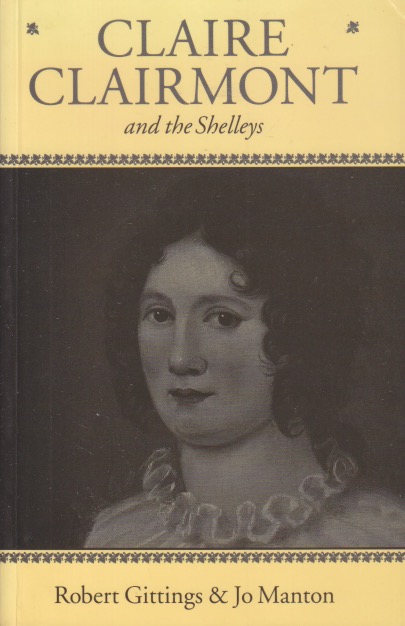
Claire is unjustly forgotten.  Of the five gathered in Villa Diodati she lived the longest, making it to eighty.  She had a difficult but occasionally warm relationship with her step-sister.  This book by Robert Gittings and Jo Manton is the first real biography of Claire.  She lived a fascinating life.  Drawn from diaries, letters, and reminiscences of friends, as well as the other sources of the historian’s art, Claire Clairmont and the Shelleys is quite readable.  And moving.  Claire was young and infatuated with Byron when she set out to seduce him.  He never returned the love she felt for him, and took responsibility for their daughter on the condition that Claire never see him again.  Her inability to see her own child was the great sorrow of her long life.

Claire went on to live in Italy, France, Russia, and Austria.  She was fluent in French, Italian, and German.  By all accounts she was a gifted musician.  She hobnobbed with high society, often by being a governess in aristocratic households.  She lived near poverty at times, but inherited a living from Percy when his father died.  It’s the sad fate of many who don’t get published that they are forgotten to history.  (Being published is, I hasten to add, no guarantee either!)  Claire’s personality comes through in this account as that of a strong, vivacious woman who defied the conventions of her era.  She made her own way in the world, never marrying, yet being sought out by those who latterly wanted accounts of Shelley’s life.  She’d lived with Percy and Mary for several years.  This is a story of a different but fascinating time.  I hope that future treatments of that famous night in 1816 might take a bit more notice of this deserving, if forgotten, woman.


Dr. 2 P 2

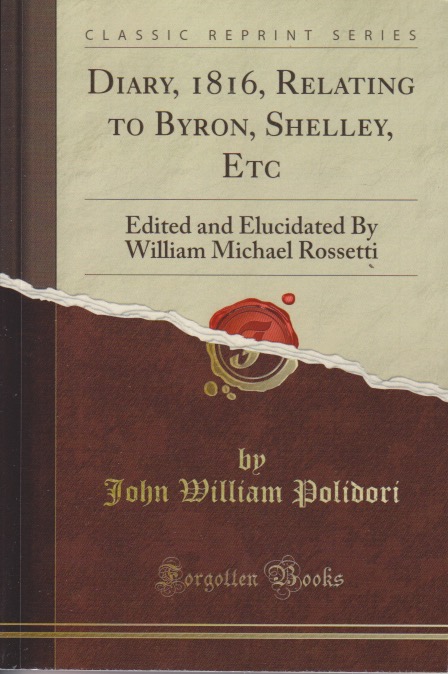
Before reading Lord Byron’s Doctor by Paul West, I started reading John William Polidori’s diary.   This is freely available online, but I need a book in my hands to truly read.  A little backstory: before his trip to Switzerland in 1816 with Lord Byron, the poet’s publisher paid Polidori to write this diary.  After Polidori died by suicide, his sister edited out what she thought reflected badly on the family, and destroyed the original.  The diary was published in 1911, edited by Polidori’s nephew William Michael Rossetti.  The edition I read was a reprint by Forgotten Books, containing the University of Toronto’s Library’s edition for scanning.  While not the most exciting reading, it is revealing.  Polidori appreciated the finer things in life (he qualified as a medical doctor), but he sometimes missed the point.  For example, being paid to write about Byron’s travels, his mentions of Bryon are relatively few.

You get the real sense that Polidori was jealous of the Lord with whom he traveled.  Then, when Percy Bysshe Shelley and his party arrived in the neighborhood, it becomes clear that Polidori was jealous of Byron’s attention to Shelley.  I sympathize with the author; both Byron and Shelley were already famous and infamous for their writing and lifestyles.  Both were from aristocratic families and had no profession other than writing and traveling.  For Polidori this was a working trip.  His mood seems to be reflected in that, just after the famous ghost story contest, entries begin to focus mostly outside the gathered writers until they stop altogether.  Much of the summer is left blank.  In September Byron sent Polidori packing, and the remainder of the diary is about his, often penurious, travels through his ancestral Italy.

Polidori is now known as the author of “The Vampyre,” which he wrote during the period covered in the diary.  He doesn’t talk about it much.  For me, Polidori is a sympathetic figure.  A lonely man, he was intimate with the most famous English poet of his day.  He often, however, in his own accounts, wasn’t in control of his emotions, particularly when he felt he’d been slighted.  Jealousy can be a very difficult monster with which to wrestle.  But reading this diary does lead to the uncanny sense that the most interesting parts were the things he didn’t discuss.  The diary has been used as the basis of more than one fictional treatment of the events of the summer of 1816.  And since some of the juicy bits are left out, free rein is given to the imagination.


A Different Lord

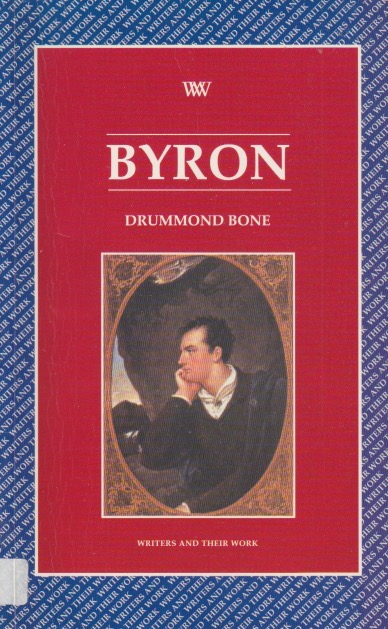
I just wanted to learn the basic outline of Lord Byron’s life without having to commit to the hundreds of pages most of his biographies boast.  Something brief, but authoritative.  Something for which I could be sure the author was vetted.  I hadn’t read any of the Writers and their Works series before.  It gets good reviews and here was the story of Byron in less than 100 pages!  I was excited to get started.  Then I discovered this is mostly about his poems rather than his life.  It contains 21 pages of biography and 60 of poetic analysis.  I really should’ve checked more reviews.  I’m not really into poetic analysis.  I know that those of us who create tend to think of our creations as extensions of ourselves.  I’ve made 3-D art (kind of like sculpture), I’ve drawn, I’ve painted, I’ve written.  These are parts of me that exist in the world.  But really, I just wanted to know what Byron’s life was like.

Actually, I did learn the answers to some of my questions.  Although a “lord,” he didn’t inherit much wealth.  Indeed, the opposite.  His eventual wealth came from his poetry.  This is nearly an impossible dream these days, of course.  His fame brought the spotlight onto his personal life and politics.  A man who easily “fell in love”—he was a Romantic, after all—he had affairs and his politics weren’t those of the majority.  He left England at the advice of a friend, never to return.  He was friends with Percy Shelley, which is common knowledge.  As he made a home, actually several homes, in Europe, he continued to earn good money for his poems.  He was famous and feared, it seems.  Although the book doesn’t describe it, he gave the world its Byronic hero.

I haven’t read much of Byron’s poetry.  That style of writing has never appealed to me.  The poetic life, however, is of endless interest.  Shelley drowned on a boat trip home after visiting him in Italy, and Byron was present at the cremation.  (And I got yelled at in the New York Public Library for trying to snap a picture of the fragments of Shelley’s skull that were on a special display.  Byron had been there in person, of course.)  A few short years later Byron also died while helping to plan and finance the Greek war for independence.  Still, there is more I’d like to know.  But probably not enough to read a biography of several hundred pages, though.


Summer of Frankenstein

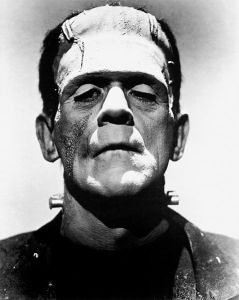
Two centuries can make an enormous difference. Just two-hundred years ago Napoleon’s defeat at Waterloo was merely one year in the past. North America and parts of Europe were experiencing “the year without a summer.” Perhaps due to that cool and rainy summer, when Mary Godwin and Percy Bysshe Shelley called on their friend Lord Byron, their thoughts turned to ghosts. According to the legend, together with Byron’s personal physician John Polidori, the friends spent a night writing scary stories. Polidori, although not widely remembered today, invented the vampire that would, in Bram Stoker’s hands, become the aristocratic Dracula, and eventually, with Anne Rice’s influence, Lestat, Louis, and Armand. Mary Godwin, soon to be Shelley, gave birth to perhaps the most successful of new monsters ever created—that of Victor Frankenstein’s construction. Many have claimed the monster’s pedigree to have been that of the golem, but Shelley’s creativity went beyond this forebear into the sympathetic misfit who, like all of us, never asked to be born. The two centuries since that summer have been haunted.

477px-Frankenstein's_monster_(Boris_Karloff)

Quite apart from the monster tale, Frankenstein is also about building that which we, in our hubris, can’t understand. Progress without forethought, as Epimetheus could never learn, housed immediate and very real dangers. The two centuries since Frankenstein have proven Mary Shelley a prophet. An early supporter of women’s equality, she profited from her novel, but never managed to thrive. Just six years later her famous future husband would die tragically in the Romantic genre of a shipwreck. Even with important friends, Mary found it difficult to capitalize on her success. The monster was real enough.

We’ve become accustomed to making things we can’t control. When’s the last time you were able to fix a car broken down by the road, apart from the occasional flat tire? Can you really stop your job from becoming completely different from what you signed up to do? What about when that bully wanders from the playground into the political field? Once you’ve figured out how to split an atom, you never forget. It may have been Napoleon still recently in the news, or the fact that 1816 failed to warm up like it was expected after the solstice. Perhaps it was the fact that Mary Godwin was a liberated woman in a world still utterly determined by men. We can’t know her intimate and ultimate reasons for creating a monster, but we do know that once the monster is unleashed we can never bind it again.


Shelley, Byron, Trelawny, and Ahab

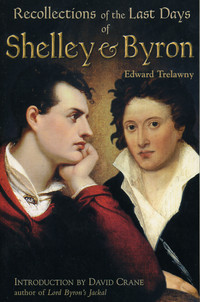
“I took up the word [atheist], as a knight took up a gauntlet, in defiance of injustice. The delusions of Christianity are fatal to genius and originality: they limit thought.” The words come from Percy Bysshe Shelley, according to Edward Trelawny. After visiting the display Shelley’s Ghost at the New York Public Library last week, I was struck by how little I knew of Shelley. I’d read some of his poetry, and had watched the fictional movie Gothic (maybe more times than is really healthy) to get a sense of this candle in the wind, the Romantic poet who died in a shipwreck before reaching 30. Edward Trelawny’s reputation as an historian is somewhat suspect, but he did form friendships with Shelley and Lord Byron and arranged the disposal of their earthly remains. His book, Recollections of the Last Days of Shelley and Byron, while somewhat self-serving, weaves an intriguing account. Among the mementos in the library display are some fragments of Shelley’s skull, taken after his cremation by Trelawny. This erstwhile biographer did prove his mettle by reaching into the pyre and pulling out Shelley’s heart, according to his own account, that eventually returned to Mary Wollstonecraft Shelley, his widow.

Trelawny admired Shelley’s atheism, and even applauded Darwin’s Origin of Species when it appeared. The nineteenth century was setting the stage for a strange Frankenstein’s monster of political and religious backlash against the freedom of the Romantics. Not all of the Romantics, obviously, were atheists, but their works extolled the wonders of nature and a sense of liberty from tyranny that would define them as dreamers and idealists. Lord Byron comes across much less favorably in Trelawny’s account, although their friendship lasted through some difficult times. After the poet’s death, Trelawny claims to have examined his feet, discovering the cause of a lifelong limp. His psychologically astute conclusion is that Byron’s disagreeable personality traits arose from his lifelong anger and anxiety about his birth defect.

Being an ardent admirer of Herman Melville’s Moby-Dick, I have to admit that the elements of anger at the divine for a limp (Captain Ahab forcefully stomps into mind), and the emphasis on ships and shipwrecks (as in Shelley’s death) tie these three literary geniuses together into a knot of suffering and seeking. Religion had consoled many in the nineteenth century, just as it continues to do now in the twenty-first. Among many of those who have endured through their literary works, however, God had slowly disappeared. Not quite as dramatic of a demise as Shelley’s, nor as unforgettable as Captain Ahab’s, but one for which there will be few biographers.


Varieties of Non-Religious Experience

The New York Public Library is an icon of rationality. Daily tourists throng by—some inspired by Ghostbusters, others by Between the Lions. Nestled in among some of the tallest buildings in New York City, it is a symbol of culture amid its antithesis, business. Nearing its last days is a small display in the library entitled “Shelley’s Ghost.” Containing handwritten manuscripts and a few artifacts from Percy Bysshe Shelley’s cradle to his grave (literally, his baby-rattle and fragments of his skull), the display celebrates one of England’s most famous and short-lived poets. Shelley, although his life was scandalous at points, was no doubt an idealist. A vegetarian, advocate of “free love,” and protestor, he would have fit well into life a century-and-a-half after he died. He was also an early atheist.

“If ignorance of nature gave birth to gods, knowledge of nature is made for their destruction,” he wrote in The Necessity of Atheism. Not quite the angry atheism often found today, but then, despite his obvious spirituality, Shelley was a rationalist. Born during the English Enlightenment, be was a strange mix of the alchemical and the reasonable. To his young mind the truth was self-evident: the belief in gods grew from nature and therefore the study of nature would reveal those origins. Today the origin of gods is still up for debate, as is the nature of the human animal. It is routine for scientists to claim that our brains are simply processing electro-chemical signals that have no reality beyond this physical world in which they occur. To be a human, however, sure feels like more than that. Shelley was a writer at this nexus. No one writes poetry like that who believes their brain to be full of only electrons.

Reductionism often gets us into trouble. The problem has always been that humans are myopic; we can only see so far and yet assume we have all the data. This myth persists despite the fact that we know some animals pick up on environmental factors that we as humans miss. It need not be supernatural to claim that there is more to the world than we can perceive. This is a double-edged sword. Many of the absolute pronouncements of religions simply don’t match our experience of the world. We find ourselves bombarded by authoritative statements by experts who know as little as we do. I have yet to hear a televangelist who can claim on any intellectual basis any reason that anyone else should pay attention to his raving. Perhaps what the world needs is a few more like Shelley’s ghost—rationalists who still recognize the necessity of poetry.