The State Demon

It’s the time of year for seeing things. I suppose that’s why there have been two supposed sightings of the Jersey Devil flying around the internet this past week. The credulous take these kinds of things for evidence, and the posters claim complete sincerity and who doesn’t want to believe? Still, the photos and videos fail to convince. It’s the time of year when we want to see monsters.

DSCN0128

While the origin story of the Jersey Devil is one of the main strikes against it for sheer impossibility: Mother Leeds, who had twelve children, finding herself pregnant with a thirteenth, wished that it would be born a devil. The cursed child, meeting motherly expectations, came out a devil, flew up the chimney, and has haunted southern New Jersey ever since. The folklore elements are thick in this tale: the thirteenth child, the exasperated mother, devils in the woods. This doesn’t, however, suggest much confidence in the literal truth of the story. This traditional tale circulated in the same region where legitimately strange things were seen, especially around the turn of the last century. Every now and again the devil reappears in a present-day venue. At one time the Jersey Devil was even the official state demon of New Jersey.

The ease of use of photo-altering software has taken us further and further from the truth. It is an impoverished world that has no mystery to it, but the easily hoaxed world of Photoshopped monsters will cast doubt on all contenders, I fear, forevermore. We can no longer trust the veracity of the lens. Our world has become an electronic illusion. The creature spotted in the Pine Barrens can be more readily believed without photographic proof. The sober, shaken witness who can’t explain what s/he saw one dark night is more believable than a goat with wings or a stuffed animal on a string. Our religious sensibilities urge us to believe in the impossible. Our cameras urge caution. After all, internet fame is often the only kind available to those whose videos and photos go viral. The devil, they say, is in the details.
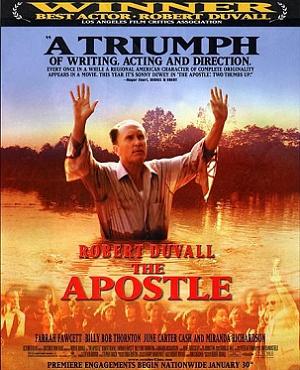

Apostolic Succession

I try, normally, to limit blog posts to one per movie (per viewing), but I’m still thinking about The Apostle, so I thought I’d share a bit more. I can’t get that scene of “tag team” preaching out of my head. The extras on the DVD reveal that the preachers, other than Robert Duvall, were actual ministers. When Duvall comes on the stage, acting, these other men “catch on fire,” preaching to the small congregation gathered under the tent. They’re not acting. This juxtaposition of someone acting as a preacher sharing an actual revival with those who are actually preaching makes me wonder if there was any dissonance felt. Did anyone feel any compunction about really preaching after getting riled up by someone who was only pretending? Where is the line between fiction and fact here? Film and reality blend.

Apostleposter

The same kind of question occurred to me after watching The Witness. I’m not a Hollywood expert, but the rumors that circulated then (and I was in college at the time) were that some of the actors were actually Amish. They too, lived their actual faith while in the presence of actors, cameras, and a director. These films that use non-actors certainly score points for verisimilitude. Rev. Charles Johnson, for example, is really “in the spirit.” The scene of him, “coming down from the spirit,” Duvall reveals in the Making of segment, is real. This man, at least, had a spiritual experience in a fictional piece. The same, Duvall suggests, may apply to Sam in the final altar call. This was, he avers, real emotion, not acting. Does being saved in fiction count in real life?

Movies sometimes leave me wondering what is real. I suppose that’s part of the draw. Religious experience, like sex, is generally faked on film. Things that are sacred are felt to be off limits to the eyes of strangers with only voyeuristic interests. I’ve lived long enough to see photographs go from proof positive to Photoshop fantasy. We can’t believe what we see any more. How are we to comprehend films that portray religious experience? Did Robert Duvall actually save any sinners from Hell? Does it make a difference if an ersatz minister is the one who leads you there? What of a real minister who fails to convert the viewing audience? Films are not simple escapism, I know. And as I continue to wonder about saints and apostles, I’m going to have to try to understand what can be caught on celluloid and what can’t.


Watch, and Pray

Religion is a lucrative business. There is likely a deep, evolutionary urge for fair play nestled somewhere in primate DNA. Monkeys and apes seem concerned about it, and certainly nothing gets people more upset than a cheater who does prosper (unless he, less often she, is the protagonist of some gangster movie). Most of us work pretty hard to make a living, often doing tasks that push us beyond our comfort range in order to ensure some kind of success. The same is true of clergy. Yes, stories of lazy or lackadaisical ministers abound, but many work long hours under often stressful conditions. Most are not paid very well. Their eyes, according to unwritten writ, are turned toward a larger prize. In an economy that has become a nearly universal capitalism, everything has a price. People want to feel that they are pleasing God but there are oh so many rules and regulations! The Hebrew Bible alone has 613, and then add the Christian Scriptures and two millennia of ecclesiological dogmatism and you’ve got one hefty bill. We don’t mind paying a bit of that for a religious specialist to take care of the details while we get on with the real business of life.

Now add a little math. How many people does it take to add up to a small fortune? Already by the Middle Ages the Catholic Church, really the only show in town across Europe, had amassed a real treasury. Although individually the clergy could claim to own nothing, collectively they were flush. Even today the wealth (and therefore power) of the Vatican is nearly beyond comprehension. A colleague recently pointed me to a story I had missed back in April. This involved the computer age and lucre in an unexpected place. Russian Orthodox Patriarch Kirill I was photographed sitting at a high-gloss table, wearing a Breguet watch valued at $30,000. There was an outcry. The Russian Church, long under the pressure of a communist state, could hardly be described as opulent. Well, liturgical vestments and accouterments are expected to be costly, but personal items such as watches, are expected to be modest. Thirty-thousand dollars is a lot of money to be reminded of when to show up for mass.

In response, some church leaders turned to technology for a solution. The watch was Photoshopped out of the picture and, as if a miracle, the scandal disappeared! Except they forgot the glossy tabletop—the reflection of the watch, like Dorian Gray’s portrait, remained as evidence. (The story may be found here, along with the damning photos, if you can stand the snarky writing.) Owning such a watch may be considered bad form among the humble clergy, hiding it, however, is even worse. I don’t mean to single out Patriarch Kirill—the Russians have had a pretty rough go of it, what with Stalin and Reagan and all—but religions seldom like to have their coffers examined. The laity will pay handsomely to avoid the extra work salvation demands. Herein lies the rub: salvation has become less tangible as material wealth has expanded. Many people have mistaken one for the other. It’s just that they don’t want to get caught enjoying a little too much of the one at the expense of the other.

Now watch this, for time is fleeting