
I was maybe six or seven when Frankenstein’s monster charged us. My mother, brothers, and I were part of a small crowd at Niagara Falls, where we had gone to visit relatives, when we found ourselves in the monster’s path. We were among of a knot of tourists, and plate glass separated us from the great roaring beast, posted to draw visitors to one of the many plastic tourist attractions around the famous falls. Each time the monster charged, we all screamed, knowing full well he could never break through that glass. As a member of the Monster Boomer generation (although on the tail end of the boomer part), the monster that disturbed me the most has always been Frankenstein’s monster. I’m not sure whether that was natural squeamishness, or if it was that as children my brothers and I tried to divide things up evenly and I ended up with the vampire while one of my brothers claimed possession of “Frankenstein.” Certainly when I grew old enough to read the book, it only added to my discomfort. The concept of Frankenstein’s monster was old enough to have lost its scary edge, but the story was very sad. The monster was not evil, but lonely.
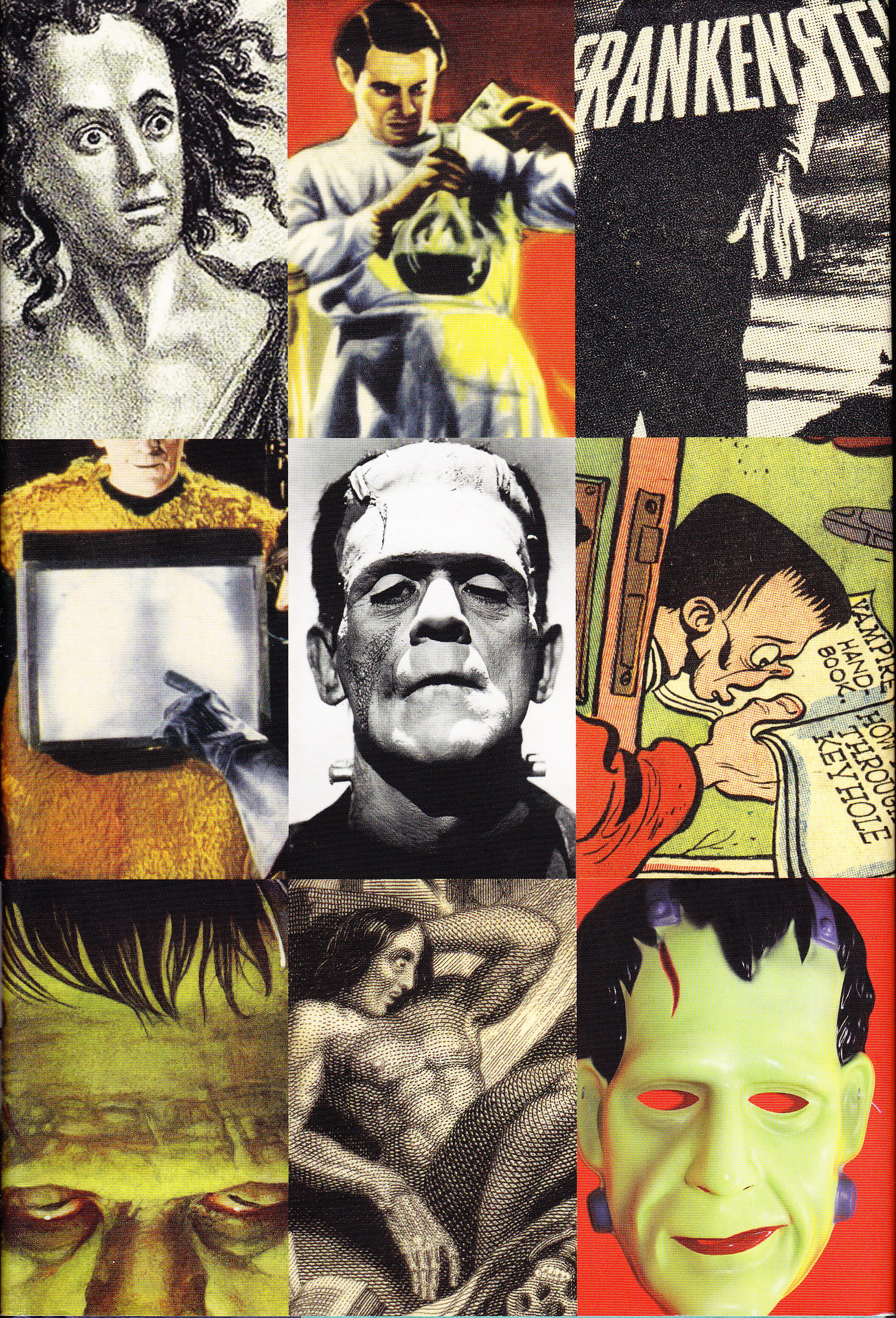
Sarah Tyler Hitchcock’s Frankenstein: A Cultural History revealed a new angle on the monster. A thoroughly fascinating anthropological approach to one of the more modern constellations in the night-time sky of fear, what became immediately obvious in this book is just how religious a monster Frankenstein’s creature is. Many of us think of “playing God” as a recent phenomenon. Mary Wollstonecraft Godwin (Shelley)’s Frankenstein was published in 1818 with just that concept in mind. Mary Shelley, barely twenty when the book was published, had tapped into one of the most vital of religious topics—what it means to make life. Hitchcock’s treatment of the subject covers the conception of the monster, the book and its history, the plays and movies based on the story, and Frankenstein’s monster’s reception into popular culture. At every step of the way, religious issues are raised. Mary, in her birth of an immaculate creature, gave the world theological conundrums through which we’re still sorting nearly two centuries later.
Often on this blog I maintain that monsters and religion are cut from the same cloth. Hitchcock provides a compendium of supporting evidence in her compelling book. Even down to the contemporary debates of scientists over genetic engineering and cloning, the story of Frankenstein and the overstepping of ethical boundaries comes up again and again in scientific literature. I couldn’t help but to think how this reflects the current acrimony between the materialists and the dualists among the intelligentsia: is the forging ahead with manipulation of life simply an experiment we must undertake or is it really an ethical (read “spiritual”) issue after all? Mary Shelley was not so strident as her erstwhile husband Percy was regarding the necessity of atheism. Her monster seemed to be raising that question in terms profoundly theological for a girl not yet of seminary age. Sarah Tyler Hitchcock has done us a great favor by producing a history that stitches religion, culture, and science together into a beast that we still haven’t learned to control.
 Steve A. Wiggins