Paying Troll

There was a time, should the media of my youth be believed, when a man insulted another man’s wife at his peril.  A barroom fight, or perhaps a sober brawl, would ensue.  Such chivalrous days are likely over and the internet makes nasty comments so easy to disseminate (how terribly masculine!) for all the world to see.  Hiding behind assumed names, avatars, or delusional fictions, you can feel like a big man by saying unkind things to a person you’ll never meet.  Such is the world of Trump’s America.  Although he may think himself divine, Trump didn’t invent Twitter or the internet.  Neither did Al Gore.  Still, the distasteful political rancor leading up to the midterm elections led to a man (I presume) trolling my wife behind a mask of Facebook anonymity.

It’s hard to tell how to react.  Feminism doesn’t always want a man to step in and defend, but we’re all raised with tales of princesses and those who honor them.  Having been raised by a woman with an absentee husband, I have nothing but admiration for strong women.  Although categorized as a “white man,” I can’t see my own brand as better than any other.  We are all human beings, and with some rare exceptions, we deserve respect.  Like all evolved creatures, however, I sometimes reach deeply back into my primate roots and the tropes of my childhood begin to simmer.  Who trolls another man’s wife over politics?  Who doesn’t stop to consider that every woman is a daughter and many are mothers and sisters?  If you want to pick on someone, well, you know how the saying goes.
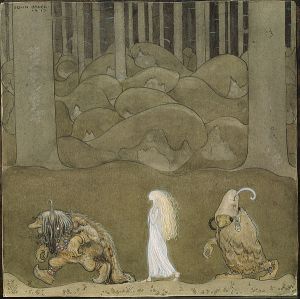
The midterm elections brought some much-needed balance to a government way off kilter.  There are still trolls under the bridges, however.  The storybooks tell how knights vanquish trolls and even the liberated male can’t help but imagine himself on that proud steed.  What kind of man takes a keyboarded cheap-shot at another man’s wife?  The quality of his discourse speaks volumes.  Those on the left believe in equality and can’t respond in kind.  It is, ironically, a far more biblical response than trolling on the right.

I’ve lost readers of this blog due to politics.  Some of my former readers have even told me so.  I appreciate their candor.  We can’t all agree, I know.  What we can do, however, is be civil.  Those who put themselves in elected office know that they are opening themselves to criticism.  It is very hard to slander a United States president, in the words of the Good Book, “how the mighty are fallen.”  Those with thin skin should think twice (or even once) before running for the most criticized office in the world.  Most, until now, knew that what they said would set the tone for the nation.  We’re all entitled to an opinion, and, for the time being, are free to express it.  Still, I’d think twice before insulting another man’s wife.  But then, I’ve always been a hopeless idealist.


The Problem with Shaving

Evil may be an abstract concept, but that doesn’t mean it isn’t real.  Sorry for the double negative—finding the right angle of approach is difficult sometimes.  I say that because I believe that the misattribution of evil is tearing civilization apart.  Science has rightfully taught us the tricks for understanding the material universe.  Problem is there’s more to the universe than material.  If all our minds consist of are electro-chemical signals, well, this batch swirling in my head isn’t alone in doubting itself.  (Think about that.)  So, here’s the problem—those on the opposite side of the political spectrum rending the United States into shreds aren’t evil.  They’re doing what they believe is right, just like the lefties are.  The evil comes from forces trying to tear good people on both sides apart.  The simplest solution, Mr. Occam, isn’t always the best.

Putting it out on the table, right and left have some basic disagreements.  By far the majority of them are sexual.  Both sides believe what they’ve been taught or what they’ve learned.  Sex, of course, is one of the great dividers of humankind.  It brings us together and it tears us apart.  Religions have always been very interested in sexuality—who does what to whom and what to make of the consequences.  None of it is easy to sort out.  Since the Bible voices first-century (and earlier) opinions on a matter they understood even less than we, the situation is very complex indeed.  Especially since many people wrote all the self-contradictory words within its stolid black, pigskin leather covers.

Complexity reigns in the world of explanation for both politics and sex.  Put them together and see what happens (if a Clinton, impeachment, if a Trump, nothing).  The issue with Occam’s razor is that the simplest solution doesn’t always explain things best.  It’s not evil to suggest woman plus man equals marriage.  Unenlightened, maybe, but not evil.  The truth is that things are more complicated than they seem.  A society taught, in many ways, that only one solution works could easily boil it all down to one size fits all.  Evil is the desire for political power that draws its energy from making each group think the other is evil.  I realize this courtesy often goes in only one direction.  That too is part of the evil machinations of a system that divides instead of seeks common ground.


Moving Plans

I’m moving. I’m seriously considering Enceladus. Oh, you haven’t been? One of Saturn’s icy moons, Enceladus was discovered to have the basic elements of life as Cassini plunged to its death in Saturn’s shroud. But why Enceladus? I want to make space great again. You see, in my native country all sense of fair play has fled one of the political parties, of which there are unfortunately only two. There haven’t within my lifetime and many decades before, been any contested wins by Democratic candidates. There have been two by Republicans, among the last two elected, and yet they keep changing the rules about who can appoint Supreme Court justices. When I was a kid stacking the deck got you kicked out of the game. What’s fair’s fair.

I hear that on Enceladus they are open to actual intelligent life. You see, they’re evolving and they know it. Unlike my native planet, they believe representative government should be, well, representative. There should be some account taken of the majority. There are no Fundamentalists on Enceladus. See, there they realize that an outgoing president has the legal authority to appoint a judge, bypassing the senate. They believe, I hear, that the senate is controlled by a being called “the adversary.” One of their recruiters told me that the phrase translates, in Hebrew, to “the Satan.” They believe the adversary should not be able to change the rules every time. They’re not Fundamentalists, but they believe in Hell. They say it’s three planets from the sun, make a left at Lisbon.

Of course, they don’t see the sun much on Enceladus. They orbit Saturn, which doesn’t emit any light of its own, although it has the coolest set of rings in the solar system. It’s icy there for a reason. But the employment situation favors the workers. They believe in rationality there. They don’t put children in cages. Their scientists have studied the primates on our planet and have found that all species of them, except one, will reject leadership by individuals who bully the group. They have documented studies—for they believe in science there—that show chimpanzees will drive out an abuser of power because even they have a sense of fair play. Of course, chimpanzees don’t have a senate, but on Enceladus, some joke that it’s hard to tell the difference some times. They have a sense of humor there which, I think, goes a long way toward balancing out the chill. I’m moving, and Enceladus is firmly in the running.


Augustine’s Secret Sin

I’m curious: what do you think of Augustine? Augustine of Hippo was an odd blend of saint and sinner. I don’t mean “saint” in the sense of being so designated by the Roman Catholic Church, but in the sense of having reputable and progressive ideas. For example, Augustine argued that science, such as it existed in his day, had to be taken into account when understanding Christianity. If the Bible’s account of creation didn’t match what we knew of the world, then literalism had to go—that kind of thing. This was quite liberal for someone in the fourth-to-fifth centuries. He believed in reason, to an extent. The sinner side of the equation goes beyond his Manichean days, however. The sins I’m referring to are his dangerous and long-lasting theological assumptions that’ve helped to hold back civilization throughout history.

It was Augustine, for example, who gave us the idea of original sin being involved in sexual reproduction. The church has always been cagey on why we should reproduce when the second coming is right around the corner, but Augustine declared that from our very conception (which he couldn’t understand scientifically) we were tainted with sin. But that’s not the particular sin to which I’m referring. Augustine also spread the persistent idea that curiosity itself was a sin. Christianity, in his view, was a “need to know” religion, and curiosity about the natural world could lead to uncomfortable answers. He held this in tension with his belief that we should accept what science teaches, but there were many questions, he decided, we simply shouldn’t ask.

Religions have often come to this crux. Science has a strong explanatory track record. Religion is frequently based on old texts, written in an age when science was but an infant. As the power of rationality grew, the role of miracles shrank. Over time the proof of theological structures began to crumble. And since life was all about correct theology, those edifices had to be shored up against the onslaughts of reason. If this sounds hopelessly outdated, I’ll have to confess that many of my students at Nashotah House believed reason was tainted by original sin. Augustine had the answers they believed; somehow rationality had stopped with him. Human curiosity, Augustine felt, was a sin. All questions should’ve ended with his arguments. It’s this kind of theological bravado that gets us into the mess we find ourselves in today. Voting blocs that never question what their religious leader tells them. Never curious enough to ask “Why?” Augustine was a brilliant man, in many respects. He was also a sinner of the highest degree.


More than Baptism

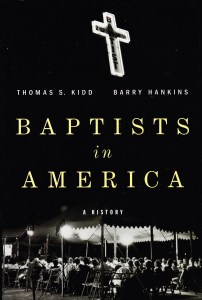
Few things distinguish American Christianity as much as its divisions. These aren’t precise, however, and often the borders are fuzzy and held more by cultural history than by theological outlook. One of the denominations—indeed, the umbrella for the single largest Protestant denomination in America—often faces the question of its identity. Who are the Baptists? Many Protestant groups can trace their histories to defining moments; consider Martin Luther and his hammer, according to the Lutheran origin myth. Baptists are a little tricker to pin down. Dissenters, yes, convinced that adult baptism should accompany conversation, yes, but beyond that widely divergent. Thomas S. Kidd and Barry Hankins have provided a service by writing Baptists in America: A History. Going back before America, they trace the origins of the sect and quickly bring it into the context in which it would thrive.

Persecuted early in American life, Baptists grew in numbers and recognition during the period commonly known as the Great Awakenings. Suited to frontier individualism, non-doctrinal, and advocating for freedom of conscience, the Baptists gained large sums of converts in this era. With their congregational polity, Baptist cultural influence really only took off when mass media gave its more aggressive preachers a venue not limited by church walls. As Kidd and Hankins point out, however, the denomination proved friable. Splitting apart over various issues, the number of Baptist denominations grew. Their political influence would also grow so that they would become a force with which to be reckoned even today. Few, however, really understand who the Baptists are.

The Southern Baptist Convention is the largest single Protestant denomination in the United States. It defines itself by a radical conservatism that masquerades as “orthodoxy.” Heavily biblical, many in the tradition have a strong preference for inerrancy. Social causes that appear outdated to most modern people are do-or-die issues for this sect within a sect. Baptists in America does a good job showing how contradictory Baptists can be. They were, after all, dissenters from the beginning. Their championing of religious freedom often doesn’t apply outside their own borders. The more political of the denomination know very well how to game a democratic system. Perhaps the lesson they’ve learned most acutely is that being unseen carries with it great advantages. They play the sport of legislative chess very well. In a culture that loudly and repeatedly claims that religion no longer matters, those with conviction have a natural hiding place. From there pieces are easily moved to positions of power.


Turn the Other What?

The man next to me on the bus is reading his Bible. At one point in my life that would’ve made me feel safe. I would’ve known that the person next to me was committed to the same value system as mine—love for all, peace, equality, and acceptance. Now, however, I see that Bible and I’m afraid. You see, I’m reading Chris Hedges’ American Fascists: The Christian Right and the War on America. I can’t remember the last time I’ve been so scared. Hedges’ book was published a decade ago. What he wrote about then is coming true now and it’s because the elites of society—university folk and all—don’t take the radical religious seriously. In their delusional ways, they assume all will be well. If you think like that, read this book.

Dominionism is fascism dressed in Christian garb. It has no room for tolerance. It teaches that those outside its circle are to be ignored at best, and murdered without compunction at worst. This is not exaggeration. It is their teaching. It’s like that computer game that used to come with Macs where a time-traveling dinosaur collected the eggs of other species to save them from the coming asteroid. You could kill other dinosaurs without guilt because you knew they were going to die in 20 minutes anyway. That is very much the way Dominionists feel about you and me. We aren’t saved—their word is “Christian”—God has rejected us, and therefore we deserve to die. Many of them stockpile weapons just for this reason. Their goal, not at all hidden, is to take over the United States and make it a Christian nation. Already many in the houses of Congress are their candidates. They have a president who shares their values. We should be very afraid.

Hedges does a very good job providing the statistics that back his assertions. There is no question that this is real. Those who blithely vote Republican out of fiscal conservatism have risen to the bait. Trump has proved that once and for all. These “Bible believers” do not value or treasure love. They treasure treasure (many of them are very wealthy) and what they desire is power. Tolerance, in their view, is evil and compromising with the literal Satan in which they believe. Their Jesus does not love. He fights. And he fights for white, straight, privileged men. If you’re willing to forsake sleep, read this book. And if you think it’s exaggerating read the headlines.


Voting Belief

No one knows the origins of religion. Before the advent of writing we can only guess, based on artifacts. Even in the era of scriveners, nobody jotted down the origin of belief until modern times, long, long after it began. Once writings about religious practice become reasonably clear, we find temples in the service of palaces, and vice-versa. Monarchs needed the validation of deities and priests required the support of the crown. Together they brought the two swords together and managed to keep the unruly masses in check. This isn’t cynical, not necessarily, since it reflects, the best we can reconstruct, how western organized religions began. Power was always part of the picture.

A recent Washington Post story, “The stark racial and religious divide between Democrats and Republicans, in one chart,” by Christopher Ingraham, shows the diametrically opposed pie-charts of self-identified white Christians (Republicans) versus non-white or non-Christian (Democrats) Americans. Such survey results tell us much about ourselves. We vote with our faith (or lack thereof) and not with our rationality. This has long been the piece of the political puzzle that Democrats have failed to comprehend. Not to take away from Barack Obama’s charisma, but people were afraid of Mormon Mitt Romney in 2012. Although conservative, white, and evangelical, Mormons have long been questioned as to their Christian identity by other evangelicals. It would seem, in the light of present circumstances, that understanding the “white Christian” mindset might be the only way out of the morass.

Typically self-defeating, academic institutions have shown little interest in understanding religion among hoi polloi. Long ago they bought into what Peter Berger admitted was his biggest blunder, the idea that religion was dying out. By the time he made that admission, academics had ceased to pay much attention to religion. It has, of course, come back as the ghost that haunts us. Or is it a zombie, once dead and now back to life? The fact is religion was never dying. It is as much of being a human as is driving a car or owning a cell phone. When times are uncertain, we turn to what is perceived as unchanging—religion. In truth, religion is constantly evolving to fit outlooks influenced by science, technology, and social progress. Worldviews change. Our culture is becoming more diverse. Republicans have a natural voting bloc that identifies itself by race and religion. Information about the former is readily available. You’ll need to look a bit harder to find quality information about the latter, no matter how important it may be.


Good Newsists

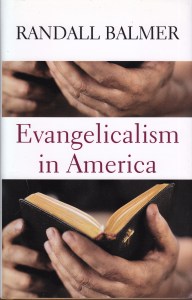
In the interest of avoiding conflict thereof, I cannot yet give a review of Randall Balmer’s Evangelicalism in America. Since I’m writing a review of it for Reading Religion, I’ll use it as a springboard into a topic that should concern all who believe in religious freedom. One of the resounding themes of Balmer’s treatment is that Evangelicalism, after it wedded to the Religious Right, lost its soul. Those are my words, not his, but the sentiment’s about right. For anyone who wasn’t politically aware in the 1980s, it may seem a surprise that religion didn’t enter into politics before that decade. With the exception of the fear of the Catholic in the case of John F. Kennedy, religion wasn’t used as a political wedge until the presidency of Jimmy Carter. The Religious Right, unhappy with the born again Southern Baptist in the White House, moved to solidify the Evangelical bloc.

Evangelicals had been an underground movement for half a century. Many had no idea what being “born again” meant when Carter first claimed the sobriquet. Balmer points out that it was the threat of the withdrawal of tax-exempt status to discriminating Christian schools that led to political action. Bob Jones University, fearful of racial intermarriage, didn’t admit African American students. Leaders of the Religious Right saw the loss of tax-exempt status as a move against their sacred segregated culture and a push that required a shove. Coopting the abortion issue (historically Evangelicals had supported women’s rights, including the right to abortion in many cases), they nailed together a platform for political activism which put women “back in their place,” kept racial “purity,” and romanced a total aberration in Christianity—the “prosperity gospel.” All of this is well documented. And well hidden.

Looking at Evangelical politics today, abortion—the control of women—has become THE issue. It’s hard to believe, as Balmer amply illustrates, that Evangelicalism used to be allied with the Social Gospel. It was a religious view with a conscience and it supported issues that are now polarized as “liberal” and leftist. This shift came about gradually, but not accidentally. There were political players—Balmer names names—who had one goal in mind, and that goal wasn’t Jesus or what he’d do. It was the sweet prize of political power. Evangelicals, you see, are born followers. A leader with a strong voice can lead them just about anywhere. Many Evangelicals today would deny their more liberal history, but it is right there for anyone who’s willing to learn something about who they once were.


Informed Deceit

I sign a lot of petitions. That’s because the job of prophet doesn’t pay well enough to support a family any more. What it does mean is that I get a lot of emails from causes looking for supporters. I don’t sign blindly. That was brought home to me the other day when I had an email from the “White House.” A more obvious effort at trying to scramble for table scraps of respectability I cannot imagine. Already since January our government has swooped to new lows of deception and now false news comes right to your inbox. This email informed me that Neil Gorsuch has overwhelming bipartisan support for his Supreme Court nomination. Being an individual with a working brain, I know that’s not true. The “White House” wanted me to sign a petition supporting Gorsuch when I’ve already signed several protesting his candidacy. It’s clear that our government wants a court prophet.

Isn’t it odd, I mused, that a government that has no intention of listening to the majority is sending a petition to support one of its own? We know that the Russian Party (formerly known as the GOP) will support anything Thurston Howell the President hands them. Such a petition is only a way of saying “I told you so.” I miss the days when Isaiah could walk right into king Hezekiah’s bedroom and say “Thus saith the Lord…” These days the Lord tweets and the chirplings in the nest beg for more worms. You see, court prophets know which side their palms are crossed on. This isn’t Ash Wednesday, it’s Ash Administration.

Court prophets, in ancient times, were those paid by the government to support what the king wanted to do. It was a cushy job. What the reigning Trump wants at the moment he or she (for the modern court prophet can double-cross her own gender) proclaims it as God’s will. No experience necessary. The thing about the Bible, though, is that court prophets are pretty roundly condemned. The real prophet could generally be told by the fact that he (less commonly she in those days) was dead. Or soon to be. Those in power seldom care for criticism. Especially when skeletons are fighting each other for elbow room in their closets. Even so, Holy Writ says, figuratively, that it’s better to be a living politician than a dead prophet. If that doesn’t sound biblical, read the words of the prophet: “Nevertheless the sun hides not Virginia’s Dismal Swamp… and break the green damp mould with unfathomably wondrous Solomon.”


Beating around the Bush

You know things are bad when another president who couldn’t win the popular vote criticizes you. Don’t get me wrong—criticism is good. In my academic existence (on life-support for over a decade now) I’ve received plenty. The point is you can’t improve if you’re not willing to take a few blows. Defensive academics don’t survive long. The problem seems to be, if I may speculate from my knowledge of biblical studies, the word “criticism.” Growing up, one of the last things I wanted to have was criticism. Already overly self-conscious of my sins, criticism only felt like making an already bad situation even worse. Then I was introduced to biblical criticism.

Biblical criticism sounds like the worst kind, but in reality it’s absolutely necessary. The idea is to study the Good Book rationally. I knew, and still know, many people who believe biblical criticism to be evil. If you trust any history—either secular or divine doesn’t matter—you quickly learn that nothing is simply one-sided. The Bible itself offers examples of this: did God or the Devil tempt David to take a census? Just how many angels were in that tomb on Easter morning and who arrived there first? Only one answer can be right. Criticism is, typical of academics too long out of the sun, a poor word choice. Nobody’s picking on the Bible. All the biblical critic is trying to do is to find out what it really says by asking questions of the text.

IMG_1163

That’s the heart of the matter. Autocrats don’t like questions. The assumption that the inherent authority of a position should be unquestioned undermines any attempt at democracy. As I was often told in church—Christianity isn’t a democracy. Our political system, we’re told, is. That why checks and balances were built into it. Either extreme and the applecart is upset. No matter what believers believe the same applies to biblical studies. Some rampant Harvard toadyism remains, but for the most part we recognize that a scholar with—shall we call them “critical skills”? may emerge from even a school shorn of ivy. We understand that’s how learning works. No one’s above criticism. Only those with something to hide can’t take their lumps like the populace that allow them to claim the name populist. Nobody likes it, but we all have to take criticism from time to time. Even the Good Book.


United or Untied?

Beliefs can be most problematic things. I’ve spent the better part of the last five days in one of the reddest of “Red States.” People in Texas were unfailingly friendly and kind. They seem genuinely interested in helping me although I’m pretty stereotypically a “blue stater” (the beard, the tweed, the glasses—there’s no mistaking it). They help me when I’m lost. They look out for my well-being. But I’ve been conditioned to think poorly of my neighbors. My father was a high school-educated working man from South Carolina. I grew up poor in Pennsylvania. This man taking my check ticket is amiable and solicitous. He doesn’t ask me what I believe.

Sometimes the Founding Fathers got it wrong. The Electoral College has created Red and Blue States. God created people. I want to think that those who are from elsewhere are different. Predatory. Out to get me. In reality what matters is that you and I are beside each other right now, and we’re perfectly happy to be so. We are people. I don’t know what you believe. You don’t know what I believe. It really doesn’t matter unless you believe you should harm me or I should harm you. (I don’t.) This isn’t normalizing the devastating administration constructed brick-and-mortar on hate. There are legitimate foes to face. Me? I’m on the side of the people. All the people. Female people. “Foreign” people. People who love those who are biologically similar or different or anywhere in-between. I can’t believe that our government has tried to drive such a deep wedge between us. From Camelot to Asphodel in one lifetime.

img_3087

Our deeply divided country is in need of healers, regardless of belief. From everything I’ve heard there is no health in the incoming administration. Business has long been the enemy of people—long before Adam Smith formulated its name those who have, without intervention, take advantage of those who have not. Its no coincidence that those wounded in service of their country are given purple hearts. Not red hearts. Not blue hearts. I’m here among people who wish me well, and who, although they’ve disagreed about politics in the past, have never allowed an election stereotype them so badly. We need to end the Electoral College and its unholy progeny of red and blue and swing states. Let people be people who unite against the real enemy—the one that’s trying to tear us apart. That’s something I truly believe no matter how problematic it might be.


By Their Love

One of my high school teachers—I don’t have to say who; if you attended my high school you’ll already know and if you didn’t you won’t know him anyway—wrote in my yearbook, “I hope you get what you deserve.” I wasn’t very good in this teacher’s class, but he explained to me, “I sign everyone’s yearbook the same way. If you do well, I hope you get rewarded. If you don’t do well, I still hope you’ll get what you deserve.” This teacher had a reputation for being somewhat of a philosopher, and his words have struck me as particularly appropriate for this moment. We, in the cosmic scheme of things, get what we deserve. As a nation I guess we deserve a First Lady, in an example to young women everywhere, has appeared naked on the internet. Her husband married her after two previous women and has made his views on gender perfectly clear. My conservative friends went to the polls knowing that. I hope they get what they deserve.

The problem is the rest of us are stuck with him too. I’ve lived through bitter, spiteful campaigns before. The genteel art of campaigning is thoroughly deceased. 2016, however, is the first year that I saw pure hatred as a political platform. And it wasn’t on both sides. Trump made of virtue of hating one’s neighbor and claimed the election was rigged until he won—then it was, of course, impossible that it would’ve been rigged. Former First Lady Hillary Clinton, who kept her dignity throughout, never stooped to inciting hatred of fellow Americans. It likely cost her the election. To the people now saying this is just politics and stop complaining I say we have all been victimized and we all ought to feel very ashamed. This election wasn’t about money. Or financial positions. Or foreign policy. It was about hate.

DSCN4694

Hate can only be counteracted by love. I have seen many women responding to a man who considers them mere sexual object by reaching out in kindness to strangers. Women organizing to try to make this country a more positive place. Meanwhile, I hear men I know saying at last we have a strong leader who will bring them prosperity. If money is what you care for, you have my pity. This country is about freedom, equality, and fairness. All of that was jettisoned last Tuesday. Even those saying “get over it” are doing so with a smugness that is a thin veil over intolerance. I’ve never carried on with frustration so long after an election before. That’s because never before has an election—no matter which party triumphed—been won by a platform of evil intent. My grandmother, a Teutonic matron of occasional Valkyrie disposition, used to sum it up well when we boys were getting out of hand. “Schäme dich!” she used to scold. I know a country that could use her words right now.


Final Frontiers

img_0610

Is there such a thing as an existential illness? Answer that if you want to, but it’s rhetorical. I’ve been voting since 1980 and I’ve taken my fair share of bruises in the process, but this time my soul feels as if God has hung his “gone fishin’” sign on the pearly gates for good. I am ill. Maybe it was the ebullience that came from having eight years of progress where, although things weren’t perfect, they were sort of holding steady. I’ve always considered myself a populist. I don’t know how a billionaire can convince millions of people he’s one. To be populist you’ve got to be one of hoi polloi. Growing up poor, I took my licks then and I’m still taking them now. No, this wound goes deeper than the bone. Deeper than the viscera. It’s an existential illness.

All things considered, I don’t write too much about politics on this blog. All my adult years I’ve been an unapologetic Democrat. I confess to having grown up Republican. But I believe in the fair treatment of others. I know not everyone will or can be happy. I also know that it’s wrong to denigrate anyone because of their gender, race, orientation, or physical ability. Seems to me that our country was sort of the final frontier where you could go if you believed this kind of thing. Where can you go from the final frontier? There are no other land masses to discover. Maybe if I put on enough layers, Antarctica might not be so bad. Beyond that, where can one go to be a liberal in a world that desperately need some heart? Where money isn’t the measure of all things. Where Mom is right just as often, if not more than, Dad.

It’s a strange thing, this existential illness. Politicians are already cooing their pleasantries, as if nothing more than a slight upset occurred. It seems to me that whenever there’s an upset the popular vote disagrees with the electoral college. It also seems to me there should be a place where the wealthy aren’t considered better by virtue of their material status. I have this existential illness, but I can still dream. Is there a way forward from here? Sometimes I think I can see that horizon where all people are treated fairly and equally, and sometimes the sun seems to be rising over that horizon. Today I feel motion-sick from being jolted backwards. I’ve been disappointed before, but I don’t remember it hurting this badly. If anyone knows a good existential doctor, please pass along her name.


Zoo or Farm?

It comes as no surprise, I hope, that I read lots of fiction. While not every book I read makes it onto this blog, a good many of them do, along with some I haven’t read yet. Bill Broun’s Night of the Animals is one of the latter. A suspicion is itching way down deep telling me that I’ll probably end up a fan. Part of my suspicion comes from having read a story on NPR about the book. First of all: dystopia. Need I say more? I admire those who try to paint a future with a lighter palette, but I’ve been observing the way those in power behave and it kind of makes me think optimism about improvement is just a tad naive. People are too easily lulled into apathy by things like sports and the internet. The Romans used bread and circuses. Meanwhile those in power help themselves to a bit more until you can’t even get on an airplane without a total stranger seeing you sans briefs. If I can’t be trusted by those I elect, what cause do I have for hope? But enough about me. The book’s the thing.

DSCN1969

Night of the Animals, according to the NPR piece, is kind of a reverse ark. The animals in the London Zoo are understood by a man and they ask him to release them. I don’t know what happens, but I sure hope to find out. When interviewers ask Broun what it was like to spend fourteen years working on a novel, he responded in a way that, I suspect, many writers would understand. He said that it was a spiritual journey. Writing this book was his search for God. Many of us must nod our heads to that.

Concentration is becoming a dying art. I’ve written a number of books in my life—by far the greatest number remain unpublished—and I know there’s nothing like the intense concentration you experience when lost in such a world. Yes, it is spiritual. It is also a cry to be heard. As George Orwell well knew, we are the animals hoping to be heard. Zoos represent entrapment. Broun states that he wanted to explore how people are trapped in his novel. Looking at a system that rewards greed and keeps workers in unfulfilling jobs just so they can keep the system going while their CEOs buy another hotel chain or sports team and decide to run for office, I begin to hear the oinks, whinnies, and neighs all around me. And I haven’t even read the book yet.


Twitter Me This

Techoncrat I’m not. At least I understand that to be authentic in this world you need to be on social media. I have a Twitter account. Have had for years. I don’t follow it religiously, but then, I don’t treat any social media like holy writ. The other day I noticed a disturbing trend. Donald Trump’s tweets end up on my bird feed. No, I didn’t accidentally follow him—I have a natural aversion to fascists with delusions of divinity—but nevertheless his mug shows up so frequently that I tend not to follow the bird maybe as much as maybe I should. I wonder how someone thinks s/he has the right to buy part of my consciousness.

Tweet or honk?

Tweet or honk?

The world-wide web is without laws, like the subconscious mind. Thoughts from around the world—at least the affluent part of it—milling, swirling about in an electronic soup thickened by irony. It’s addictive. The opiate of the masses. Perhaps it is a religion after all. Tweets are micro prayers. Blogs are sermons. Facebook is coffee hour. All these connected minds have created a consciousness of their own. Like Victor Frankenstein, we too know what it feels like to be God. It’s not a particularly joyous place to be. Does God, I wonder, lack the control that we experience on the Internet?

I like Twitter. It doesn’t demand much. The only problem is that to stay on top of things you have to have it going all the time. I turn it off and when I come back on I’ve missed hundreds of tweets. And then there’s Donald Trump again. I can come up with my own nightmares, thank you. I don’t need Twitter to suggest any.

Perhaps this is the apotheosis of capitalism. The ability to buy anything, including space on somebody else’s bird feed. Buy the most powerful office in the country, if not the world. Buy hatred and distribute it freely. One thing you can’t buy is intelligence. At least, up until now, some universities still understand that. It has taken me years to gather Twitter followers, like Mrs. Partridge the family band-mates fall behind in a neat, technicolor line. I have no money. I have very little influence. I’m really not a very good capitalist at all. I give away for free what universities charge for. Just like in the classroom, few pay attention. What do I expect? Who really listens to sermons anyway?