Who Owns It?

Who owns the Bible?  No, you can put your hands down.  I mean who owns the concept of the Bible?  This question occurred to me while thinking about the Apocrypha.  Does the Apocrypha belong or does it not?  This became a polarizing issue with the Reformation and subsequent Protestant ownership of the concept of the Bible.  The Apocrypha was mostly written by Jews, but has never been part of the Hebrew Bible.  The process of narrowing down the books to include wasn’t straightforward and since God hasn’t spoken on the topic, has never really been settled.  The books of the Apocrypha circulated with the Bible, as did a few other books.  Sometimes they were even bound together inside one cover with the standard Protestant 66 books.  Obviously I’m discussing the Christian canon here.

I’m sure you’ve known someone this has happened to, if it hasn’t happened to you personally.  This person is an actual expert on a topic.  S/he goes to a place where an unexpected discussion on their specialization breaks out but nobody asks them to speak to it.  This person then becomes offended, sometimes even speaking out, loudly, that this is their area, they have expert knowledge of it and should be consulted, at the very least.  More likely than not, their opinion should be considered definitive.  This is the image I have in my head with Protestants and the Bible.  Sure, the Catholics had it long before, but they didn’t encourage individual study.  In fact, they discouraged laity from reading it.  Only when they, the Protestants, came along did anyone really pay attention to the Bible, and, it must be admitted, they do have a point.  All the Bible study that goes on today, no matter what faith tradition (if any) would not have happened without the extreme Protestant reverence for the Good Book.

But still, there are other branches of Christianity that disagree.  There are more Catholics than any single sect of Protestants.  And a great many Orthodox Christians as well.  Some of the latter include the books of 1 Enoch and Jubilees in their Bibles.  Even so, any publisher that wishes to make inroads on selling the Bible must defer to the Protestant canon.  This is the case even though the King James Bible included the Apocrypha.  So as I ponder who it is that owns the image of the Bible, my mind keeps coming back to the same place.  Those who make the loudest, and most prolonged claim are the Protestants.  They own the Bible, in the public eye.


Mystic Thoughts

Those who know me primarily from my writings on horror are perhaps whiplashed when I muse about spiritual matters.  I don’t mean just religion, but spirituality—the two are quite different.  If life had unfolded differently I would likely have ended up as a mystic.  The problem is “rational mystic” is an oxymoron in most minds.  Either you’re one or you’re the other.  To become a proper mystic, in any case, you can’t be bothered with such things as secular work.  Mysticism—direct encounters with the divine—requires development and practice.  You can’t always control when a trance or vision might hit you.  What if it comes during a meeting?  Say your performance and development review at work?  You see the problem.

I seriously considered becoming a monastic as a young man but I had a problem.  I was a Protestant.  Protestantism was based on the idea that Catholic practices, such as monasticism, were wrong by default.  Miracles don’t happen—haven’t done since New Testament times—and God is a biblical literalist.  Why spend valuable church funds, then, on establishing monasteries?  Still, mystical experiences happened to me.  (You’ll have to get to know me personally to find out more about that.)  I talked to my (Protestant) professors.  “You don’t want to become a mystic,” I was told.  “They always have trouble with the church.”  Eventually I became an Episcopalian, a tradition that was more open to mysticism.  It became clear in 2005, however, that the Episcopal Church wanted nothing more to do with me.  Besides, I’m a family man.

Monasteries for married folk is an idea whose time has come.  Monasticism is based on the idea that you need to isolate yourself from the world’s distractions to grow spiritually.  To me, as I noted recently regarding sacraments, the “distraction” of marriage isn’t the problem.  It’s the constant need to earn money.  More and more money.  Monasteries became wealthy because other people were glad to pay money so that someone else could do the spiritual heavy lifting for them.  You can get into Heaven on borrowed virtue.  (Even Protestants believe that.  If you doubt it, get a degree or two in theology and you’ll see.)  So why not provide monasteries for those poor souls that just don’t fit into the capitalistic ideal?  I have the vision that such places would become havens for artists of all stripes.  And that, with the goodwill of society, locations where your needs were met for an exchange of goods—building good spiritual karma for a world where most people are content with trying to get rich—might just work.  It’s an idea whose time has come.  Who’s with me?

Photo by Luís Feliciano on Unsplash

How Many Stairs?

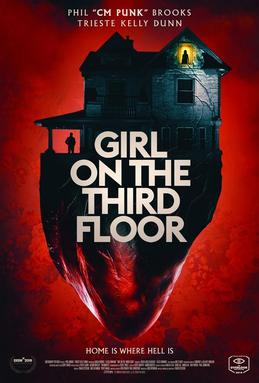
It tries.  It really does. Still, The Girl on the Third Floor is just not that good.  It got quite a few accolades, but I was waiting for something extraordinary.  It seemed to fall down on two counts—the writing isn’t very good and we’re allowed to build very little sympathy for the protagonist.  If you can’t feel for somebody and the dialogue does only light lifting, what’ve you got to go on?  Some critics suggest that if you know the star (Phil Brooks) and his persona you’ll appreciate it more.  That must be a problem for many movies where baked-in personalities are counted on—early Disney used to do this to make cartoons attractive to adults.  If you don’t know them the appeal evaporates.  In any case, a couple buys a house. He (Don) goes to renovate it while she (Liz) works to support them.  The house used to be a brothel and Don has no problem cheating on his wife when a hot ghost shows up.

The reason I watched the movie was the connection between horror and religion.  The first person to check in on Don is Ellie Mueller, the pastor of the church across the street.  She’s simply identified as “Protestant” and she drinks bourbon and swears, so it’s fair to guess she’s not Baptist.  In any case, she warns him about the house but ever confident, Don carries on.  Later, as all the ghosts come out and Liz shows up unexpectedly, Ellie shows up again.  This time she advises Liz to leave but she frames the evil of the house as a matter of choices.  Don (who succumbed to the ghosts) consistently made bad choices in order to get what he wants.  Liz and Ellie, however, think of others.  In that sense there’s a parable here.

The haunted house tropes have mostly been seen before.  Some manage to be a bit freaky, but many of them don’t really shock.  Or maybe I’ve seen too many movies for them to have an impact.  The heavy metal soundtrack is a bit—ahem—heavy-handed.  Using marbles as weapons is a little unexpected and angry ghosts often make for effective monsters.  Still, these seem to succumb to a sledge hammer pretty easily.  One of them keeps coming back, however, and one is more a monster than a ghost.  In any case, there was real effort here.  For my taste, however, good writing can cover a multitude of sins.  And it really helps if you sympathize with the main protagonist, even if just a smidgen.


Godic

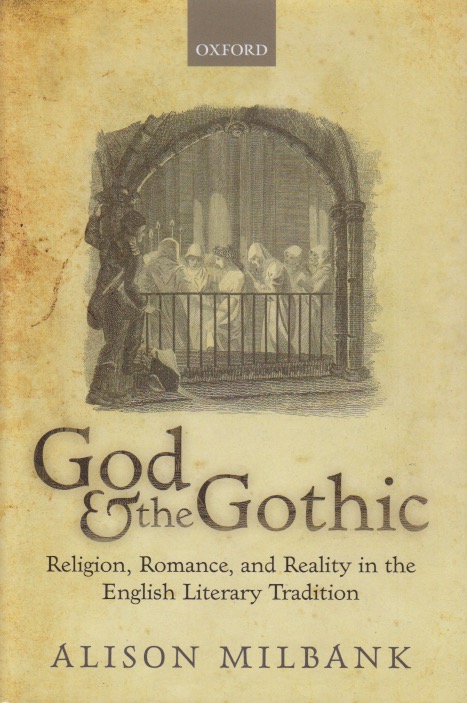
I have tried, in my halting way, to articulate what religion has to do with horror.  Alison Milbank is more experienced than I and it shows in her book God and the Gothic: Religion, Romance, and Reality in the English Literary Tradition.  There can be little doubt that the gothic is the direct ancestor to what became horror in the twentieth century.  In this intriguing study, Milbank explores just how the gothic made extensive use of religion, a sensibility that has carried over into modern horror.  Having taken a good long look at this myself—the fascination was there before Holy Horror and reaches back to my childhood—it is nevertheless affirming to find another student of human fears and fascination regarding the darkness has come to similar conclusions.  I always walk away from books like this with a renewed reading list.

Milbank points out, in the context of the literary world of England, how horror and religion not only cover the same theological ground, but come into direct contact time and again.  She does so by suggesting that Protestantism constantly seeks the lost Catholicism.  In England this came to be embodied in the Church of England, the middle way between Catholic and Protestant.  She covers various aspects of this such as melancholy, the doubling of characters, supernatural creatures, and death.  And more.  This isn’t a quick or light read, but I found myself making many connections I had missed.  Much of this, admittedly, came in books I’ve not read.  One of the problems with interest in the classic gothic is that bookstores don’t cater to selling older books and some of them weren’t successful in their own day, let alone ours.

There is a vindication in finding you’re not alone in a field.  Many of us who work on religion and horror know one another.  We’re a somewhat small, hidden group.  Milbank approaches all of this from the point of view of theology.  Theology is a somewhat distinct practice from religious studies and even from biblical studies.  There is overlap, of course, but theology is generally distinctly Christian in a context like this.  And that fits the living context of the many authors explored in this study.  Many familiar, and a few unfamiliar names appear.  What they have in common, apart from making up the cadre of gothic writers, is that religion influenced their writing and they weren’t shy about noting it.  This book explores the shadows very well and I’ll be revisiting its insights again and again.


Virgin-Haunted World

One of the most frequent accusations of “idolatry” I heard as a child was leveled at Roman Catholic devotion to the virgin Mary.  Lessons learned during childhood are difficult to displace, especially when they concern your eternal destination.  I overcame this particular objection, a bit, during my sojourn among the Episcopalians, but I have to confess I never felt right praying to Mary.  In my Protestant-steeped mind, there were two classes of entities involved: gods (of which, properly, there was only one) and human beings.  Only the former received prayers.  The rest of us simply had to contend with non-supernatural powers and do the best we could.  Still, I met many believers devoted to Mary, and honestly, some accounts of Marian apparitions are pretty impressive.

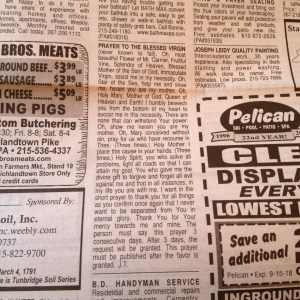
A local source for inexpensive advertising in our area is essentially a weekly set of want ads.  For a small fee you can advertise just about anything you want to buy or have to sell.  Spiritual or physical.  A few weeks ago, someone ran a magnanimous piece on a prayer to the virgin never known to fail.  The words of the prayer were printed, along with the instructions, for nothing is quite as simple as “ask and you shall receive.”  The prayer must be recited thrice, and thanksgiving publicly proclaimed.  A number of questions occurred to me, regarding not only this, but all prayers for divine action.  One is the rather simple query of how you can know if a prayer has never failed.  I suspect this is known by faith alone.

There are any number of things most of us would like to change about our lives, and the larger issue of prayer is the daisy-chaining of causality.  One change causes another, causes another, and often that for which we pray will impact another person in a negative way.  This is the classic “contradictory prayer” conundrum—one person prays for sunny skies while another prays for rain.  Neither is evil, both have their reasons, perhaps equally important.  (The weekday is a workday for many, and that’s non-negotiable in a capitalist society, so I suspect prayers for sunny skies tend to be weekend prayers, but still…)  The prayer never known to fail is either a rock or a hard place.  It’s that certitude that does it.  I don’t begrudge anyone a prayer that works.  Faith alone can test the results.  And although we could use a little less rain around here, we could all benefit from a little more faith, I suspect.  And for that there’s no fee.


What’s the Story?

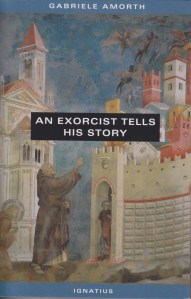
Belief is truly an amazing phenomenon. Even as we see it play out daily in the news, rational people ask themselves how people can accept something that all the evidence decries; just take a look at Fox news. In any case, those who study demons come up against the name of Fr. Gabriele Amorth with some frequency. Amorth was a true believer. Earlier this year I read one of his books and I wondered if he might reveal more in An Exorcist Tells His Story. Forgive me for being curious, but I really am interested in his story—how did this man become the passionate spokesperson for exorcism being reestablished in every Catholic diocese? What were the personal experiences that led him to this? Who was he?

Some people can’t write about themselves. Some, and I suspect clergy often fall into this trap, can’t write without the material becoming a sermon. This book is such an extended homily. Along the way Amorth does discuss a few cases of demonic possession and how it is to be confronted, but mostly he discusses the theology of his view of Catholicism and how that is essential to understanding demons. What is most odd about this is the inconsistency of a true believer in Catholicism admitting that Protestants too can drive out demons right after declaring the Roman Ritual is the only way for Catholics to do so. And only bishops, or those priests appointed by them, are permitted as exorcists. Is this a case of the enemy of my enemy is my friend? Protestants, according to the theology he espouses, shouldn’t be able to do this. If they can, why doesn’t it make him question his faith?

Known for his thousands of exorcisms, Amorth continues to have a healthy following. Anyone reading this book for a consistent outlook will be left wondering. How can Catholic exorcism work only if it follows the rules, and Protestant exorcism work when it is done by those who believe falsely? The same applies to his assertions that those who are possessed are not morally at fault, for it is the demon that makes them do evil things. At the same time those who lead “immoral” lives—according to Catholic standards—are more likely to become possessed. A few pages earlier we’d been told about saints who’d been possessed. I don’t mean to suggest anything about Amorth’s faith commitments—it’s celestially clear that he was a true believer. His commitment to help those who were possessed was legendary. Perhaps it’s just that demons are agents of chaos, and in such circumstances even theology can become a victim. I’m still wondering about his story, though.


Interior Theodicy

Photo credit: Richard from Canton, Wikipedia Commons

Speaking of theodicy, I have a dentist appointment today. Now, if you were raised with the Protestant guilt that used to be so pervasive in this nation, you’ll understand. I do brush my teeth twice a day. I even use floss and that mouthwash that burns away a layer of mouth lining every night. But there’s always more you could do. I’m not particularly good about visiting the dentist, though. Partially it’s a memory thing, partially it’s a pain thing, but mostly it’s a time thing. No matter how far back I jam the toothbrush, well beyond my gaging threshold, cavities seem to appear. And I don’t even have a sweet-tooth. What kind of deity allows cavities in a person who eats very little sugar and brushes so assiduously that last time the dentist told him to ease up a bit since he was scraping away the enamel? (People tell me I’m too intense.)

One of the real ironies of all this is that for all the trouble teeth give us during our lifetimes, they are our most durable parts after we die. Archaeologists find mostly teeth. In fact, it seems that Neanderthals might have practiced some primitive dentistry. I wonder what they thought of their neanderthal deity? So teeth are pretty useful, no matter whether the gray matter above them is dead or alive. I can explain this to my dentist, but he only seems interested in me as a specimen of carnassial curiosity. Maybe it all goes back to my belief that fillings were meant to last forever. Or all those root canals that seem to come in pairs that cost as much as a semester at a public university. Mostly it’s the memories.

In Edinburgh I had a tooth go bad. The Scottish dentist was surprised. “You’ve got a twelve-year molar erupting,” he said (you’ll have to imagine the accent). I asked if that was unusual. He owned that it was as I was a post-graduate student in his late twenties and the twelve-year molar was so precise in its timing that child labor laws used to be built around its presence. Years later in Wisconsin a different dentist asked about one of my fillings. I told him it was from Edinburgh. He called all the other dentists in announcing, “You wanna see a real Scottish filling?” Or maybe the fears go back to my earliest dental nightmares where the cheap doctor seemed unaware that teeth actually had nerves in them. I always left with a guilt trip. “You should brush —“ (more, better, longer, with a more gentle touch) you fill in the blank. I’m afraid of another kind of filling. And I know as it is with Protestant guilt, so it is with teeth. There’s always more you could be doing.


Alt Bible

A friend recently sent me a story from Anonymous titled “Why Did The Vatican Remove 14 Books From The Bible in 1684?” This piece reminded me of just how rampant biblical illiteracy is in this Bible-worshiping culture. To begin with the obvious, Roman Catholics are the ones who kept the Apocrypha in their Bibles—it was Protestants who removed the books. No doubt, retaining the Deuterocanonicals was a rear-guard action of the Counter-Reformation, but still, if you’re going to complain about the Papists it’s best to get your biblical facts straight. The story is headed with a picture of The Key to Solomon’s Key. Ironically, Solomon’s Key is actually an early modern grimoire that the author seems to think is the same as the Wisdom of Solomon, one of the books of the Apocrypha. Reading through the post it was clear that we have an Alt Bible on our hands.

(For those of you who are interested in the Key of Solomon, my recent article in the Journal of Religion and Popular Culture on Sleepy Hollow discusses the Lesser Key of Solomon, a famous magic book. It features in one of the episodes of the first season of the Fox series and, I argue, acts as a stand-in for the iconic Bible. One of my main theses (don’t worry, there aren’t 95 of them) is that most people have a hard time discerning what’s in the Bible and what’s not. But I obviously digress.)

The post on Anonymous states that the Bible was translated from Latin to English in 1611. The year is partially right, but the facts are wrong. The translators of the King James Bible worked from some Greek and Hebrew sources, but their base translation was the Coverdale Bible which had been translated into English and published some eight decades before the King James. Myles Coverdale relied quite a bit on German translations, but the King James crowd went back to the original languages where they could. The KJV was published in 1611, but the translation from Latin was actually something the Catholics preferred, not Protestants. The Vulgate, attributed to and partially translated by Jerome, has always been the favored Roman base text. Ironically, and unbeknownst to most Protestants, the King James translation did include the Apocrypha. I like a good conspiracy theory as much as the next guy, but they certainly make a lot more sense when the known facts align without the Alt Bible unduly influencing the discussion.


Reformation Blues

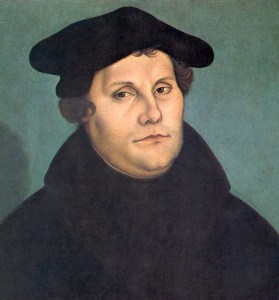
Welcome to Reformation Year! Well, not actually. It’s more like an anniversary. Five centuries ago this Halloween, Martin Luther grabbed his silver hammer and history forever changed. In 1517 nobody could guess that that obscure strip of land across the Atlantic (nobody knew how far west it went except maybe those who already had lived here for millennia) would one day identify itself so strongly as Protestant that other religions would be merely tolerated. Even when it established itself as a land of religious freedom, it mainly would have Protestants in mind. Indeed, Martin Luther unlikely ever met a Hindu or Buddhist. His concern was the Catholic Church which, in all fairness, had already split into two major branches a few centuries before he was born.

lossy-page1-558px-Martin_Luther_by_Cranach-restoration

Thinking about the Reformation makes me uncomfortable. As my regular readers know, I’m concerned about ultimates. In a universe where “you only live once,” and eternity is so very long, you need to make the right choices when selecting a means of salvation. Really, an eternity in constant torment makes a Trump administration look like a day in the kiddie zoo. This is a very important choice. Heaven and Hell are a non-zero-sum game. You pick the wrong one and you suffer for ever and ever and ever. And ever. With one united church at least you could know that everyone else believed the same. Now you have to shop around for salvation. Which brand really does whiten best? Which is the most flame retardant? Things got pretty complicated as soon as that nail entered that Wittenberg wood.

The truly sad thing is that all this splintering represents those of the same “religion.” It’s bad enough that Christian versus “infidel” was already a thing, but from 1517 onward it was Christ versus Christie, as it were. You may have been lucky enough to have been born into the right family, but if you descended from the wrong scion you were still going to end up in Hell. Catholicism may have been corrupt—selling indulgences is pretty shady business when you can get them for free—but once that break is made we can’t all be right. Somebody’s going to end up eternally in torment and it’s not even going to be the heathens. Reformation suggests something’s wrong in Rome. You can’t hide behind being born Baptist, Methodist, Presbyterian, or Lutheran. No, you’ve got to do your homework and learn which is actually correct. Where is Pascal when you need to make a bet?


Majority Report

In your mind’s eye, picture American 500 years ago. What do you see? Even those of us who’ve studied history have trouble envisioning the past with so different a set of parameters. At least if we’re honest with ourselves. 1516. The Salem Witch trials are almost two centuries in the future. The landscape is occupied by Native Americans. There are some European settlements. Protestantism is something new. In fact we’ll need to wait another year for Martin Luther to drag out his hammer and nails, theses in hand. The America we see then, not called “America,” let alone “United States,” is a diverse—some might say “wild”—world of decidedly non-European sensibilities. Global warming wasn’t an issue, and King James hadn’t even been born yet, let alone been commissioning the most famous Bible in English ever. So why am I asking you to look back?

luther_at_erfurt_-_justification_by_faith

This presidential campaign has largely been a waspish one. During the turmoil, books have been published proclaiming the end of “white, Christian America.” In an interview on PBS one of the authors of such a book, Robert Jones, talks about how America has changed. He notes that what he really means is that white Protestants are, statistically speaking, no longer the majority. Just a few centuries ago that was also the case. Think about Protestants a minute. They’re the ones who invented the Bible as we know it. Oh, the book had been around, in some form or other, for a couple of millennia (well, a millennium and a half, back then). Other than scholars in need of more fresh air, few spent much time with it. The church told Europeans what God demanded and the majority of people just got on with their daily lives not worrying about what some book they couldn’t even read might say. How things have changed!

We worry about the end of our majority. I like to look back and see that this world we’ve built is one based largely on a book that was mainly the invention of those who had some discussion points with the church. Not quite a hundred of them, even. They were largely Anglo-Saxons. If they knew about “the New World” their knowledge was hazy and imprecise. From that perspective it doesn’t seem like much is being lost in the changing religious demographics of this country. Back in the old world, if one wished to feel nostalgic for such things, they would’ve taken their complaints and found the nearest church door. Now we nominate candidates who think this country was ours in the first place, without ever even reading the Bible used to support that myth. What a difference a few centuries can make.


Not Quite Dead

Duria_Antiquior

Extinction is a cause of fear. Having evolved a certain level of self-aware consciousness, we fear becoming the next tyrannosaurus-rex or spinosaurus, or whatever the next top predator turns out to have been. We’re here to stay. So we like to think. Data have been known to interfere with comfort zones, however. Take religion, for example. America has always been a religiously diverse “country,” but many people suppose it has a Christian beginning. Moreover, the historically uninformed suppose that generic Christianity to have been Protestantism (which is not really a single religion) and white (which isn’t really a race). Now, it seems, that white Protestantism is slowly going extinct. An article in the Washington Post by John Sides contains an interview with Robert P. Jones of the Public Religion Research Institute. Jones has written a book about the end of this particular hegemony.

Demographics tell the story. The powerful cultural force of the mainstream Protestant churches hasn’t disappeared, and really isn’t likely to become extinct. It has, however, diminished. As soon as we began to embrace technology this was a more or less inevitable trajectory for the human race. We made oceans smaller and came to see that we’d evolved different religions in different regions. And that Christianity wasn’t quite unique as we’d thought. “Orthodoxy” was actually a form of prejudice for a past that may never have been. We saw the writing on the wall and went on scribbling. Making claims the data don’t support.

One of the drivers—and this is a complex phenomenon—behind this shift has been the ossified positions of religions in the light of increased understanding. For example, most people see no problem with homosexuality. They believe shooting someone because of their race is wrong. Women, they radically suggest, should have the same rights as men. The hold-out positions on these issues have historically been religiously based. Just listen to the rhetoric of televangelists and see if it has changed. Meanwhile, the world moves on. Many religions are holding still. Or racing to see if their diminishing number of feet might make the world spin backwards after all.

Religion is a human invention. Many protect themselves by claiming direct revelation by a God who used to live in a glass ceiling above our heads. Trips to the moon, probes to Mars, and out of our solar system have proven that view false. If the view of something as basic as the universe was wrong, what else might’ve been a mistake? Jones’ new book will no doubt cause some panic. Extinction, at least not imminently, doesn’t seem to be in the cards. Protestantism seems to have reached a stasis. Religion still has an important function in society. When it takes the lead on issues of equality, we may begin to see a miracle.


All Things Newton

Andover Newton Theological School is the oldest stand-alone graduate school of theology in the United States. Was, I should say. Declining enrollment—supply and demand dictates fewer clergy are required—and the rising costs of a job description that has no obvious retirement age have led many seminaries to merge or close. It seems that Andover Newton is about to merge with Yale Divinity School, much like Berkeley Divinity School, bringing together a mix of Congregationalists, Episcopalians, and Nones to huddle together across the quad until people want to believe again. Those of us who grew up being taught that belief was normal, and widely accepted, have experienced a sense of bad investment lately. We poured resources into keeping our product current only to find the use by date predated the use of use by dates.

Think of it as evolution. From the earliest days of civilization, priests were integral to, well, civil society. Evidence more and more points to religious belief being the actual glue that held larger communities together in permanent settlements. In other words, that’s how we’ve lived for five thousand years. How were we to know that the rules were about to change? You could always count on a need for clergy. The world’s first service industry. Ah, but it’s the latter word of that noun phrase that’s the problem. When religion becomes a commodity it’s subject to supply and demand. Supply has exceeded demand for some years now and the factories are shutting down. Anyone want a used Bible, cheap?

The Episcopal Church, with its outsize influence for such a small body, used to have eleven seminaries in this country. The United Methodist Church, larger by nearly an order of magnitude, had thirteen. Once and future clergy such as yours truly were produced in classes of dozens. We didn’t diversify our portfolios enough. So now, Andover Newton—the very school where I learned Hebrew—is downsizing faculty by a rather drastic percentage. I’m not so worried about deans and administrators since they easily buy into the business model of education. I do wonder about the effect on society of having so many unemployed theologians around. One thing we don’t have to worry about is organized groups of them roving the streets; theologians are fiercely individualistic. As they transition into the corporate world—the only world that now exists—they’ll find themselves wondering how to live among the soulless multitudes. There’s only one orthodoxy here—lucre be thy name. And, oh, you might consider asking about entry-level positions.

IMG_1550


Foundational Books

Over the weekend I visited one of my favorite used book stores, The Old Book Shop in Morristown. It’s neither huge nor fancy, but it has the feel that is so important to the restless mind. The feel of not knowing what you may find. The mystery of discovery. As I browsed, it occurred to me that although books of all varieties lodge here, the predominance of the old books tends toward the religious. The books associated with the church have survived for their centuries, closely followed by the classics—what was once considered the purview of the educated. I suppose one might argue that the breviaries, hymnals, and Bibles indicate overprinting on the part of overzealous presses, but I know that’s not the whole story. In fact, until quite recently the educated were expected to be religious as well. There was a kind of humility at work here. Even scientists respected the God who’d put all of this into place. This was not so much overprinting as it was meeting a prevalent need.

In early America, for example, if a household owned a book, it was more than likely a Bible. Bibles existed in profusion due to—putting it most crassly—demand and supply. People wanted to have a Bible. Particularly Protestants who’d been taught that it alone held the key to their salvation. There are some things you just don’t leave to chance. As that era continues to fade and people unload the books they no longer need or want, the Bibles and hymnals and prayer books make their way to antiquaries and I spend my weekends browsing among them and pondering how we came to be in this place.

Education—books—is/are foundational to our society. Books may be messy and lend to clutter, I’m told. In our apartment they climb in stacks alongside overfull bookshelves like ivy up the side of a tower, and yet I find them difficult to release. There’s knowledge here for the taking. The visit to the used bookstore inevitably leads to finds I hadn’t expected. There were no Bibles in my hand as I checked out, but no matter. I’ve got many Bibles at home. I’m aware that building requires foundations. Architecture may change over the centuries, but old foundations remain for millennia. To be educated is to be aware of them and appreciate them for what they are.

IMG_2732


Biblically Business

Bibles are business. I recently read that the first book of which Oxford University Press sold a million copies was the Scofield Bible. The Scofield is incredibly resilient to the advancement of scientific thought, and, although large print editions seem to be gaining, it is nevertheless an icon. Conservative Bibles still make good business sense. Still, the Bible originated in a rather more Catholic context. As Christianity was being born, and growing up, there were many sources of information on what it mean to be a member. Initially, being Jewish was a prerequisite. When that was dropped, you would have needed to be able to find an enclave. This wasn’t always the easiest thing to do since Roman emperors sometimes made a quasi-Olympic sport out of killing Christians. Once a church was found and joined, you just participated in the fellowship and listened to the leader. Reading from “Scripture” was likely part of worship services, but the Bible we recognize didn’t exist.

Well, parts of it did. Torah and Prophets were around. The Writings were written. Paul’s letters—several of which are still missing—were still circulating. The Gospels and Revelation would come somewhat later. About the fourth century there was general agreement about which books we meant when the word “Bible” was used. There was some fuzziness around the edges, though. Books like Tobit and Maccabees were accepted by the church, but had never been part of the Jewish canon. Judaism never officially closed its canon, so putting a limit around what would become the “Old Testament” was not as easy as saying it was just the “Jewish Bible.” No books have been added, of course, but nobody bothered to set the list in stone. Now Catholic Bibles, largely because of the counter-Reformation, included the Deutero-Canonical, or Apocryphal books. Protestants soundly rejected them. And Protestants were the champions of personal Bible reading.

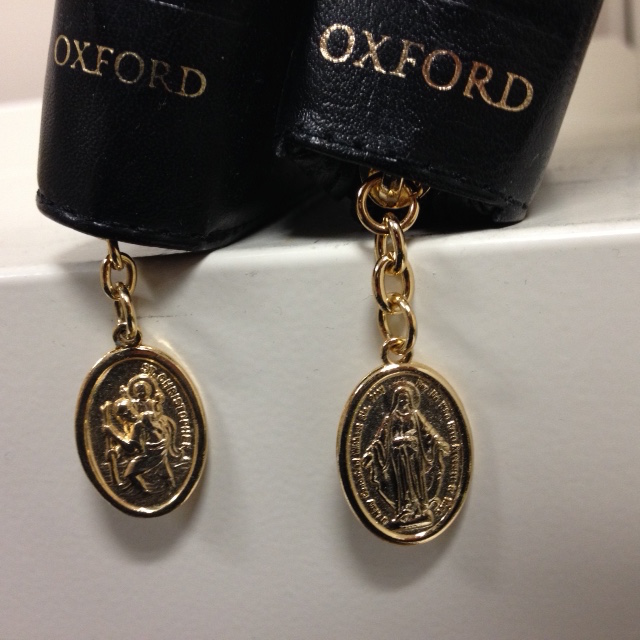
About the midpoint of last century, both Roman Catholicism and Judaism began to show a renewed interest in what had largely been a Protestant (and somewhat Teutonic) endeavor: critical study of the Bible. Bibles specifically directed toward these new readerships began to be produced. With metaphorical bells and whistles. The zipper Bible has always intrigued me. I never owned a zipper Bible. Once I had a zipper case, but never a zipper Bible. What was the message here: the word of the Almighty had to be protected? The other day I came across two zipper Bibles with saints’ medals as fobs. One was St. Christopher (who protects travelers) the other was for St. Mary (generally overall saint). These symbols of tradition interact with the more textual tradition that has come to be known as Bible. Religion is seldom monolithic, and even saints can watch over what is hidden by a zipper and regarded as the ultimate truth among those for whom Bibles are business.

IMG_2404


Plainly Ghosts

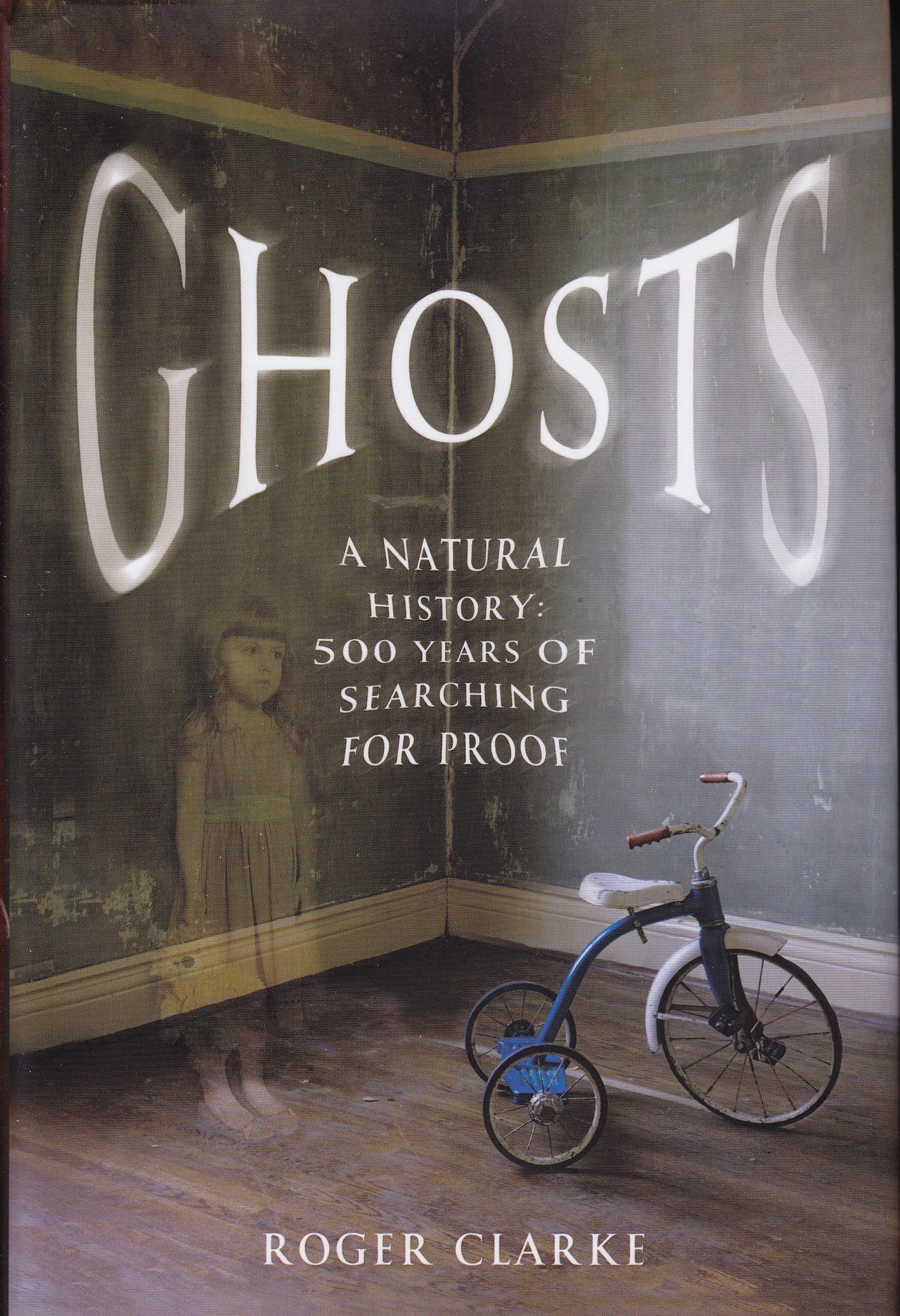
GhostsSometimes I’ll buy a book and secret it aside to read later as a kind of reward for making it through some heavier material. Research monographs don’t always do the job for which they are required in the commuter’s life—keeping me awake on a long and tiresome bus ride. I look forward to the book that has more appeal, and I don’t want to rush through it right away. I picked up Roger Clarke’s Ghosts, A Natural History: 500 Years of Searching for the Truth in Princeton’s wonderful Labyrinth just after Christmas (the traditional time, I learned, for telling ghost stories). Now that spring is more or less firmly in place, and I’ve gotten through some erudite studies that I might use for an academic paper or two, I picked it up to pass the time on my weary ride. As regular readers will know, ghosts have long been a preoccupation of mine, but one on which I’ve always been ambivalent. Clarke doesn’t set out to prove anything here. His book is more experiential than agenda-driven. He begins with the simple observation that people do see ghosts.

Lamenting that he himself has never seen one, Clarke sets out upon a partially autobiographical explanation of where this fascination began. Being from the United Kingdom—often cited as the most haunted country in the world—he goes through some of the more famous accounts with a sharp eye. Crying shenanigans when they’re obviously there, he questions how one can claim that any one country is more haunted than another. More importantly, he notes how seeing ghosts is a marker of class. Historically, the rise of the middle class led to the death of the ghosts. The rich and the poor see ghosts more often. Those in the middle associate such sightings with poor education, while those who are most educated and refined take ghosts for granted. It is only with the rise of reality television, the true opiate of the middle class, that ghost belief has become acceptable in the broad center.

Clarke also frames his work against the religious background that Catholics, with their belief in purgatory, had room for ghosts in their theology. Protestants tended to see anything reported as a ghost as a demon, since the soul either went to heaven or hell after death, meaning that there’s no ghost left to wander around. While doubtlessly skeptics exist, I have always been intrigued that even hard-nosed scientific views of the paranormal world tend to go a bit softer on ghosts than they do on cryptids and aliens. I suspect that’s because ghost reports have been around as long as written records and, presumably, long before. People have always seen ghosts, and in such large numbers that it is difficult to simply call them names and say they’re foolish. Yes, we may be a credulous lot, but we can still find books like Ghosts at a reputable bookstore. And we can tuck them away as guilty pleasures to take the chill off an otherwise very dull ride.