Mystery Religions

Religion.  What is it?  Those of us with many years—or decades—of experience in it find ourselves asking that often.  A Raëlian I know pointed me to the documentary The Prophet and the Space Aliens, by Yoav Shamir.  Shamir is an Israeli film-maker who was recognized by Raël some years ago as being in sympathy with the principles of Raëlianism.  The result is this film, released about a year ago, and available in its entirety in the context of an interview on Vice, housed on YouTube.  It is well worth the watching, although be warned, it is NSFW (not safe for work), as they say.  I found the post-viewing interview of Shamir to be quite enlightening as well.  Shamir’s film itself is, of course, worth pondering.

Image credit: George Stock, via Wikimedia Commons

Raël, born Claude Vorilhon, began his career in France as a singer and then a journalist for a racecar magazine he founded.  In 1973, after a close encounter of the third kind, he founded Raëlianism, a movement of which he is still the leader.  While Shamir is not a Raëlian—indeed, he’s a non-religious atheist—his documentary treats Raël respectfully.  After giving an overview of the movement at the present time, following Raël as he goes about his daily activities and interacts with his followers on his estate, it then gives his biographical story and interviews some of the people he knew as Claude Vorilhon.  The documentary is balanced and addresses issues such as the movement’s proactive outreach to Africa and respect for African religions and its unconventional views on sexuality.  The issue of cloning, which came to a head in 2002 with the claim that a human, Eve, had been successfully cloned, is also covered.

What it truly striking about The Prophet and the Space Aliens is that it intentionally raises the question of how religions begin.  An originator, a prophet, gathers a band of followers.  Its beliefs are distinctive from other people and tend to outlive the death of the founder.  If it is strong enough the religion will go on to become a fixture in society, sometimes gaining influence and respectability.  One of the points Shamir makes is that if religions survive long enough they simply become part of the cultural fabric.  One of the most interesting scenes in the documentary is an encounter between Raël and Mormon missionaries.  Mormons are one of the more recent, successful New Religious Movements that has become mainstream.  When a member receives a major political party’s nomination for president, it’s obvious that the candidate’s religion (if any) has become accepted.  This documentary will make you think.

Spirituality Sampler

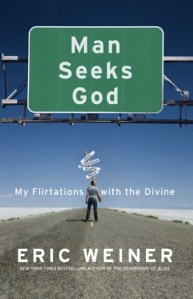
ManSeeksGodSometimes you read a book and wonder if somehow the author got into your head and fished around for material. Although I’m not Jewish, at least not that I know of, I found Eric Weiner’s Man Seeks God: My Flirtations with the Divine to be uncannily familiar at points. Not that I’ve ever been a journalist, nor have I had more than a few hundred people read anything I’ve written, but somehow I just couldn’t shake the underlying connectivity. For those of you unfortunate enough not to have read it, Man Seeks God is Weiner’s spiritual journey through various religions, seeking his God. Born culturally Jewish, Weiner never really resonated with the religious aspect until the last chapter of the book. In between, however, he shows a true pioneer spirit and tries diverse faiths, some of which are not for the fainthearted. As fits the postmodern period, he’s an authentic, intentional spiritual shopper. And he provides many laughs along the way.

Such a book must be difficult to write. There’s a lot of baring of the soul, and even a little baring of the body, at times. Weiner begins with Sufism, the mystical branch of Islam. Yes, it’s based on love. He then travels to Nepal to pursue Buddhist meditation, followed by a stint with the Franciscans in the Bronx. The only one of the “big five” he doesn’t sample is Hinduism. That might have thrown a speed-bump into his ending, though, to be fair. He makes no claims of comprehensiveness. At this point the story takes a turn toward decidedly exotic selections in the cafe of spirituality. I couldn’t read his account of the Raëlians without snorting aloud once or twice on the bus. Taoism takes Weiner to China and into a distinctly more philosophical frame of mind. He explores Wicca and Shamanism, which may be more closely related than he supposes, before coming home to Kabbalah, the mystical branch of Judaism.

Spiritual seeking is as mandatory as breathing for some people. Eric Weiner is one of those teetering on the edge of active exploration and the ability to shut out the questions, if only temporarily. Reading his confessions, it’s clear that he’s a rational, intelligent man. He made it through decades without really feeling the need for religion. When the ineffable pressed itself onto him, however, he turned to the mystical traditions. I was warned, in conservative Grove City College’s religion department, to be very careful of mysticism. The professor was dry-eyed serious as he said that seeking direct experience of God would generally lead to heresy. So there it was, in plain sight. Doctrine has precedence over the truth. Long ago someone smarter than us figured it all out. Our job? Just follow their path. I have a feeling that Weiner, having had some unexplained experiences of his own, might disagree. Sometimes you have to take out a personal ad in the spiritual scandal-sheets to get an idea what the divine really is.