Prey Again

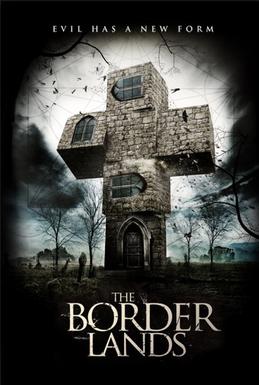
Let’s begin with the title.  Final Prayer was released in the United States as Borderlands.  I still found it on a free streaming service under its UK title, and I’m glad I did.  The movie falls under a a few different categories—cinéma vérité, found footage, and folk horror come immediately to mind.  The story follows a set of three very different Vatican-sent investigators, promotors of the faith, to check out a miracle claim in Devon.  I was a little confused at first, assuming this was an Anglican church, being in England.  One of the investigators, Deacon, a religious brother (monk not associated with a monastery), Gray, a techie who has some basic beliefs, and Mark, a priest technically in charge.  There’s tension between the men and between them and the locals.  The parish priest believes God appeared during a baptism at the parish that was being filmed by a family member.

The investigators come up with plausible explanations for the “miracles” caught on tape, but they also find some phenomena that are difficult to explain.  The local priest, distraught that they are disproving the “miracle,” jumps from the church tower, killing himself.  Mark, taking this as an admission of guilt for a hoax, closes the investigation.  Deacon, however, refuses to give up and calls in Fr. Calvino, who mentored both he and Mark.  Calvino believes the church was built on pagan sacred ground and it must be purified.  The ceremony, however, doesn’t end the way it was expected to.  All the while, the locals are—mostly passively, but at times overtly—hostile to the team.  Calvino’s revelation of the pagan background, however, makes clear that at least some of the locals haven’t given up pagan ways.

There are a number of elements worthy of commentary here.  It seems likely that a longer piece will be necessary to cover much of it.  A discussion in the local pub between Deacon and Gray, before calling in Calvino, raises the central question.  Gray, as a layman, suggests that pagans had to be worshipping something they believed was real before Christians came along.  He wonders if intruders (Christians, in this case) were unwelcome by this earlier deity.  Deacon, who is skeptical, but who’s come to believe that a former priest was involved in pagan worship, resists such thinking.  The ending makes clear what’s been going on, but getting to that point does involve quite a lot of religious discussion.  Horror and religion go naturally together, as I often opine, and this is a particularly good example of their common labor.


Opposites?

Not having the money to subscribe, I limit myself to the daily headlines of Publishers Weekly.  When physically in the office in New York City, it circulated among editors in print form.  I do miss that.  The weekly is a great place to stay informed of what’s going on in the book world.  Interestingly, the headlines—which are often linked together newsletter-style—noted that the annual preview of religion books was on the way.  This was followed by “On the exact opposite side of the publishing spectrum, Orbit has launched its fourth imprint, Run for It, capitalizing on the horror boom.”  So there it was staring me in the face.  Religion and horror are exact opposites.  Now, I can’t expect even experts in publishing to be aware of all the trends, but the religion-horror connection has been alive and growing for a few years now and those of us who publish books in it might dispute the “exact opposite side” designation.

Photo by Thomas Park on Unsplash

Horror and religion are closely related.  Many in the religion camp would want to deny that, but those who know horror know that religion quite often wanders in.  More than that, religion often drives the horror.  They’re not so much exact opposites as they are playmates.  Rather like the Bible depicts God being the chum of Leviathan.  (Who is, after all, a perfectly good monster.)  While my own humble efforts are frequently overlooked, the last four books I’ve written explore different aspects of religion and horror.  This includes my forthcoming Sleepy Hollow book.

Even if you’re not a fan of horror movies, if you pay close attention religion is not the opposite of horror.  We have this mental image of religion as a pure and holy thing in and of itself.  We don’t often stop to think that religions are invented by humans.  Yes, they are often in response to what believers see as divine stimuli, but the way that they are conducted is part of our human ingenuity.  They are considered good because of their emphasis on love and positive virtues.  If you watch enough horror you’ll notice that the menace is often a threat to love.  In other words, horror too emphasizes the value of love.  It’s a perception problem that sees horror as the opposite of religion.  Simplistic categories are often necessary to get through life—that’s why we stereotype.  Those of us who like to stop and think through things can gum up the works.  Even a headline in a magazine we like can lead us to wonder about the deeper implications and the biases they perpetuate.


Singing Darkly

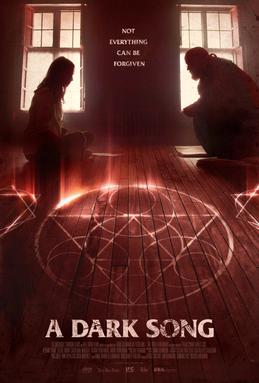
Euro-horror has become one of the more profound sub-genres of film.  I can’t recall who it was that recommended A Dark Song—set in Wales although filmed in Ireland—but it was immediately obvious I was in for a treat.  Dealing with Gnosticism, occult, and demonic manipulation (I wish I had the script!), it takes on the big issues of death, loss, and forgiveness.  The premise begins chillingly enough.  A woman rents an isolated country house for an entire year, paying in advance so there will be no disturbances.  She brings in an accomplished occultist to let her speak to her dead son again.  The two don’t know each other and this ritual will take many months, during which they will not be able to leave the house.  Neither really trusts the other, but Joseph (the occultist) tells Sophia that she must obey everything he says if she wants the ritual to work.  Once they begin they cannot stop until it reaches its conclusion.

Sophia hasn’t revealed the real reason she wants to summon her guardian angel.  She wants revenge on those that used the occult to murder her son.  The truth Sophia kept from Joseph requires them to restart, so he drowns her in the bathtub and then uses CPR to revive her.  As they grow increasingly tense, a fight breaks out where Joseph is accidentally impaled on a kitchen knife.  With only bandages and whiskey to treat the wound, they press on, but Joseph dies leaving the ritual unfinished.  Sophia can’t escape but after being tormented by demons, her guardian angel arrives.  Her request is actually wanting the ability to forgive.

This profound story has many twists along the way, but a scene that I would like to consider is where Joseph tells Sophia “Science describes the least of things… the least of what summat is. Religion, magic… bows to the endless in everything… the mystery.”  The suggestion that science is indeed correct, but limited.  Religion goes beyond science, however, to the world of possibility.  The movie suggests these two worlds intersect.  After Joseph dies Sophia can’t escape that other world until its rules have been met.  And when she does reenter the world of science, what happened in the world of magic has lasting effects on her.  A Dark Song is one of those movies that will haunt you after watching.  The Euro-horror of the last decade or so has been incredibly profound, showing the promise of what horror can be.


Carnival Days

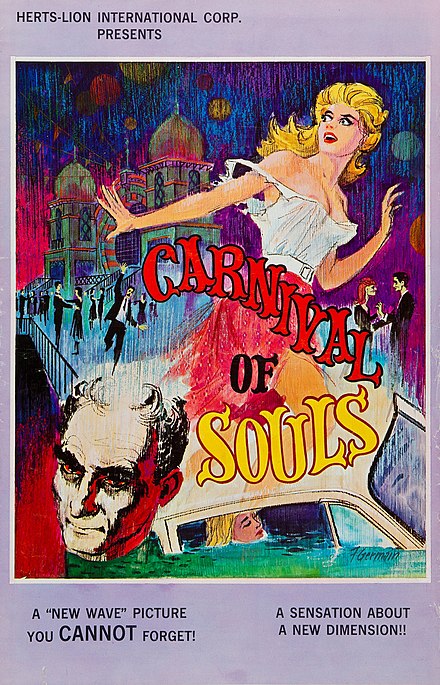
Carnival of Souls has been receiving renewed attention of late, so I decided to watch it again to see if I’d missed something the first time.  Indeed, I had. Carnival of Souls is one of those low-budget movies that was really never considered worth much until reevaluation started to take place several years after it was released (1962).  As a snapshot of an era, it offers a view of how horror and religion interact.  The story, in case you’re unfamiliar, follows Mary Henry, a young woman who’s a professional organist.  Even here a few things stand out.  She went to college, she relies on no man to support her.  And she views church work, as an organist, to be “just a job.”  This is pretty incredible on its own, but I’m getting ahead of myself.  Her car is nudged off a narrow bridge by a couple of guys out hot-rodding.

From the beginning the viewer is clued in that she drowned, although this isn’t made explicit until the end.  She makes her way to Salt Lake City where she’s been offered a job as an organist in an Episcopal church.  She “sees dead people” and becomes fascinated by an abandoned carnival on the shore of the Great Salt Lake.  The priest at first notes that she plays music to elevate the soul.  Later, however, after the dead man she keeps seeing unnerves her, she plays eerie music on the church organ (during practice) and the priest realizes that she’s not a believer.  He fires her on the spot.  Apart from getting the ethos of the Episcopal Church about right, this in itself is interesting.  The playing of creepy music is enough to lead to the loss of a church job.

John, the guy who won’t stop trying to score with her, wonders at one point if viewing church work as “just a job” doesn’t give her nightmares.  These attitudes, from only about six decades ago, seem terribly remote by today’s standards.  Many clergy have doubts about their faith.  Many don’t really believe what their church actually proclaims.  The movie shows a society that has an almost magical view of the church.  You can probably even take the “almost” out of that last sentence.  While the Bible’s not mentioned or quoted, the idea of a lost soul finding no home in the church is a telling bit of commentary.  Intentional or not.  Carnival of Souls will never be my favorite horror movie, but it has pre-echoes of Night of the Living Dead and a sincerity that invites consideration.  I can see why it’s gained renewed interest.


Shifting Gears

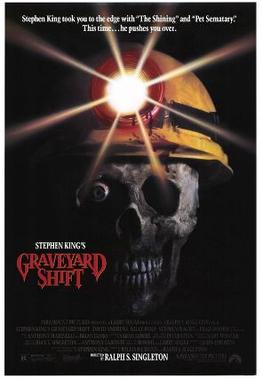
The question’s very basic: do you pay with cash, or by watching commercials.  When it’s the same three commercials the whole way through—for products you’d never buy—just paying the cash may seem the better option.  But it’s too late for that.  It’s the Graveyard Shift.  There’s no doubt  that Stephen King is responsible for the ideas for more horror movies than probably any other single individual.  I’d read his story, “Graveyard Shift,” many years ago.  I was warned, though, that this was one of the least favorite of his adaptations, and that’s a pretty low bar.  Still, it was just a matter of sitting through the same commercials over and over.  And one of them was more entertaining than the movie.  Of course, I don’t really watch for entertainment.  This is a learning opportunity.

Let’s start with the basics: You need at least one sympathetic character.  Okay, you kinda like Jane, because she shows basic humanitarian traits.  And Carmichael.  Then you want a plot that makes some sense—what is Warwick’s motivation?  The writing is particularly bad.  If there’d been a bit more intentional camp, this might’ve made a reasonable horror comedy.  I mean, you’ve already got the empty aluminum cans being fired by slingshot.  As it is, it’s played straight with an evil foreman, rats everywhere, and a giant bat in the basement.  By the end you’re kind of rooting for the bat.  And whose idea was it to use voiceovers of the sub-par dialogue over the closing credits?  Is this so bad that it’s good?  I’m having trouble deciding.

Although set around the fourth of July I wouldn’t call this holiday horror.  Nevertheless, there are some moments of religious imagery that pop out.  The graveyard sinking in the river has a listing statue of Jesus near the start of the film.  And the exterminator—the only real camp in the flick—narrates how in Vietnam they pinned victims down, like Jesus, to feed them to the rats.  The final couple of minutes—well earned, I assure you—have Hall fighting the wicked foreman with the jawbone of an animal (one has to assume an ass), inexplicably among human bones (some still in their coffins).  And his slingshot ultimately killing the giant (bat).  The references are to Samson and David, respectively.  Perhaps this movie’s an indictment of capitalism, since the basement cleanup is on Independence Day.  Or maybe it’s just tired horror tropes on a break.  (Having one of the characters reading Ben in the diner was a nice touch.)  It may become a holiday tradition after all.


Under Bite

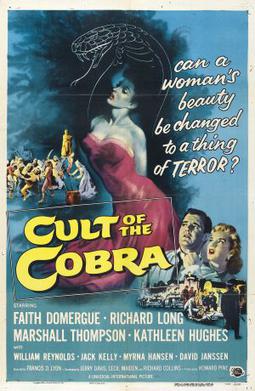
Religion and horror have long been bedfellows.  And quite companionable ones at that.  I’ve written a longer piece that I’ve not yet managed to wedge into a book about how the earliest Universal monster movies all involve religion in some way.  Maybe some day it will come out into the light.  In the meantime, I submit, for your consideration, The Cult of the Cobra.  This 1955 horror film was one of a series of movies about shapeshifting.  We’ve recently seen The Leopard Man on this blog, and before that Cat PeopleCult of the Cobra, set in amorphous “Asia” to start, involves the invented religion of the Lamians.  A group of US Airmen pay a Lamian to watch a woman transform into a cobra in an “Asian” ritual.  They’re revealed by trying to take a photograph—they’d been warned that if they were discovered the cobra would hunt them down and kill them.

Convinced this is all superstition, despite one of them dying the next night from a cobra bite, they return to New York City and civilian life.  The cobra woman follows them to carry out her mission.  She’s killed, however, before getting the last two.  What’s so interesting here is the discussion of belief that takes place throughout the movie.  Americans can’t believe in some “cult”—it’s clear from the start that anything not western is cult—but none of them show any inclination to church, or crosses, or even references to God or the Bible.  The only religion shown is that of the Lamians.  The cobra woman falls in love with one of the Airmen and tries to explain that she’s coming to doubt something she’s believed all her life.  She’s caught between religious duty and the experience of falling in love.

The movie failed to impress critics and was largely dismissed as a knock-off of Cat People.  There’s too quick a judgment here, however.  One of Universal’s earlier monsters had encountered a non-western religion but became much more famous for it.  The Mummy was based on “ancient Egyptian” religion.  Indeed, the whole story is premised on it.  The Cult of the Cobra, however, engages with the religion.  As jingoistic as it is, it nevertheless tries to represent “the cult” as a religion taken seriously by an exotic group of believers.  “Lamians” seems to have been borrowed from Greek mythology, however, where lamia were demon-like devourers of children.  I write about them in Nightmares with the Bible.  This isn’t a great movie by any stretch, but it shouldn’t be dismissed either.  It’s an important piece of the puzzle of how religion and horror interact in film.


Horror History

Trying to make sense of life has perhaps been my only real vocation.  As I continue to work on horror-themed books, reasonable people ask why I keep doing this.  It’s a question I ask myself.  The other day, while working on one of these projects, I had a realization.  The narrative I’d been playing in my head is that I grew up watching monster movies and then, apart from a few slip-ups, fell off the wagon again after my career malfunction.  That’s largely true but I suddenly remembered that seminary was actually another period of my life when I watched a lot of horror.  Regular readers know that I’m intrigued by the connection between religion and horror, but I’d forgotten how early this started with me.

A friend, nameless here, was a fellow seminarian and a total cinephile.  He and I would watch movies together quite a lot.  As I was recollecting which ones, it suddenly struck me that many of them were horror films.  And it wasn’t just this unnamed friend.  Another anonymous comrade frequently talked me into theatrical horror.  He’d go with his girlfriend (something I lacked at the time) but he liked to chat about the movies with me and often invited me along.  So it was that I was watching horror into the mid-to-late eighties.  I stopped, pretty much cold turkey, when I married.  It seemed that the therapy horror was offering was no longer needed.  Life settled into a happy, if weird existence stretching several years into Nashotah House.  This was the locus of said malfunction.

Losing my only full-time teaching post led directly to watching horror again.  My wife had to take a job out of state.  We crammed ourselves into an apartment after having a four-bedroom house.  Jobs were not coming my way, no matter how low I aimed.  Horror was cheap therapy.  What’s more, it’s remained a hobby ever since.  (Read into that what you will.)  People who know me personally (but who don’t frequent this blog) are often surprised to learn that I watch horror.  I don’t act like someone who does.  At least according to this usual, prejudiced image of the horror fan.  What’s more, the friends who share this fascination are nice people.  I was recently asked to speak about Holy Horror to a senior seminar at Transylvania University (it’s in Kentucky).  The students all seemed to be upstanding, bright young people.  They, however, like horror.  I don’t know their stories, but I’m guessing that they’re probably quite interesting.  They’re just beginning to try to make sense of life.


Leopard Spots

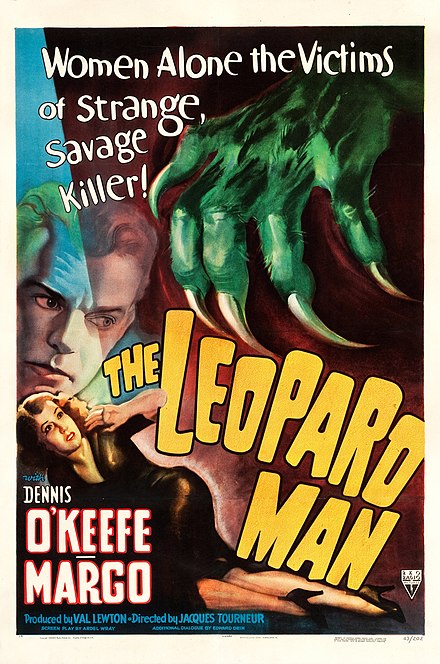
There’s always a dilemma involved.  Rent or buy?  Libraries face this when deciding on a subscription or perpetual access deal—is this something you’ll need for a long time?  More than once?  So also with movies.  Do you rent, watch, and forget or buy, supposing you’ll need to go back?  This plays out in my head when there’s a movie I want to see in these days of streaming.  The Leopard Man wasn’t a big hit when it came out in 1943.  There wasn’t really much of a taste for horror during the Second World War anyway.  In retrospect, however, it’s one of those films that has appreciated with age.  Apart from its effective use of the Lewton bus, the movie was well written.  It retains ambiguity and suspense throughout.  And if there is a leopard man who shapeshifts, we never see him doing it.  Spoilers follow!

Following on from his better known Cat People the previous year, Jacques Tourneur kept with the large cat theme in this film.  A publicist who (apparently) has no scruples, encourages his client/girlfriend to upstage a fellow performer by taking a leopard into her act.  The stunt backfires, however, when the frightened cat escapes.  Then mauled women are found and a hunt is on for the leopard.  If you’re adept at this kind of set-up you’ll figure out who the killer is—it’s not the leopard, except in the first case.  It’s implied that, rather like Cat People, the religion of the ancients, as Dr. Galbraith points out, might have some effect on modern people.  His dispassionate remarks about serial killers provides a clue, however, to who’s really behind it.

Religion runs like a thread throughout the movie.  The processions intended to alleviate the guilt for the treatment of the Indians, the ancient religion of those who made the museum pieces, and the Catholicism of the locals all play a part in this.  The question of whether Galbraith really becomes a leopard or not remains unanswered, but I sense it’s strongly implied that he does.  He had no intention of murdering the young woman in the cemetery and certainly had no time to premeditate the carrying of leopard hairs and claws to cover his tracks.  This is a man of science caught up in the spell of a forgotten religion.  Or so it seems to me.  In any case, it’s time to dust off this old gem and bring it back to the light.  It’s probably worth buying just to see it again.


No Demons

There’s a connoisseurship about it.  Making bad films, that is.  It’s a wonder that Night of the Demon—I should specify 1980 as the year—hasn’t really become a cult film of any standing.  You can tell the maker tried hard to shoot a reasonable film, but with a nearly Ed Woodsian level of incompetence.  It lacks Woods’ artistry, however.  For those just getting on the Bigfoot kick in the new millennium, it might help to know that Sasquatch was big in the seventies.  Yes, the first real efforts to sort this thing out came about when the psychedelic seventies were underway.  The documentary The Mysterious Monsters came out in 1976.  The first serious efforts to explain Bigfoot as not just a hoax began.  And James C. Wasson, Jim L. Ball, and Mike Williams took a shot at making a horror film of the hairy guy.

The acting is about the worst you’d care to see, and the script is abysmal.  The effects are anything but special, and the flashback scenes incongruous.  But it does have significance for religion and horror.  It goes like this: a professor and some students go to investigate a series of Sasquatch-related murders.  They’re led to “Crazy Wanda,” who lives alone in a remote cabin.  Wanda, when finally persuaded to talk, reveals that her crazed preacher of a father killed her Bigfoot-hybrid baby.  His followers still perform demonic rituals in the woods, worshipping the Sasquatch.  Wanda had burned her father to death in retaliation for killing her child—she kinda likes Bigfoot, it turns out.  The professor and students, naturally, fall victim to the beast.

Only the professor survives.  He’s assumed to be criminally insane and suspected of murdering his own students.  It’s almost painful to watch a movie where everyone is trying so hard to do it well, but just can’t seem to manage it.  The plot line about the cultists is immediately dropped after an intended rape ritual is interrupted by the professor.  Wanda’s preacher father, who seems to fit into no particular form of Christianity, has no motivation beyond avoiding Hell for himself.  At one point he seemingly admits killing her mother.  There’s even a scene where Bigfoot kills two Girl Scouts.  With all of this going for it, you might think it would’ve picked up a following.  It has some fans, I’m sure, but I’m not certain that it’s well enough known to make it onto lists of worst movies of all time.  More’s the pity since it would absolutely deserve it.


Facing Fear

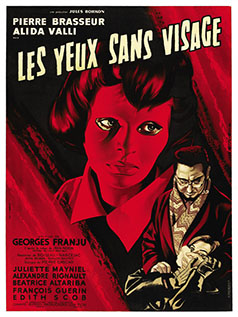
The relationship between fathers and daughters is intangibly profound.  (I can’t speak for fathers and sons, from either side of the equation.)  That was the angle that Georges Franju took when approaching Eyes Without a Face.  I have to confess that I knew the basic idea behind this movie and it took years to build up the courage to watch it.  I’m squeamish, and the fear that the film might show too much was a very real fear.  After you watch a movie, it can’t be unseen.  Still, it is a classic of the horror genre (although that is disputed) and it gets referenced all the time.  In case you haven’t heard about it, a plastic surgeon is attempting to graft a new face onto his daughter after she’s mutilated in an automobile accident.  Things, as you might guess, don’t go as planned.

Critics didn’t care for the movie when it was first released, but, as we’ve seen from time to time, re-evaluation changes things.  It is now considered good enough to be part of the Criterion Collection and ratings on the usual websites are quite favorable.  It’s often cited for its poetic treatment of the subject, and the response of Christiane, the daughter, seems to bear that out as she moves from complicit in her father’s crimes to sympathetic to his victims.  Indeed, the surgeon himself is conflicted, but that father-daughter relationship is something he can’t ignore.  He seems compelled to help her at any cost—it’s the price of parenting, I suppose.  It’s not for the weak.  But we’re in movie-land, aren’t we?

Christiane is sympathetic to the animals her father uses for his experiments.  When she frees them, after releasing the last intended victim, she’s depicted St. Francis-like, with the doves.  Knowing her own suffering, she can’t bear to impose it on another.  Our bodies are how we present ourselves to the world.  We rely on faces to tell us much of what we need to know, even without words passing between us.  Interestingly, even when wearing her mask, Christiane’s eyes tell the viewer much of what she’s experiencing internally.  Poetic, as the critics say.  If there’s a monster here, however, he’s driven out of love in the context of an imperfect world.  Eyes Without a Face works as a horror film and the reported fainting that took place among viewers early on demonstrate that we tend to feel for others, just as Christiane comes to.  And the father?  Well, that’s the unanswered question.  He’s a victim in his own way.


Wondering Wailing

You have to wonder, it seems to me, if the western, imperialistic gaze sometimes overcompensates for its past sins.  We remain reluctant to say we don’t understand something and sometimes even declare such things superior to what we produce.  That was the feeling that came over me upon reading about The Wailing.  Don’t get me wrong—I like K-horror well enough, but I’m not sure that I would say, with some critics, that it leaves American horror in the dust.  It’s good, yes, and it’s very long (two-and-a-half hours seems too long for a horror film).  The story doesn’t answer all the questions it raises and I was looking for some kind of religious message.  That’s why I watched it in the first place.  

What’s it about?  That’s hard to say.  The best that I can do is it’s about the doomed family of a Korean police officer in a small village.  As others have pointed out, this movie has ghosts, demons, zombies, exorcisms, and other horror standards.  There’s a considerable amount of Christian versus shamanism interplay.  And it seems okay, when someone else is doing it, to suggest a foreigner is the Devil.  None of this is intended to take away from the fact that the movie is effective.  I particularly found the shamanistic exorcism scene fascinating.  The thing is, you never really learn if the self-admitted Devil at the end is working with the shaman or not.  Or if the third potential villain, a woman named “No Name,” is in on it with them.  Or maybe I’m looking at this from the wrong angle.  Maybe the policeman’s family is simply doomed.  Nothing they can do changes that.

The movie suggests that such things are like fishing.  You can’t be certain who’s going to take the bait.  According to those who know, apparently a deleted scene at the end helps to clarify this a bit.  There is a lot of talk about belief, and a Christian clergyman confronting the Devil.  For me, however, I need to be able to follow a story well enough to figure out whether I’m misinterpreting or not.  The problem with a movie this long is finding the time to go back and rewatch it.  It opens with a quote from the Bible and it uses biblical tropes, such as the cock crowing three times, to make some strong points.  In fact, the opening quote from Luke 24.37-39 implies that the ghost may be God.  One thing is certain, I’ll be mulling over The Wailing for some time.  And maybe someday I’ll start to understand.  In the meanwhile, I’ll still watch and appreciate American horror, inferior though it may be.


More Omens

Brushing up on my eschatology, I watched The Omen again.  The original, that is.  One of the underrated aspects of cinema is that people learn their theology from it.  Movies tend to be more memorable than sermons.  It is opined among some that The Omen is responsible for the prevalence of dispensationalism among many Americans.  I’d put a bit of a finer point on it in that The Late Great Planet Earth was being raptured off the shelves all the way through the seventies (I personally bought two copies) and it caused a feedback loop with The Omen.  Many mainstream ministers, without benefit of a Fundamentalist upbringing, were caught unawares, I expect.  Scholars of religion have noted how several aspects of the narrative—the character of “the Antichrist,” the rapture, indeed, the Apocalypse—have been read back into the Bible by credulous believers.

What I found interesting in this viewing is the debt owed to The Exorcist.  Of the two there’s no doubt as to which is the superior film.  The name Damien in The Omen, I read somewhere once upon a time, was taken from Fr. Damien Karras.  During the late seventies and early eighties, unruly boys were routinely called “Damien” by frustrated camp counselors and others.  Apart from this nod, if true, is the fact that the abruptly introduced character Karl/Carl Bugenhagen is an archaeologist exorcist.  (He’s the guy who gives Robert Thorn the knives, if you haven’t seen it for a while.)  The scene shot in Jerusalem (said to be Megiddo) underscores that Fr. Merrin is also being channeled here.  I suspect that the film was getting a bit long in the tooth and some explanatory material on Bugenhagen was left out.

It has also been suggested that the number 666 entered popular culture because of The Omen.  I would temper that a bit with the fact that a lot of people were reading Hal Lindsey’s new apocalypse as well and the two of them got the job done.  There’s no doubt that after the film the evil number took off in a direction that would’ve left John of Patmos scratching his head.  This brings me back to the point that belief is influenced—sometimes constructed—by movies.  The Omen was a huge success at the time, despite the fact that many critics (also not raised Fundie) thought the premise was silly.  Most people aren’t film critics.  The Bible can be pretty impenetrable as well.  Preachers may not be inspiring.  Movies, however, wrap it up neatly and tell you what to believe.  Perhaps it’s some kind of sign.


Gather Round

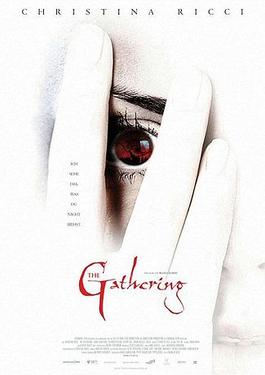
The church has been keeping secrets.  That’s the basic premise behind a fair raft of horror films.  Apart from giving those of us watching religion and horror quite a bit to talk about, it reinforces just how close the two are.  The Gathering is a film I missed when it came out, but one which has an interesting, if unlikely premise.  At times it reminded me of The Reaping, and at other times, the prequels to The Exorcist.  Cassie is a young American woman who loses her memory after being hit by a car near Glastonbury, England.  At about this time a deliberately buried church is being explored by an art history professor.  He asserts that it is the church Joseph of Arimathea built and represents, in its altarpiece, the earliest rendition of the crucifixion.  The clergy seem quite disturbed by this.

Meanwhile, Cassie recovers and is taken on as an au pair for the art historian and his wife (the one who hit her with the car).  The people of Ashby Wake stare at Cassie, as if they know her.  She has premonitions of several local people dying violent deaths.  The clergy learn that the altarpiece depicts those who came to watch Jesus’ crucifixion, not out of love or devotion, but simply for spectacle.  Since then they’ve been cursed and show up to watch various historic tragedies.  The clergy want the church, the earliest representation of the spectators, reburied.  The people of Ashby Wake include those of “the gathering,” indicating tragedy is about to unfold in that small town.  There is a twist ending I won’t reveal, but this is one of those horror films that rely on religion to make them work. 

Critics tend to dislike the film while viewers are divided on the question.  I actually enjoyed it, personally.  The concept of the watchers committed to bloodlust seemed different, particularly when put in the context of nascent Christianity.  It doesn’t handle religion as well as some horror does, but it’s a serious effort.  Why Joseph of Arimathea would want to have portrayed gawkers rather than those loyal to Jesus is one of the bigger questions left unanswered.  After the ending some of the unusual scenes earlier on make more sense.  But still no reason is given why an early church would have portrayed those not to be emulated.  As a horror film with no jump startles, but a slowly building dread, it fits the bill for some of us.  The “church keeping secrets” theme is one that should be explored further.


Troubled Water

There’s nothing like a good monster movie.  Of course, your local streaming service will have some considerable say over what you might watch.  Amazon Prime is likely my biggest influencer because I can’t afford the movies on my watch list and there’s a monster-load of “free” content.  Still, I fear something may have been lost in translation.  I wasn’t in the mood for anything too heavy, and The Lake thumbnail had a retro-Godzilla vibe to it.  The fact that it’s a Thai horror film certainly enhanced the appeal.  But I’m not sure I understand what it’s supposed to be saying.  The dialogue translation wasn’t, I suspect, very accurate.  More than that, however, I’m in no position to judge cultural tastes for a culture I know primarily through cuisine.  There’s more than a rampaging monster here, but it doesn’t translate well.

There’s a monster in the lake, shown pretty clearly early on.  It kills several villagers, perhaps for disturbing its egg.  A bunch of characters are thrown at the viewer—a family where the brother psychically bonds with the young monster (there’s a bigger, madder, mother monster), a researcher and his assistant, a detective and, quite late in the movie, his daughter, a police chief and his daughter, and none of them have enough screen time for us to figure out who the story’s about.  The monster doesn’t seem evil, although it killed several people at the start.  The police chief evacuates people to the temple and some Buddhist priests show up.  There’s religion and horror worth exploring here, but the dubbing calls the temple a “church” more than once.

The story largely seems to be about family.  The initial family, after losing a couple of members, reunites.  The detective’s daughter dies after he has reconciled with her in the ambulance.  The female police officer reveals near the end that the chief is her father.  (The researcher doesn’t seem to be related to his assistant, but they drop out of the plot.)  It’s difficult to tell if this is a bad movie or simply a cultural gap that puts real understanding beyond the reach of those in such a different realm.  From my viewpoint it was a movie not unlike the Godzilla films with which I grew up.  In other words, better than sleeping away an afternoon but not worth putting too much brain power behind trying to comprehend.  Technically it was a movie better than I could hope to make.  Some of the cinematography was quite nice.  I’m just not sure if I understood what was being translated or not. 


Clergy Problems

I believe Revival is the most recently written Stephen King novel I’ve read.  It was pretty good—it certainly scores high on the religion and horror scale, although it takes quite a while to get to the horror part.  Part of the problem for me is that I liked Charles Daniel Jacobs.  I tended to relate more to him than to Jamie Morton (the narrator/protagonist).  Perhaps this was because, like Jacobs, I studied to be a Methodist minister.  And like him, came to have a rather different view of what is really going on in the world.  He’s clearly King’s villain, however.  Or “fifth business” as he’s termed in the novel.  The secret lightning he seeks turns out to be a kind of MacGuffin.  I was curious to know more about it.  The novel, as is typical, has several subplots but the main one is how Jamie and Charlie face what’s after death in a tragic climax.

Charlie starts out as a Methodist preacher.  When his wife and son are tragically killed, he becomes a huckster who actually has tapped into an electrical power that can heal people.  It often, however, leaves bad aftereffects.  Jamie, who knew him as a kid, is cured by him from a heroin addiction.  Their paths continue to cross over the next fifty years or so—this is a longitudinal story—as Jamie comes more and more to distrust his childhood hero.  Charlie can use electricity to perform wonders and it make him rich.  He wants more, however.  He wants to see beyond death to assure himself that his wife and son are in a better place.  It seems to me that that motivation isn’t a bad one.  The only way he seems a villain is that he doesn’t really care for other people.

The story is well told but it doesn’t have the same “classic” feel as some of King’s earlier novels.  He well understands, however, that horror and religion belong together.  I haven’t read all of his novels—not by a long shot—but clergy aren’t rare and when they’re present they’re implicated in the horrors, or in this case, responsible for them.  These are important insights, as others have also noticed.  Revival is one of those books that requires some reflection.  It certainly feels like something written by a man facing the limitations of the aging process.  And not necessarily at peace with it.  Ministers sometimes do go bad—they’re only human—but they can also lead to real change.  I, for one, am interested to hear what King has to say about it.