Empty Pews

An insightful op-ed piece by Robert D. Putnam and David E. Campbell in yesterday’s paper asked the question “why youths are losing their religion.” The authors, professors at Harvard and Notre Dame, respectively, answer with the suggestion that religion and politics just don’t mix. The truism that religion and politics are taboo subjects of polite conversation was widely accepted in my younger years. During the Reagan campaigning era, however, it became clear that some unprincipled louts were drawing religion into the political mix to garner votes. Those who actually research Reagan’s religious convictions are often surprised to find that they are not as “George W. Bush” as everyone thought. It was a ploy, and a vastly successful one at that. A new avenue had been paved, however, for hotly contested elections: use the Bible. The fawning attitudes of many Americans toward the Bible they seldom read is a powerful political tool.

Putnam and Campbell note that adults coming of age in the 1990s and later have been alienated by this paring of religion and politics. The results have tended to be the rejection of organized religion that is seen as hypocritical and intolerant. The interesting factor is that it is the political agenda that is hypocritical and intolerant, but organized religion is paying the price for going along with the Ralph Reeds, Jerry Falwells, and Pat Robertsons of the early religious right. One guy from an old book once said something like “what you sow you also shall reap.” The political use (abuse) of religion has only and always been about power.

The authors are able to provide statistics to back up their models, but their reasoning is clear enough on its own. Some of us have experienced first hand the ugly, hideous agenda behind the angelically smiling evangelistic face. Those who hold to it may be naïve enough to believe that it is actually religion that they are serving, but the sad truth is their positions are cravings for power. There are those who actually relish the days of imperial Christianity when, despite its Roman Catholicism, the church made Europe tremble. They forget that pilgrims and colonists moved to this land to flee such tyranny. Americans, reluctant to elect Roman Catholics to the presidency because of the latent fear of a hierarchical religion — so close to kingship — now bow down before political rulers in religious garb. Decidedly Protestant. And the Tea Party continues to crank out candidates who do not even realize that the separation of church and state is a founding principle of this nation. If there is a backlash coming, it is a well deserved one indeed.

Wasps

I just finished reading Iain Banks’ The Wasp Factory. It is a disturbing novel on many levels; even the back-cover comments warn against reading it. The reason for mentioning it on this blog, however, is that it is so full of religious ideas that it would be a shame not to address them here. I won’t put in any spoilers for those who might, even with adequate warning, want to read the book.

The wasp factory of the title is a divination device. The narrator, Frank, does not believe in God because of the unfairness and cruelty in the world, although he is also a frequent perpetrator of cruelty. As he seeks revenge on animals other children, Frank views their suffering as a form of punishment from the God he disbelieves. At one point, after his brother Paul dies, Frank compares him to his old dog Saul, also unfortunately deceased. At this point he reveals, “Paul, of course, was Saul.” Death is the Damascus Road experience in this world devoid of a deity, but one where death is considered far more certain than life. At one point Frank declares the sea to be a mythological enemy, a point of view shared by the Bible and many ancient societies.

Frank is a neurotically ritual-bound individual. No matter how gruesome, his tasks are part of an elaborate system that must be repeated in order to maintain its efficacy. At one stage Frank declares, “this is like intellectuals in a country sneering at religion while not being able to deny the effect it has on the mass of people.” This statement is more insightful than it first appears – it is the dilemma of many who attempt to understand religion who are considered a luxury not to be afforded by society. Frank is a paradigm: people are religious, even in heterodox belief systems. The Religious Right has understood this for decades: talk religious talk and they’ll vote for you. Most people have no way of checking out what form this religion might take. It makes me almost as nervous as The Wasp Factory itself.


I’ll Take Coffee, Thank You

Yesterday’s victory of Christine O’Donnell in Delaware’s senate primaries seems to have shocked a lot of people. Have these people not been paying attention? Did they sleep through Beckpalooza? Have they failed to see that Sarah Palin’s lackluster life story has become a best-seller? Are Americans in denial that we are facing a major Religious Right comeback? The problem, yes, problem, is that Americans are not taught to think about religion for themselves. Raised with the idea that their political and religious leaders have some special channel open to the divine, they are sheep led to the, well, you know…

Society pays for its sins. One of the most fatal of the deadly sins is the refusal to take ownership of religious education. Unreflective religion in the hands of politicians is a fully armed atomic warhead. Many Americans like to think this is only a problem in nations with Islamic infrastructures, nations unduly influenced by shahs, ayatollahs and imams. Nations influenced by Tea Parties, Neo-Cons and biblical amateurs are much safer, much more friendly.

Problem is, the Bible’s a mixed bag. Some of the loftiest spiritual sentiments nestle down uncritically next to calls for genocide and harsh repression. As long as it is the magic finger from above that’s written it, that’s good enough for tea-tipplers. There are few opportunities to call Americans together for a religious town meeting. We’re all too busy off doing it our own individual way. In such a climate, isn’t it best to let those without any formal religious training tell us what the Bible says we should do? Do you want one lump with that, or two?

O'Donnell takes Castle to school


Freiheit

This week’s Time magazine has a rhetorical question on the cover: Is America Islamophobic? Not a word need be said. The real issue at stake, the one many Muslims feel the brunt of, is religious freedom. This founding concept of America has been eroding for decades. How many Americans have tried to imagine what it would be like if they were Muslims living in “the land of the free”? For that matter, how many have tried to imagine what it would be like to be Catholic, Protestant, or Unitarian? Certainly, it would seem, Jews know the value of religious freedom. Do we ever really try to feel their experience? It is much more cozy to be part of the religious majority and tell others to step in line.

With great roaring newts and Alaskan beauty queens telling them what to think, Americans are easily stoked to injustice. No, they have no right to worship here, they tell us. The truly frightening part is how easily manipulated the masses are. America a Christian nation? Who can adequately define “Christian”? Those who make such claims tend to be Neo-Cons who assume some fundamental form of Christianity is the default version. The only version. Their goals are not religious, but rather intensely selfish – the antithesis of Christianity. By their fruits you shall know them, a wise man once said. It is easy to forget who.

We live in a nation that since the Reagan years has attempted to privatize industries that had ensured fairer treatment because of government standards, no matter how faulty. Now private companies could run with the basic necessities of civilized existence and grow wealthy on them while those who were poor could be forced to pay more. This was done with the public image of a “Christian nation.” RR, the poster-child of the Religious Right. Laissez faire has come to mean “leggo my Eggo” – let me claim the one true religion and capitalize upon it. One size does fit all as long as the wealthy are left free to grow wealthier. Let’s call it religious freedom, but let’s prevent others from pursuing their religion freely. To me it feels like 1984. And that was decades earlier than 9/11.


Blogging the Blob

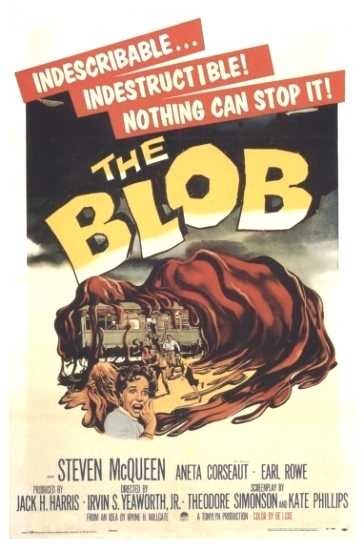
It has no shape. It has no brain. It oozes in where it is not wanted and wreaks havoc on the innocent people of the local community. It is in the hands of an apocalyptic clergyman. No, it isn’t the Republican Party, it is The Blob (1988). Having just watched the remake of the 1958 sci-fi film of the same name, a number of elements relevant to this blog (blob?) stood out in sharp relief. The most notable change from the original movie comes in the form of the role played by Reverend Meeker, the (apparently) Catholic priest turned tent-preaching revivalist. Of course, the whole government conspiracy plot is also new to the film, but that is best left to other blogs.

As noted in previous posts, religion and horror genres share much common ground. While it is hard to take a blob seriously – the role of Bob the blob in Monsters vs. Aliens is precisely comic relief – the idea of a crazed minister unleashing chaos is perhaps a little too believable. The real source of terror in the 1988 version of The Blob is not the monster but those who control it: the government and the church. When the government demonstrates that it cannot control the monster it has generated, it moves into the hands of Reverend Meeker. Here it rests until, after a sermon about the end of times, the reverend pulls out his jar of blob and indicates that as soon as he receives a sign from God, it will be released.

In a strange way this strange film proved prescient. The move of religion into politics was underway already in the Reagan years, but it was a threat few took seriously. It was not until W’s reign that the implications began to become clear. A religiously motivated electorate resembles a blob in significant ways. Once released it is difficult to contain, even by its creators. In aspect it is laughable, but in consequence it is deadly. It stops at nothing short of total domination. This film, which never made the impact that many horror films achieve, may turn out to be the scariest movie of its era after all.

Not your parents' blob


Casting the First Stone

I’m not overly nostalgic for a guy interested in ancient history. I tend to look at the more recent past as a via negativa for the young who might make a difference today. Very occasionally, however, aspects of society were handled better back in the 1960s and early 70s. One of the most obvious instances of a more sane society was the segregation of politics and religion. Prior to the rise of the “Religious Right” as a political machine the religious convictions, or lack thereof, of politicians played little role in their campaigns and American culture itself was much more open. A story from today’s MCT News Service illustrates this all too well.

In an article entitled “In S.C., religion colors gubernatorial race,” Gina Smith reports on the various religious slurs that now pass for political campaigning in that state. “Raghead” (for a former Sikh), Buddhist, Catholic, and “anti-Christian Jewish Democrats” are among the aspersions freely cast by those without the sin of a non-evangelical upbringing. As if only Fundamentalists are capable of making the right political decisions. As if Fundamentalists ever make the right political decisions. Fundamentalism is a blinding force on the human psyche, and those who are misled by religious leaders who claim unique access to the truth are to be seriously pitied. Conviction that those most like you are to be trusted most may be natural, but dogged belief that pristine morals accompany any religion is glaringly naïve.

The American capacity for belief in fantasy worlds is in the ascendant. No matter how many times Fundamentalists or Evangelical politicians are arrested or forced from office for the very sins they rant against, their overly forgiving constituencies come flocking back to them. Commit the sin of being born Sikh, Hindu, Buddhist, Muslim, Jewish, or Catholic and no quarter will ever be offered. No, I have no desire to go back to the 1960s, but I sure wish politics would.


Long, Dark Tea Party of the Soul

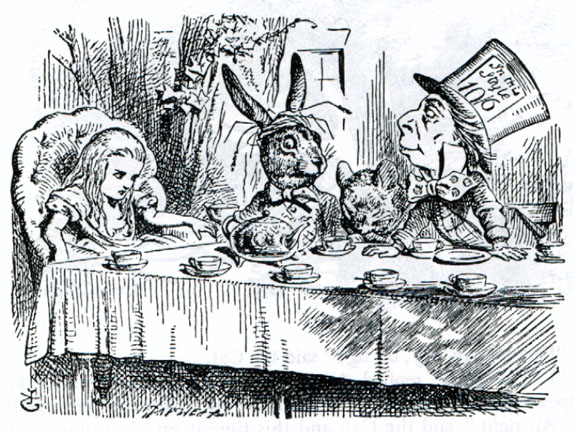
I remember a time when it was considered bad taste for politicians to utilize their religion to garner votes. Crass and vulgar, it was considered an impropriety not unlike bribery – offering power in exchange for support. Two for tea, and tea for two. Elect me and I’ll make America a Christian nation again, i.e., in my own image. What perhaps bothers me the most about this culture is its deep-rooted arrogance in co-opting history, decorum, even the very imago dei itself. The lie in the service of the truth is a very powerful weapon. When a case is erected on a house of cards, architects must be careful indeed.

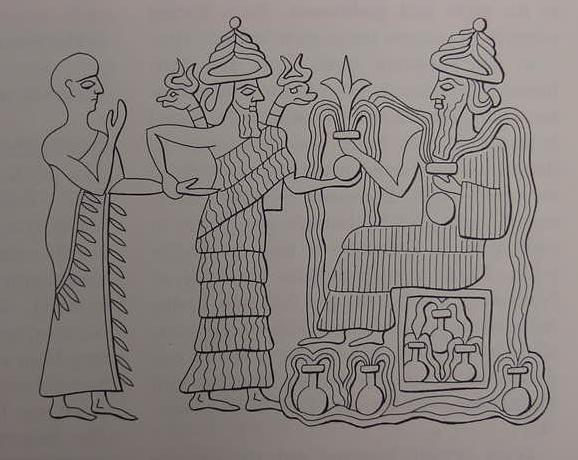
A very ancient image for the king was that of the shepherd. This is not surprising since the early kings were not afraid to confess to being gods, and characters like Dumuzi, originally a man, later became divine. And Dumuzi was a shepherd. Sheep are seldom classed among the most intelligent of mammals, being natural followers rather than leaders. When a sheep with the right stuff led the flock, he reserved the right to claim divinity.

The same dynamic is at work in Tea Party mentality. Although the leaders would be swift to deny – the truth is in the denials – that they are anything but humble servants, old ideas die hard. Civilization was built around the idea that leaders got their mojo from on high. Kings were only gods in disguise. Modern politicians are Joe the Plumber in aspect, but Belial under the skin.

Dumuzi leading a follower to a Tea Party?


Zombies, Golems, and Robots – Oh My!

A truly great metaphor is hard to kill. Despite detractors and naysayers, the zombie has clawed its way into the modern psyche as a denizen of the living death of a world we’ve created for ourselves. Joblessness, environmental disasters, tea parties – just when you thought it couldn’t get any worse, the dead refuse to stay dead. Elsewhere on this blog I’ve written about the origin of zombies in Voodoo, and I mentioned in passing the connection with the golem. The golem is a mythical Jewish creature that serves the role of protector of the oppressed (one can’t help but think of the Democratic Party). It is strong, dedicated to its task, brainless and soulless (one can’t help but think of the Religious Right). Like the zombie, the golem has no inherent ability to think for itself, and it must be animated by a magical word written on its forehead.

Golem around the corner

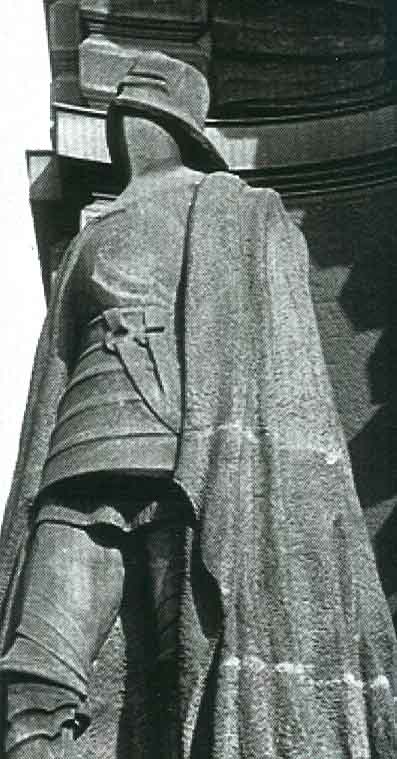
One of the most famous golem stories involves the Golem of Prague, defender of the oppressed Jews in that city in the Middle Ages. The Prague connection also forever ties the golem together with robots in Karel Capek’s 1921 play, R.U.R. (Rossum’s Universal Robots), the very origin of the word “robot.” Like the golem the robot putatively has no soul. It too is controlled by a code written precisely for it. Unfortunately on my one trip to Prague back in 1991, I didn’t know to look for the golem – I did find the statue of Jan Hus, however. Right around the corner the golem lurked, standing guard over the oppressed. It is a powerful image when the world is in such a state.

We need a hero

With the recent release of George Romero’s Survival of the Dead, the zombie has been given renewed life. Watching the Republican Party gearing up for a major thrust at the very soul of America, lining up the local BP station to support big oil, spouting false rhetoric about what the Bible says, I think I’d rather take my chances with the zombies. Does anyone out there happen to have a golem for sale, just in case?


Militant Evangelists

It is not often that the military gets to rebuke an evangelical, no matter how much the evangelist may deserve it. In the world of Christian crusaders few come close to the stature of Billy Graham, a man who has had more than half a century of undue influence on American culture. At a library book sale a couple weekends ago a middle aged-couple hovering over the religion books (where I have professional obligations to hover) were discussing how they’d read all of Billy Graham’s books. When the family business passed to Franklin Graham, however, the scepter failed to be firmly grasped by the blushing co-regent. At the center of controversy since his comments about Islam beginning in 2001, Graham the younger was recently stricken from the (apparently) prestigious Pentagon prayer service roster.

I have to admit that I was surprised to learn that the Pentagon has a regular prayer service. My image of the military is one of beefy guys (and some gals) with ultimate confidence in their weapons and more than enough brashness to go around. They don’t project the down-on-your-knees-before-the-almighty image. “Guided by the beauty of our weapons,” as Leonard Cohen once sagaciously quipped, the military gets first crack at technological advances and heavy metals. The basic components of carnage and devastation. Yet they pray.

The old adage that there are no atheists in fox-holes glosses military service with a divine prerogative, so when these tough guys rebuff a famous evangelist there must be a story behind it. The military’s refusal to dis Islam displays a sensitivity uncharacteristic of most evangelical rhetoric and theology. The Religious Right’s revisionist claims that America was founded as a Christian nation are impotent without their WMD. Even so, the program should continue. “I don’t think it’s quite fair to condemn a whole program because of a single slip-up,” do you?

When Enola Gay comes to play


Thoughts Off de Waal

Although Frans de Waal’s Our Inner Ape was published half a decade ago, the monograph remains terribly relevant. I gave some primary impressions of the book last week, but one section has remained firmly in my head and has mingled with all the harsh rhetoric in the news about health care reform in the United States. Asking the question of whether Homo sapiens are still evolving biologically, de Waal withholds his final opinion on the matter, but he points out that statistics indicate Americans are falling behind much of the rest of the developed world in terms of general health. This he ascribes to the competition inherent in a free market economy that favors the best health care only to the wealthy while the average citizen is offered substandard options. The numbers bear him out on this – he notes that on the standards utilized to measure general health, the United States is not even in the top 25 industrial nations.

With the conviction of a true prophet, de Waal notes that privatization of health care has led to a precarious imbalance in medical care in the United States, where the top 1 percent of citizens has more income to spend than the bottom 40 percent combined. This, he believes, is because we have lost sight of the altruism inherent in apedom. Although the great apes are endangered (ironically, by their overly greedy genetic cousins) their societies show no such disparity. An ape family will assist a weakened or feeble member and give it extra care to ensure that it is offered a life as comfortable as possible. They do not discard the fragile and “expendable” members. Republicans, however, wave placards trying to shout down basic health coverage for the poor.

Does biological evolution continue among the human species? Have we stopped natural selection’s eternally ticking clock? Only time will tell. It does seem, however, that the very Bible pounded by the Religious Right (health care reform’s greatest opponent) would argue that the apes got it right. We should care for the poor, disadvantaged, and underrepresented. While the Tea Party belles are busy trying to rewrite history with America founded as a Christian nation they daintily wipe their mouths on the pages of the very book they treasure so deeply and claim as their authentic heritage.


Not My Cup of Tea

The cutesy and puckish title of “Tea Party” is intended to sound whimsical among a group of political activists who lack imagination and creativity. They wear biblical-sized blinders that block out all enlightenment, trying to appear trendy and radical when what they really want is a return to the Dark Ages. Trying to make turning the clock back on progress chic and sexy, they stand for old-fashioned selfishness and the preservation of privilege for those who deserve preferential treatment – others just like them.

They grab headlines and limelight. So diametrically opposed to the progress that the real Tea Party (in Boston, 1773) strove for – progress against the privileged and mighty holding down those at disadvantage, the Tea Party movement seems to have convinced the media that it is worthy of their absconded moniker. Once again the Bible finds itself slave to an outlook. Ironically, Christians who look to the Bible as an unchanging anchor in modern society have no desire to return to the dietary restrictions and apparel requirements of yesteryear. They do not comprehend the vast gulf in morality outlooks that separate flat-earthers from space-age technocrats. A disconnect that would short-circuit the most robust processor drives their fantasy-world desire for a yesterday than never really existed.

What can a concerned biblical scholar do? Is it possible to force a conscientiously willful party that disregards facts and history to face reality? Perhaps the response should be that of the eighteenth-century Bostonians: board their ships of privilege and jettison their valued cargo utilized to create and uphold a system of abuse. Should that happen, we would soon see front-page pictures of Boston Harbor bobbing with saturated Bibles.

Mutiny on the Bountiful?


The Call of the Apocalypse

In discussing various polemics against religion, such as those by Christopher Hitchens and Bill Maher, I have frequently stated that they have a point, but they have ignored the good that religion hath wrought. It is like an Anti-Julius Caesar – the good is oft interred with the bones. Then the news goes and validates their polemic. The arrests yesterday of the leadership of the Christian militia calling themselves the Hutaree (I’m sorry, but it sounds like a happy Boy Scout gathering) highlights once more the danger that religion poses to an already unstable society. I’d not heard of the Hutaree before, and chances are I would never have heard of them had they not plotted an apocalyptic war against the United States’ government that landed them on the front page.

Few people are willing to admit just how dangerous apocalyptic thought is, or how deeply rooted it is in American politics. Tracing the roots of this form of belief is not difficult – apocalyptic first appears in the Bible when revelation through prophecy met and mated with Zoroastrianism’s dualism. The offspring of this union was the belief that a new, and better (!), age was about to dawn. God would usher in an era of peace, but it had to be precipitated by an era of war. Presidents drawn from the Religious Right have held this belief. Some have even eagerly begun wars in hopes that this ancient Afghanistanian religion would lead to the Christian apocalypse. At least the Hutaree were up-front about it: they believed that armed conflict with the government would flush out the Antichrist and usher in the end.

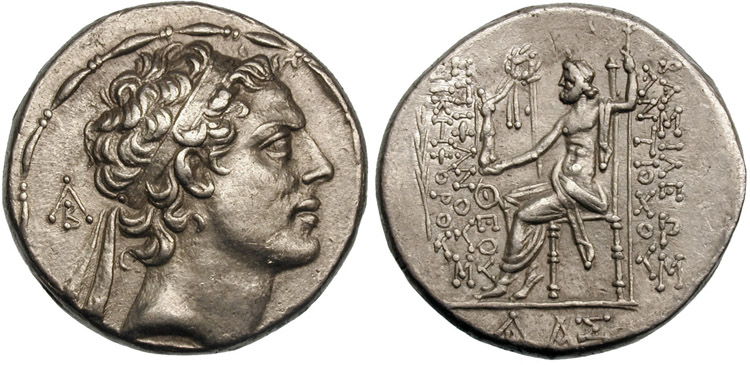
Last night in my Prophets class student questions indicated just how much interest there is in apocalyptic. We live in an era when information is all-too-easy to find, and yet many otherwise intelligent people believe that a hidden knowledge about the future is available in the Bible. It is not. For those who have ears to hear, Daniel was written about Antiochus IV Epiphanes. Revelation was written about a Roman emperor (perhaps Nero or Domitian) who threatened nascent Christianity. The apocalyptic battle was already underway. The future they longed for was peace. Modern apocalypticists see all of this as future prediction and believe that they must start the war. All of this makes me feel strangely vindicated. The FBI and other government officials are starting to demonstrate an awareness that to prevent religious extremism you must understand it. Now if only universities would catch on and realize that the study of religion is vital to national security I might end up with a full-time teaching post after all.

The original Antichrist


Biblical Outlooks and Science Fiction

Alumni magazines depress me. Between my wife and I, we receive a half-dozen every month. I thumb through and see the cheery faces of classmates, most of whom I don’t know, who’ve gone on to great things – writing books, world travel, scientific breakthroughs. They’re not on the couch Saturday afternoons in New Jersey watching 1950’s sci-fi and wandering what went wrong. Especially bad is Bostonia, since I attended Boston University with many noteworthy individuals. Being forced from academia early in my career because of petty religious differences, I just want to bury my head and grab the remote. An article in this month’s BU shame-fest, however, pictured a professor, younger than myself, who joined the school of theology after I left. The title of the piece is “Biblical Sexuality.” Well, the connection with this blog couldn’t be more obvious.

Dr. Jennifer Knust is a professor of Christian Scriptures at BU who has written a couple of books on sexuality and the Bible. I’ve read widely on this topic in the Hebrew Bible, and was curious as to what the post-Jesus crowd was saying these days. The article specifically addresses homosexuality, but I did applaud one of Dr. Knust’s statements: “My main argument is that biblical texts do not speak with one voice.” Amen. Bravo. Goal! Our society is so imbued with the bibliolatry of the Religious Right that it is difficult for most Americans to understand that the Bible was written by many people over a few centuries and these people did not always share the same outlook. The Bible is an exercise in multiple voice-overs. Specific religions, as many denominations of Christianity testify, have harmonized these divergent voices into a coherent, if biblically untrue, theology. Some voices must be stifled so that others may dominate.

We live in a religiously plural world. There are about as many religions as there are believing people. We experience the world through our own lenses and within our own gray-matter. Our perspectives are uniquely our own. And yet religious leaders bend, worry, and force views closer to their own so that they might have a theological quorum, a consensus that one viewpoint is right. They silence the Bible’s divergent voices and claim they do not exist. I wish Dr. Knust well. She’s got the right perspective, in the opinion of my own weary gray-matter. And speaking of gray, where did I put the remote?


Under G-d

In one of the great showcases of civil religion, the Pledge of Allegiance is again in the news for its brash statement, “under God.” Lawsuits have been introduced in California to try to label the statement as unconstitutional – state supported religion, a declaration that the United States is a theistic country. Even as a child, a religious child, no less, I was vaguely disturbed by the Pledge. I am a sentimentally patriotic American, and I begrudge no one that natural feeling of pride in their heritage. We all come from somewhere, and we like to think the best of ourselves, and therefore our forebears. I’ve tried to trace my ancestry and find that with a sole exception on a great, great-grandparent’s exodus from Germany that my roots are hopelessly lost in long generations of northern European expatriates that have been on these shores for well over a century and a half. Some even more. And yet, to pledge allegiance to a flag? As a student of religion, I understand the value of symbols, but I always felt that a hand over the heart while addressing a banner was a little like idolatry.

Well, I’ve grown up since then. I spent three years abroad, and returned with a renewed appreciation of how much this country has to offer. I’m still a little puzzled by the “under God” bit, however. Sure, America’s founders were generally deists (not Christian by any recognizable stretch of the definition), and since God is assumed, why not add him to the books? But God was only added to the pledge in 1954. In the heat of McCarthyism it seemed important to fly our “anti-communist,” theistic colors high for all to see. And yet, we never define who “God” is.

The God of the Bible has a name. Every semester I find students that have difficulty grasping the idea that “God” is not the name of a deity – it is only a generic title. It could be anybody divine. Shiva, Zeus, or even Baal. In the written work of many of my students from the Jewish tradition, the reverence accorded to the deity’s personal name has been transferred to this innocuous title. In essays and papers I frequently find reference to “G-d,” as if the Torah commands never to make reference to deity at all. So, out of reverence to the same divinity we have some citizens leaving out the lonely vowel of a one-syllable deity while others loudly proclaim that he (never “she”) must be kept in the little bit of civil religion we impress on our public school children. We don’t agree, as a nation, on who “God” is. Reading the rantings of the Religious Right with their tea parties and Conservapedias, I’m sure that this is not the G-d of the Bible. What does it mean to be a nation under a deity we don’t recognize?


Portrait of an Artist as a Young Woman

The world is a topsy-turvy place. In times of turmoil people turn to the old, the familiar, the classic, for assurance of continuity and stability. Ah, those halcyon days! Perhaps the newspaper is not a place to seek solace, but as I was flipping through the Friday edition, usually a little lighter after the dread of another week, I noticed a story about Leonardo da Vinci (before the code made him famous).

Self portrait or mirror?

For many centuries people have pondered the understated smile on the Mona Lisa’s placid yet knowing face. Recent forensic-type investigations are now strengthening the old suggestion that the Mona Lisa was actually a self-portrait of the artist as a woman. Some will, no doubt, find such news distressing – a masculine artist portraying himself as feminine? (Surely such a thing has never been done before!) Most concerned of all would be the Religious Right, a group that seeks a god excelling in sharp distinctions. Either male or female, no intersexuals need apply!

Over the past several months I have been reading Stephen Asma’s On Monsters, a book that can’t really be called “enjoyable,” although it has been eye-opening and informative. One of the recurrent themes throughout the book has been the fear of the liminal being conjoined with our growing understanding that sharp distinctions are rare. Ever since Freud it has been known (at least subconsciously) that people participate in aspects of both genders with social constructs determining which role is to be filled, feminine or masculine. Those who look honestly at the aggregate of the human race realize that we are all points on a continuum rather than simply members of one or the other gender. As Asma points out, however, we prefer distinctions.

In painting himself as a woman perhaps Leonardo once again proved himself ahead of his time. Perhaps the Mona Lisa is a mirror we should long gaze into before judging others on the basis of artificial distinctions.