Searching Again

Research can be addictive.  Those who know me are generally aware of how I can’t let ideas go.  I suppose this is necessary for those who write books—concentrating on one subject for a long time is mentally taxing and can lead to early loss of interest.  Those of us inclined to embrace this activity live for the thrill of uncovering new ideas and making connections that we’d overlooked.  My work on Nightmares with the Bible is a case in point.  Before submitting this book proposal I’d done a lot of reading on the subject of demons.  This is a dark topic, but those of us who live in temperate zones spend quite a bit of time without daylight, so I might think of this as a kind of therapy.  Or an excuse to do research.

Here’s often what happens: I’ll be writing along when suddenly a new question pops into my head.  Why was this or that the case?  The internet makes amateur research quite easy, but as someone raised on solid scholarly food, I need to check my sources.  When a professor I would’ve headed to the library with interlibrary loan slips in my hand.  These days I tend to turn to my own books and lament that I don’t have just the right one (there’s a reason, you see, that there are so many tomes in this house).  I try to find workarounds and used copies.  Perhaps I’ll pick up an adjunct class or two to be given library access again.  Meanwhile, the idea, like an ear worm, is burrowing into my conscious mind.  Until it’s time to go to work.

That great eight-hour stretch of day drains my energy.  Indeed, many employers count on taking the best you have to offer and making it their own.  What you do with “the rest of your time” is up to you.  Thing is, research is a full-time job.  Fortunately some of what I learn while on the clock will help me with my own research agenda.  The overlap isn’t especially strong, but now and again something I read in a manuscript will sync with what I do in the pre-dawn hours before I commit myself to the time-clock.  It’s a strange way to do research.  Back at Nashotah House I’d use the summers to follow the clues laid before my mind and, as long as I went to chapel, it was considered part of my employment.  Now it’s considered an avocation.  I can’t help myself, though.  Personal research is not part of the job description, but I’m an addict when it comes to learning new things.


Contracting Something

Book contracts make me happy. After slipping from higher education into the limbo of editing, it took a few years before realizing that not all books have to be academic monographs. For the past couple of years I’ve been silently writing a book intended for general readers. The subject will remain hidden for now, but a contract for the book has arrived and I’m happy. As my friend Marvin says, “for a man being published is about the closest you can come to giving birth.” There’s a bit of truth to that. Several months of thoughts growing in your head finally culminate in a full developed form, capable of surviving outside the confines of your protective mind.

The motivation for many academics to write is “publish or perish.” In my career track I both published and perished. The thing is, I write because I read. It seems unfair to read so much and not to share a bit of what I’ve learned. If you read this blog regularly you know that I have a restless intellect—the kind of thing that in the old days would’ve made you a professor. I no longer have access to university libraries with their arcane journals and massive collections, but reading on the bus is its own kind of research. (Anyone who’s tried to write notes on a bus, however, knows that the research is limited strictly to what can be remembered after a wearisome 90-minute-plus ride in stop-and-go traffic.) A few years back I decided to start writing up what I’d been observing. Slowly a book was formed. The process is not a swift one.

Many people question the ability of editors to write books. No, seriously. Agents are generally only interested in professors, celebrities, and journalists, not those who may have been one of the above once upon a time. That’s why this book contract feels like a small victory. Weathering the Psalms was written for other professors while I was still one myself. A lot has happened since then. I’ve read hundreds of books in the intervening years. Slow study that I am, it took some time before I realized I could begin to analyze all of this and write it in a way the average educated reader could find engaging. Agents declined the project, but now I’ve found a publisher who believes. When you work on your own, like many authors do, finding just one believer is sometimes all that it takes.


Original Research

“But are you able to continue your research?” they ask. Academics can be so hopelessly naive sometimes. I recently had a notice on academia.edu that I was in the 30-day top 5 percent of page views. So I’m feeling like the Bruce Springsteen of academics for a few seconds. Meanwhile institutions who look at my record wonder why I haven’t produced anything lately. It’s really quite simple. Take a 40-hour work week (a foreign environment to most academics), add a daily commute of 3 hours, and subtract access to an academic library. As the old computers in sci-fi movies used to say, “does not compute.” My research these days is limited to material that is actually able to keep me awake on the bus (thus excluding most academic monographs) and those that I can afford to buy on an editor’s salary. My research has slowed considerably, in other words, due to circumstances beyond my control.

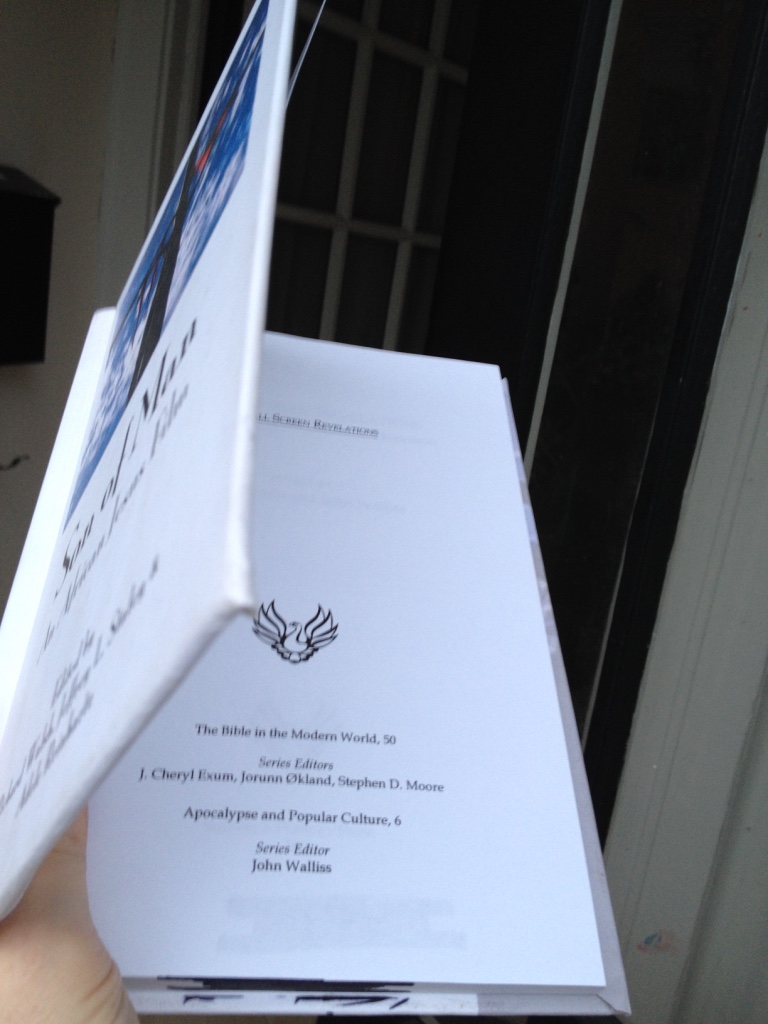
thumb_IMG_2163_1024That’s why I’m sitting here perplexed. Despite it all, I have had a paper accepted for presentation at the Society of Biblical Literature Annual Meeting this year. My project is on the Bible in Sleepy Hollow (thus the recent spate of books on Washington Irving and his hometown). Still, I had to challenge the budget and purchase a couple of things. The cover of my book has me confused. Son of Man, it says. Inside, however, is the text I need—Small Screen Revelations. (If you wonder why, watch Sleepy Hollow, or, if possible, come hear my paper.) The reason for the mismatch between the cover and content of my book is the price. A tome from the appropriately named Sheffield Phoenix Press, even used the volume costs almost $100. It’s just 200 pages. I managed to find a copy misbound for the bargain price of half that. Only an academic would pay $50 for a defective book just to get at the content. Am I able to continue my research? Reach for your wallets and see.

A large part of my job is spending time on university faculty webpages. Many of those I find haven’t published nearly as much as I have, but have comfy, tenured positions. Often it is because they’re the right brand. Catholics like Catholics, Presbyterians like Presbyterians, Baptists like Baptists. State universities hate them all. And once in a while I pull my doctoral robe out of my closet, press it to my face, and weep. I don’t know what a blue collar kid might have been thinking. Earn a challenging doctorate in an obscure field overseas and hope for a modest teaching position somewhere in the land of the most abundant colleges in the world? My race and gender should’ve come to mind long before I got that far. In some ways, I too am a misbound book. Am I able to continue my research? You be the judge.