Spinning Wheels

That warm, secure feeling of being home for the holidays never goes away. Admittedly Thanksgiving takes on a different cast for those of us who are vegetarians becoming vegan, but it’s not about the food, really. It’s never been only just about the food. Thankfulness as a way of life seems to hard to obtain when your own government has turned against all the principles that once made America a wonderful nation in which to have been born, but it doesn’t mean you can’t be grateful. As a commuter, I’m especially thankful for time. Each day’s normally spent riding a bus, working, and riding again. Over the past several days I took a train to Boston for the AAR/SBL annual meeting, and then a long train ride back. Followed by a single-day drive to Ithaca and back. I’m thankful for a little time not to be on the move.

Among the many memories for which I’m grateful is a mountain road that divides Glen Kinglas and Glen Croe in Scotland. Known for its splendid view, it’s one of many places that I have had the privilege of visiting. Although sitting still, here in my chair, I recall yet another busy day of driving with friends. Poor graduate students all, we nevertheless knew the value of good company and taking little for granted. As someone who grew up poor, I had managed to move to Boston, travel to Israel and work on a dig, and now I was living in Edinburgh, working toward a doctorate in one of the world’s great universities. That afternoon, however, I was out viewing what the wider world had to offer. The name of the viewpoint on the A83—from which that world all seemed visible—was “Rest and Be Thankful.”

The name speaks volumes. New Jersey certainly isn’t Scotland. My job is not that for which I trained. I continue to live as if I were a graduate student while friends have purchased houses and furnished them nicely. Today none of that matters. I’m not on a bus, train, or plane. I’m not glued to my seat in an automobile. I’m thankful to have some time to sit and reflect. Catch up, perchance, on a little bit of sleep. Unstructured time is perhaps the rarest commodity in a capitalistic society. Today I have it in relative abundance. No turkeys have lost their lives on my account and I’m able to rest and be thankful. There’s still a long way to go, but for today I’ll enjoy family and stillness. And I am thankful.
Thank You

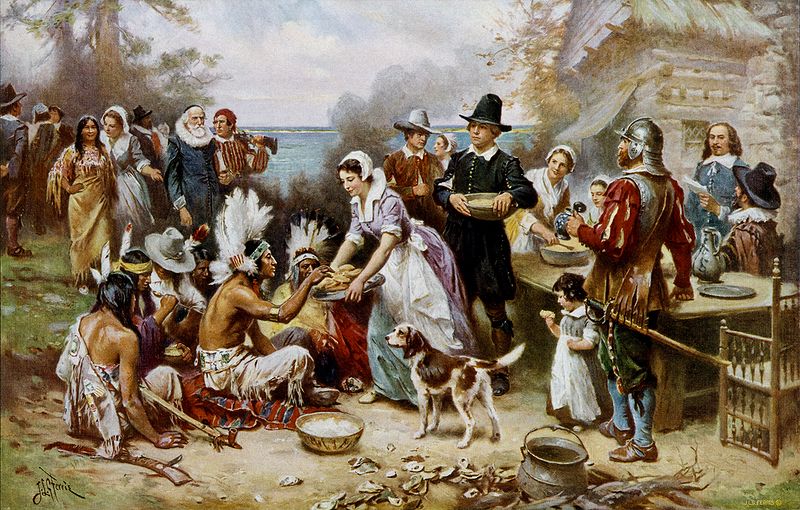
Comments being rare on this blog, I do read them when they come along. Recently I had a reader comment, in the form of a question (as sometimes happens): “Do Native American Indians do ‘Thanksgiving’?” Although I’m fairly certain this was intended as a rhetorical question, I was raised a literalist and couldn’t help trying to formulate an answer. Although I can make no claims to know Native American culture well (I wish I did) it led me to ponder the concept of Thanksgiving. No doubt the idea had at least informal religious beginnings. Even with the early European settlers, a religious diversity was already appearing. Still, although the Native Americans lost pretty much everything, they were still involved, at least according to the early accounts. The great spirit they thanked was not likely conceived of in the way that the god of the pilgrims was, and yet, thankfulness is a natural human response. Writers, often fully aware that their work deserves publication, frequently thank an editor for accepting it. It’s a deeply rooted biological response.

800px-The_First_Thanksgiving_cph.3g04961

For some of us, Thanksgiving is more about having time to recuperate after non-stop work for about ten months. The standard business calendar gives the occasional long weekend, but after New Year’s the only built-in four-day weekend is Thanksgiving. It is that oasis we see in the distance as we crawl through the desert sand. Time to be together with those we love rather than those we’re paid to spend time with. To rest and be thankful.

Among the highlands of Argyll, in western Scotland, is the picturesque Glen Croe. Years ago, driving with friends through the rugged scenery of boulders and heather, the little car struggled with its burden of four passengers. We stopped at a viewpoint known as “Rest and Be Thankful.” The name derives from an inscription left by soldiers building the Drover’s road in 1753, at the highest point in the climb. The Jacobite movement and the Killing Time had instilled considerable religious angst to the Scotland of the previous century and led to the calamity of Culloden less than a decade before the road was laid. These religious differences led to excessive bloodshed throughout a realm supposedly unified by the monarchy. Even though no natives protested displacement, religion led to hatred and mistrust, as it often does. Is not Rest and Be Thankful, however, for everyone, no matter their faith or ethnicity? And in case anyone is wondering, yes, this rhetorical question contains a metaphor to contemplate. Rest and be thankful.