Childhood TV

It’s probably safe to say that most Americans my age were influenced by television when they were young.  Since I’m a late boomer, I fit into the “monster boomer” category and I suspect that if you gathered us all in a room you’d discover we had some of the same watching habits.  I confess to having watched a lot of TV.  I will also admit that some of it was absorbed particularly deeply.  I mean, I liked shows like Scooby-Doo, Jonny Quest, Get Smart, Gilligan’s Island, and even The Brady Bunch.  While I still quote from a couple of these from time to time, they never penetrated as deeply as a number of other early fascinations.  I saw nowhere near every episode of The Twilight Zone, but those I did see absolutely riveted me.  They still do.  As an adult I’ve read many books on or by Rod Serling.  There’s depth there.

Another strong contender for real influence is Dark Shadows.  Again, I never saw all the episodes but it created in me a feeling that no other television show did.  My breath still hitches, sometimes, when I think of it.  I watched the show and I bought used copies of the novels by Marilyn Ross.  As an adult I even collected and read the entire lot of them.  And I’ve read a book or two about Dark Shadows.  And one about Dan Curtis, the creator of the series.  Recently a good friend, aware of this particular predilection, sent me the Barnabas Collins game and a copy of The Dark Shadows Almanac.  I have to admit that it was difficult to work the rest of that day!

Probably the last very influential television show—more from my tween Muppet Show era—was In Search of…  This I watched religiously, and, like Dark Shadows, I went out and bought the tie-in books by Alan Landsburg.  One thing all three of these series (Twilight Zone, Dark Shadows, and In Search of…) have in common in my life is that I purchased the accompanying books.  Those that I foolishly got rid of when I was younger I have reacquired as an adult.  Sure, there’s some nostalgia there, but these shows were more than mere entertainment.  They have helped make me who I am today (whoever that is).  I rediscovered my monster boomerhood after losing my tenuous foothold in academia and saw that other religion scholars were writing books about these somewhat dark, and deep, topics.  So I find myself with friends ready to help indulge a fantasy and a shelf full of books that many my age would be embarrassed to admit having read.  But chances are they too were influenced by television, even if they hide it better.


Carpenter Ward

Surveying my streaming service for something free, I found The Ward.  It advertises itself as “John Carpenter’s The Ward,” and Carpenter has proven his mettle more than once.  I found out afterwards that this 2010 film is his last, to date.  Although it has jump startles and scary sequences, it isn’t as frightening as his best work, such as Halloween and The Thing.  The eponymous ward is a psych ward.  A young woman with amnesia is brought to the facility in 1966.  She’s somewhat violent but begins to make friends with the other four girls in the ward.  It won’t be satisfying to discuss this without a major spoiler, but I’ll try to hold off for another paragraph before giving it.  Overall the movie is creepy and atmospheric, but not really a classic.  Movies about mental hospitals have built-in scary material, and The Ward meets expectations there.

Kristen, the girl with amnesia, is resourceful and nearly escapes a few times.  She’s worried because a ghost in the asylum is killing the other girls.  Nobody will believe her, of course, since she’s an inmate.  Now the reveal: the other girls are all projections of Kristen’s personality.  Actually, Kristen’s name is Alice, and she’s been at the asylum for some time, a patient with multiple personality disorder.  The other girls that are killed by the “ghost” are part of a new therapy her doctor uses to try to get Alice back.  The other girls, or personalities, had banded together and “killed” Alice and her “ghost” is now seeking them out and killing them.  In reality, only Alice is there.  While the viewer is rooting for the other girls, they are preventing Alice from being cured.

In some ways this is similar to Split, but that would come six years later.  The horror here is the loss of self-knowledge.  The little backstory that is given shows Alice suffering trauma as a child, forcing the dissociation that leads to her split personalities.  As a horror movie The Ward has the jump scares and eerie atmosphere that often work in the genre.  There are chase scenes and a monster.  The story, however, rides heavily on that final reveal.  It really doesn’t live up to Carpenter’s full potential.  It does, however, take the final girl trope seriously.  It’s not really a surprise that it failed at the box office.  Although Split came later, other such films had been produced earlier.  What this one lacks is Carpenter’s characteristic flair.  Still, there are many other films that deliver less when they stream for free.


Q’s and P’s

I finally had to break down and buy it.  Quatermass and the Pit has been on my “to see” list probably longer than any other single movie.  I managed to stream the first two of this telinema series for free, so I guess it was like getting three movies for the price of one.  Aired in the United States as Five Million Years to Earth, this isn’t the greatest sci-fi-horror movie ever, but it isn’t bad.  The pacing is a bit slow but the story is intriguing.  Rocket scientist Quatermass gets involved in the excavation of what turns out to be a buried rocket ship from Mars.  Surrounding the ship in the five-million-year-old matrix are the remains of apparently intelligent apes.  The scientists discover that the apes were artificially enhanced by insectoid martians that resemble the devil.  It’s pointed out that any time digging has taken place near Hobb’s End, strange phenomena occur.  It’s noted that Hob used to be a nickname for the devil.

This detail leads to a perhaps unexpected connection to religion and horror.  Quatermass and Barbara, a scientist who has the ability to “see” the creatures via collective memory, realize that the hauntings that have taken place around Hobb’s End for centuries may have been the image of demons, or the devil, emanating from the evil of these would-be invaders.  At one point a priest argues that their influence is essentially demonic, but the scientists realize that these modified apes are actually the creatures from which humans evolved.  All the human tampering with the ship eventually frees the spirit of the martian insects, resembling a devil.  The way to destroy it is with iron, relying on folklore which, in this instance, works.

The four Quatermass movies (I don’t plan on seeking out the last) were theatrical reshoots of television serials.  The last movie is essentially the TV series stitched together as a movie.  From at least the seventies on (Quatermass and the Pit was released in 1967) the first and third installments were considered fairly good horror films.  They aren’t always available in the United States, probably due to digital rights management.  It seems ridiculous that in this day and age that companies still restrict access, even to those willing to pay a modest fee, for movies that are essential parts of the canon.  Hammer (all three Quatermass movies are Hammer productions) films are still difficult to access in the United States.  At least, with the willingness to wait half a century, I’ve finally be able to see Quatermass and the Pit.


Experimenting with Quatermass

Hammer films are coy.  In these days of digital rights management, they’re often difficult to locate in the United States.  Even on streaming services.  I’d known about Quatermass since I was a kid.  I’d heard about Quatermass and the Pit as a pretty scary early science fiction-horror offering.  I’ve still never seen it.  Quatermass was a BBC television character, a kind of mad scientist figure.  The Quatermass Xperiment was the first of a set of four Hammer films based on him.  Also known as The Creeping Unknown, it was cast with an American Quatermass (ironically, it turns out) to appeal to American viewers (who can now seldom access the film).  In any case, one of the streaming services finally acquired rights to the 1955 movie.  The special effects were naturally primitive, but that doesn’t stop this from becoming a scary film.

Watching these early movies is like studying history.  Other films were influenced by The Quatermass Xperiment, most notably Lifeforce.  I couldn’t help but think of Night of the Living Dead as well.  Quatermass, a rogue scientist, sends a rocket into space with three astronauts.  Since this was before we had any kind of conception of how this might actually be done, the idea seems implausible, of course.  The rocket returns with only one of the three crew members, and he’s morphing into something else.  Despite his arrogance, Quatermass realizes he has to cooperate with the police to contain the menace.  Inspector Lomax describes himself as a “Bible man,” unacquainted with science, and Quatermass considers his work superior to that or mere police.  When the hybrid is finally located and destroyed, however, it is in Westminster Abbey.

Although the runtime is just over an hour and some of the acting is quite wooden, this is an affecting story.  The scene where the transforming man encounters the little girl’s tea party bears elements of the pathos of Frankenstein.  Without the budget, science, and even acting resources of modern productions, The Quatermass Xperiment manages to fall squarely into horror with a monster I’d been waiting since childhood to see.  In those days you were at the mercy of your local television offerings.  Now that we have worldwide content on the worldwide web, we still restrict viewing so that the most money can be made from a movie that’s seven decades old, and its cohort.  In any case, this experiment has left me determined to find what Quatermass discovers in the pit.  Once that becomes available on a service I use.


Philadelphia Story

I’m guilty of a little home-state pride when I consider Philadelphia as a seedbed for diverse filmmakers.  Perhaps the most famous is M. Night Shyamalan, but I recently watched Tayarisha Poe’s first feature, Selah and the Spades.  Poe (and Edgar Allan also lived in Philly) is an African-American woman, and like Shyamalan, writes and directs her own movies.  Selah and the Spades came out in 2019, just as we were settling into pandemic life, but it is a gentle kind of dark academia.  A coming of age story set in a fictional Haldwell Boarding School, it features three African-American leads.  The violence is mostly offscreen, but there is a darker story here.  Selah heads the Spades, one of five factions of student-led extracurricular life on the elite campus.  She’s a senior who doesn’t want to face college—she enjoys her power and doesn’t want to appoint a successor.

The factions plan communal pranks, and each has its own specialization.  The Spades supply the alcohol and drugs to the student body.  This involves some violence, as is to be expected.  Selah has a record of ruining her protégés before they can become her successor.  The movie focuses on Selah’s relationship with Paloma, a transfer to the school who seems a promising new leader.  But Selah has difficulty letting go and the drama plays itself out in a student-led prom after the administration cancels the official prom due to the factions’ actions.  There are lingering shots and some art house elements to the film, making it a drama rather than a thriller.  Dark academia encompasses several genres and this is, as I say, a tamer one.

Philadelphia is a city with a generational history for me.  My mother, who was born in New Jersey, lived in Philly for some time as a child.  She found the city a scary place and unwittingly passed that fear onto me.  I’ve been to Philly several times, of course.  My main concern is driving there—the traffic is always intense and I don’t know my way around very well.  It is a diverse city.  While it’s too early to tell if Tayarisha Poe’s work will center around eastern Pennsylvania (I can’t find a summary of her second movie, The Young Wife, that states outright where it is set), it does underscore that the cinematic world is reaping some benefits from the city of sibling-like love.  And such things happen best when diversity is given a place to shine.


Fear of Puppets

David Schmoeller is a horror director I discovered only in the last several months.  I watched his first film, Tourist Trap, after having found Netherworld streaming for free.  Perhaps his most famous film is Puppet Master.  Although intended for a theatrical release, it was ultimately shifted to direct to video.  That didn’t stop it from becoming a cult film and from spawning sequels and spin offs.  Like other Schmoeller films, it’s a bit disjointed.  But it’s also fun to watch.  Since this is a film from the eighties, I won’t be too worried about spoilers—fair warning.  So, the puppet master lives in a hotel and brings puppets to life, literally.  He does this using ancient Egyptian magic.  About half a century after his death, four colleagues of Neil Gallagher receive a psychic message from him.  They travel to the hotel only to find he’s dead.

The puppets, released from their hiding place, begin killing the guests.  This is one of the many things never explained.  The puppets don’t appear to be evil, but they are murderous.  Three of the four colleagues become their victims in typical horror fashion.  The last surviving friend, an anthropology professor from Yale, and Gallagher’s widow, discover Neil has brought himself back to life, using the puppet master’s Egyptian magic.  He plans to live forever, but apparently he has to kill his former friends to do so.  As he explains this, and beats the professor and his wife, the puppets realize that he’s a bad man.  They attack and kill Neil when he’s trapped in an old elevator.  The ending reveals that his widow can also reanimate the dead.

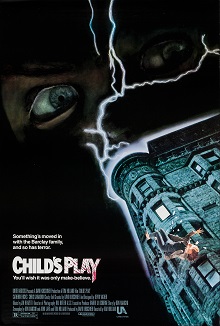
Child’s Play had been released the previous year, but the trope of haunted or cursed puppets had been in the horror tradition already for decades.  Dolls and puppets are often residents of the uncanny valley and yet people can’t stop making them.  We often learn to draw by representing our families with crayons.  The fascination of replicating ourselves artistically provides low hanging fruit for horror films.  Fabricated things that look human—and we can add mannikins here—starting to move, or coming to life, scares us.  So much so that even less-than-great movies such as Puppet Master can become their own franchise.  As a horror movie, it isn’t terrible.  It’s also not likely to keep you up at night.  At least one other David Schmoeller film is on my to see list, and I have a fair idea of what to expect.  I watch them duly warned.


And Bones

Often making lists of dark academia movies, The Skulls plays right into that territory.  A secret society, an elite college, and something’s definitely gone wrong.  It’s not a great movie, feeling somewhat contrived, but it fits the mold pretty well.  Things are a little too pat in the film, and the writing isn’t the best.  It’s entertaining, if overblown.  The story begins at an unnamed Yale (actually University of Toronto) with working-class Luke being invited to join the Skulls after an impressive rowing competition victory.  From the first, the Skulls meetings seem to lack gravitas.  Rich and powerful, they are above and beyond the law.  The problem for Luke is that his friends, Will and Chloe, are being edged out of his life.  Will, who writes for the school paper, breaks into the Skulls headquarters but is caught by Caleb, Luke’s “soul mate.”

Will is killed in what follows, and Luke wants to get out but it’s too late. Caleb’s father is the head-honcho for the Skulls and decides to have Luke committed to an asylum when he refuses to cooperate over his friend’s death.  Chloe and the second-in-command of the Skulls, Senator Levritt, rescue Luke and he challenges Caleb to a duel.  I’ll leave it off there so as not to spoil too much.  That gives you a sense of the darkness, in any case.  But the film doesn’t feel that dark.  Yes there is a murder, and there are bad guys, but something I can’t define prevents it from having the tone that you might expect from a grim tale.  As I say, things are a little too pat.  The characters’ emotions are a little too close to the surface.

The movie did well at the box office, but the sequels were released direct to video.  As far as the academia side goes, there are, no doubt, secret societies.  Privilege doesn’t let go once it gets a grip.  But the above-ground “Yale” sees a bit too light and airy.  Maybe more classroom and library scenes might’ve helped.  Likely it would’ve been better had it been based on a novel.  Films that are based on books have a solid development on which to stand and it’s often a matter of figuring out what to omit.  The writer and director had gone to Yale and Harvard, respectively, and wanted to portray what secret society life is like.  But that’s the thing about secret societies—you can’t really know, can you?  It’s a matter of imagination.  And dark academia is where such things fit.


Breakage

Glass makes me wonder; can any member of a trilogy really stand alone?  As someone who consumes fiction, the question always arises as to who really controls the meaning of individual units.  Scholars have given us reader-response theory that posits meaning rests with the reader (viewer, listener, etc.) rather than with the creator.  Being on an M. Night Shyamalan kick—I was brought in through his horror movies—I watched Unbreakable.  I vaguely knew it was a trilogy, but when I saw Split I was caught off guard.  Unbreakable was a super-hero movie.  Split was a horror film.  I knew Glass brought them together, but I wasn’t sure which way it would break.  It turns out the trilogy is a horror sandwich on super-hero bread.  It’s also surprisingly thoughtful.  And over two hours long.  There are horror elements, but it made me wonder since Split is horror, could it stand alone without the other two.

Having read about the development of this a little bit, Unbreakable could have stood alone.  It did for sixteen years.  Split could also, but for the reveal in the last few minutes.  And Glass manages to pull the whole thing off with a characteristic Shyamalan twist ending.  I’ve written about the other two movies in their own posts, but I really don’t want to give any spoilers for the last one.  I can say it ends with a message that is worthy of the Matrix.  It shows what movies can do.  Or at least it was taken that way by this viewer.

Given what movies are, and what they represent, I have to wonder if there’s not a good dose of racism in the criticism of Shyamalan’s work.  His movies are intriguing, without fail.  I haven’t seen all his films, but I have watched eleven of them now.  Some multiple times.  Here’s a guy with stories to tell.  I know, as a fiction writer who has trouble selling anyone on my vision, that a story can take over your life.  And you want to tell that story and see if it resonates with anyone else.  Those of us who make up tales generally recognize when something we write isn’t good.  My list of unfinished or unpursued stories dwarfs the stack of those I’ve had published, or tried to.  When you release a story out there in the world, you hope that others will get it.  I trust certain auteurs.  Even if not all of their films appeal to me, I like to think I see what they’re getting at.  This trilogy is well worth watching through to the end, even if it isn’t horror.


Don’t Let Go

We watched Hugo, as a family, over a decade ago and quite enjoyed it.  At that time I only really blogged about horror movies or those with a religion element that I could spot.  Over the years, I’ve taken to reflecting on movies themselves and so, since we rewatched Hugo recently, I thought it might be time to talk about it.  This is one of those movies that was critically acclaimed but a box office flop.  It’s still a wonderful film.  As a side note, working in any media (including academic publishing) introduces you to familiarity with the project, such as a book or movie, that becomes widely praised but just doesn’t sell.  Public taste is very difficult to predict (note who’s in the White House) and sometimes a book, movie, record album, or any media hit, becomes highly acclaimed while losing money.  Hugo is worth re-watching and, despite the financial hit, is quite good.

Hugo is based on a children’s book, Brian Selznick’s The Invention of Hugo Cabret (which I would like to read).  The movie is a paean to early filmmaking and involves some real history, especially around the life of George Méliès.  Watching the film a second time, I was struck with how Hugo ends up reenacting several scenes from early films in his own life.  The film also captures how movies are more than simply entertainment.  They have become an integral part of life in some cultures, and, for some of us, a source of meaning.  That’s why I wanted to see Hugo again.  It struck me as a compelling story—a redemption story—bringing a sense of meaning to a life where George Méliès went from fame to obscurity because his contribution to film was unrecognized since movies hadn’t yet become a major industry.  Look at Disney today and wonder, dear reader.

Or consider Hugo itself.  With a gross profit of “only” about 15 million dollars over the budget, it barely covered its costs.  Lots of people are involved in making a movie and this is quite an expensive venture.  Anyone who earns a paycheck knows that the net is always disappointingly lower than the gross earnings.  Cinema in general struggles with the need to adapt to streaming culture where profits are parsed out in small bits rather than drawing large crowds to fill seats.  And yet, movies act in many ways like the modern mythology.  They tell important stories.  They provide touch-points for society.  Unfortunately, however, this is often only the case when they make a lot of money.


Water Lady

Being creative poses the very real threat of being misunderstood.  I can’t help but think that some of this was going on in M. Night Shyamalan’s The Lady in the Water.  Initially cudgeled by critics, it nevertheless seems to me that the perceived arrogance is overstated.  I generally like Shyamalan’s movies.  I think he does horror quite well, and I thought that maybe there’d be some horror elements here.  There were a few, but the story is kind of long and rambling, kind of like the stories I told my daughter at bedtime.  The movie begins by laying out a legend of a narf (water nymph) who will bring the world peace.  She is attacked by a scrunt, the monster in the film, but has to deliver a message to humans and has to be protected by the maintenance man at an apartment complex in Philadelphia.  And complex is right.

Since this isn’t a widely-known story, we have to be told, in pieces, by a number of the ensemble cast.  A lot of it is unbelievable, even for a fantasy movie.  At the same time, it contains a good message and I get the sense that this is why Shyamalan made it.  He does have an important role in his own movie (which is why it is said to be arrogant), but the style is reminiscent of his other movies.  The scrunt seems like a good idea for a monster and a couple of the attack scenes veer briefly into horror territory.  There’s even an element of Scream when Bob Balaban’s character explains (incorrectly) why he will survive an encounter with the scrunt.  The story has some likable elements but when so much of a fantasy world is being revealed piecemeal it’s sometimes hard to keep your focus.

Based on a bedtime story Shyamalan told his own children, it does resemble that genre of story.  Personal.  When my daughter was small, I made up nighttime stories for her pretty much on a daily basis.  They had a kind of rambling, plodding nature to them.  I made up creatures, as in this movie, and, as Balaban says, kept it family-friendly.  Classic stories do tend to follow a trajectory that is well known to literary scholars.  Something entirely new thrown into that area will sometimes emerge  beaten up.  It wasn’t a waste of time to watch The Lady in the Water.  Not one of Shyamalan’s best, it is nevertheless a film that makes you think a little while afterwards.  And that seems to be what it was intended to do.


Addams Family Research

After having binged on Wednesday earlier this year, and wanting something lighter to watch, we finally saw The Addams Family.  Neither my wife nor I watched the television series too much when we were kids, but it’s probably no surprise that I watched it more.  As with Wednesday, if you didn’t see the television show, or read Charles Addams’ cartoons, you can still enjoy the movie.  After all, some of the salient aspects of the eponymous family are never explained.  Why are they so wealthy?  Things like that.  Although the movie, which is family friendly, can’t be called horror, it is a dark humor piece that scratches a certain itch.  For several years I’ve been pondering how horror has become such an amorphous genre that it really tells us little about a movie.  Taken literally, this one would be horror.

Not having grown up as a particular fan, I never really attempted to research the Addams family, but the basic idea was that they were people who lived as they liked, not caring what others thought of them.  They remain happy and cheerful in their macabre tastes.  The humor in such a situation is obvious.  The ultimate non-conformists, they are wealthy enough not to have to worry about fitting in.  Also, they tend to have some supernatural abilities.  Watching the show growing up, the character that never seemed to fit  the macabre image was Pugsley.  Often a partner in crime for Wednesday, his “monstrous” nature seldom seemed obvious to me.  Maybe it was his outfit.  In any case, not fitting in is what the show is all about.  Not fitting in and not worrying about it.

The plot of the movie is surely well known by now.  Gomez’s brother Fester is missing and a criminally minded Abigail Craven sends her lookalike son Gordon to take Fester’s place to get access to their riches.  The humor, apart from the madcap plot, often comes from subverted expectations.  A character points out a gloomy, macabre, or scary situation followed by a comment of how much they enjoy it.  As I’ve noted, taken literally such things define horror.  Horror and comedy can work well together.  In fact, I’ve reviewed many horror comedies on this blog.  I would have never thought to have watched this movie, however, without the prompting of Tim Burton’s Wednesday.  She’s an underplayed character in the series since the focus tended to be on the bizarre adults, as far as I can recall.  As Christina Ricci’s second feature film, her Wednesday laid the groundwork for the Burton series.  Maybe it’s time to do a little more research into family history.


Split Decision

Sometimes advertising and packaging can make you ill-prepared for a movie.  I know that M. Night Shyamalan’s Unbreakable, Split, and Glass are considered a trilogy.  Without knowing the story, I saw the first film and discovered it was a superhero movie.  That’s fine, of course.  It’s not really horror much at all.  That’s maybe the reason Split caught me off guard.  It is brought into sequel territory right at the very end, but the story is tense and scary.  Kevin Crumb is a man with DID, dissociative identity disorder—what used to be called a split personality.  Quite apart from the inherently fascinating phenomenon (and the criticism the movie received for misrepresenting it), the idea that a person shifts and you don’t know who s/he is, is frightening.  A couple of those personalities have teamed up and become criminal.  Kevin abducts three teenage girls for a purpose that only becomes clear later.  Their efforts to escape create a great deal of the tension, and the quick shifting of identities that Kevin displays makes any kind of reasoning with him impossible.  

There are any number of avenues to discuss here.  One is that Kevin’s disorder stems from how his mother treated him as a child.  (Unintentionally I’ve been watching movies that trigger me that way lately.)  He developed personalities to protect himself from the pain and they continue to multiply.  Meanwhile, the kidnapped girls can’t figure out what’s going on but Casey (Anya Taylor-Joy—my first clue that this was horror instead of a superhero movie—)realizes that she has to treat the different identities in different ways.  Another avenue is to consider what “the beast” (one of the personalities) asserts: only those who’ve been broken are truly evolved.  Some children make it through difficult childhoods by becoming resilient while others don’t.  Casey, it turns out, also had an abusive relationship in her childhood.  Movies like this always make me reflect on how difficult being a good parent can be.

The person not in control of their own actions (ahem) is among the most frightening of human monsters.  Those with mental illness, however, seldom fall into this category.  I understand why mental health providers found this film problematic, but it showcases Shyamalan’s horror chops.  It was the scariest movie that I’ve seen in quite some time.  After I ejected the disc I felt bothered (and trapped) for quite a few minutes.  And I realized that if this is a trilogy then superhero and horror combined await in the third part.  We shall see.


Friendly Fear

I opened my book Holy Horror with an epigraph taken from Apocalypse Now, a movie I recently watched again.  That quote was from Col. Kurtz: “It’s impossible for words to describe what is necessary to those who do not know what horror means. Horror… Horror has a face… and you must make a friend of horror. Horror and moral terror are your friends. If they are not, then they are enemies to be feared.”  I’ve been thinking quite a lot about how you can make any progress in a discussion with anyone who’s already made up his or her mind (i.e., no matter what you say to them they will not take it seriously.  Think your favorite Trump supporter).  People far smarter than I have noted that the only way to combat this unthinking adherence is to get people to think critically.  That may be correct, but to preserve democracy we need a more assured method in the short term.  That of Col. Kurtz.

Apocalypse Now was based on Joseph Conrad’s The Heart of Darkness.  Both contain a vital truth—fear motivates people.  Democrats have been forward-looking in recent decades, but Republicans run on that fear playbook and it’s very difficult to defeat.  That’s because people are afraid.  It’s important to face fears, but to win elections, you need to seed them.  I know whereof I speak when it comes to phobias.  I was so riddled with fear as a young person that at times I could not leave the house.  At other times even the house didn’t feel safe to me.  I had multiple phobias and difficulty talking to other people.  I’ve grown out of many of these fears, but if I’m honest, I know they’re still with me.  I suspect many other people are also afraid.

Strong men (even if personally weak) appeal to the afraid.  They want someone who can protect them.  I tend to think Democrats think many Americans are better adjusted than they actually are.  You want their votes?  Make them afraid.  I’ve been writing books on fear and its many cinematic manifestations for several years now.  I grew up being afraid of everything.  I don’t advocate creating fear, but when a nation decides Hitler would be better than letting young people read, it’s reached a crisis point.  I do wish progressive political leaders would consider my humble observations.  When afraid people herd together and become the mob with torches.  And just such a mob became the mindless followers of Col. Kurtz.  Just saying.


Eye Eye

When trying to be conscientious about not spending too much money on movies there’s always the risk of seeing something cheap.  In the case of The Eye Creatures, not only was it cheap, but it was also a throw-back to childhood.  I remember seeing this one in my younger years, and, not yet old enough to be critical, loving the costumes.  Rewatching it as an adult, where some critical faculties remain, reveals it to be a bad movie.  Poorly written, poorly acted, and poorly financed, it ticks all the boxes.  It’s actually a remake of an earlier American International Pictures film, and AIP wasn’t known for its lush budgets.  To be fair, the film is supposed to be a sci-fi horror comedy, but the comedy isn’t that good.  The unintentional gaffs are.

So, the Air Force is concerned about keeping flying saucers secret.  When an “unfriendly” one lands where the teens all go parking, the Air Force investigates while the eponymous eye creatures terrorize the local kids.  Specifically, they seem bent on revenge against Stan Keyton and his girl, because they ran over one of the creatures.  Keyton gets arrested for manslaughter because the creatures substitute the body of a drifter they killed for the corpse of their own comrade.  The police don’t believe in aliens, of course, and the Air Force denies everything.  Keyton and gal decide, after discovering the the eye creatures explode when exposed to light, to round up the necking kids and wipe out the aliens with their headlights.  They figure nobody will believe them anyway.

Some movie monsters stick with you for decades.  The eye creatures are one example of this.  Simply seeing the movie title reminded me of them, although the only plot point I could remember was that they exploded in the light.  I didn’t recall all the voyeuristic watching of teens making out that the Air Force officers did.  Or the tedious revisiting of the Old Man Bailey character.  One of schlockmeister Larry Buchanan’s films, it was released the same year as his other cheap childhood favorite, Zontar, Thing from Venus.  As much as people like to make fun of makers of such cheap movies, Buchanan gained recognition in the New York Times (as have other makers of schlock such as Roger Corman and William Castle), so there is something to these movies.  For one thing, those of us who grew up in the sixties remember them.  And, if we also remain cheap, we can see them again as adults, and relive a bit of cinematic history.


Easter Gathering

On Easter I’m thinking of Conclave.  My wife had been wanting to see it and we watched it on Good Friday—a work day, of course, in this “Christian” nation.  In any case, it’s fascinating for a couple of reasons.  One is that, as a drama surrounding the election of a new pope, it draws you in.  The politics and intrigue are, I assure you, quite real within in the church.  People are, in seems, incurably political.  Conclave is fiction, of course.  And in reality, very few people are ever admitted to the chambers where a world leader is elected by those priests who’ve risen to the highest levels of church hierarchy.  This fictional reconstruction may give a window into that.  The other reason that I found it so fascinating is that it was quite a box office success for being a movie about a religious subject that isn’t biblical.  Appropriate viewing for Easter weekend.

There were a few striking scenes.  Here’s the outline, though: a pope has died and Cardinal Lawrence is the deacon in charge of the conclave to elect a new one.  Four main candidates exist—one a staunch traditionalist, one a liberal, one an African who is conservative, and the last a moderate American who has a past.  The pope had appointed a new cardinal shortly before his death and some people think he’d make a good pope, despite his relative youth.  One of the striking scenes is Cardinal Lawrence’s homily to open the conclave.  He preaches against certainty.  Not only is this a powerful scene, for some of us watching he is absolutely correct.  Certainty is the death of faith.  That scene alone is worth watching the movie for.  Go ahead, it’s Easter.

The other striking scene is the twist ending, which I won’t reveal here.  Anyone who’s honest and who’s lived long enough to become a pope has secrets.  Not all of them reach to the level of scandal, but the movie also emphasizes that the pope is also a sinner but must be willing to seek forgiveness.  Indeed and amen.  The problem we face today is that, even and perhaps especially in Protestantism, many people look to condemn sinners without realizing their own faults.  The movie points out that even the holiest acknowledged person within Christendom can’t make any claims to perfection.  If we’d all admit that we’re doing the best we can not to offend deity or fellow human being, perhaps there really would be cause to celebrate this Easter.  Even without a conclave.