Babylonian Boogle

220px-SinisterMoviePoster2012

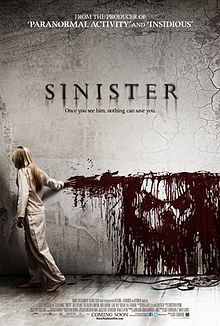
I confess. I’ve fallen behind on my horror movies. My work schedule doesn’t allow for much down time, and on weekends when I spend time with family, well, horror films aren’t their favorites. So on a weekend afternoon when I was alone, I finally saw Sinister. I remembered seeing ads for it a few years back, but far enough back that I didn’t know what to expect. As I’ve often asserted on this blog, horror frequently draws its spookiest material from the deep well of religion, and Sinister once again emphasizes this point. With clear connections to The Shining and Ringu, Sinister does keep you in its web. Of course, ritualized murders are by their nature scary, since those who perpetrate them have taken leave of reason. I don’t read true crime because I have to sleep, and I’d rather not know what some psychopath has eating his brain as he plans his sacrifices. So it comes out in fiction.

The protagonist, crime-writer Ellison Oswalt, consults with a Professor Jonas, whose name those acquainted with the Bible can’t separate from Jonah, to find out about ritual crimes. Jonas informs Oswalt that the occult symbols found at a couple of the murder sites are unconventional. He eventually traces them to Bughuul, a Babylonian deity that eats children. The religious element couldn’t be clearer. Bughuul, who is a god fabricated for the movie, is effectively frightening in the film. But for the ritual element to the murders, the story might have passed as just another gruesome offering to audiences who want a little fright in their October. Religion makes it scarier.

The second appearance of Professor Jonas reveals that, like Ringu, watching the films that tell the story is dangerous. He delves into iconography. Icons, according to orthodox tradition, take part in the reality they represent. Bughuul knows that, and merely by watching the films, or looking at pictures (icons) you open a portal between his world and that of the viewer. By the time Oswalt learns this it is, of course, too late. Again, the element of terror is introduced through religious thought. Bughuul (Mr. Boogle) is a morbid iconographer. The reality of the evil is represented in the “artwork” itself. Once you’ve seen an image, you can’t unsee it. So it is that Sinister draws on religion to plumb the depths of fear. It is surprisingly effective, even on a sunny afternoon when I’ve had too much time alone.

Ring

Absence of evidence is not evidence of absence. So goes a trite little statement meant to calm the fears of new students of biblical studies who worry that the historical record for biblical events is so sparse. The professor can head off many confrontations by declaring that such-and-such an event could have happened, but if it did it left no mark on the historical record. As I was watching the Japanese movie Ringu last night, I wondered about the apparent absence of religious imagery or themes. I am fully aware that not all horror movies have religious components, but the juxtaposition of religion and fear is so common in the western world that it often shows up in scary movies. I wondered if this translated to other cultures or not. Ringu is a decidedly creepy ghost story that creates considerable tension with little gore and not much in the way of special effects. The social commentary is evident even without the benefit of first-hand knowledge of the culture. The paranormal pervades the film.

Christianity is the matrix of many scary movies made in a North American, or even European, context. Although I have read about Buddhism and Shinto, and even occasionally taught courses on “World Religions,” my knowledge of eastern religious traditions is admittedly still quite basic. I can usually spot a biblical allusion a country mile away, but subtleties of foreign religions are harder to discern. Although many religions coexist in the United States the overall context is still Christian—there can be no doubt for anyone who follows politics. Japan is, like America, largely secular. The religious base, however, tends to involve both Shinto and Buddhism and I’m not sure which, if either, forms the recognizable “religious” basis of the collective consciousness. In many ways “religion” only applies to the Judeo-Christo-Islamic model. Much could have been transpiring in Ringu that I simply missed.

After the first mysterious death in the film a short sequence of a family in mourning is shown. Clearly this is what we in the western world would consider a religious context. The decision to try to calm the avenging ghost by uncovering her murdered corpse also conforms to what we might term religion. The fact is, these are very human concerns. Religions throughout the world treat death with a religious reverence since it is the great mystery of the living. Religion frustrates many scientists just for the fact of its mysteriousness. So, does Ringu revolve around religious fear? I don’t know. With the karmic implications of the story-line I would suggest that maybe it does. I’ll remain agnostic on the point, however. The same goes for the absence of evidence is not evidence of absence. Is it or isn’t it?