
I’ve long wondered about what appear to be coincidences. Specifically, about movies on the same topic that seem to come out at around the same time. I saw Gothic about a year after it was released in 1986. In 1988 two other versions of the Shelley-Godwin-Byron-Polidori-Clairmont meeting came out. I’ve already written about Haunted Summer. The third of these films was a Spanish production, Rowing with the Wind. It is the most poetic of the three. The dialogue is often poetic and it pulls out several historical details—some of which the other two films leave out. Mary Godwin and Percy Shelley decide to elope, taking Claire Clairmont with them. Lord Byron does not wish to see them. He and John Polidori, his physician are out on a boat. Boats play a large part in this movie. Byron, played by Hugh Grant, soon comes to like Shelley. Polidori’s role is underplayed and he dies by suicide before the party leaves Villa Diodati.
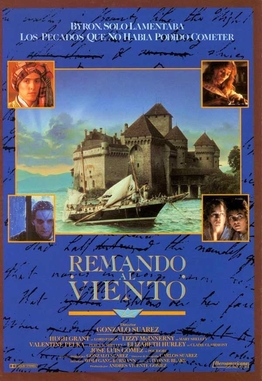
Mary Shelley’s monster, however, follows them. Back in England it leads both Mary’s sister Fanny and Shelley’s wife Harriet to suicide. Extending beyond the summer of 1816, the film follows the Shelleys and Clairmont to Italy. They have their children with them. When they come to Venice, they once again meet Byron, but Mary’s monster kills William Shelley (their son) and Allegra (Claire’s daughter). Obviously, death is a major theme, along with boats. (Historically, all of these people died, but not in such close time, but close enough to be tragic.) The Shelleys stay with Edward Williams, a friend Percy met in Italy. The monster then leads to Shelley’s death by drowning. Byron’s death in Greece somewhat later is narrated by Mary but not shown.
The film is framed with a fictional arctic journey by Mary to pursue her monster. Interestingly enough, no mention is made of Polidori’s story “The Vampyre.” There’s not even any suggestion that he set out to write it. Movies of this meeting often point out how the vampire and Frankenstein became famous because of it. Rowing with the Wind is an arthouse movie rather than a studio blockbuster. It isn’t a bad story. It tries to tap into the sorrows of Mary, and again, historically she did suffer loss. Her mother died shortly after she was born. A child died before the first visit to Byron. Percy’s first wife Harriet and Mary’s stepsister Fanny both died by suicide in 1816. William died in Italy, as did her third child with Shelley. Polidori poisoned himself. Allegra died at five. Shelley drowned in a storm at sea. Byron died while trying to fight in Greece. This film is a fitting tribute.

