Harboring Hopes

I am not what you’d call a fashion-conscious man. I literally still wear clothes I had in college. Most of them are petty much for around-the-house, given the condition they’re in, and although I wear jeans less, I have never really tried to “change my look.” I wear my hair (now grayer) the same way I did in high school, and most of my clothes, realistically, come from my teaching days. As I walked along the Seaport Village walk here in San Diego, a group of red-shirted workers, on break from unloading a truck, called out to me. Now, I know better than to talk with strangers, but working class types are my people. I am from a deeply blue collar background, and I feel that I have much more in common with them than with the priest who’s handing me a pink slip. Or the average professor. So I stopped. “Are you a professor?” one of them asked. In honesty I answered, “I used to be.” The fellow turned to his companions and said, “I knew he was a professor.” Turning back to me he said, “of what?” This is the part where crickets start to chirp and a tumbleweed blows by. “Religion,” I confessed.

This led to a spirited debate between two of the men. The one who called out told me that he’s now a Christian. He was raised Catholic but after having been out on an “effing ship like that” (the USS Midway) he found Jesus. One of his companions began arguing that religion was a terrible thing—causing people to insist that they are right and others are wrong. He argued that faith was fine, but as soon as you start calling it a religion, problems arose. I put my hand up to shade myself from the late afternoon sun. I was far from home, and I had no idea what these men wanted from me. Was I supposed to give them the answer to which was the true religion? Maybe they just wanted to be heard. I demurred and encouraged them to continue seeking. As I walked away, one of them said, “that’s a smart man.” The first said, “I told you he was a professor.”

What does a professor profess? While waiting for my plane in Newark, I heard two religion professors (actual, and ancient) discussing the fact that they’d retired. “But I want to keep on teaching,” one said. Without, I thought, considering that you’re keeping younger scholars from finding gainful employment. Yes, teaching is enjoyable—I know nothing like it—but there can be other outlets for sharing your wisdom. My wife has recently taken to MOOCs (Massive Open Online Courses). There are community events where you might not get paid, but your wisdom would be providing a service. And you’d be opening the door for others. Sounds like a religious thing to do, instead of being selfish or self-important. Or then, you could just walk along Seaport Village. Rather than turning away from the common worker, answer him or her when he or she calls out to you. It is the way of true teachers.

IMG_1809


Only Midway

Unlike some employers, my current one sees the wisdom in arriving early for a major conference. The American Academy of Religion and Society of Biblical Literature is meeting in San Diego this year, and for those of us in the New York area, it’s about as long a flight as you can have in the lower 48. Having arrived in good time, and not knowing much to do in San Diego (I don’t know of any famous writers from this area whose childhood homes I might haunt), I ended up walking to the USS Midway. I’ve never been on an aircraft carrier before, and, on the eve of a religion conference, it was a strangely moving experience. Maybe it was the recognition that I was standing on a floating city on which many people had died in various wars. Perhaps it was the fact that this was a massive piece of machinery designed for its destructive potential. Or it might have been the sheer determination that appeared in every placard: this was a cause we had to win.

No doubt, the Second World War was a just cause. The force of destruction had to stop and the aircraft carriers that enabled the war effort were a huge feature in the “Pacific theater.” Staring at these massive jets, the finest technology of their day, I knew that our greatest efforts had been poured into violence. These were not mere deterrents. Yes, people had died here, but those launched from these decks also killed. War makes claims that way. As I pondered these sobering thoughts, I came to the chapel. Obviously I had to see. An eerie recording of “Eternal Father, Strong to Save” came over the speakers as I walked in. Yes, those on a warship are in peril on the sea. If they are successful, others will have died.

IMG_1797

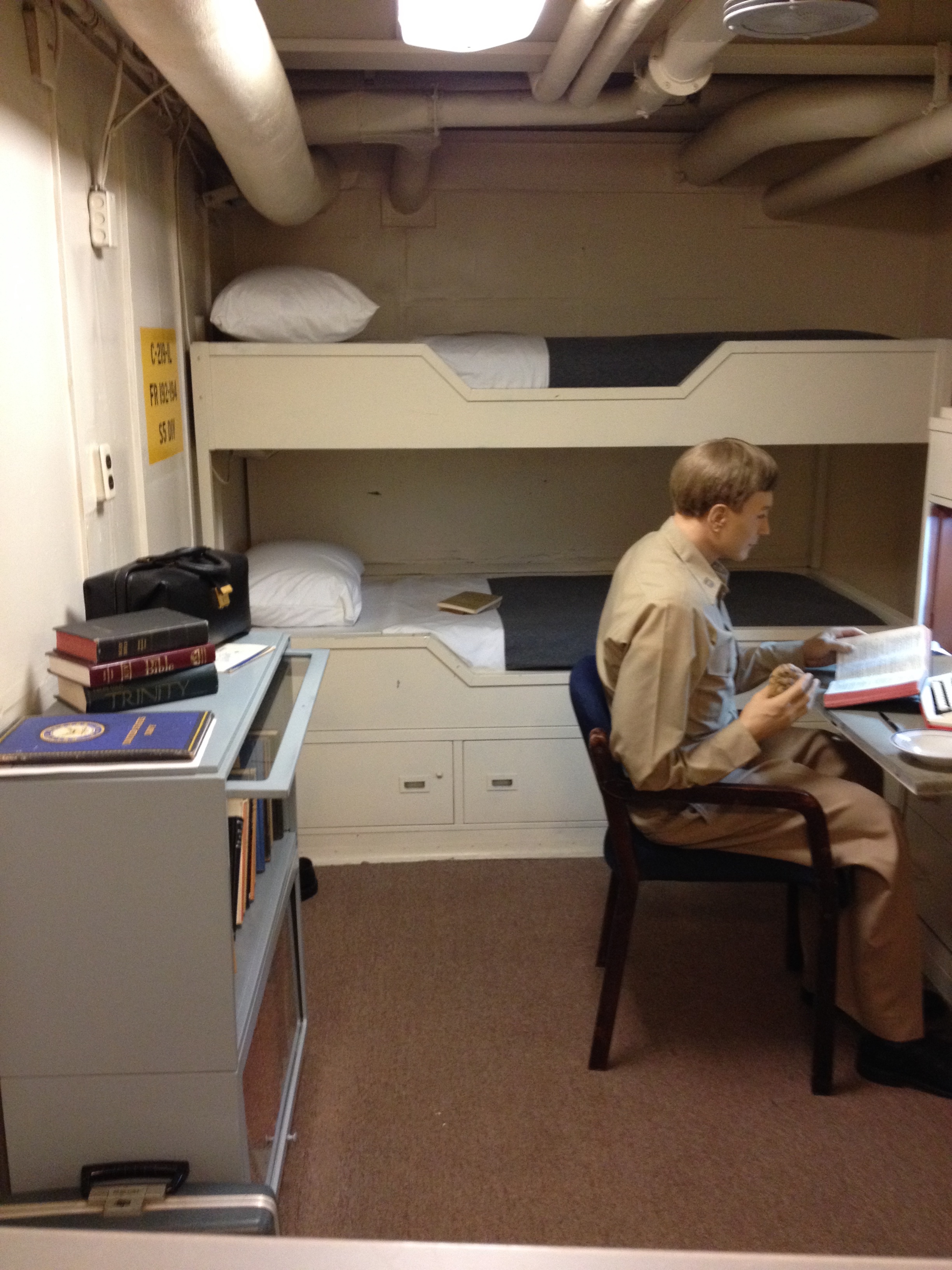
A little further along the corridor (or is it “hatchway”?), I came upon the chaplain’s room, along with my first Bibles of the trip. (I knew they would be here.) A mannequin of the chaplain, cookie in one hand, Bible in the other, sat, apparently, preparing a sermon. What does one say to those going to war? God is on our side, obviously. But what more? The Bible does not forbid warfare. It was a way of life in the centuries during which it was composed. We like to think we may have advanced since then. But as I prepared to exit back onto deck in the warm California air, I passed a display of aircraft carriers past and present. More sophisticated, more deadly weapons continue to be built. And in this day of nones, I wonder who their chaplain might be.


Sola Scriptura

IMG_1641Would you buy a Bible from this man? “The trade is not a complicated one,” quoth Big Dan Teague. People are looking for answers. To making a living selling Bibles, however, requires some finesse in a world where scripture may be had for free. The trick is added value. Now, for those who approach this from a religious angle the obvious question is how you add value to what is claimed to be the word of God. It is, however, a matter of understanding it. Martin Luther, apart from starting the Protestant movement, also translated the Bible into German. The concept was simple: if the Bible contained the truth, the whole truth, and nothing but the truth, then if the laity read it, we wouldn’t need priests. Greek and Hebrew (and a smattering of Aramaic) are no longer the main elements of a well-rounded education so we need a version that anyone might read. Even the King James is a little rusty, what with words that don’t mean what they seem to—who wants to suffer? Especially in the biblical sense.

Contrary to Big Dan’s assertions, the Bible trade is a complicated one. The text of the Bible (if not specific translations) is in the public domain. The Bible is, however, more than words. It is ink, and paper, and binding. It is an object. By swearing with your hand on it, you can convince the court you’ll tell the truth. Or become president. Or raise a lot of money. Despite the Bible’s decline in academic prestige, it remains a source of popular trust. Not too many items that can be had for free can make such claims of power. It is the book that founded western civilization.

As I board a plane for San Diego, I know that I’m about to see lots of Bibles. Lots and lots of Bibles. Thousands of scholars who spend their lives studying it will gather to discuss its continuing significance and debate its finer meanings. Some will venture to purchase new Bibles. New versions of old words. See what others have to say about them. Somewhere distant I hear Big Dan breaking a branch from a shade tree. This, like most patterns, repeats itself endlessly. Some with tenure will argue that the whole thing ought to be abandoned. Others, forever denied tenure, will vociferously disagree. “One, find a wholesaler, the word of God in bulk, as it were.” And so the debate will continue long into the night. And over the weekend. In fact, ’til Tuesday.


Someplace Beyond Longing

November is a month pregnant with significance. It is the month of NaNoWriMo (National Novel Writing Month; when I tried it a few years back I finished a novel in three weeks). It is the start of the “Holiday Season” with Thanksgiving kicking off a slightly more relaxed schedule for businesses and students alike. Often the first day of Advent falls near the end of the month. In many places it has already provided the first snow of the season. For scholars of religion, however, November is the month of the American Academy of Religion and Society of Biblical Literature annual meeting. This year it will be held in San Diego, and will, no doubt, impact my blogging schedule somewhat. Being a creature of consistency, I try to upload my posts around 4:30 a.m. eastern time on weekdays, as I start pulling myself together for work. I’ll be three hours off for the latter part of this week, but if trips to California conform to any pattern, I may still find myself awaking at 1:30 wondering why the city is so quiet. California, here I come!

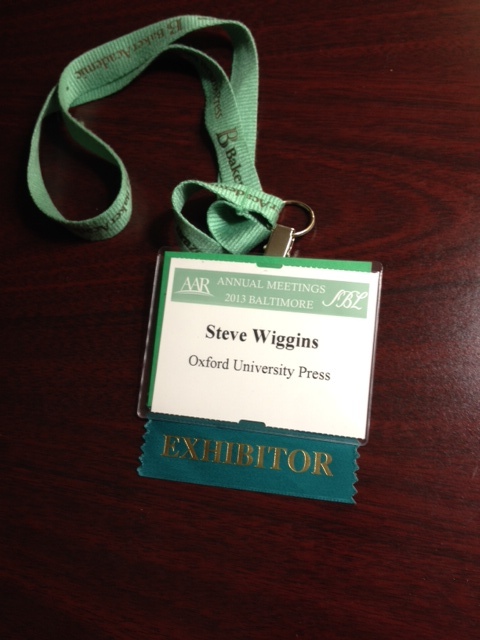
When I attended as a participant, I gave a paper nearly every year. Several of these papers were making their way toward a book that will never be published. Some produce content. Others only consume. Attending as a participant was kind of like a professional vacation—a few days off the usual teaching schedule, trying to find colleagues to catch up on, listening to papers. From the publishing perspective, it is a non-stop four-day weekend of work. As I see my colleagues on their way to late night receptions, I have to beg off. Tomorrow’s a working day for me. The exhibit halls open at eight, and I will have no idea what time it is in any case.

Ironically AAR/SBL is one of the things that has remained consistent in my professional life. It is almost a migratory feeling. I began attending in 1991, only missing the odd year here and there when something more important took its place. I was, however, never an insider. I chaired one of the sections for six years, but nobody ever contacted me suggesting we meet up. I could advance no one’s career. Now my calendar’s full. Now that I have something others want, suddenly I’m a commodity. Funny thing about a conference dedicated to disciplines associated with selflessness. As I pack my bags and make my plans to take care of details while I’m gone, my mind wanders to the purpose of it all. I used to dream that I would forget to visit the book stalls, and on the plane returning home I’d realize that I’d missed one of the most important parts of the show. That nightmare no longer plagues me. It is now the sole purpose for which I attend.

Am I that obvious?

Am I that obvious?