The Triumph of Lovecraft

The deeper you peer into the mouth of nature, the more Lovecraftian the world becomes. Just days after I had posted a little meditation on Cthulhu, the great old god of H. P. Lovecraft’s unholy pantheon broke into the mainstream news. No less a source than NBC ran the headline “Tiny Cthulhu ‘monsters’ discovered in termite guts” only a few days ago. The microbe with the scientific name Cthulhu macrofasciculumque lives in the digestive system of termites, helping them in their destructive work. True, Lovecraft described Cthulhu as a bit bigger than that, but the first appearance of the microbes, according to Megan Gannon, reminded the discoverers of the eponymous terror of the Cthulhu mythos.

From microbes to the major football leagues such as the Baltimore Ravens, writers of the macabre have left their mark on our culture. The darkness they describe so richly is something we all feel at some level, but that we sublimate most of the time so that we can get on with our lives. Cthulhu macrofasciculumque may be very, very small, but the super-viruses and bacteria that we are encountering have the ability to destroy us just as surely as the chimerical colossus of Lovecraft’s nightmares. When we look for a way to describe these terrors, we have brave literary heroes from whom we might draw. We would be lost without them. They make it safe for us to venture into that darkened room, for they have been there before us. Lovecraft gave the world its first scientific description of Cthulhu, and although that description defies adequate reconstruction, we recognize it when we see it.
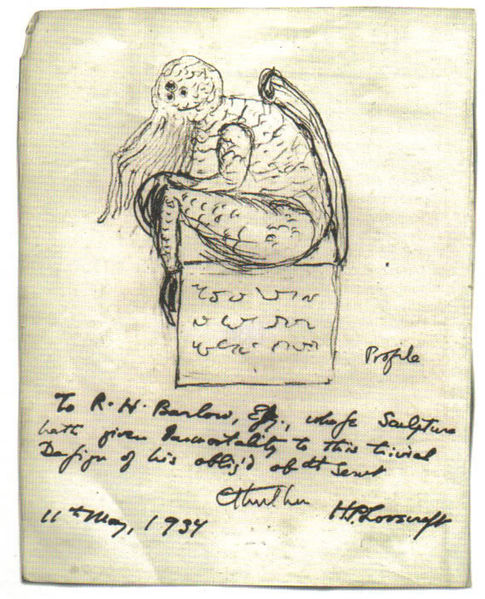
As Lovecraft saw him.

As Lovecraft saw him.

Science has brought us so very far. We can now see to almost the brink of an infinite universe and delve into the guts of termites. We have the ability to prolong life and increase physical comfort for those who can afford it, and we can annihilate entire nations at the press of a button. Drones can fly overhead and do the dirty work, and we don’t even have to step outdoors. Yet when we meet something that shivers our scientific spines, we turn back to the old gods to name it. Yes, religion may be the bête noire of science, but the dark night of the soul is not illuminated by LED’s or lasers. To see in this dark you need to have the night vision of literary perception. And those lenses, according to Lovecraft, reveal that the old gods are dead but still dreaming.


Next to Godliness

Catholics, secularists, and even a Pharaoh or two. Loud, pounding music. Dancing teenagers. It must be FIRST Robotics season again. Although I’m ambivalent about the implications of a world filled with robots, I can’t help but be impressed by what high school students can do when they are mentored so closely by adults eager to share the tricks of the trade. If you’re not familiar with FIRST Robotics, here are the basics: each January a new game objective is released. Participating high schools throughout the world have six weeks to plan, design, construct, and program a robot to perform the tasks spelled out. Since this is a busy time of year for many schools, dedicating extra hours to building a robot leads to complaints and loss of sleep—maybe a skipped supper or two. When they come together on the playing field, however, all that is forgotten and the wonder is that kids, who are often disparaged in our society, have managed to construct a working, complex machine capable of tasks impossible for many adults (for example, doing chin-ups).

Every year I can’t help but think how like a religious service these events are. The robots are like deities to be served and the technology flits about like mechanized angels. There is an increasingly complex hierarchy of officials telling you what you can’t do (now this is beginning to feel like work!). At the end of the day, however, the kids get to be the stars in a competition that puts brains over brawn. And the robots are treated with extreme deference, because we know that we wouldn’t stand a chance if they had a will anything like the deities of yore.

The religious imagery, however, is never absent. Technology represents humans doing things without divine intervention. These are empirically devised devices, performing according to the laws of physics. And yet, teams from Catholic high schools, bearing mythologically-laden names, join in the world where no gods need apply. Robots, as initially named by Karel Čapek, were human servants, the ultimate in godliness—making images in our likeness to do our bidding. And yet we can’t escape the language of religion when thinking about our own creations. The fascination applies to non-parochial schools as well, with some teams claiming names echoing themes from holy writ. Creating autonomous beings is next to godliness. We make our own future, and, god-like, we hope that nothing goes wrong.

Humans and machines

Humans and machines


Animal Mentalism

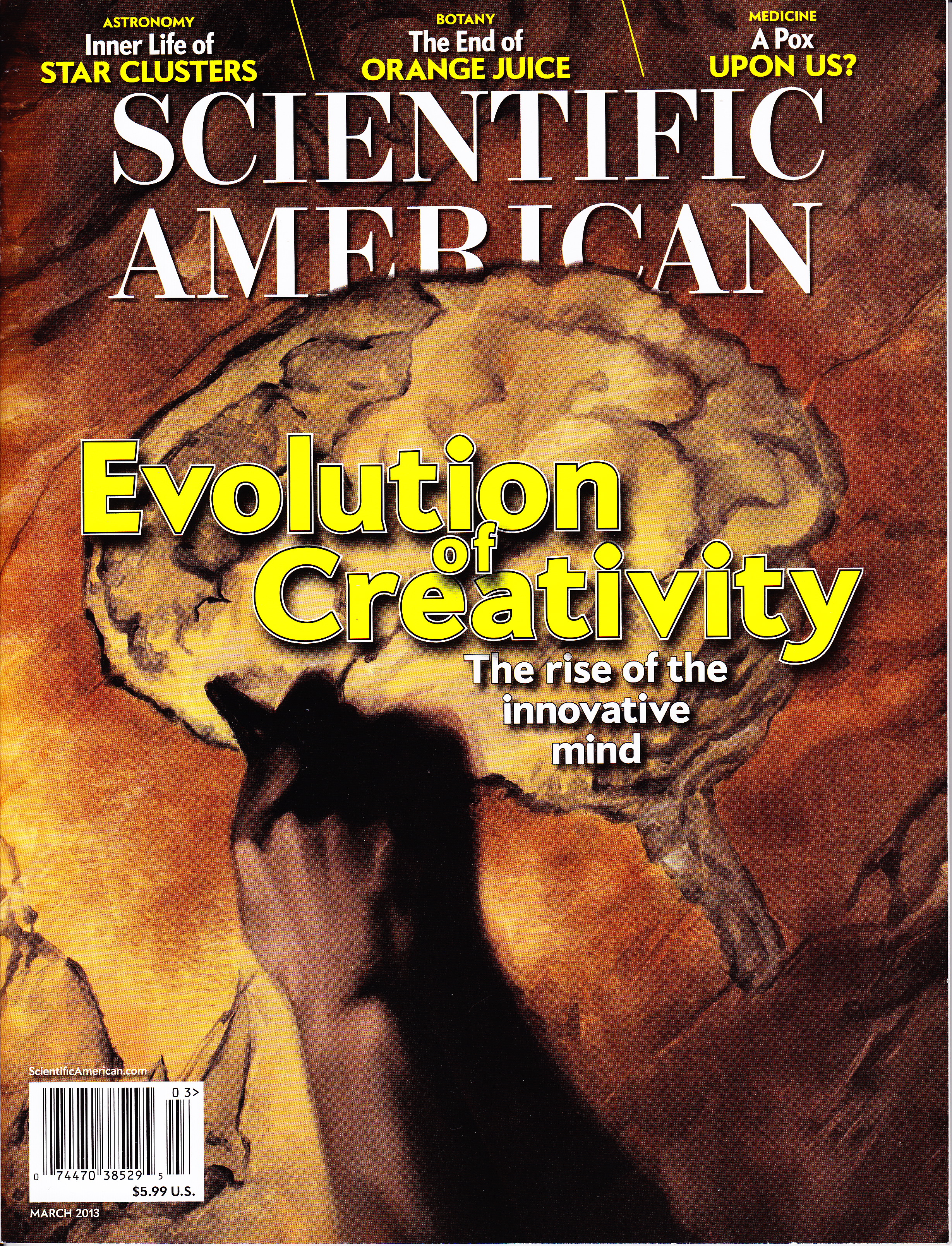
SciAmScience is how we know things. Most things, at least. One of the fundamental aspects of human life not yet grasped by the great empirical method is creativity. We generally have an idea how it works, but, like so much of human experience, it is difficult to describe precisely. When I saw this month’s Scientific American fronting with the headline “Evolution of Creativity”—two of my favorite topics—I knew I’d have to read it. The article by Heather Pringle zeroes in on the archaeology of very early human history. Before modern human, actually. I’d been telling students for years that the development of such traits as artistic representation, burial, music, and an awareness of some forces “out there” could be found tens of thousands of years ago. These, I suggested, marked the beginnings of religious sensibilities. I’d be willing to go even farther, however, and suggest that we share some of these traits with our fellow creatures. Religion may have a biological basis. That’s not where Pringle is going, however, and she addresses not religion, but creativity.

Pringle suggests that evidence for human technology—modest though it may be—stretches back further than the 40K epoch that seemed to house an explosion of human innovation. She shows how sophisticated knowledge of the environment and corresponding innovations were occurring 77,000 years ago, and even earlier. Some of it stretches back before Homo sapiens; stone weapons may be as early as Homo heidelbergensis and kindling fire as early as Homo erectus. Even our Australopithicene cousins seem to have been happily knapping stones two-and-a-half million years ago. The evidence, at the moment, seems to end there. I wonder, however, how far back cognitive development goes. We tend to underestimate the thinking abilities of animals, despite our constant surprise at how smart they seem to be. How very human! How very male, to assume that everything else is here for our use and pleasure.

Scientists often come upon with astonishment ideas that creative folks have been pondering for centuries. Science must be careful—that is one of its limitations. Creativity, the phenomenon Pringle explores, contains, in the words of Lyn Wadley’s team in Science, chemistry and alchemy. Creativity, like religion, isn’t afraid of magic. No doubt, some scientists will claim that true intelligence only begins with humanity. Looking at the way we treat each other, sometimes I doubt that it begins even there. If there is any hope for us, I would humbly suggest, it will come in the form of creativity. It is that very alchemy that keeps me coming back to science, and science will teach us, eventually, that animals are creative too. When we place ourselves among them, we will have created a world.


Continental Drift

So this is the way epiphany works. (I know it’s Lent, but I’ve got bigger fish to fry.) I sat down to check my personal email after a horrid day at work, and since I have a Verizon account, I can’t help but see the news headline that’s on the page when I open it. When the headline said something about a new continent discovered by scientists under the ocean, I’ll have to admit that Atlantis sounded better than anything I’d heard in the office. So it was worth a click.

Athanasius_Kircher's_Atlantis

Turns out that this isn’t Atlantis at all—I have this habit of making naive assumptions—but a continent just north of Madagascar that sunk some nine million years ago. No happy lemurs or Homo sapiens around then. So when this Atlantis sank, there was nobody around to see it. At least not Plato.

The story was broadcast by Newsy and it made mention of Science World Report. Here’s where the epiphany piphed. I’d never heard of Science World Report. When I went to their site, the wonders of the universe spread out before me. “Dying Stars Reveal the Clue to Extraterrestrial Life: Earth-like Planets Unmasked” read one headline. “How Dinosaurs Evolved the World’s Longest Necks While Giraffes Fell Short.” These are the things I need to brighten me after a rotten day. A world with wonder in it. A world where money is not the sole, or even the highest good. A world where an intellect need not go to waste.

“Human Language May Have Evolved from Birdsong: New Meaning for Communication.” This website is like my eternal monologue in headline format. I’m not naive enough to suppose this website will be the nepenthe for all my workaday woes. But it does serve to remind me that science and religion are not always foes. A religion only becomes belligerent when it takes its truisms too seriously. We evolved in a world of wonder, but we’ve taken great care to remove the wonder from it. As if joy and delight were puerile phantasms with no place in the serious adult world of finance and industry.

I became an educator because I’ve always been in love with ideas. I lost my job in education because I was an idealist. Yes, continents do indeed sink. And while it may not be Atlantis down there, a simple click led me to a world of wonder. And that is, if anything can be, cause for hope.


Rational Religion

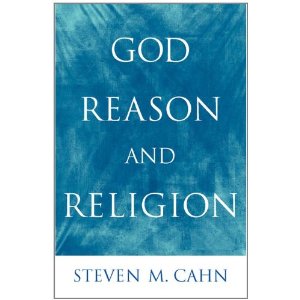
GodReasonReligionGod, Reason and Religion, the title of Steven M. Cahn’s book, fit uneasily together. Or so it would seem. Cahn, a philosophy professor, collected together in this little book a set of sixteen short, provocative essays keyed to major topics of the philosophy of religion. I’m always skeptical when I see Reason and Religion together on a book cover. It seems like an unholy plotting is going on. Perhaps it’s because those of us who study religion are often classed together with those who use slipshod techniques to “study” a subject they’ve already made up their minds about. Any scientist who’s seriously tried to learn Akkadian might have to reevaluate that premise. Happily, Cahn is not trying to promote such an idea. He states in the introduction, “My conclusions may be surprising, for although I am not a traditional theist, I find much to admire in a religious life, so long as its beliefs and practices do not violate the methods and results of scientific inquiry.” For books with Reason and Religion on the cover, that can be quite a concession.

One of the biggest faults of religions is their lack of introspection. That is a gross generalization, I know, but there is truth in it. Most religions have been severely challenged by the empirical method. Reason, it turns out, can explain most of what required one—or a multitude of—god(s) to accomplish. At the same time, religion makes people feel secure and happy. My experience of science has often been enlightening, but decidedly prickly. I’m sure I’m not the only one. Nevertheless, Cahn takes the reader through a maze of ways to think about religions from different angles. What is the tie between religion and ethics? How do we tell a good deity from a bad one? What is faith and is it a safe bet? Do miracles happen? These kinds of questions, when viewed rationally, don’t always have the dreadful results so often feared. So maybe the laws of physics aren’t violated, but that doesn’t mean you have to stop praying. Did I mention that Cahn makes concessions?

We are the cultural children of our logical, Greek forebears. They taught us to trust our reason and we’ve developed that to a high skill. Yet reason has its limits. Consider the Republican Party, for instance. Or Snooki. In life not everything adds up. Facing their final moments, few have the fortitude to keep their thoughts purely on the rational. What lies beyond we just don’t know. Science has no way of answering. So Reason and Religion should get along. There may be more than one way of knowing, and some things in our world may bridge that deep gulf between Reason and Religion. That bridge may sometimes be difficult to find. If you decide to seek it out, however, I would recommend taking Cahn along for some good reading. Even the most serious search must offer some concessions.


Deep Things

Religion concerns itself with the big issues. The biggest. As a child, I remember wondering how anyone could be concerned with less than the ultimate. No, I wasn’t a nascent Tillichian, I was just someone who saw things in what I supposed was a practical light. If you’ve got the temporary, the fleeting, the insubstantial over here, and the permanent, immortal, supreme over there—who wouldn’t go for the gusto? I suppose by my reasoning that all people would end up clergy of some sort, we would all be fixated on why we’re here and what our purpose was. You’ll still find pockets of theologians here and there who debate these kinds of issues, but our existence has grown comfortable enough that, for some people at least, if this ends up being all there is then, gosh, it’s been a fun ride thank you very much. But I don’t want to get out of the train just yet. I wonder if there’s more than the ultimate. It is a religious question.

For a while I grew enamored of the trappings of religion. Ceremony, ritual, strong rhetoric in sermons—these things can move you, and become beguiling. Somehow, knowing there’s an infinite universe just outside the church doors gives me pause for consideration. The ultimate must be very big. Walking through a large city helps to provide some perspective. I find myself next to buildings that cause me to tremble when I consider the implications. Next to those tons and tons of stone, steel, and glass, I am the smallest spark. But those buildings are dwarfed by the city that contains them, and that city a mere pinpoint on a map of the country. Even the planet is less than an atom in the universe of infinite size. Who can help but to be concerned about the scope of it all? Ever since I was a child I’ve worried about this.

In the media today, religion is all about hypocrisy and whose pants are at what latitude vis-a-vis whom. While matters of love are ultimate in their own way, we, as people, have a much larger space with which to concern ourselves. Science has stepped up to the dock when it comes to sworn testimony about the universe we inhabit, but even scientists shrug once we get back before the big bang. Time is even more inexorable than space—there’s always got to be a time before time. Like any child we can always ask, and what happened before that? Perhaps time is the true ultimate. Thank you for spending a bit of your ultimate reading this. It’s time for me to catch the bus, but work will never inspire me the way the rest of the universe does.

Hubble's eye view

Hubble’s eye view


Leviathan’s Sibling

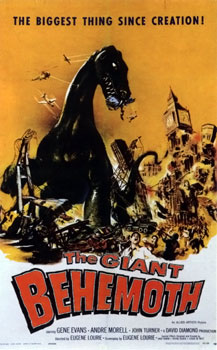
TheGiantBehemoth Formulaic to the point of plagiarism at times, 1950s science fiction movies often follow the deeply worn ruts left by countless forgettable monsters. One such film that I managed not to see until recently was the biblically entitled The Giant Behemoth. In a more biblically literate society the poster’s catchphrase “The Biggest Thing Since Creation!” may not have been necessary, even though leviathan’s lesser known companion stole the title this time. Of course the movie begins with stock footage of nuclear explosions, and although I’ve seen such renditions hundreds of times, they remain troubling to the core. Those 1950s that many consider so carefree were days of insidious freewheeling with the environment, days before human infatuation with the power over nature revealed its horrifying consequences. The behemoth, a sign of Yahweh’s great creativity in Job, here becomes the human-wrought agent of destruction.

Poor Tom Trevethan is blasted by the beast’s radioactive breath in a scene more fitting to Revelation than to Job. In the funeral scene, the priest somewhat insensitively reads a description of behemoth before Tom’s sole surviving family, his daughter Jean. So like the 1950s the minister then declares that the Bible gives comfort to those left behind, when the Lord said to Job, “Gird up thy loins like a man.” Indeed. Loin girding was a masculine activity in the days before Fruit of the Loom had been grown. Comfort for the woman comes in acting like a man. Yes, the 1950s considered the man the default model of human being. It says so in sacred writ. Genesis 3, to be exact.

When the scientists can’t figure out what killed the old man, along with thousands of fish, they ask Jean if her father said anything before he died. She tells them about behemoth. Being scientists, they have no idea what a mythical, biblical creature might be. Jean informs them, “It’s some prophecy from the Bible; it means some sort of great, monstrous beast.” Well, Job is technically not prophecy. Actually it’s not even untechnically prophecy either. In the 1950s, however, if it was biblical, it could be interpreted as prophecy. The real foretelling, though, is clearly atomic. Such films can easily be forgiven their biblical infelicity for the sake of their good intentions of reigning in human self-destructive behavior. In the end science destroys the biblical beast, but I’m left wondering if it isn’t more of a parable than a prophecy. I guess it’s time to gird up my loins and go find out.


Hallowed be thy Kane

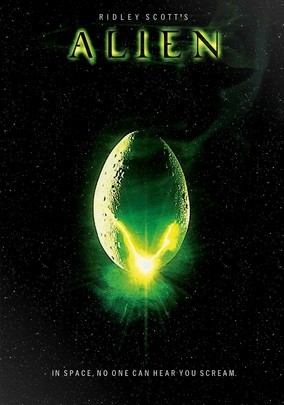
Watching the alien burst from Kane’s distended abdomen as he appeared to have eaten too much seemed somehow appropriate on Thanksgiving. I’m well aware that my taste in movies does not always match expectations and few bother to comment on my idiosyncratic observations. Nevertheless, it had been years since I’d watched Alien and on this particular holiday it felt like synchronicity. I’ve seen the film a few times before, but this is the first time since starting this blog. Not surprisingly, some biblical allusions popped out at me as I watched the crew of the Nostromo struggle with alien life. And I’d just read of NASA’s “exciting discovery” on Mars, a discovery whose official announcement for which, like Christmas, we’ll have to wait until December. Learning that the gut-busting alien was modeled on Three Studies for Figures at the Base of a Crucifixion by Francis Bacon (a contemporary one) only sweetened the analogy.

Character names hide aspects of personality and intention. Sometimes the writers may not even be aware of all the shades of gray. The alien’s first victim is Kane. On paper he seems an ordinary citizen, but on the screen the euphony with the first human child, Cain, is obvious. As Parker is lamenting how large the alien has grown in just a short time, science officer Ash whispers, “Kane’s son.” Or is it Cain’s son? Cain, the infamous ancestor of the sinful Grendel and any number of other villains of literature and cinema. Cain is, significantly, the first child born in Genesis, himself the genesis of sin in the world since his murder of his brother is the first act that the Bible declares a “sin.” The alien, born worlds away, conforms to biblical expectations.

Since Ash is actually an android and has no real feelings, he admits the alien to the ship and protects it until he is destroyed by his shipmates. He represents unfeeling science amid the horror of human bodies being invaded and rent apart. When accused of admiring the alien, the resurrected (!) science officer states, “I admire its purity. A survivor… unclouded by conscience, remorse, or delusions of morality.” Is he not really describing science itself? Religion is running rampant on the Nostromo. As Ripley sets the detonation charges and finds her escape blocked, she races back to the console and cancels the self-destruct order which the HAL-like Mother ignores. In a secular prayer Ripley calls out to Mother who, like any deity, does not answer all human pleas. And even as she escapes the detonating ship, Ripley will find that Cain’s son is still lurking in the corner of the emergency shuttle, for the science can never truly escape from Genesis.


Bedrock

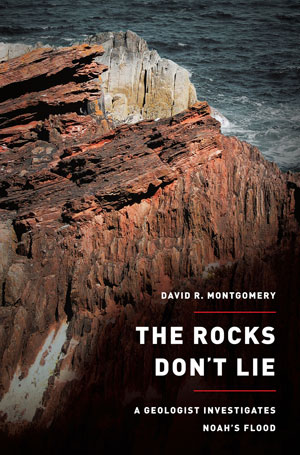
Sadly it is a rare occasion to read a truly stupendous book. There are lots of wonderful books in the libraries of the world, great and small. When I read a tome that brings two of my favorite subjects together in a genteel cotillion, subjects which are generally portrayed as aiming heavy weapons at each other from deeply sunk trenches, it deserves the epithet of stupendous. David R. Montgomery’s The Rocks Don’t Lie: A Geologist Investigates Noah’s Flood is one of those books. By page 8 I was thinking that Montgomery was someone with whom I’d feel comfortable raising a glass and sharing a story. He is a rare, serious scientist who considers that maybe religious stories have something to tell us about being human. The book, as the subtitle indicates, is about the Noah myth. Geology is the science that has taken the brunt of (the relatively new religion of) Creationism’s umbrage. Still, like a rational scientist, Montgomery doesn’t get mad or fly off into hyperbolic denunciations. He takes his rock hammer and taps until the flood myth crumbles.

Unlike many sober writers on the subject, Montgomery considers the possibility that folklore may in fact give clues to science. Those cultures that have flood stories, he patiently explains, probably has reasons to tell such myths. In this one book we are taken on guided tours of the Grand Canyon, bits of the Himalayas, “ancient” Mesopotamia, the scablands of eastern Washington, and even the Creation Museum in Petersburg, Kentucky. At each station, we learn a bit about floods and rocks and fantasies. Although not a biblical scholar, Montgomery obviously did his homework and gives a fresh view of how Christians went from non-literalists in the first centuries of the church, through the scientific revolution, only to become literalists in the geologically very recent twentieth century. Creationism has nothing to do with real floods and quite a lot to do with personal insecurities.

It must be easy for scientists to trumpet bravado throughout the infinite universe. The scientific method is our best testable explanation for the physical world. Montgomery resists that temptation, realizing that religion does count for something after all. Religion evolved for a reason. Maybe it isn’t scientific, but it helps people to make sense of their world. Instead of characterizing religion and science as combatants in a war, Montgomery likens the opposition to a dance where the partners sometimes step on each other’s toes. I read his book dreaming my geological dreams, lost in deep time, and thinking that the world is maybe even more wondrous than miracles could ever convey. And we have occasional floods, and floods sometimes give us reasons for going on. There’s perhaps something religious about that.


Science Friction

What hath CERN to do with Jerusalem? It might seem that the House Committee on Science, Space and Technology would be a reasonable place to look for members of Congress with a grip on science. But then, I often live in a fantasy world where things make sense. It is with some sadness, but no real surprise, that I read about the words of Georgia Representative Paul Broun, lambasting evolution and the Big Bang as theories from the Devil. Broun is a medical doctor who, under conviction of his Fundamentalist faith, has rejected the basic tenets of science. According to the Associated Press, he told a Baptist church congregation, “All that stuff I was taught about evolution and embryology and Big Bang theory, all that is lies straight from the pit of hell. And it’s lies to try to keep me and all the folks who are taught that from understanding that they need a savior.” Sounds like Satan had a very busy pre-history.

Anyone who knows me knows that I begrudge no one their personal religious beliefs. Someone who does not believe in embryology, however, might have selected a career more commensurate with his religion than medicine. Election year does tend to bring out the shock value statements in politicians. Having to convince their constituencies that they are just simple folk, they deny what their faith belies every time they accept an inoculation. If evolution is a lie, so is vaccination—something most medical doctors would have to have understood before facing medical school examinations. In the United States, however, such wrong belief is a generally apt qualifier for Congress. Especially among the Tea Party. Broun hails from the ironically named Athens, Georgia.

Over the weekend I watched the Star Trek (original series—please, I’m a connoisseur) episode, “The Mark of Gideon.” It is one of the episodes I don’t recall from childhood, but then, with Kirk and all that “mushy stuff” of being alone on the Enterprise with a woman, well, maybe it just didn’t stick when I was in my tender years. In any case, the symbolically named Gideonites have overpopulated their planet to the point of disaster by good clean living. They attempt to hijack themselves a disease “inadvertently” to reintroduce population control. Captain Kirk asks why they don’t use safe methods of birth control, even volunteering the Enterprise to be a kind of inner-galactic condom-dispenser. The Gideonites explain that they believe all life is sacred, and that preventing life is a great crime—regardless of the misery it causes. I had to smile to myself. Sounds like the people of Gideon may have had been lectured by a Georgia medical doctor who had gone off on a peculiar flight of fancy.


Queens and Playmates

Once upon a time, theology was queen. I’m no theologian, but then, I didn’t make up the phrase. A recent article in the Chronicle of Higher Education discusses how some scientists say there is no longer a need for philosophy. In passing the piece mentions that theology had, long ago, been considered the queen of the sciences. According to medieval thinkers, philosophy was her handmaid. Antiquated archaisms apart, I sometimes think back on this whole venture of education. Few today acknowledge, and most probably don’t know, that education began as a religious exercise. Writing, and reading, were overseen by the gods. Even in the modern world the earliest universities were founded to teach theology and law. Many of the ivy league schools, including Harvard, Yale, and Princeton, began as training grounds for the clergy. How quickly our forebears are forgotten.

It’s not that I think religion deserves a privileged place in the academy, but I do believe it deserves a place. Science has a long track record of spectacular successes. Not only that, but the advances in science often capture the imagination—and here we are back in the realm of the humanities, that place where feeling and possibility are unlimited. Many of those of us in religious studies—apart from creationists and their kin—gladly award science its deserved paean to successfully unpacking the intricacies of the material universe(s). As the Chronicle article demonstrates, some on the science side of the circle want to claim all the marbles and go home. Some of us want to keep the game going well after dark.

Maybe that’s a very wide metaphorical shift—from queen to playmate—it may be presumptuous. After all, what has religion, or philosophy for that matter, got to claim? What shiny Nobel Prizes to display gracefully, or great advances of which to boast? The benefits religion can claim are somewhat less tangible, but important nevertheless. While some people declare that meaning is a chimera, deep down, as a species, we know that it is important. Even more than that, the fact that you’re reading this right now owes its ultimate origin to religious thinking. Writing was the brainchild of the gods, an activity we learned in imitation of the divine. I will always find science fascinating, but I will always do so with a book held in my hands. “Now, here, you see, it takes all the running you can do, to keep in the same place,” in the words of another famous queen.


Believer’s Market

It seems that the world has lost another messiah. Sun Myung Moon, founder and leader of the Unification Church, died yesterday in South Korea. When I was younger “the Moonies” were known as a cult, but scholars of religion have abandoned both terms (Moonies and cult) as pejorative ways of referring to alternative religious beliefs. Monotheistic religions tend to be, by their nature, supersessionistic. They claim that they are the final revelation, but then as the world ages new religions appear and those of more time-honored traditions wonder how to define the new-comers. Accompanying the speed of technological development, religious developments keep apace. Now we are so accustomed to a world full of religions and most people are ill-equipped to tell the difference. Other than the highly public mass marriages, what can the average non-Unificationist tell you about the religion?

This dynamic illustrates a basic fact of human beings—we are meaning-seeking creatures. Founders of New Religious Movements, often convinced that they have something valuable to offer, seldom have difficulty locating followers. We are not trained to think for ourselves in religious matters; in fact, most religions would prefer to have unquestioning followers. Not based on the same logic as physics or mathematics, religions are easily backed into the “it’s a mystery” corner when logic breaks down. That is not to suggest that logic is the only way to know the world, but it does mean that the choice of correct religion often comes down to a feeling, an emotional satisfaction. Problems frequently arise when practitioners of a religion mistake it for science (or when a religion itself makes that mistake).

Over time the New Religious Movements that survive become benign elements of the religious landscape. Although many Americans are still scratching their heads about what exactly Mormons are, they are certainly nothing new or unusual. As a religion the Latter Day Saints are less than two centuries old, but since many people have trouble distinguishing a Baptist from a Presbyterian (on a theological level—the political spectrum is fully represented in both traditions) and could tell you very little about when either tradition began, what do they know of Joseph Smith’s followers? We are far too busy to spend time researching religion. Most people stay with the one they’re born into, and every few years a new one makes it onto the radar of public awareness. The Unification Church, which has at least five million members, may or may not survive the death of its messiah. Either way, there will be plenty of new options for anyone shopping around for a new faith.


Goats and Sheep

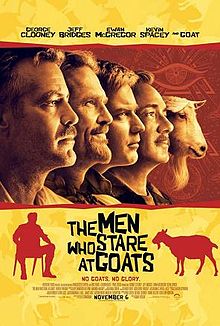
Having missed the movie, when I found a cheap copy of Jon Ronson’s The Men Who Stare at Goats, my curiosity was piqued. With such a title I had assumed it to be fiction, but, proverbially it turned into the truth stranger than. The book explores the weird world of the X-Files chestnut, the super-soldier. There is no doubt that despite science’s discomfort with the paranormal, government agencies have utilized psychics for some years now, hoping to gain some advantage over the other guy. Not everyone agrees on how effective such tactics are, but they exist nevertheless. The Men Who Stare at Goats (TMWSAG) provides a rare glimpse into that world where no one knows who is telling the truth (otherwise called “government”); we live in an era when truth has become negotiable.

One of the accidental recurring themes in my recent reading has been the horrendous abuse of power at Guantanamo Bay and Abu Ghraib. Far from placid eyes, the land of the free advocates torture to get prisoners to talk. After years of government bungling, it is no surprise that misguided efforts at torture on the part of a democracy would invariably be discovered. It would be easier to doubt that governments kept lethal secrets if they didn’t keep getting caught in flagrante delicto. Who can you trust when governments, ruled by gods of their own making—in their own image—preach the gospel of torture? TMWSAG weaves this sordid story in with 9-11, Uri Geller, Branch Davidians, Heaven’s Gate and Deuteronomy 18—what’s not to like?

I’ve been alive long enough to know that some supremely odd stuff goes down. TMWSAG provides a service in demonstrating that the government takes some of this mysterious reality seriously. It also shows the twin surfaces of resistance: religion and science. Science has a difficult time admitting what can’t be seen; with few exceptions psychic phenomena are considered not even worth the bother of a lab test. Religion, at least in its biblical, American incarnation, lumps all spooky stuff together with the devil, something Jon Ronson declares that even high-ranking generals in the military believe. So when I put this little book down I was left scratching my head. It may just be me, but where have all the sheep gone?


Coexistence

Sometimes I think I’m a punching bag. Not uncommon among scholars of religion, I suppose. I have read my fair share of overt attacks on religion: Hitchens, Dawkins, and even Jillette, and sometimes limp out of the ring wondering why I even bother. Still, science doesn’t completely explain the universe I inhabit either. Thus is was with some glimmer of hope that I read a story in Monday’s Chronicle of Higher Education entitled “Does Religion Really Poison Everything?” There can be no doubt that religious behavior has a track record of some execrable atrocities—some very bad behavior has been engendered by fervent religious belief. At the same time, those who despise religion have a hard time explaining it. As the Chronicle piece points out, religion is likely an evolved trait. There is some survival value in it, otherwise it would, by natural selection, disappear. Religion is seldom a rational enterprise. That doesn’t mean that it can’t be rationally studied, but rather that religion is primarily experienced as an emotional phenomenon. We find ourselves motivated by feelings, although reason will often drive us to do things we don’t feel like (like going to work). And emotion is necessary to be truly human.

It is often difficult to respond to those who castigate religion as an evil or poison, not for lack of reason, but because of feelings. Having spent most of my life with religion, it is not surprising that attacks on it often leave me feeling ashamed. But ah, that is an emotional response! It seems rational on the surface, but really, shame and embarrassment are typical emotional responses. This is the realm of religion. Reason may indeed indicate with great accuracy the way the universe works—of this I have no doubts. At the same time, I’m not sure the entire universe is something that humans can adequately comprehend. I have a hard time remembering what’s on a short shopping list if I accidentally leave it at home. Our brains aren’t equipped to the task of comprehending universes. Feel overwhelmed when facing a physics test? That overwhelmed feeling is an emotional response. With considerable cheek, might I suggest it might even be a little bit religious?

The Chronicle is a high-profile source for academic rectitude. I am pleased to see Tom Bartlett pointing out that the line-drawing in the sand between religious Fundamentalists and pro-science New Atheists will not solve anything. Religion is often guilty as charged. It is not, however, pure evil. There is enough evidence out there to suggest that religion is a tremendous coping mechanism for billions of people. And coping is not a bad thing, all things considered. Wisdom that is often attributed to the Greeks suggests that “all things in moderation”—the golden mean as it’s known—is the way to human happiness and success. The idea is older than the Greeks, and indeed, can even be found in the Bible for those who are willing to look. One need not be religious to see that, like most human inventions, religion has both good and evil uses. Evolution gave us religion, and it gave us science. It also gave us brains divided down the middle and strong reasoning that must dance with creative emotion in a tango that frequently makes abrupt shifts of direction. Our job, as humans, is to learn the steps to the dance.

Different, but equal.


Isaiah Thwarted

Back in January, out of a sense of curiosity on a number of points, I began tweeting the Bible. I wondered how long it would take, at 140 characters a day, to type the King James Bible into Twitter. Since that time, I have not missed a day. Until this week. International travel and business travel with uncertain Internet access have been overcome as I flew with Bible in hand to keep it going. On Monday I was just wrapping up the flood story. Clearly this was going to take a long-term commitment. Then early this week a message popped up on my Twitter account stating, “You cannot send messages to users who are not following you. Learn more,” so naturally, I learned more. Unfortunately I am not now, nor have I ever been, a techie. Just a sentence in and words I don’t understand begin to flummox me, building confusion on confusion. What it appears to be telling me, in layman’s language, is that I can no longer post to Twitter.

Apart from the personal rejection such impersonal messages inevitably engender, this development brought to mind the famous verse from Isaiah 40.8, “The grass withereth, the flower fadeth: but the word of our God shall stand for ever.” Hath the Lord been stopped by Twitter? Technology changes rapidly, and those of us who’ve never had any formal training in it sometimes feel like we’re driving a car on a dark country road at night with no headlights. I’m not really sure how this all works, but I try to send daily thoughts out into cyberspace and, yes, what you say can and will be used against you. And I wonder about old Deutero-Isaiah sitting there in Babylon peering into an indefinite future.

Our abject dependence on the Internet has changed us as a species. I’ve recently read about how technological innovations have become the evolution of the human species. This collective brain we refer to as the Internet has revolutionized the way we do business, but it has also introduced a component of fragility into the equation. Electronic information is untested in the long term. Some of my earliest writing projects now exist only on three-and-a-half inch floppies, most of which are tucked away in some musty corner of the attic. And what if the earth passes through a comet’s tail or a nasty solar flare jets out our way? Doomsday scenarios have been based on such things (just remember Y2K and smile). So maybe Second Isaiah was onto something after all. Printed books have been known to survive for at least half a millennium, and in rare instances, a couple thousand years. And the pagan sources on which parts of the Bible are based, written in clay, last even longer. And one of the earliest stories recorded was that of a worldwide flood.