Sh*t Apes Say

Knowing from experience that when I stay alone in a hotel, despite my best intentions, I will get bored and end up watching Mudcats or Dual Survival until my brain feels like a boiled egg, I anticipated my trip to California. I packed Planet of the Apes, the original and best of the lot, hoping for some intellectual stimulation. Having grown up in an anti-evolution household, we were curiously allowed to watch Planet of the Apes, a kind of forbidden zone of the mind. It remains one of my favorite movies of all time. It is also a manifesto of science besieged by religion. Note what Dr. Zaius says, “There is no contradiction between faith and science… true science!” And he is the Minister of Science, and Chief Defender of the Faith. The trial of George Taylor, a thinly disguised parody of the Scopes Trial, has Honorious (read William Jennings Bryan) stating, “It is based on our first article of faith: that the almighty created the ape in his image, that he gave him a soul and a mind, the he set him apart from the beasts of the jungle and made him lord of the planet,” and turning on his fellow apes Zira and Cornelius, he accuses them of being “perverted scientists who advance an insidious theory called evolution!”

Dr. Zira, as one of these “perverted scientists,” asks Cornelius (incidentally, the name of the first non-Jewish Christian, according to Acts), “How can scientific truth be heresy?” This is echoed by Dr. Zaius in the trial where he states, “It is scientific heresy that is being tried here.” Indeed, the entire simian culture is based on the blurring and blending of science and religion. Throughout the film various characters make barbed statements about the human propensity to ignore the obvious. Landon, challenging Taylor about the time change they experienced in space, says—in a line that could come straight from Answers in Genesis—“Prove it! It’s still just a theory.” The exact rhetoric currently used by creationists in school board meetings around the country. To which the most apt reply seems to come from Dr. Zaius, speaking of humanity: “his wisdom must walk hand-in-hand with his idiocy.”

Occasionally even the gun-toting humans get the picture clear. In his opening monologue George Taylor wonders about the world seven hundred years from now, “Space is boundless. It squashes a man’s ego. I feel lonely. That’s about it. Tell me, though. Does man, that marvel of the universe, that glorious paradox who sent me to the stars, still make war against his brother? Keep his neighbor’s children starving?” This seems to be the true measure of heresy—a religion that puts fellow humans on the same level as animals (and even animals deserve far more credit than we are willing to give). Among my favorite lines is Cornelius’ response to Taylor shaving his beard; “Somehow it makes you look less intelligent,” he opines. Endlessly remade, Planet of the Apes is a movie that still answers some of the issues that plague our society nearly half a century later. Perhaps the last line should go to the apes, adjusted of course, for gender sensitivity, “[hu]man[ity] has no understanding.” Well said, Dr. Zaius, well said.
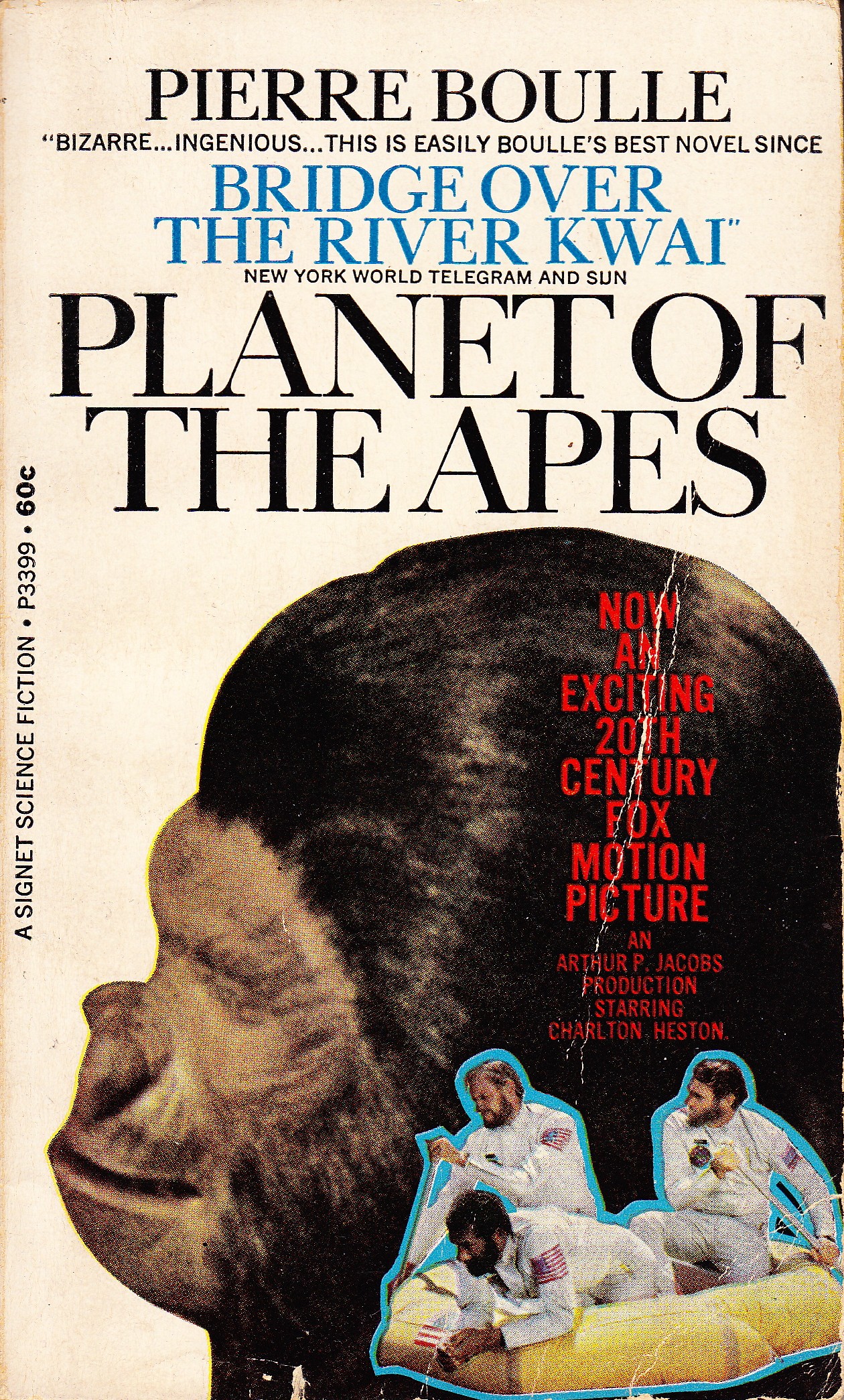
A piece of childhood

Hope for the Flowers

Resurrection can become a tired trope, but it is the stuff of both religion and science. Last week it was reported that Russian scientists revivified a plant frozen on the tundra 30,000 years ago. Quite apart from proving that Siberia was already in place 24,000 years before God got around to creating the planet, this amazing feat teaches us lessons about life and its resilience, and also of the possibilities beyond the great pale. The scientists regrew the plant without the benefit of using seeds, making this a kind of virgin birth of the florid kind. Using plant versions of stem cells (the kind of science forbidden in the USA: “won’t somebody think of the seedlings!”), the dead plant was rejuvenated and is alive and healthy in a world vastly different than the mammoth-infested, frosty plains of northern Russia where it first saw daylight. Still, that environment was less hostile to science than the Religious Right. This resurrection shows that we don’t need miracles to bring inert matter back from the dead. No doubt there are covert Creationists trying to sneak into Russia with travel-sized bottles of Roundup in their carry-on bags.

Science has brought us to incredible places by its continued, self-critical process. Religion, preferring no critique, has given us characters like Rush Limbaugh, Glenn Beck, and Rick Santorum. And a really big book. Looking at the religious scene today it is difficult to believe that religions began as exercises in optimism—the world could be better if only we’d progress. Regress now characterizes the religion in the public eye—men (occasionally women) claiming that things were better when we were tilting with mammoths than they are now with people advocating equality for people of other genders, races, and sexual orientations. Science represents our progress, and the vocal theocrats claim we should be going backward. Back to when men were measured by the size of their spears.

Back when I was a teenager I discovered the book Hope for the Flowers, by Trina Paulus. Not really a graphic novel, and not really a children’s book, it tells the story of two caterpillars with the courage to reject the constant, heartless climbing so often required by the world. In the end, of course, they become butterflies. The story has a religious subtext, naturally, but it was for a religion that believed butterflies should be valued rather than smashed between the pages of a heavy Bible. Butterflies bring the pollen that allows flowers to thrive. We live in a world where butterflies have become soft and defenseless while religion is aggressive and offensive. Science has shown us the way to bring flowers back from the grave, but old-time religion is waiting in the shadows with its rusty scythe.


Being Human

Within the first three pages, if you’re not mortally offended or inexplicably happy, you’re probably not an American.

Growing up with pets, I had a hard time understanding the hard and fast line drawn between animals and people. The failsafe fact used back then is that only people used tools. When we looked closer at animals we found that wasn’t quite true. Well then, only people have language. A large question mark has grown from that assertion too. The final fallback, the sine qua non was souls: only people have souls. It is also the safest of assertions, since it can be tested for neither people nor animals.

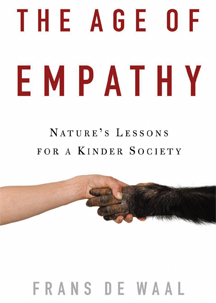
This way of thinking, according to Frans de Waal’s The Age of Empathy, arises from the western religious tradition—a religious tradition that grew up in relative isolation from other primates. Many world religions do not feel the necessity of making people absolutely different from our animal cousins. In Christianity at least, heaven itself rides on it. What are we so afraid of?

I posted, a couple years back, on Frans de Waal’s Our Inner Ape. Having just finished The Age of Empathy, I have reaffirmed my earlier accolades—he is one of the most sensible and important writers alive. Step by slow, evolutionary, cautious step, de Waal illustrates that one of the taboos of science—that animals don’t have emotion—is patently wrong. Not only do they experience emotion, but apes, cetaceans, and dogs at least, know empathy. Even scientists don’t like to admit this because science grew up in the shadow of the Judeo-Christian-Muslim worldview of human superiority.

But there’s even more at stake. As de Waal makes perfectly clear, the unbridled capitalism of the United States goes against nature. The unlimited acquisition of the vast majority of the resources by the few sets our primate sensibilities on end. Empathy, the ability to feel for another and take their perspective, is not only part of animals’ experience of the world, it is also a mandate of our religions. In order for society to survive, we must come to know this truth. Falsely applying Social Darwinism as factual, biological Darwinism, the few have taken more than either biology or religion permits.

The Age of Empathy should be on every school’s mandatory reading list and corporate climbers should learn that even selfishness has a very steep price tag. Not only for themselves, but for all of us.


A Strange Confirmation

I’ve been tweeting the Bible. Many years ago I lost track of how many times I had read it, but tweeting seems to be a way to examine the text carefully, 140 characters at a time. As a college student who’d recently learned about textual criticism (many years ago), I approached my local pastor and asked him if we could try something at church. I had a big, old, black leather Bible set up in the vestibule and made announcements—and even had it printed in the bulletin—that we were going to copy the Bible. I placed a three-ring binder and a pen next to the Bible, and I asked the parishioners to write down a verse in the notebook on their way in or out of church. I wanted to see how long it would take, and to give the laity an idea of how difficult it was to copy accurately. (Hey, I was young and idealistic!) The Bible sat there many months, perhaps a couple of years. I would occasionally check on progress, and was surprised to see we were still in Genesis. We hadn’t even reached the flood yet. And mistakes? Ye gods! It was like the Bible had been written on another planet. I now see the many problems with the way the experiment was set up, but copying the Bible is a revealing exercise nonetheless.

My tweets are with the King James Version of the Bible, and over the weekend I discovered something. According to the KJV, seed-bearing plants are male. Note Genesis 1.11 “Let the earth bring forth grass, the herb yielding seed, and the fruit tree yielding fruit after his kind, whose seed is in itself.” This corresponds to a post I wrote late last year about the notion of distorted masculinity in the biblical worldview. The operating assumption seems to be that male and seediness go together. Since the Bible is literally right, somebody better get out there and explain the facts of life to the female plants that constitute roughly half the flora on this planet. Herein lies the rub: ancient assumptions no longer hold sway. Trees are not all “hes,” and yet many treat the surrounding context of a literal seven days (only one day in Genesis 2) as worthy to take down science itself.

Once in a while I have my own gripe with science—or at least its cousin technology. I was looking forward, many years down the road, to putting all my Bible tweets together into a seamless whole. The tweet I twittered on Sunday, however, never appeared. I can’t go back and add the missing 140 characters now, because that would throw the order off. And those ancient scribes thought they had it hard! Maybe there is an object lesson at play here. Maybe the utter devotion to a text has the potential to lead the righteous astray. As a society we’ve built a tremendous world of luxury around ourselves (well, most of us), and isolated ourselves from the wild animals and masculine fruits of biblical times. And yet, when we look at the text up close, we often find things we might not expect. Or even support. I will dutifully carry on my Bible tweeting, but like any human venture, my Bible will never be perfect.


Trouble with Triffids

Some time ago, I posted about the John Wyndham novel, The Day of the Triffids. In playing on the loss of humanity’s primary sense of sight, the story creates a truly eerie scenario in which people are harvested by plants. Not just any plants, but alien plants! Of course, such an idea demanded a movie rendition. The film was released the year I was born, but I only just got around to watching it. Compared to the psychologically thrilling novel, the movie doesn’t ever reach the intended level of terror. Nevertheless, religion, as usual, plays a role in the movie. As Bill Masen, the protagonist, makes his way from London to Paris, attempting to find other people who retain their sight after a devastating meteor shower blinded most of the world, he comes upon a mansion where the wealthy owners are caring for the disabled. (Hard to imagine that these days, but it was the 60’s, and idealism was kicking in.) While discussing their rather hopeless options, Bill suggests there is little reason for optimism. His new-found love interest, Christine, says “We must keep faith,” to which Bill replies, “It’s going to take more than that to get through this.”

Indeed, God is no help against the triffids. These intelligent, moving plants are soon everywhere, consuming humans and intent on taking over the planet. Bill and Christine, along with their adopted daughter Susan, make their way to Spain in hope of finding a military solution. They stop at a mission, topped with a cross and inhabited with a helplessly blind, and expecting, couple. The message is clear—there is no god to help those left to their own devices. Even those who live in god’s real estate have been abandoned. Those who survive are those who help themselves. Eventually our hapless heroes are rescued by the navy and a submarine moves them safely away from triffid-infested Europe. Then, in the final scene, our blended family is seen walking into a church while a voiceover declares that the triffids did not defeat humanity after all, and “Mankind survived and once again have reason to give thanks.”

Exegeting this film, however, leads to some uncomfortable conclusions. Those who had no divine aid give thanks to an impotent deity after it is all over. The solution for destroying triffids—salt water (you might want to store that away for future use)—is discovered by scientists and is applied at their personal peril. Even the heavenly-based origin of the menace has divine overtones: colorful portents in the sky are the provenance of God. In 1962 science had not yet even reached the moon. The default fallback, based on decades of evangelical sculpting of culture, is to give thanks to the Lord, despite the devastation. Indeed, a new Garden of Eden might be said to have resulted from the triffid assault. In this garden parasitic plants teach humans to give thanks, but the vast majority of humanity remains blind.


Send in the Robots

The FIRST Robotics kickoff is an event that is difficult to describe for those who’ve never attended. First, it must be noted that FIRST Robotics is sometimes described as “the varsity sport for the brain.” While engineering students with a penchant for athletics are not unheard of, the majority of robotics team students are not cut from the same cloth as the athlete. The FIRST kickoff, the first Saturday in January, is the opportunity for these kids to be told it is cool to be smart and that application of brain power is not the liability that many of the electorate seem to think it is. At this event the competition for the year is unveiled, and the kids (with some adult help) have six weeks to design and build and program a robot to do some very complex tasks. It is a season of sleep deprivation, programmed Saturdays, and the celebration of learning. Before NASA shows the game animation—the competition for the year—celebrities and other people in the public eye endorse the program. It is a time for praising the benefits of science.

Yesterday’s kickoff, however, was marred by the appearance of one of the guest celebrities. When George W. Bush was announced as a supporter of the program, a sense of disbelief fell over the room. This man who advocated for creationism in the classroom, who fought to stop research in cutting edge disease control, who began a war as a personal vendetta, was showing his dully beneficent face on the big screen telling the kids what a great program it was. A chance, as he said, to use your “God-given talents.” He ended his brief—and obviously scripted—sound-byte with his characteristic “God bless you.” I could not stomach the hypocrisy. I’ve blogged about religion and the science of robotics before, but to have a president who did nothing to strengthen the cause of higher education and fought science with eight years at his idle hands was just too much. If I was Dean Kamen, I would have insisted that that clip be left on the cutting room floor.

The former W represented religion in its guise as the enemy of science. It should be clear to my readers that I do not believe science has all the answers, but I also believe it is wrong for religion to stand in the way of knowledge. Science is something that we shouldn’t give lip-service without backing it up with programs and funding. That one minute of disingenuous, religion-riddled speech trumped all the other endorsements, including the sensible one by Bill Clinton who emphasized the need to work together even with those who are your opponents. This was a point W obviously missed. There comes a time when some public figures, like overused cattle, should be put out to pasture. There are some cowboys that should just stay on the ranch. I understand that presidential endorsements are important to FIRST, but in this case integrity should not be compromised. Especially when most of the teenagers watching the kickoff possess far greater potential than a mere politician elected on religious sentiment and dubious counting.

Does this face inspire science?


God Particle

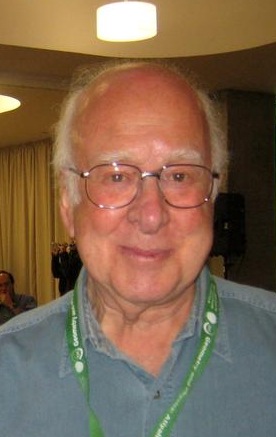
Over the last couple of days the Higgs boson has been in the news. Although I seldom ventured too far from New College and the faculty of divinity at the University of Edinburgh, it makes me glow with a special pride knowing I inhabited a small corner of the university of Peter Higgs. (And many other luminaries, including Charles Darwin.) My hopes of understanding the Higgs boson are more remote than even finding a university post (very long odds indeed), but I know that it is so important to physics that it has earned the moniker of “the God particle.” I first learned of the Higgs boson through Morgan Freeman’s Through the Wormhole series. At that stage it hadn’t yet acquired its divine status. Godhood must be earned, after all, at least in the eyes of humans. It is the proposed particle that stands to make sense of quantum physics, the world of the very small and the very weird.

There is an object lesson hidden in here. When even scientists get pushed to the limits of human knowledge, superlatives grow diminished. What can we call such a radical, powerful force in human thought? The particle itself, the boson, is not inherently stronger than a proton or electron, but its divine designation comes from its ability to, dare I say, replace god. In other words, it is the particle that explains so much that it is like the new god. News stories do not tell us where the nickname arose, but the best guess seems to be that some journalist with a flair for the dramatic brought God into the equation. God sells copy. But has the name also got enough room for a snake around the tree—or rather, around the nucleus?

In America, where science is under siege, any claims for God will be taken literally by some. We have witnessed again and again sheer silliness being paraded as “science” by Bible “experts” who take nearly half the population with them. The mental gyrations of the intelligent design crowd as they try to force God back into the equation should be warning enough. The God particle is baiting them and most Americans are ill-equipped to decide for themselves what is actually science. No sooner do we get a grip on nanotechnology than we begin building nanocathedrals. In that cathedral if scientists find the Higgs boson, it will not be god. It will, like god, open the door to many more unexplained phenomena, for god is not an explanatory principle. If we need a name to convey the great, rational explanatory power of such an elusive sub-atomic bit it seems to me—and I may be biased—that we call it the Edinburgh particle instead.


Soccer Moms and Robot Dads

Long past Halloween, the air is taking on its terminal, winter chill. High school football teams have moved off the fields (although the “pros” will keep at it until the Super Bowl in sunnier climes). What are sports parents with an excess of aggression and competitiveness to do? It is the time of year when some parents start thinking about the FIRST (For Inspiration and Recognition of Science and Technology) robotics competition. It is a good sport for the hibernation season.

My daughter is on the FIRST Robotics teams in her high school. FIRST was invented by Dean Kamen (along with many physical inventions) as a way of stirring up interest in STEM careers. Interest in science and technology careers, inexplicably, is faltering in the US, while many of us who grew up enamored of science but without any natural ability sit by and scratch our heads. Careers in robotics are very hot—especially since machines can do things we mere biological units can’t. We are that squishy, organic chemistry with a mysterious plan that serve as gods to the mechanical beings we create. Woe to humanity when the robots become atheists! But that’s a point for another post. Sports—and FIRST clearly is a sport, as much as racecar driving or horse jockeying—take on a religious devotion among people of leisure that rivals the commitment oppressed peoples have to their more tradition forms of faith. The easiest means of seeing this is in the fans.

“Fan,” of course, is an apocopated form of “fanatic,” a word wielded with derision against those who take religious belief too seriously. In sports it is a venial sin, if not a downright virtue. Consider the continuing news stories still swirling around a non-necessary sports figure at Penn State. Even the name of the school evokes football rather than academic performance. The same thing applies to FIRST. FIRST robotics is a sport for the mind, and it has its share of analogues to the soccer mom, what I might call the robot dads. These are parents who are particularly driven to win. In a sport involving band saws, hydraulic lifts, and multiple motors, parents are actively involved in building robots suitable for competition. And the competition can be intense. It becomes a kind of robot religion. Dean Kamen, the Susan Calvin of FIRST, has tried to instill commandments of sportsmanship and gracious professionalism into the competitions. That is something the kids understand. As I attend the competitions, however, it is the religious parents that I worry about.

My worry includes the kind of gender disparity that characterizes the work place. Why should not the scientists and engineers include more women? The field strives to do so, but our society still discourages the participation of women in the men’s room of heavy equipment and intense mathematics. Isaac Asimov, frequently a writer with distance vision, made a woman the head robopsychologist of U.S. Robots and Mechanical Men, Inc. If Dr. Calvin were to look back from her fictional 21st century to the actual 21st century she would see women still struggling for equal voice in both science and religion.

Let's hear it for the boy


Dawkins Dilemma

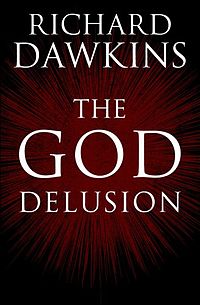
Some of my regular readers may have divined that I’ve been reading Richard Dawkins’ The God Delusion. It is a book well worth more than one post on a blog, but it is also one of those troubling and liberating books all at the same time. Dawkins is a gifted writer who explains things clearly. He sometimes makes mistakes in the details, but his logic is flawless and consistent, at times running up against the limits of reason itself. There is a dilemma here, however, and that is the ghost in the machine. It may not be supernatural, but even Dawkins must occasionally refer to “enlightenment”—a term derived from Buddhism, and “essence”—something that does not actually exist, and other turns of phrase that wander beyond the strict purview of science. Nevertheless, his point, hammered home repeatedly, is well taken. The perpetuation of religion is not very healthy, and in a way, contains the seeds of its own destruction.

As a specialist in religion reading this book by a world-class scientist, it feels like awaking in the morning after a stranger has broken into your room at night and beat you soundly while you slept. Religion is what we do, our thing. That voice of indignation whimpers, “why must scientists come in here and trash all our stuff?” And yet, that is the way of reason. It takes no prisoners. Back at Nashotah House I used to argue points of Scripture with students. Often there would be someone who would resort to, “reason is fallen and is therefore not to be trusted.” I would always respond, “how do you come to that conclusion if not by reason? Can you trust it?” If reason be true, it must be true the entire journey, as anyone who has ever flown on a plane knows. When reason meets religion, however, fireworks fly.

Dawkins does an admirable job illustrating the troubles into which religion has led the human race. It is very unlikely, however, that the human race will ever outgrow religion. Perhaps it is one of those evolutionary mechanisms set into our brains in order to ensure that we are not too successful. With the exception of crocodiles, sharks, cephalopods, and many insects, life forms are continually evolving and dying out. Maybe religion is our apocalypse, the mark of the beast. The original sin. Call it what you will, but religion often acts as a massive deterrent to human progress, and especially to the ideals that it often promulgates. Sometimes it takes a biologist to sort out the menagerie.


Yeti Again

Time magazine announced last week, in a story spelled out on Time.com, that “There may be solid evidence that the apelike yeti roams the Siberian tundra.” This is surprising news given that even in the face of good evidence, science is reluctant to admit new large animals to our biological family. The reasoning goes that since humans (mostly white, male humans of the western hemisphere) have explored most of the landmass on this planet, we could not have missed any large land creatures. There are rare exceptions, such as the mountain gorilla, added to our database only about a century ago, but it seems to have been the last of the large animals to avoid detection. Now the yeti, the bogeyman of many childhood dreams, may be coming to life.

Science is our way of describing and theorizing about what we have discovered. Many therefore assume that science is all about new discoveries. Some of us feel a tinge of sadness at having been born after the great era of discovery. Reading about how adventurers (responsible for far more fundamentally earth-shaking discoveries than scientists of their times) ventured into new worlds and declared the wonders of God revealed in the formerly unknown, is always a humbling experience. We know so little. The mark of the truly educated is not the claims of great knowledge, but the admission of how little we really understand. Does the yeti roam the inhospitable and very sparsely populated regions of Siberia and the Himalayas where it has been a staple of folklore for centuries? We may never find definitive proof, but Time holding out a candle of hope seems a step in the right direction.

Relegated to the world of the “paranormal,” elusive animals demonstrate that the ways we know about the world are multitude. Science does not, and does not claim to, know everything. Indeed, science has a limited frame of reference within which it works. Going out seeking cryptids is not, properly speaking, science. The belief that those seeking evidence display is closer to religious conviction. That does not mean it is wrong or that it is founded upon faulty suppositions. It is simply a different kind of knowledge. It is common to say science is in conflict with religion. It need not be. If we accept science at its word, as doing what it claims to do, there is no need ever to question assured results. Belief, on the other hand, seldom crosses over into the realm of objective truth, empirically demonstrated. If it did, it would not require believing. If yeti is discovered, there will be much celebration among believers, but the creature will necessarily pass into the hands of science. For this reason alone, many are glad to leave it in the realm of folklore and myth. Either way, to some people, yeti will always be real, whether scientifically verified or not.


Timing God

Two weeks in a row now God has made it into the pages of Time magazine. You’d think he was Rick Perry or something (no insult to God intended). This week’s Commentary, written by Harvard physicist Lisa Randall, argues for the importance of believing what science forces us to conclude. The world is warming up, ice caps are melting, and those in low-lying regions are in hot water. I am fully in agreement with her sentiments, but it’s the practicality that bothers me. Not the practicality of listening to science—that’s just common sense—but the practicality of doing so in a world where religion reigns. Despite cries of oppression and suppression and repression—just about any pression you choose—religions dominate the world. What particular brand you prefer does not matter; the fact is most people are religious. Randall believes that religion and science must learn to live together. Her problem is that she is looking at it rationally.

Science has given us excellent leads on tracing the origins of religion itself. Between psychology, anthropology, sociology, and biology we’ve got a fair idea how religion came about. The same brain that shows us the way, however, has evolved with religion still intact. In short, it has learned to accept the unlearned. With our brains acting like dogs chasing their own tails, is it any wonder that as a species we are confused? We see only what we choose to. In the great, artificial landscape of Manhattan many very wealthy people traverse the streets. Every day I see suits that would cost my entire paycheck casually strolling up Madison Avenue. I also see the beggars in the same doorways day after day, blending in with their surroundings. The solution of choice is to pretend they aren’t there, to not accept the evidence of our eyes. The wealthy have a knack for it, it seems. And when they work their way into politics their vision doesn’t improve much.

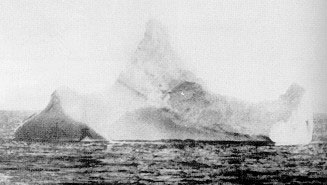
The problem that Randall points out is very real and deadly serious. Trouble is, those who pretend not to see are among the best actors on the planet. Faced with incontrovertible evidence the rational mind has no choice but to acquiesce. Religion, however, offers the perfect escape clause. If global warming discomforts you too much try fanning yourself with a Bible. Soon the excess degrees will simply melt away. And when the religious enemies of science find themselves sitting on the ocean floor like the victims of the Titanic, they too will have the satisfaction of knowing that they were privileged above all people for the time they had on earth. Everyone wins. The insatiably greedy and the abjectly poor both share a spot on an overheated planet. And if the pattern holds true we’ll evolve eyes to read under water, along with our gills, so that we can continue to read our waterlogged Bibles to find out what’s coming next.

Iceberg? What iceberg?


Calm Before the Storm

All the build-up for Hurricane Irene masks a deep-seated fear of the uncontrolled. If the storm devastates anyone, there will be Biblicists who say, like Job’s friends, that they must have sinned. Such pronouncements accompany nearly every natural disaster, as if God is huddled over the globe attempting to concoct more horrid and sinister ways to punish sinners. Natural disasters, however, have a way of effecting good and bad alike, just as the benevolent sunrise and the soft kiss of the rain (both according to someone mentioned in the Bible as being the son of someone important). But when danger looks down its barrel at human communities, they don’t neatly divide into sheep and goats. All people are a mix of virtuous and vice-ridden in varying ratios, and only the God of the Marquis de Sade would slam the iron maiden shut on all alike. The East Coast saw this earlier in the week when a benign earthquake shook our world. Barely had the ground stopped trembling before we were informed it was divine punishment. For what, no one could really say.

Interpreting nature according to the Bible is so misguided that it is difficult to know where to begin the critique. Yes, some biblical writers with a flare for the dramatic will claim that Yahweh was behind some disaster. Of course, they had no concept of science, in this case, meteorology, upon which to draw. Nature acts in unexpected ways because God has his fingers in the bowl. Even the early church gave up on that way of interpreting things as soon as natural processes could substitute for God. When religion because politicized, however, we started to see a backlash of backward thinking. It is a simple enough deception to utilize. People fear natural disasters, and the politically savvy know that few have any theological training. You can very easily encourage panicked masses to follow you if you claim to have read the Bible. From years of teaching it, I can certainly affirm that many clergy have not read the whole thing. Yet we use it as the barometer of divine wrath.

I, for one, am not worried about Hurricane Irene. As New Jersey has zigzagged in and out of the predicted track of the storm, it seems as though God may be wavering. If it misses the politically astute will say it is Chris Christies’ righteous policies of helping the wealthy at the expense of the poor. If it hits they will claim it is the sinfulness of the liberal camp that led the winds this way. It is all wind. Having written a book-length manuscript on weather in the Psalms, I know a fair bit about biblical perceptions of weather in the world of ancient Israel. Although over-zealous translators ill-informed about meteorology used to translate a word or two as “hurricane” the fact is that biblical Hebrew has no such word. Due to the rotational direction of the planet (about which they also did not know) hurricanes never hit Israel. Herein lies the basis of my confidence in the face of Irene. If the Bible doesn’t mention hurricanes, they can’t possibly exist. Literalists up and down the coast should heave a sigh of relief. But just in case, I have stockpiled several gallons of water, right next to my Bible.

Good morning, Irene -- if that is your real name.


Honest to God

“A lot of traditional beliefs are outside people and have grown into rigid things that you can’t touch any more”–these words come from a minister of the Protestant Church of the Netherlands, according to a report yesterday on the BBC. The title of the article, “Dutch rethink Christianity for a doubtful world,” touches on a theme mentioned earlier on this blog about the church in Sweden: clergy often live with their own doubts about God. Showing similar results to the Swedish study, the Protestant Church of the Netherlands hosts one in six clergy who are agnostic or atheist. I would suggest that the specialization of labor–as well as the persuasiveness of science–stand behind this phenomenon. In modern societies far removed from human roots, we really don’t pay much attention to the training others receive to take on their professions. We assume that higher education is doing its task and that professional bodies like the American Bar Association put up tests to deter those who make false claims. Seldom do we reflect that our off-the-farm lifestyle is a very recent human development and that we haven’t really had time to sort out whether all this complicated training ever really works.

Don't rock the boat...

When I was a seminary professor, I saw the dilemma this way: seminaries crave, indeed require academic respectability. Accrediting bodies insist that a substantial portion of faculty hold terminal degrees. Seminaries, however, are run by confessional groups that insist on certain unscientific worldviews and premises. Doctoral students, unless indoctrinated at faux institutions that block scientific evidence, are educated in a worldview that contradicts their religious training on several levels. Seminaries require educated faculty, but education itself undermines traditional beliefs. Some conservative groups have been aware of this dynamic for years and have begun establishing “universities” that intentionally bar subjects that challenge their worldview. In other words, they want clergy with false credentials who are willing to fight for the cause, while still receiving academic accreditation. Few insiders will blow the whistle since the modern church is built on this shaky foundation.

What is being discovered in northern Europe likely pulses beneath the surface of many developed nations (again, with their specialization of labor). After a person spends three years of training beyond college to receive a “Master of Divinity” degree there is high financial motivation to see the process through to the end. The faithful in the pews, far removed from the realities of theological education, expect the same old show. With employment options nearly nil outside the church, smart clergy know the score. It is better to live a life of quiet desperation, mouthing the party line, than to be thrown into that swirling maelstrom of survival called the job market. Organized religions began when people lived on the land, very few people were educated, and priests were left alone to do their job. Education is costly in far more than college tuition bills. As they are learning in the Netherlands, growing up is never easy.


Who Made Whom, Now?

John Lennon has great currency, in part, because he is a martyr. Music has moved on since the ‘60s and ‘70s, but aging Boomers still like to quote him, especially his song “Imagine.” In an article written for the Los Angeles Times, reprinted in the local Sunday newspaper, J. Anderson Thomson and Clare Aukofer cite “Imagine” as the statement of what a world “that makes sense” looks like. I applaud their idealism. Citing psychological and sociological work that has been done over the past decade in the attempt to unravel “homo religiosus” they entitle their article “God didn’t make man: man made gods.” Much of the evidence they cite has been discussed elsewhere on this blog, but the overarching issue—whether this explains human religious behavior or not—remains open. In other words, if evolution provided us with religion, it must have some survival benefit and humans are not easily going to dismiss it.

Admittedly, the evidence for human conceptions of God arising from the need for close connections in community is pretty convincing. Nevertheless, the issue of whether there is a God or not will never be answered by empirical observation. As I tell my students, belief is not based on empirical observation. We do not yet know why people believe, and even if we find the right node, neuron cluster, or sensory stimuli, there will always be those who insist that the hardware is sparked into action by the unseen Other outside the system. It is the classic chicken or egg debate, taking place in that henhouse in the sky. The problem is that God is more like the rooster in that scenario.

The human brain is an endless source of fascination. Science has given us a sense of wonder about our own on-board computer, but it has not managed to capture the sine qua non of the totality of the experience of owning one. Scientists also read, go to shows, make love and eat fine meals for the enjoyment of it all. But as Cipher says in The Matrix, “I know this steak doesn’t exist. I know that when I put it in my mouth, the matrix is telling my brain that it is juicy and delicious. After nine years, you know what I realize? Ignorance is bliss.” Our perception of the world as a stable, unmoving center of existence is an illusion. Science has revealed an even stranger reality involving equations that used to haunt my nightmares. Should God ultimately be reduced to formulae, true believers will find another entity to name as the divine. “Imagine… no religion too”? As long as humans are humans such a world remains pure imagination.

Imagine


First Byte

The scientific study of religion poses dangers to the native environment. It doesn’t take a specialist to realize that different people respond to different religious stimuli; some like smells and bells and others prefer the stripped-down Puritanical style. Even beyond that some people get their religious thrills from nature, others from meditation, and some from controlled substances. In a story on CNN late last week, it was revealed that some Apple users find worshipping their favored brand a religious experience. A study by British neurologists discovered that the same areas of the brain are stimulated by both thoughts of the deity and Apple gadgets. MRIs have been utilized for many years now to study where the brain “lights up” during intense spiritual states. It seems we now have proof that God is a Mac user.

While some would cite this story as an example of idolatry, others would interpret the results in a more technological way. Our brains resemble motherboards, in some sense. Even Stephen Hawking’s famous interview of last week had the genius saying that human brains are just like computers. (I must confess to siding with Stuart Kauffman (Reinventing the Sacred) on this one—the brain does seem to be more than the sum of its parts.) If our brains are computers, then the Mac question is a literal no-brainer. Having worked in offices where every PC tries to be a Mac knock-off (wake up, folks! Windows is a Mac emulation environment) I too can sense a superior being behind that Apple with Eve’s first byte removed.

Should we attempt to explore where religious impulses originate? As intimated by Newberg, D’Aquili, and Rause (Why God Won’t Go Away), if we are able to find the God centers in our gray-matter and stimulate them electronically, we may trigger religious rapture on demand. How does this artificial stimulation differ from the religious experience brought on by years of meditating, praying, or fasting? Or Apple products? Our brains are complex and only imperfectly understood. Religions have been around long enough for us to get a grip on their origins. Billions of believers worldwide, however, would prefer that other people keep their hands off their Apples.

Original thin?