Simple Gifts

During my many years of studying religion I learned about the Shakers.  It was many years ago and my knowledge isn’t extensive.  I was caught off guard when my wife suggested we see The Testament of Ann Lee.  I hadn’t heard of it and knew nothing about it, but she had me at “Shakers.”  This is a most unusual and engaging movie.  I didn’t realize it was a musical until after it was over.  (It had been a long day and I did, a time or two, think, “hey, this is like a musical, the way characters break into song.”)  The thing is the songs are all diegetic; they fit into the plot and the Shakers were known for their music as well as for their furniture.  The movie follows, in broad outlines, the life of Mother Ann Lee, the founder of the sect.  It made me curious to learn more.  
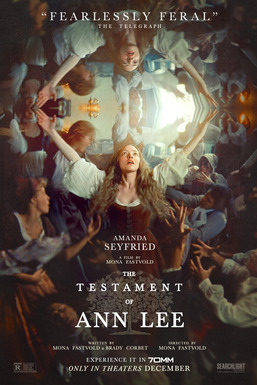
The Shakers emerged during that period of intense religious foment in the eighteenth and nineteenth centuries.  They settled in upstate New York where numerous other sects came into the world, such as the Mormons and the Millerites.  The Shakers had their origins among the Quakers, but it is unclear if Ann Lee’s family were members of the latter denomination.  In the movie an encounter with George Whitefield awakens Lee’s spiritual curiosity.  Historically, Whitefield was one of the first trans-Atlantic superstars, drawing rock-concert-sized crowds to hear his outdoor preaching.  In my head much of this was muddled during the film—it had been a long and disappointing day and I was totally unprepared for it.  I’m glad to have watched it, however; it rekindled my interest in American sects.

I have on my shelf an unread history of the Shakers.  It has consequently been moved to my “to read” pile.  I read, a few years ago, a history of the Oneida community in Upstate, and also a biography of William Miller.  The Oneida community practiced open marriage and eventually became known as the producers of flatware—Oneida silverware is still easily found.  Shakers, on the other hand, believed in celibacy, meaning that they could only grow through conversion.  The many Shaker communities founded by Mother Ann Lee dwindled and now appear to be down to three members.  The movie, which is quite good, is unlikely to lead to a resurgence of celibacy and revival of the Shakers.  They did have an outsized influence, not only for their furniture (think Oneida) but also for their music.  Add to that now, a musical.

Curious Valley

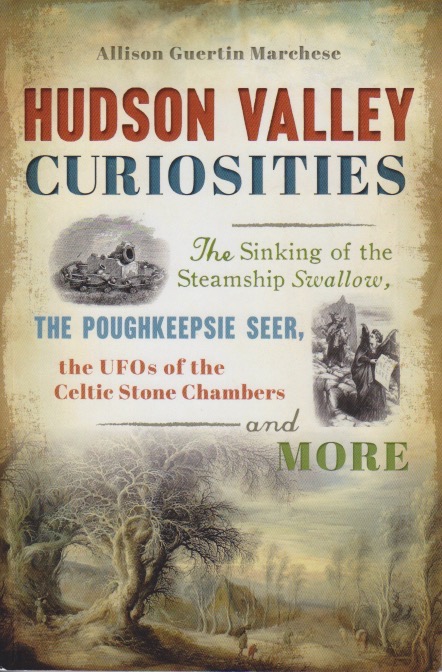
Another of my guilty pleasure reading categories is local history, written by locals.  As a genre these books may not always go back to primary sources, and they may get a fact or two wrong, but still they’re endlessly fascinating and I always learn something (which is the point of reading, after all).  I enjoyed Allison Guertin Marchese’s rambles along the Hudson Valley.  I’d encountered some of these tidbits before, but most of them were new to me and show just how interesting a place this particular river valley is.  Living in a strange world is so much more beguiling than a prosaic, predictable place.  Still, you’ve got to accept that anything can happen.  Unlike many such books, Hudson Valley Curiosities does not focus on paranormal, although ghosts and UFOs turn up a time or two.

Since this region is about 145 miles from end to end, the book divides it into lower, middle, and upper regions and gives about equal time to each.  The curiosities range from mastodons to prohibition busters, from shipwrecks to Shakers.  I’d never made the connection with the Shakers and the Hudson Valley before.  While the Shaking Quakers had their origins in England, they eventually migrated to the New World, settling in the northern end of the Hudson Valley.  The book points out that they were noted inventors, living by their own means as they did, they came up with their own solutions to problems.  Another aspect of these curios is the number of them that involved women who took on the cause of women’s rights.  The first female candidate for President of the United States, Victoria Woodhull, is discussed, as is Deborah Sampson, the woman who dressed as a man to fight in the Revolutionary War.

Marchese provides a helpful bibliography as well.  As someone trained in historical method, I like to go back to the sources.  Of course, that means assessing both publisher and author, and taking into account what passed for facts at the time.  History is an endlessly fascinating enterprise.  Many historians, however, leave out the controversial or questionable materials that a local historian is inclined to leave in.  That’s what makes books like this such a guilty pleasure.  Who doesn’t like to look behind the curtain now and again and see what’s happening out of the public eye?  And it’s helpful to keep in mind that by far the most of history takes place far from the headlines.  That’s where real life happens, no matter how strange.  And it’s a guilty pleasure to read about it from a local who finds, gathers, and preserves the stories.


A Glimpse at the Future

Last month one of the three remaining Shakers died. In this era of religion unawareness, not many Americans, I expect, could identify this dying religion. The Shakers aren’t the Quakers—we like to give religions we don’t understand pejorative monikers—they are a group that grew out of the Friends but that had important differences. Shakers believe, especially, in celibacy. It had to grow through conversion since Shakers could not reproduce biologically. At their height there were about 6000 of them—the number of Twitter followers of a fairly successful humanities professor, I suspect. They were hard-working and their brand of furniture endures beyond the life of the sect. The official count of Shakers worldwide now stands at two.

This little bit of news saddened me. Not that I’ve ever been tempted to join the Shakers—it would be a bit of a stretch for a family man—but I’ve always admired countercultural groups. Like many religious sects of the late eighteenth century, the Shakers were millenarians. That is, they believed in the imminent second coming of Christ. Given this belief, biological reproduction wasn’t really necessary. In fact, it was counter-productive. Like so many of the slumberers of the Great Awakening, the Shakers eventually settled in upstate New York. Since their lifestyle was different, they had to form their own communities. The last community is in Maine. When the last two Shakers go to their reward, barring a miracle, the denomination will be extinct.

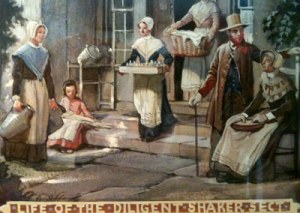
life_of_the_diligent_shaker

The Shakers were distinctive for yet another reason as well. They were open to, and often defined by, female leadership. This might be expected in a world where men have difficulty controlling themselves in mixed company. Catholic monasteries locked men in without women. To agree to live in a mixed gendered community but without mixed gendered relations took a dose of will power that borders on the saintly. The Shakers won’t be the only religion to have gone extinct, when that happens. Religions, like organisms, grow, thrive, and die. This little group had a disproportionate impact on society. Those who watched Michael Flatley throwing his body across the stage to the haunting joyfulness of the Shaker Hymn “Simple Gifts” likely had no idea that the world owed one of its most beautiful melodies to a group of people living celibate lives in the woods of Maine. The Shakers’ unique contributions to the weird and wonderful world of religion will be missed by at least one.