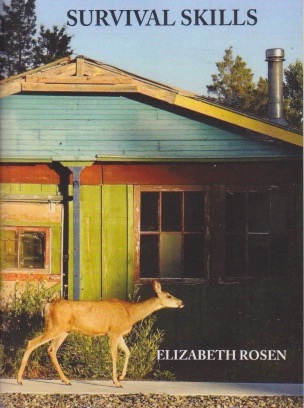
Word of mouth tends to be remote these days. I suspect local readers of this blog are quite few. I work remotely and, like many Americans, have trouble getting to know people in the town where I live. Still, I use this blog instead of my mouth. Elizabeth Rosen used to write for Nickelodeon, which I find highly impressive. As someone who has found venues to publish my fiction as common as oases in the Sahara, anyone who’s made a few bucks off their work makes me want to stand up and salute as if a general just walked into the room. I just read Rosen’s chapbook Survival Skills and thought I’d talk about it. (As an aside, I always thought “chapbook” referred to chapters, which confused me because most books have chapters. The term probably derives from “chapman,” a kind of traveling salesperson who used to include these kinds of small books among the wares they sold.)
The seven stories in Survival Skills are short—Rosen tends toward flash fiction. I’m impressed with how effective she is at it. I’ve tried to write flash fiction and have found I need more narrative space that it allows. Chapbooks are easily read in an hour or so, if you’re the kind to rush through things, but these tales left me thoughtful. You get a sense from these brief accounts that people often do nasty things to one another, or to animals, and that sometimes we really should stop and think about what we’re doing. At other times we have to realize that we’re animals too. We forget that at our own peril.
As much as I like reading short stories, books of such are always difficult to summarize. Going through Survival Skills, the stories do seem organically connected. This is something that has prevented me from trying too hard to publish collections of my stories. Like my mind, they’re all over the place. I’ve attempted, from time to time, to approach my short story writing thematically but it has only resulted in a few tales of each subject. I’d never considered a chapbook approach. Even Edgar Allan Poe made his mark in the literary world with short stories. Washington Irving published his Sketch Book in fascicles. Publishing exists in many forms for those with stories to tell. I’m glad to have found Rosen’s little book. It has spurred me on to reading more short stories, which I should be doing as a matter of course.