Old Oak Tree

Trees have much to teach us, if only we’ll pay attention.  They are fascinating plants in their own right, living longer than just about anything else.  During our years in New Jersey we made pilgrimages to two ancient trees in that state: the Basking Ridge White Oak (unfortunately cut down in 2017), and the Great Swamp Oak in Lord Stirling Park, also in Basking Ridge.  Naturally enough, then, when in Charleston last month we had to visit Angel Oak.  Our Charleston visit was not a solo venture, therefore our timing was somewhat off.  Our flight to South Carolina was delayed by about three hours, cancelling our plans for that Saturday afternoon, one of which was to see Angel Oak.  When we arrived at the oak on Sunday we discovered the venerable tree had visiting hours that started after we had an engagement on Sullivan’s Island.  We had to see it through a fence.  (In our defense, several others arrived at around that time, equally surprised to learn they couldn’t get in.)

Regardless, there’s something awe-inspiring about being next to a being four-or-five-hundred years old.  Unlike its departed cousin, the Basking Ridge White Oak, Angel Oak is of the live oak variety.  (Live oak is the rather awkward name for a type of oak tree, not necessarily a designation that the tree is alive.  People sometimes have strange ideas about naming things.)  Like many ancient things, folklore has accumulated around this tree.  Although the name derives from former estate owners, lore has it that ghosts of slaves appear at the tree in the form of angels.  Folklore has a way of saying something important in this materialistic era.  There can be something spiritual about trees.

Although we had only a few minutes outside the fence to appreciate what we were seeing on John’s Island, the experience is one that sticks.  One of the most hopeful things a person can do is plant a tree.  Back at Nashotah House I planted an apple tree that I’d grown from a seed.  I planted it the year my father died (2003) and I often wonder if it’s still there.  After buying our first house we planted a scarlet oak.  A local nursery indicated that oaks help the environment by providing the habitat for the highest number of species here in Pennsylvania.  We used A Tree to Remember after my mother’s passing to plant a memorial.  (Other trees I’ve planted have been snipped off by squirrels before they can live on their own.)  Although outside the fence, I reached up and touched some of the outer leaves of Angel Oak and connected, if only for a moment, with something great.
An EAP

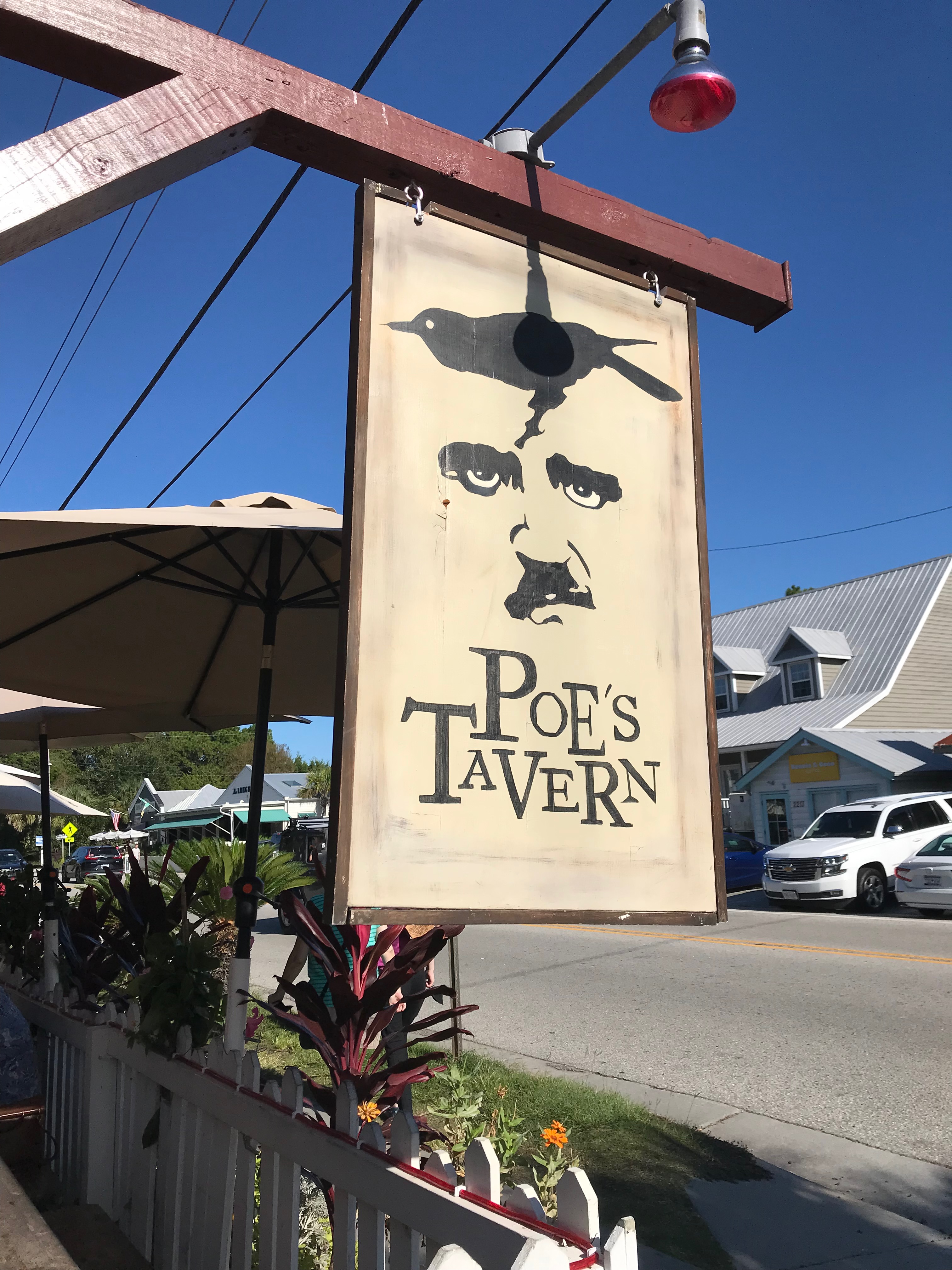
It may be superstitious, but one of the best ways to assure something else going wrong is to say, “I need something to go right just now.”  This year, since June, has been that way.  In the midst of dealing with everything, small moments of joy slip away—moments we want to hold onto during trying times.  One of the touristy things we did in Charleston—or Sullivan’s Island, more precisely—was to visit Poe’s Tavern.  We knew we had to grab a bite to eat there since Charleston is one of the many places to lay claim to America’s iconic writer.  Poe was stationed at Fort Moultrie, perhaps a mile from the modern tavern, in his short-lived military days.  His story “The Gold Bug” is set on the island, and it’s rumored “Annabel Lee” was about a girl he met in Charleston.  We’d wandered around the fort and were shortly to meet family for the gathering that drew us here.  But first we went to see Poe.

Poe himself never ate here—the establishment only dates back to 2003 (opened April 24)—but it participates in the mythology of Edgar Allan Poe.  We have followed Poe—who lived and died as a writer—along the east coast.  My family has visited his birthplace in Boston, his home in Philadelphia, his college dorm room in Charlottesville, his grave in Baltimore, and his Sullivan’s Island home at Fort Moultrie.  There are many more places to visit, and although much of this is mythology, that makes it no less real.

Poe is a controversial figure.  Both the anonymous peer reviewer and a named reviewer objected to my use of Poe in Nightmares with the Bible.  What they perhaps misunderstand is that books are deeply personal effects.  Something few understood about even my academic books is that they were intended as somewhat artistic pieces.  Holy Horror and Nightmares with the Bible are bookends, carefully crafted to go together (and both priced beyond the reach of regular readers, and not marketed at all).  Poe may well be the most recognizable American writer, largely because of an image that has taken hold.  The Poe Tavern has Poe-themed artwork throughout and it participates in that image.  It was crowded already around 4 p.m. when we stopped in for a nosh on a Sunday afternoon in October.  Such drawing power speaks to the mystique of Poe all these many years after his short life and strange death.  And of the fascination he holds for those of us who wish to write, driven by the same bug.


Simple Arithmetic?

Arithmetic progressions.  They can boggle the mind.  I think I’ve noted before—I’ve been doing this so long that it’s difficult to be sure—that the exponential increase of ancestors is astounding.  We have two parents but by the time we add ten greats to the grandparents we’ve got a crowd larger than the small town I grew up in.  Typical of a child of an alcoholic, I have no idea of what normal is, but I’ve had a rare and precious gift more than once in my life, and that has been finding that I had hidden family.  My father, unable to afford child support, made his way back to his family to survive.  Nobody in my household knew that he’d done that.  In fact, I had no idea he had siblings and I had unknown cousins.  It was a gift to discover that just as I was graduating from high school.  My mother encouraged me to stay in touch with them.  That was the reason behind my recent brief trip to South Carolina.

A few years back I learned that I had a cousin on my mother’s side that nobody in my family knew of.  People drift apart, even in families, and some people have to be rediscovered.  Call it redemption.  That’s what it feels the most like.  This cousin made the effort to travel across the country, in part to see me.  Kinship is like that.  Families feel for each other.  Being long apart can raise questions of motivation.  It’s awkward when, due to circumstances, you can’t see someone for some time.  I have a half-sibling in that boat and have recently re-connected.  I can only say that it feels like being a prodigal coming home.

I suppose that in a perfect world families would have no dysfunctional members, and everybody’d live next to each other in harmony and good will.  Right, Pangloss?  Economic circumstances would never force someone to live near where jobs might be found, and nobody would ever marry someone from another state, let alone half-way across the country.  And marriages sometimes double the arithmetic progressions, sometimes perhaps triple or more.  Families are complex and complicated, in reality.  I’ve seen pain in more eyes, and heard it in more voices than I would care to.  And I have a very difficult time letting such things go.  Charlie Bucket, according to Tim Burton’s version, says that families make you feel better in an imperfect world.  A world in which family reunions take place with individuals not being notified.  A world in which arithmetic progressions are mere fictions. Never in a perfect world like ours.


Down to the Sea in Ships

On the final day of our Charleston odyssey we toured the USS Yorktown, an aircraft carrier dry-docked at Point Pleasant.  One of my uncles served on the Yorktown between the Korean and Vietnam wars and was able to show us around.  What really struck me, as often does with military matters, is just how advanced our engineering is when it comes to war.  The aircraft carrier was invented to meet a belligerent need: to convey aircraft close enough to other nations to support air strikes against “targets” there.  These targets consist of living, breathing human beings, at least in part.  But the technical problems, where I’d rather focus this post, were formidable.  How do you land a plane moving at 200 miles per hour on a moving ship with limited runway?  And how do you do it without tearing the plane apart from the sudden deceleration?

Carriers have steel cables stretched across the landing strip.  A tail hook on the plane, or later jet, would catch a cable, wound several times below deck to increase the ratio of force (as with a pulley), to add enough play to stop a plane without the forward motion tearing it apart.  Five cables stretched across the deck and the ideal was to catch the third one for an optimal landing.  Each landing (which could take place 30 seconds apart) was filmed and analyzed for improvements.  Listening to the technical nature of all this, and knowing that such things had been invented some eighty years ago, made me wonder, yet again, at how creative human beings are.  And made me ponder why so much of our creativity goes toward war machines.  Just think of the problems we could solve if we all worked together!  Instead, Putin covets Ukraine, Trump covets everything, and we fall in line behind them.

I’ve written on such topics before.  I took a self-tour of the USS Midway while in San Diego as part of a business trip back in 2014.  The tech there was perhaps a bit more advanced as this was a nuclear carrier.  Standing on this deck, however, thinking how this one ship costs more than I will earn with a lifetime of education and employment, leaves me a bit reflective.  Those who push for wars are often those on their knees praying for the second coming.  The rest of us, content with the first coming, think how the message of love and peace seems to have been swallowed by a whale.  But this ship is larger than any whale, and, I’m told, much, much more expensive.


Swamp Things

If I have time, before I go on a trip I like to consider what different flora and fauna I might see.  People from southern states traveling north to Pennsylvania would likely not see too much that they can’t see at home, I expect.  South Carolina, however, is far enough south to hold what seem (to me) to be exotic species.  These are things that are probably pretty quotidian here, but to a traveler they really stand out.  My family had hoped to see an alligator, in a safe way, as long as we were here.  That’s why we ended up at the Audubon Swamp Garden on the Magnolia Plantation just outside Charleston.  Although it’s October, it’s still warm here and although it took some time we eventually spotted a fair sized gator sunning itself many yards away.  After seeing the first one you kind of know what to look for and we ended up spotting four more.

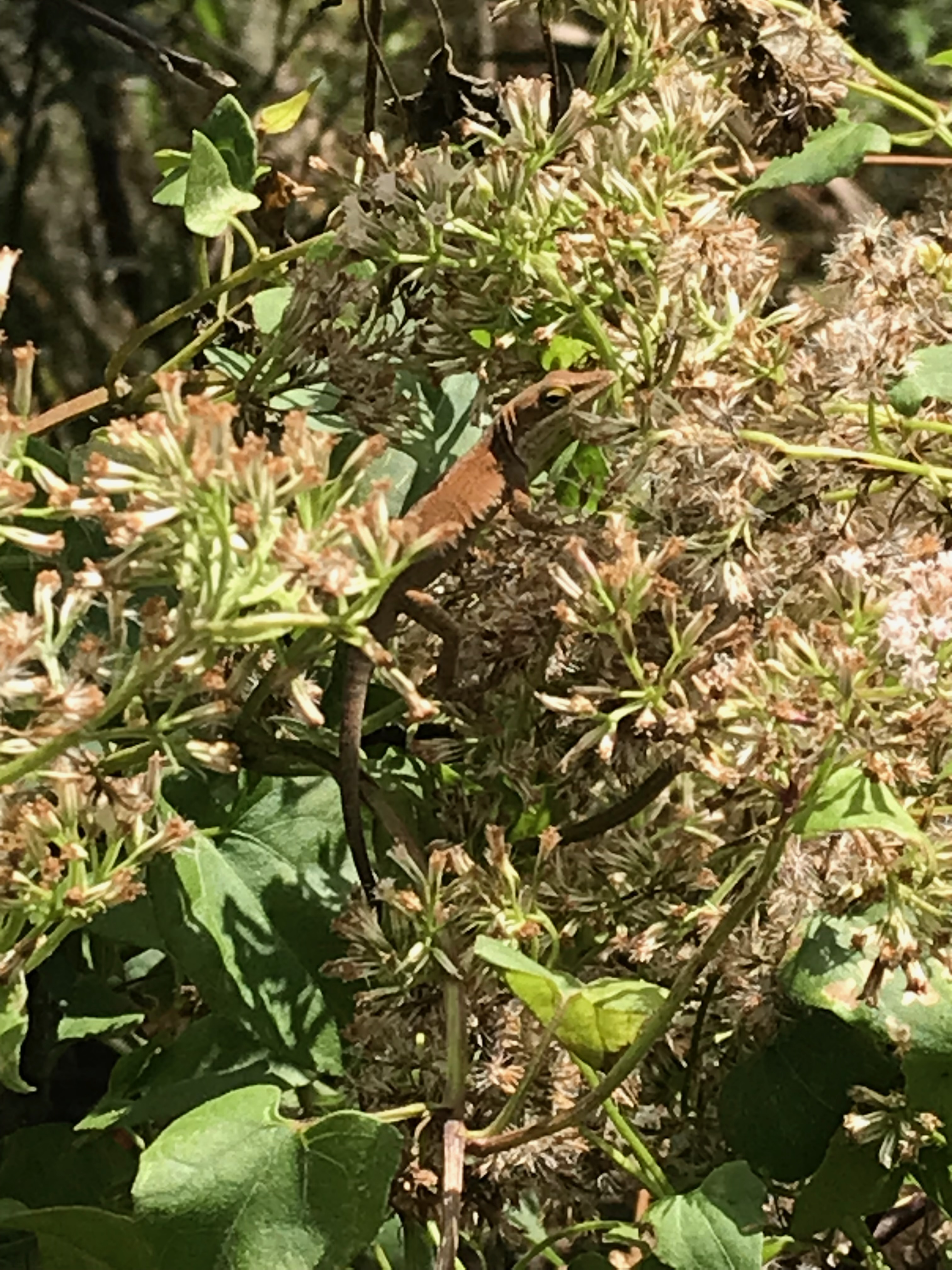
This swamp has a walkway intended to keep visitors safe, so we followed it through the facility.  You have to pass a kind of Jurassic Park entry gate to get in, and it may be best to reflect later that alligators have been around since the dinosaurs.  There were plenty of other animals too.  Our first encounter was a snowy egret.  This was followed shortly by an anole, but my lizard species identification isn’t very developed, I’m afraid.  There were dozens of turtles sunning themselves—several quite large—and a blue tailed skink.  And spiders of apocalyptic size.  My phone camera didn’t zoom in much on the gators, so I’ll put the anole here for you to enjoy.

This iconic swamp was used in the filming of Swamp Thing (I couldn’t resist), and is rumored to have been the inspiration for Shrek’s swamp in that movie.  The most poignant aspect to me, however, was just how much beautiful diversity the world allows if people aren’t constantly trying to improve it.  When a field in my native Pennsylvania is left to its own devices, it will likely become a forest and all the usual suspects will come back.  We do still have elk in some northern counties.  Yes, I suspect if we left swamps run wild mosquitos and other less fun species would also proliferate, but still, there are places that are transcendent for not having been improved upon.  The Audubon Swamp Garden is one such place, although the sunning platforms allow us to see some of the creatures, and with an alligator just a few yards away, I am grateful for this raised walkway.


Poe’s Charleston

The first thing that came to mind, apart from family, when I learned we were coming to Charleston, is Edgar Allan Poe.  I learned about Poe from my brother at a young age and he may be the earliest author I recognized.  Over the years I’ve visited his birthplace memorial in Boston, his college dorm room in Charlottesville, his house in Philadelphia, and his grave in Baltimore.  I did visit Richmond a quarter century ago, but I had a migraine that day and couldn’t think straight.  When I heard “Charleston,” I immediately recalled that Poe had been here.  He was stationed at Fort Moultrie on Sullivan’s Island, not far from where we’re staying.  As in many cities that Poe called home, he’s become a favorite son of Charleston.  I knew we wouldn’t be able to see all the haunts—I don’t think the larger family shares my fascination—but we got a start before the reunion began.

The first stop was the most tenuous.  Rumor has long had it that Annabel Lee, of Poe’s last complete poem, is buried in the cemetery of the Unitarian Church.  The cemetery is renowned for its flora, which are kept largely untrimmed to match original wishes.  It proved an atmospheric place even on a sunny day.  Then it was a trip to Fort Moultrie itself, where Poe would’ve wandered as a young man.  The thick walls and largely subterranean emplacement would’ve been impressive in the days before modern warfare.  In fact, with the large military presence here, war seems an accepted fact of life.  We didn’t have time to find the Edgar Allan Poe Library, but we were honored to eat in his presence at Poe’s Tavern.  This spot makes it into travel books not because Poe ate here, but because its decor is all Poe-themed.

This journey has been a voyage of discovery.  Our first night in Charleston I had probing dreams about my father.  They actually began a couple days before our flight.  Like Poe, my father had a problem with alcohol.  Like Poe, I never really knew him personally.  Although Joseph Campbell’s overblown, I believe he’s right that the hero’s journey is the search for the father.  Critics sometimes complain that they don’t understand my integration of Poe in my nonfiction books on horror films.  My only defense is that something deeply personal is going on.  This odyssey began over half a century ago, in my childhood, and coming here, I knew that I had to meet the man and claim my heritage.


Valuable Time

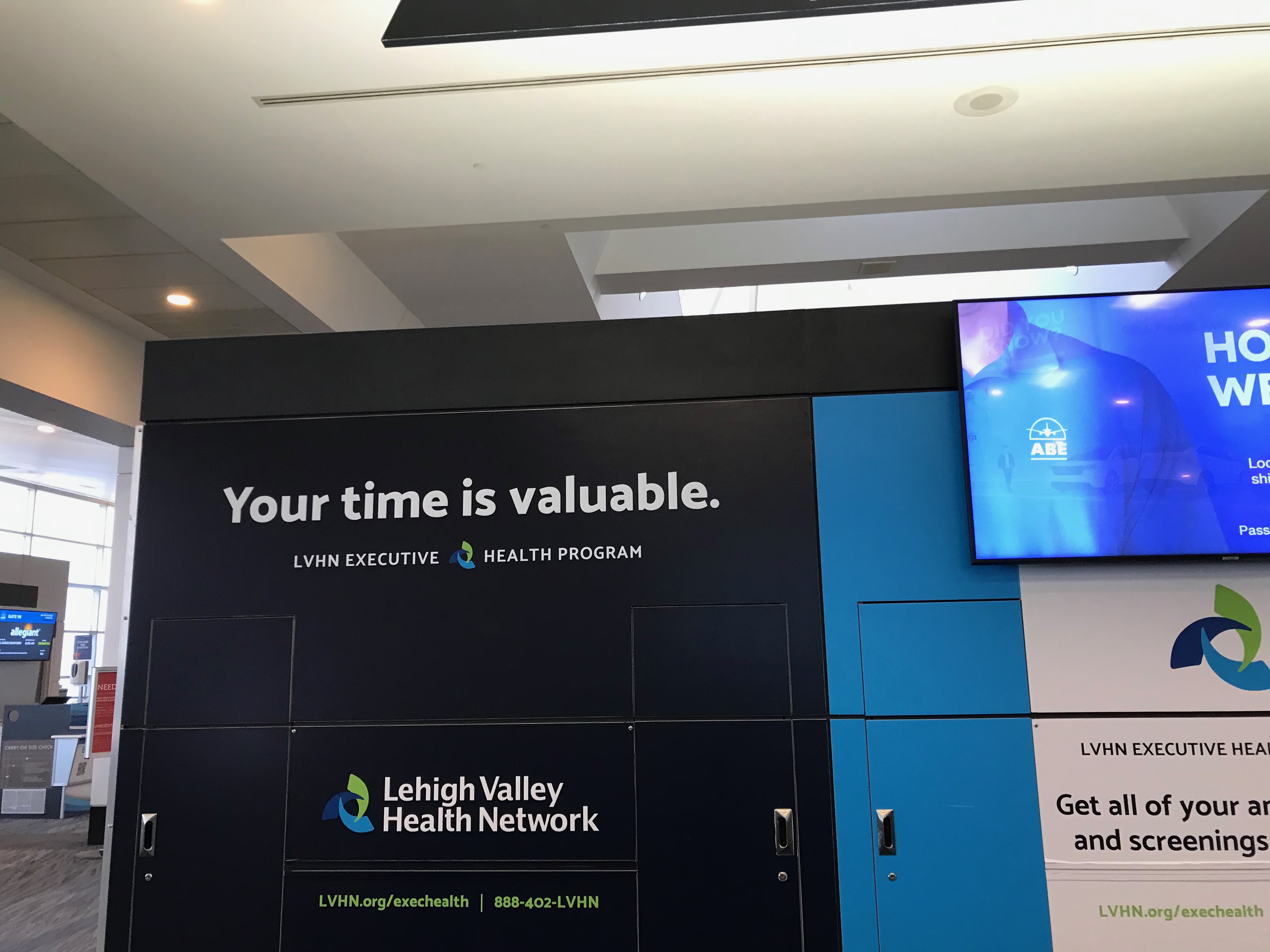
Those who know me are sometimes surprised to learn that I’m half southern, genetically, at least.  My father was a South Carolinian and so I find myself in Charleston, wondering at how I got here.  At least in the short term, it was a long trip.  We left the house at 4 a.m. yesterday and arrived in Charleston some ten hours later.  (The time in the sky was, of course, less than two-and-a-half hours.)  Our initial flight was delayed for two hours, while, in the gate next door another airplane, from the same airline, to the same hub, scheduled an hour-and-a-half later than our flight, left on time.  I sighed as I read the prominent sign ironically reading “Your time is valuable.”  Yes, it is.  And although the ABE (Allentown, Bethlehem, Easton) airport is nice enough, I think I could’ve used a couple more hours abed instead.

It must be quite a logistics nightmare when a plane breaks down.  It’s not like a bunch of spare jets sits in the Lehigh Valley, awaiting the eventuality of some mechanical failure.  Not only do you need a plane, but also a crew that consists of people scheduled to end up in a set location.  In this case they had to fly a jet up from Philadelphia, and then muster a crew to get us on the first leg.  Fortunately, they knew about the delay when we checked in and put us on a later flight to Charleston.  I wonder if our stranded original crew, wherever they were, are still there.

I often think about how long-distance travel follows a chiastic pattern.  You start by walking from your domicile to your car.  You park the car for a larger vehicle that can only land, or dock, in specified locations.  You arrive at such a location, get a car—or you know somebody with one—to take you to your destination where you walk inside.  It’s the in-betweens that take the vast majority of the time.  It’s really amazing that we can do this at all.  I’m in Charleston for a family reunion.  I haven’t been to South Carolina for about two decades—last time was for my father’s funeral.  But this is our vacation for the year.  A chance to see someplace new.  And, given the September we’ve had, to feel a little warmth.  Connecting is important.  Airports help make this possible in the world of the 9-2-5 job that doesn’t, it turns out, offer days off.  Your time is valuable.  It’s worth ten hours of traveling, and then some.


More Rainbows

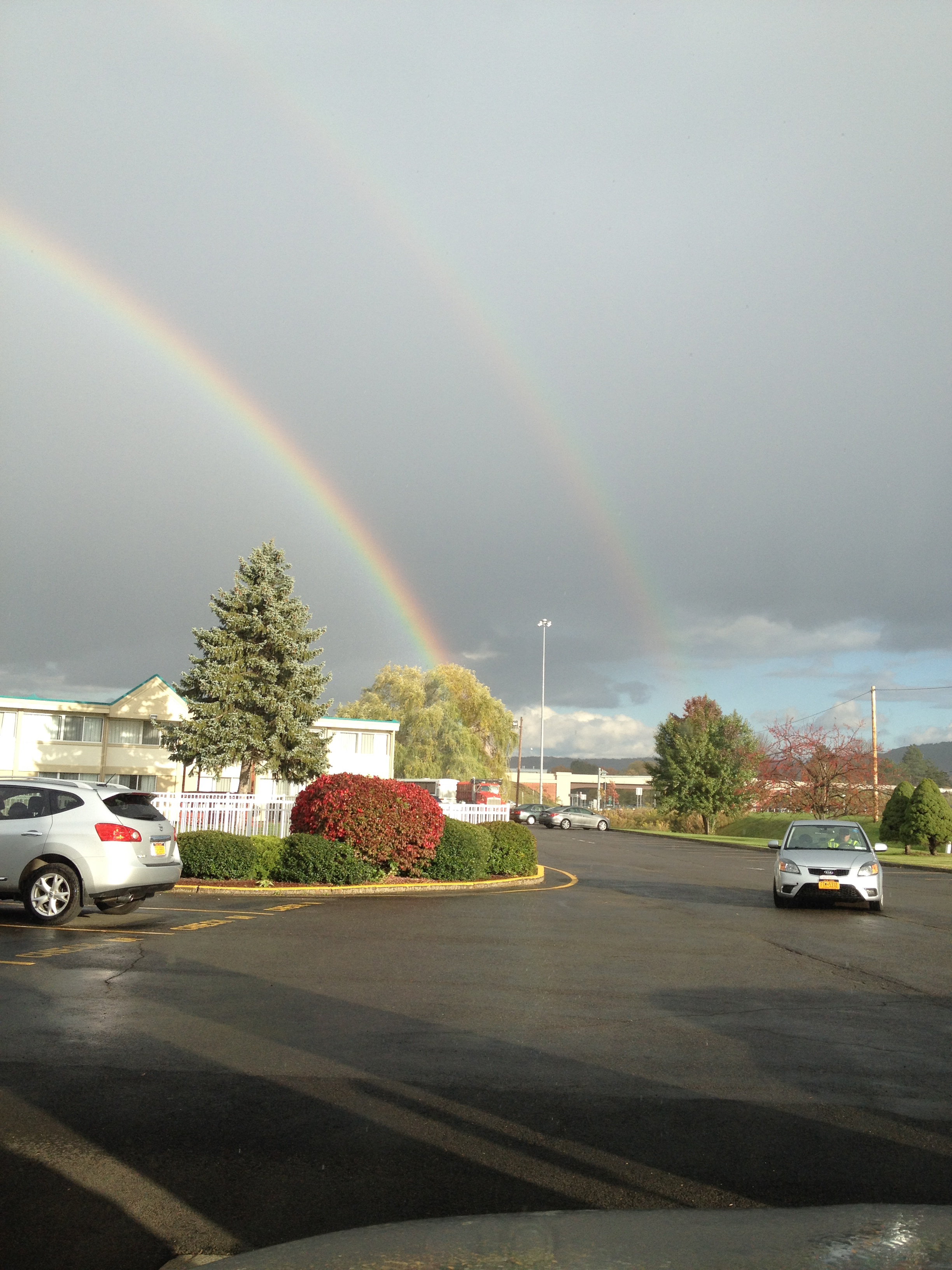
There’s been a lot of rain this June. In between there have been some glimpses of sunshine. When the rain and sun combine, I always look for rainbows. Yesterday there were rainbows. You see, I didn’t realize until physics class that the sun has to be behind you to see a rainbow. It stands to reason, of course, because the light has to be refracted before it can break into its beautiful constituent colors. If any of the colors were missing, true light wouldn’t exist. Even with many of the religious grumbling, the United States took a fumbling step toward justice yesterday. Justice is something that always comes as a bit of a surprise these days. I’m not sure that we can always trust those that money puts into power. Nevertheless, gay marriage is so in the spirit of America that I wonder it has taken so long to become legal.

I’m heterosexual and I’ve been married for over a quarter century. I know the benefits of married life, so why should they be denied any couple that love each other? Raised on conservative Christian literature that taught me homosexuality was evil, it took some intensive education to unlearn what I’d been told. The Bible has very little to say about homosexuality, and in each instance where it does there are extenuating circumstances that must be considered. The Bible, which hasn’t become authoritative for stoning adulterers (heterosexuals all) had somehow been the final word to oppress those whom nature has oriented to the same gender. I had been told “no animals are homosexual.” That is wrong. Documented cases time and again show that homosexuality is as natural as rain. Just ask the bonobos. For literalists that’s a problem because we’re not even, from their point of view, evolutionarily related.

So although it is a cloudy, rainy Saturday morning, I’m strangely optimistic. There may be rainbows today. Now if only we could spread the message wider, raise our voices louder, and maybe join in singing “Amazing Grace.” Maybe we could dare to dream that races and genders should be treated equally. Will our Supreme Court ever make true equality the law of the land? Yesterday brought us over a major hurdle. I don’t want to rain on this parade. Still, justice demands that more work be done. I rejoice with all loving humans that marriage is open to all. Charleston is still on my mind. And if some rain does fall today I can always keep what sun there is to my back and hope that there will be more rainbows.

IMG_1087


Shepherds and Sheep

Photo credit: Spencer Means, Wikimedia Commons

Photo credit: Spencer Means, Wikimedia Commons

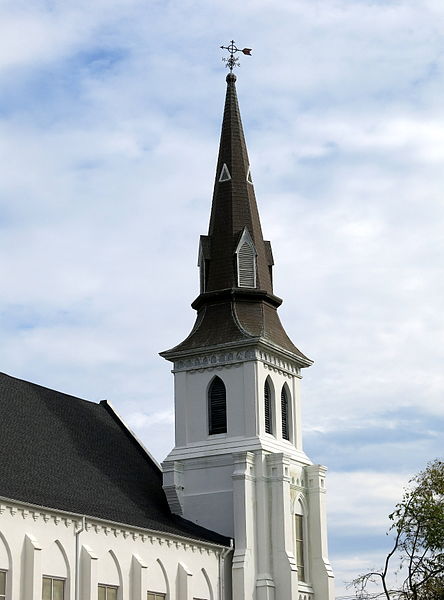
The murders in Charleston this week are part of an epidemic. The members of Emanuel African Methodist Episcopal Church join, unfortunately, a growing list of victims of hate. Not only hate, but that subspecies of hatred that calls the unstable to attack in a church, or synagogue, or mosque, as if to defy the very gods with their misanthropy. Growing up we used to be taught that any place of worship is sacred. Then we believed it was because God had made it so, but now it is clear that sacred space is made so by the intent of those who worship. We find places where we believe we’re safe from the trials of the everyday world. A place where God will look over us. A place, dare we call it, of sanctuary. Sanctuary is a concept that has gone extinct. As children we all knew of the concept of “home” in chasing games—the place where you were free and need not worry about someone coming after you. Amnesty was granted at the cry of “olly olly oxen free.”

In the biblical world, we’re told, those in danger could flee to the temple and grasp the horns of the altar and be safe. It wasn’t that someone couldn’t be pulled off, but it was that an inherent respect attended sacred places. No place is sacred any more. Hatred has a way of overriding what we all recognize as civilization. Well-armed youth and a culture of hatred have never led to peace. Xenophobia may be natural, but it can be disarmed through education. Unfortunately, in this country at least, education is not valued. In fact, in the culture wars, those who have the most sympathy for those who commit hate crimes will be among the first to cut education spending. It’s a luxury we can’t live without. We need to teach the meaning of sanctuary again. We need to teach the meaning of love.

Human beings shouldn’t have to rely on sanctuary to be safe. No matter what our racial heritage or gender or orientation, we are all simply people trying to make our way in the world. As a child I knew “olly olly oxen free” meant that nobody would try to tag me if I came out from hiding. I was also taught that the word “hate” was as bad as any swear and that it should not be said. While my mother was teaching me the virtue of love, we were sending young men to kill foreigners in Vietnam. I grew up with no doubts as to which was the superior way. One way leads to life and peace, the other to constant fear and death. The people of Emanuel African Methodist Episcopal Church have told Dylann Roof that they have forgiven him. They are offering sanctuary to one who has done nothing to earn or claim it. They, like children, lead us.


Fear of the Known

Social media has become the new reality. Not that rumor ever had much trouble before the internet, but now our cultural memes explode so fast that we have to be wired constantly to keep up. And what we see makes us afraid. The other day I came across a story on channel 7 WSPA website out of Spartanburg, South Carolina. I don’t suppose I have any business needing to know what was going on in South Carolina, but the headline “Mysterious ‘woman in black’ spotted in Tennessee” got my spidey sense going (or my Men in Black sense, but that’s just a bit cumbersome). Was this a female urban legend who shows up after UFO reports and warns the witnesses to keep quiet? The truth is much more mundane. She’s a woman, dressed in black, walking south from Virginia, currently in Tennessee. Police say she has a name and she’s from Alabama. Since she’s all over social media, however, people are worried.

She’s on a Bible mission one woman has claimed. A Blues sister in black? Others claim she’s from an Islamic nation. Some implicate the Pentagon. When someone exhibits unusual behavior our minds turn to religious causes. Why would a person dress in black and walk down the highway? It’s just not done! Must be religion. On YouTube apparently a video shows her arguing about religion with a man in a Wal-Mart parking lot. Where’s the element of surprise there? If there are any firmly fixed social markers they are surely Wal-Mart and religion. Time to be afraid.

Scarcely a day passes when I’m in New York that I don’t see someone doing something peculiar. It’s the new normal. I suppose religion is sometimes the motivation, but I wouldn’t know. The gospel can be pretty difficult to identify definitively these days. You can’t trust someone just because they dress in black any more. After all, we’ve seen agents K and J battling aliens on the big screen since 1997 and there doesn’t seem to be much preaching involved. There is conversion, however, and just a dash of conspiracy theory. That’s more like American-style speculation. Internet fame is remarkably easy for some. Put on your black and walk down the road. And if you see Johnny Cash along the way, there will be no doubt that this is newsworthy indeed.

Bible-thumper or alien?

Bible-thumper or alien?


The Shawshank Reversal

You go away for a few days and look what happens to the neighborhood. With the Bible scholars safely out of town, a South Carolina woman used two hollowed out Bibles to smuggle weapons and drugs to a friend in prison. According to a story in the New Jersey Star-Ledger, the eviscerated Bibles contained knives, a cell phone, ecstasy and cocaine. Bibles often act as metaphors, and in this case the image of trouble coming in the form of a sacred book is poignant. No one thinks to suspect a Bible (well, Stephen King did), so conservative and clean-cut. What lies inside, however, is seldom closely examined. What is found there often defies biblical scholars and prison guards.

The Bible, as an icon, is spotless in the public eye. You can place a hand atop its venerable cover and, magically, you won’t be able to lie. You can heft it aloft and demons will flee in fright. You can even use it to measure chastity. (Back in my college there was a four-feet-six-inches rule. Men in women’s dorm rooms during brief, allotted visiting hours could sit next to their sweeties, but they had to keep all four feet on the ground and remain six inches apart—a distance, we were told—that could be filled by placing a Bible between the lovers. And the door had to be kept open, just in case.) The book has become the deity. Placing God between the desires of lovers is a metaphor ripe for the picking.

Few can forget the scene in The Shawshank Redemption when Warden Norton opens Andy Dufresne’s Bible to find the rock-hammer-shaped hole cut out of the pages. The Bible had set Dufresne free. And it did so unwittingly. The Bible’s message, in the film, was intended to keep prisoners in a state of submission, but human interest brought the Bible much closer to its noble purpose of setting the prisoner free. The Bible has been a privileged book throughout American history, and even before. In England it used to be chained to the lecterns of churches to prevent it from being privately studied. Its great power, however, lays not within the manipulation it excuses, but in the human spirit that finds liberation through, and sometimes despite, the famous black book.


Dog Gone!

Religion is a strange attractor. Maybe not in the exact same sense as in chaos theory, but in reality it brings together mental states so bizarre that science fiction and fantasy writers have a buyer’s choice. Yesterday the New York Daily News reported on a South Carolina woman who hanged and burned a one-year old pit-bull puppy. Why? The bitch had bitten the woman’s Bible. Citing the animal as a “Devil dog,” the southern woman became a vigilante for the Lord. Now she’s being tried on charges of animal cruelty. This story touched me in a number of ways.

With family roots in South Carolina, I can conjure up images of this happening. Having known many, many Fundamentalists, it seems even more plausible. Given the constant barrage of contrary messages descrying the presence of evil in the world, all the sudden any mutt can become Mephistopheles. Begging off the Baskervilles, the demonic hound has a long pedigree in mythical imagination. It is well known that the Bible cites dogs as unclean animals, but it is their charnel character that leads to the development of the full-blooded hellhound. Prior to the Hebrew Bible, in ancient Ugarit dogs had an infernal connection. It isn’t seen clearly, but the association is there. Snatches of the underworldly dog appear long before Cerberus, and last well nigh into the twenty-first century.

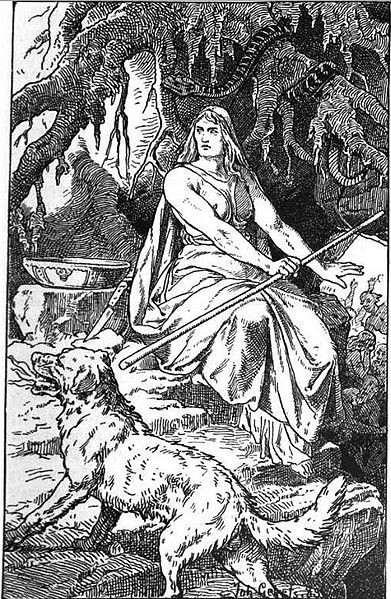
Hel and his hound

Unfortunately for the deceased canine, it is a myth. Hellhounds still abound in popular media, everywhere from The Omen to O Brother, Where Art Thou? Dogs, however, were among humanity’s earliest partners in the survival game. From about as early as I can remember, we always had dogs in the house, and nary a demonic encounter. We never put them on trial, even when house-training was in progress and an accident occurred.

The news story reminded me of an episode of Dragnet I saw as a child. A woman was arrested for murder, and Sergeant Friday, in his unflappable voice, told his partner it was because the victim had shot one of her books. In the final fade out, after Bill Gannon asked what book it had been, Friday holds up a Bible with a bullet-hole through it. I was a little confused. Was the woman guilty or was someone shooting a Bible just cause? The episode did not answer the moral dilemma. I can’t even remember the outcome. But in 2011 things haven’t much changed. If he goes to South Carolina McGruff better watch what he takes a bite out of, or it could be lynching time again.


Casting the First Stone

I’m not overly nostalgic for a guy interested in ancient history. I tend to look at the more recent past as a via negativa for the young who might make a difference today. Very occasionally, however, aspects of society were handled better back in the 1960s and early 70s. One of the most obvious instances of a more sane society was the segregation of politics and religion. Prior to the rise of the “Religious Right” as a political machine the religious convictions, or lack thereof, of politicians played little role in their campaigns and American culture itself was much more open. A story from today’s MCT News Service illustrates this all too well.

In an article entitled “In S.C., religion colors gubernatorial race,” Gina Smith reports on the various religious slurs that now pass for political campaigning in that state. “Raghead” (for a former Sikh), Buddhist, Catholic, and “anti-Christian Jewish Democrats” are among the aspersions freely cast by those without the sin of a non-evangelical upbringing. As if only Fundamentalists are capable of making the right political decisions. As if Fundamentalists ever make the right political decisions. Fundamentalism is a blinding force on the human psyche, and those who are misled by religious leaders who claim unique access to the truth are to be seriously pitied. Conviction that those most like you are to be trusted most may be natural, but dogged belief that pristine morals accompany any religion is glaringly naïve.

The American capacity for belief in fantasy worlds is in the ascendant. No matter how many times Fundamentalists or Evangelical politicians are arrested or forced from office for the very sins they rant against, their overly forgiving constituencies come flocking back to them. Commit the sin of being born Sikh, Hindu, Buddhist, Muslim, Jewish, or Catholic and no quarter will ever be offered. No, I have no desire to go back to the 1960s, but I sure wish politics would.