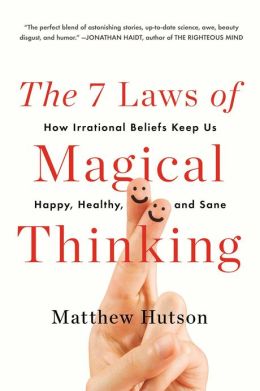
The Power of Magic Again

7laws Magic is everywhere. It may not be real (or it just might). There’s no doubt that Matthew Hutson believes the supernatural has nothing to do with it. The 7 Laws of Magical Thinking is a provocative book in that regard. An atheist who argues that we shouldn’t discourage magical thinking because it is so darned human, Hutson is a rare kind of treasure indeed. The 7 Laws of Magical Thinking begins by pointing out that we can’t psychologically accept what is really real. Reality always eludes us. Our brains are hardwired to accept what Hutson calls magic (including what I call religion). Those who enjoy provocation can take some satisfaction in knowing that either side can add another layer to the shell: physics explains everything, but maybe magic is responsible for making the universe conform to the laws of physics. And so it goes.

Although I enjoyed Hutson’s book–and he’s clearly a gifted writer—I couldn’t help but wonder at a very deep parity between the determinism he believes is really real and the magical view that is implied by such self-help manifestos as The Secret—the things that happen to you are meant to happen. I know, I know—Hutson’s point is that there’s no agency involved in determinism, but my point is that the end result is still the same. You end up where you are. I’m not so sure. Determinism has always left me cold. But since I’m no God I guess I can’t change that, yet I wonder if there might not be something outside this closed system after all. No one can peek and tell.

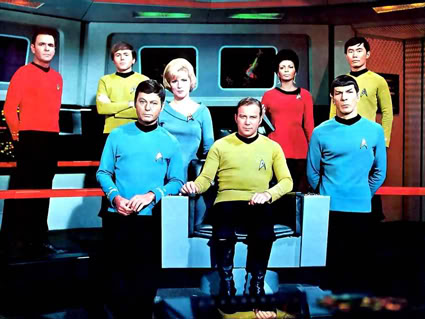
Neurology may tell us more than we want to know about the mechanics of the brain, but consciousness is reality. Science may some day lay its cold hands on consciousness, but it will always be someone else peering into my head wondering what I’m thinking. I’d have it no other way. I was strangely cheered to note that Hutson ends his whimsical study with a “stab at a secular spirituality” (a good stab, that is—not the malicious kind). I’m sure that many materialists will find such an a gesture as pandering to the masses. I think Hutson is sincere, however. Even the über-rationalists, as he points out in the book, slip into magical thinking and metaphors. It is the human condition. Those who watch Star Trek (original series, please!) know that the most tormented crew member of the Enterprise is Mr. Spock. The rationalist who can’t connect with emotion is a soul in torment. Even if that soul is a myth. The rest of the crew, I am certain, believes in the power of magic.

The Computer of Dr. Caligari

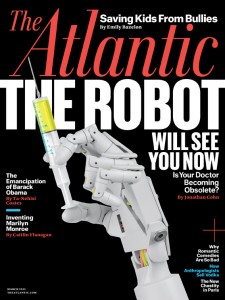
TheAtlanticTo be human is to be ethical. Not always in the best way, unfortunately. Nevertheless, our moral sensors are pretty much constantly running as we try our best to make the right moral decisions. This thought occurred to me while reading Jonathan Cohn’s article, “The Robot Will See You Now,” in this month’s The Atlantic. Having been a sideline watcher of FIRST Robotics for about four years now, I have heard countless stories of how robots perform some surgeries more efficiently than clumsy humans can. Cohn’s article starts off with the impressive potential of IBM’s Watson to sort through millions and millions of bits of data—far beyond any human capacity—and make more informed recommendations about medical treatments. After all, Watson won on Jeopardy!, so we know “he”’s smart. But he isn’t really a he at all. Still, in our reductionist world where humans are just “soft machines” computers and robots should be quite capable of helping us heal. To survive longer.

I am a veteran of Saturday afternoon science fiction movies and weekday episodes of Star Trek and Battlestar Galactica (original series, both). The present is starting to feel like that impossible future I watched as a starry-eyed child. But what of Dr. McCoy? I remember literally cheering (something I haven’t done much in recent decades) when DeForest Kelley’s name appeared on the opening credits of Star Trek when season three began. Bones was always one of my favorite characters—the doctor who didn’t trust the machines upon which he relied so heavily. He was a down-to-earth country doctor, who seemed to feel out of touch with the human (and occasional alien) element with machines interposed between them. Medicine is, after all, a very personal thing. Our bodies are our souls. I know; scientists tell us we have no souls. Embodiment studies, however, suggest otherwise. That robot coming at me with needles and scalpels may know how to heal me, but does it have my best interests at heart? Where is its heart? Its soul?

Better health care is certainly much to be desired. But in a country where our lawmakers continually debate whether the poorest should have access to Watson and his ilk, I wonder where ethics has gone. Robot doctors, I’m sure, will not accept patients with no insurance. Does not compute. Having gone without health insurance myself for several years, despite holding advanced degrees, I know that if I’d had a health crisis I’d have been rightly ranked down there with the blue collar folk that I consider kin. You see, to be human is to be ethical. That doesn’t mean we’ll always make the right decisions. It’s a safe bet that Watson can play the odds mighty finely. And the soulless machine may be making the decisions about who lives and who does not. Now that I have insurance again, when I’m on that cold slab I may have a shot at seeing a robot doctor. If that ever happens, I’m going to hope that Dr. McCoy is at least standing in the corner, and that those waiting outside the comfortable walls of affluence will somehow enter Watson’s scientific calculations with me.


Old Lies

WilfredOwenMuch of my exposure to literature has come through my daughter. I didn’t really grow up in a literary family. We had a prominent television and not much money for books, so I was headed for a typical American predilection for TV as some form of intelligence. When I began reading, it was what I could discover on my own and the required reading of English classes. Needless to say, I missed a lot. My daughter recently had to analyze a poem of Wilfred Owen. Although my wife had a book of Owen’s poetry, I never really had reason to read it. Like Joyce Kilmer, Wilfred Owen was a poet that was killed in World War One, only one in a long list of poets and dreamers that have been slaughtered in pointless conflicts. The poem that she studied was “Dulce et Decorum Est.” The poem describes a gas attack during which one soldier is unable to get his mask on in time and the gruesome death that follows.

The poem led to a family discussion about the cruelty of chemical weapons, and larger still, the pointlessness of war. Throughout history wars have been waged by the rich and powerful for reasons that may ultimately benefit some of their subjects but which, if not for the pride and prejudice of the powerful, would perhaps have been resolved without recourse to more efficient ways of killing. I always remember the Star Trek episode “A Taste of Armageddon,” where the Enterprise encounters a planet at war waged by computers and those who are calculated as victims report willingly to death chambers. This, they claim, is a more humane way to fight. In a Kirkesque maneuver, the man who gets me cut-rate flights and hotel rooms destroys the machine telling the people of Eminiar VII that if they have to face the grim cruelties of war they will find a way to stop fighting. Futuristic thinking indeed.

Today we have robots that can fly and attack, killing our enemies without putting us at risk. These are the grandchildren of mustard gas and a myriad of creative and horrid ways that people have devised for killing others. Wilfred Owen was killed just days before the war ended. His poem exposes the lie of Horace’s line, “dulce et decorum est pro patria mori”—sweet and decorous it is to die for one’s country. If I hear Owen clearly, it is the “dulce et decorum” to which he objects. Until we find humane ways to solve our differences, even in the Kirk Model, there will be wars. Death fought over effortless solutions of those in power will never be sweet or decorous. Although poets often die young, their lives remain as symbols pointing the direction ahead for the rest of us mortals left to reflect on their words.


Star Tract

Over the past few years my wife and I have been watching the episodes of Star Trek (original series; please, we are connoisseurs). As a religious child watching Star Trek I had noticed that some of the episodes had biblical titles or themes, but now that I’ve been watching them systematically, if not swiftly, I have noticed a general trend towards more biblical themes as the series goes on. I suspect most readers know that Star Trek had only three seasons. During the first season references to the Bible were a bit vague and indistinct. Episodes 23-25 (“A Taste of Armageddon,” “This Side of Paradise,” and “The Devil in the Dark”) make reference to biblical motifs in their titles, but nothing too explicit. Paradise and the Devil are, after all, in the public domain.

Season two stepped up the ante a bit. In “Who Mourns for Adonais?” the pagan god Apollo appeared, but in “The Apple” the Enterprise was transported back to Judeo-Christian themes in the paradise genre again. “Journey to Babel,” episode 10, brought a biblical place into the title, and “Bread and Circuses” (episode 25) famously put the crew into the world of the Roman Empire where the rebels were found to be sun worshippers. But no! Worshippers of the son of God, we learn. The move away from Apollo is complete, we have come back to a comfortable, Christian world.

The third and final season delved even further into the biblical repertoire. Once again, “The Paradise Syndrome” (episode 3) brings Heaven to the heavens, but episode 4 also has a biblical title “And the Children Shall Lead.” Episode 16, “The Mark of Gideon,” takes considerable thought to unpack the biblical parallel, and episode 19 is entitled “Requiem for Methuselah.” Paradise, obviously a favorite theme, returns in “The Way to Eden,” or episode 20. Each season goes boldly further than the one before.

Quite apart from the titles of episodes, Star Trek, despite the technology and unflinching logic of Mr. Spock, is an extremely biblically literate show. Even as the 1960s were fading into the 70s it was a safe assumption that watchers would pick up on the many biblical motifs and themes. Now when younger people mention Star Trek, they inevitably mean one of the various spin-off series that have grown from this original root. Biblical references are surely there, but like the times themselves, I suspect they aren’t nearly as overt as they were when I was a kid. For many even paradise has lost its shine.


Science Friction

What hath CERN to do with Jerusalem? It might seem that the House Committee on Science, Space and Technology would be a reasonable place to look for members of Congress with a grip on science. But then, I often live in a fantasy world where things make sense. It is with some sadness, but no real surprise, that I read about the words of Georgia Representative Paul Broun, lambasting evolution and the Big Bang as theories from the Devil. Broun is a medical doctor who, under conviction of his Fundamentalist faith, has rejected the basic tenets of science. According to the Associated Press, he told a Baptist church congregation, “All that stuff I was taught about evolution and embryology and Big Bang theory, all that is lies straight from the pit of hell. And it’s lies to try to keep me and all the folks who are taught that from understanding that they need a savior.” Sounds like Satan had a very busy pre-history.

Anyone who knows me knows that I begrudge no one their personal religious beliefs. Someone who does not believe in embryology, however, might have selected a career more commensurate with his religion than medicine. Election year does tend to bring out the shock value statements in politicians. Having to convince their constituencies that they are just simple folk, they deny what their faith belies every time they accept an inoculation. If evolution is a lie, so is vaccination—something most medical doctors would have to have understood before facing medical school examinations. In the United States, however, such wrong belief is a generally apt qualifier for Congress. Especially among the Tea Party. Broun hails from the ironically named Athens, Georgia.

Over the weekend I watched the Star Trek (original series—please, I’m a connoisseur) episode, “The Mark of Gideon.” It is one of the episodes I don’t recall from childhood, but then, with Kirk and all that “mushy stuff” of being alone on the Enterprise with a woman, well, maybe it just didn’t stick when I was in my tender years. In any case, the symbolically named Gideonites have overpopulated their planet to the point of disaster by good clean living. They attempt to hijack themselves a disease “inadvertently” to reintroduce population control. Captain Kirk asks why they don’t use safe methods of birth control, even volunteering the Enterprise to be a kind of inner-galactic condom-dispenser. The Gideonites explain that they believe all life is sacred, and that preventing life is a great crime—regardless of the misery it causes. I had to smile to myself. Sounds like the people of Gideon may have had been lectured by a Georgia medical doctor who had gone off on a peculiar flight of fancy.


Epiphany Perception

Our local parks and recreation department has a Christmas tree recycling program. While trees are biodegradable, it always seems crass to me to take such a symbol of joy, hope, and anticipation and have it just thrown in the landfill. The local trees are recycled into mulch, and those who own their homes are free to help themselves to the giant pile of finely chipped pine that smells like the north woods just minutes from Manhattan. The strange part is transporting a dried, outdated tree through town to the drop-off point. Pedestrians and other drivers stare at a car with a tree strapped to the top a few weeks too late for anyone’s holiday. They may find it just a little disorienting: why would someone be taking a dead tree out for a drive? It is not how we’re accustomed to seeing it done.

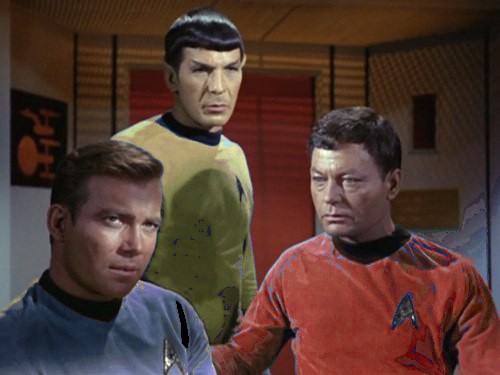
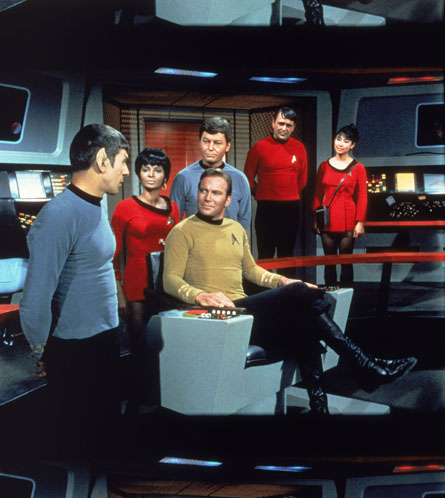
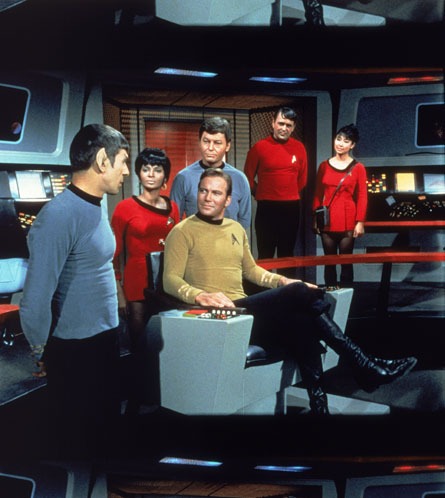
Perceptions, even if entirely artificial, see us through each day. Some continue to argue that perceptions are indeed reality. When we see something mildly disconcerting, we might ask what is happening. A familiar character in an unfamiliar costume is a trivial sort of dissonance, but it is enough to raise perception to a conscious level. We all know the accepted color scheme, so what (other than bad photoshopping) is going on when the Enterprise crew swaps shirts?

The issue is, however, a serious one. Many of the troubles we experience in society are based on fictitious certitudes. It is a strange human trait that me may not know why we believe something, but of that belief we are dead certain. From an absolute perspective, we have no way to determine which way space is oriented. If we see a globe facing “the wrong way” the dissonance drives us to correct that misperception. North, south, east, and west are relative terms. They are models that we overlay on our universe. Which way that universe actually tilts is anybody’s guess. Freshly hewn pine trees atop cars are common in December. When such things transpire in January, many people, to guess from the stares, believe their world has somehow gone askew.

Which way is really up?


Hanny’s Voorwerp Factor 5

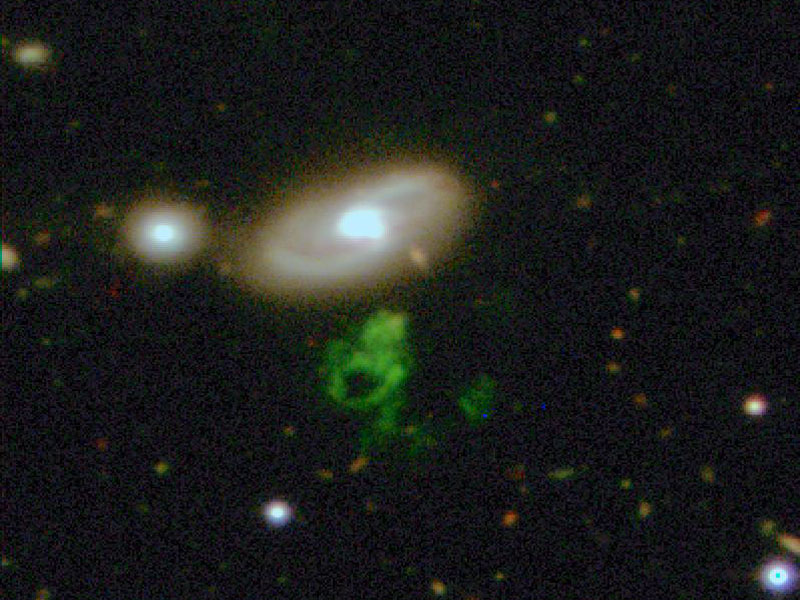
Staring at the mysterious green blob of Hanny’s Voorwerp, it’s hard not to imagine being Captain Kirk sitting cantilevered forward in that famous chair on the bridge of the Enterprise. Even for those of us who are not Trekkies, the giant space nebula looms between galaxies where no one expected stars to be born. Their own private intergalactic nursery. With my mind already on Star Trek, I think of the web-page sent to me by one of my winter term students at Rutgers: the Memory-Alpha Bible page. Since my loyalty to Star Trek only reaches as far as the occasional viewing of an episode for light relief – and only from the original series at that – I had no idea that the Memory-Alpha wiki had bloomed into existence like Hanny’s Voorwerp itself. This wiki dedicated to everything Star Trek has 32-and-a-half-thousand pages on every angle of creator Gene Roddenberry’s unintentional universe.

The Bible page’s first paragraph (accessed 1/12/11, sometime around 7 a.m. EDT) reads: “The Bible is a collection of ancient Earth writings usually bound together as a book. The Christian Bible is divided into the Old and New Testaments; however, other translations and versions exist and vary by faith groups. It is among these faith groups that the Bible is considered a sacred text, which is generally viewed as having been inspired by one of the Human gods.” Someone takes his/her future, wiki-writing persona very seriously. Nevertheless, it is a perspective that could be helpful in handling a Bible that has grown politically powerful without being understood here in the paltry twenty-first century.

The page also lists all of the episodes where the Bible is referenced or alluded to in Star Trek. As my student pointed out, almost all of these references (in the original series) are to the Hebrew Bible, with very few being from the Christian Scriptures. This makes sense, given the context of the 1960s when McCarthy’s aroma still hung heavily in the air and the war in Vietnam was daily in the newspapers. To offer up television fare that might have been considered “unchristian” in any way was a faux pas in such tortured times. The Hebrew Bible is great for providing allusions to paradise and apocalypse, but the words of Jesus were taken with a solemnity far too great to allow for fictional space explorers’ banter. So maybe it’s just an accident of astronomy that the amorphous, green cloud of Hanny’s Voorwerp appears to be wearing a galactic halo.

Hanny's Voorwerp on NASA-view


Star Trek Paradise

I am not now, nor have I ever been, a Trekkie. I did watch the reruns of the original series after school on our black-and-white television, but I have never owned “Spock ears” nor does my cell phone look like a communicator. To the best of my recollection, I haven’t even seen all the episodes. I’ve mentioned before that some generous in-laws purchased the first season of the series for a gift last year. Since then my wife (a convenient excuse) has been interested in watching the remaining two seasons. We found a reasonably priced second season set and have been working our way through over the weekends of the summer.

Paradise-busters?

This weekend we watched the episode entitled “The Apple.” Even a fair-weather Star Trek watcher such as myself can’t help but notice that the series as a whole is biblically literate. Biblically literate, however, only in a popularist way. This became clear once again in “The Apple.” Stranded on a planet modeled after a troubled Garden of Eden, Captain Kirk and his landing party soon must destroy a serpentine “god” that keeps the luau-ready inhabitants in a state of perpetual ignorance. Diametrically opposed to Eden where it is the serpent who tempts with knowledge, this is a serpent that tempts with ignorance. Long, pleasant life without intellectual development and the “god” receives daily sacrifices. A world of status quo.

Back on the Enterprise, Kirk points out that the only one on the ship that bears resemblance to the Devil is, by implication, Spock. This is where the popularist interpretation grates most heavily. The Genesis version of Eden has no Devil, no Satan in it. Only a much later, revisionist re-reading, (certainly post-Zoroastrian) equates the snake with Satan. Genesis does not condemn the acquisition of knowledge. It comes with pain, true, but that is simply the way life is. Perhaps it would be easier for us all if some great Kirk might vanquish the inhibiting serpents of our apotheosis, but that’s simply not the way life works. In this instance, the Bible trumps Star Trek.


Old Father Hubble

“Space. The final frontier.” So I grew up hearing as Captain Kirk and Mr. Spock raced through the galaxy and plucky Will Robinson explored the cosmos with Robot despite the machinations of Dr. Zachary Smith. In Seattle a few years back I visited Paul Allen’s Science Fiction Museum and as I stood before the original Enterprise console and viewed Robot in person, it was almost a personal epiphany. This was my childhood all in one room.

Experience Music Project and Science Fiction Museum, courtesy Gnu

NASA has just announced the release of more deep space images snapped by the new and improved Hubble Space Telescope. These images show objects, galaxies, back to a mere 600 million years after the Big Bang. Look any further back and you’re liable to find yourself staring God right in the eye! These incredibly ancient images are humbling to a scholar of ancient times. In the cosmic calendar Sumer isn’t even on the map. And now we can see back almost to the Big Bang itself. It is another kind of epiphany.

Here's lookin' at you, kids - Hubble's new view

Cosmology is inherently religious. Even Stephen Hawking leaves room for the unknown, “religious” entity in his popular writing. As the infinitesimal biological apex of evolution on our own planet, we are somewhat less than cosmic dust on the grand scale. When we reach out to that cold blackness of outer space metaphors fail us until we fall back on God language. I look forward to the day when the Big Bang is captured on film (or digitally). I am almost certain that when that happens science will become far stranger than fiction.


Compassion Divine

A very generous relative graced this holiday season with the gift of the first season of Star Trek, the original television series. I am not now, nor have I ever been, a “trekkie.” I did, however, enjoy the show as a child and have come to appreciate it even more as an adult. I can’t cite episode and scene like a trekkie can, and a surprise FBI raid would not turn up any pointy Spock ears or a model phaser (although my wife’s cell-phone looks like a sophisticated communicator). As a child the show appealed to my love of science fiction, and as an adult the morality play aspect of the original series fascinates me. Yesterday we watched an early episode where a crew member has his mind boosted by a trip beyond the edge of the galaxy (a la Forbidden Planet). As this character becomes more and more omniscient and powerful, he refers to himself as a god. Captain Kirk, in his attempt to stop his old friend calls out that gods are marked by compassion rather than strength.

I have been rereading Homer’s Iliad in preparation for a course on mythology. Quite apart from the fact that Star Trek borrowed heavily from classical mythological themes, one of the features I have especially picked up on in this reading has been the appeals to the compassion of the gods. As Diomedes, Odysseus, and Ajax (and finally Achilles) battle Hector and Paris both sides call out for the kindness of Zeus, appealing to his compassion (as well as to his baser instincts). Reflecting the ancient perception of the world, Zeus’ responses are fickle.

Biologists have been probing the origins of human sympathies ever since Darwin. Creationists used to argue that compassion, altogether lacking in the animal world, could not have evolved naturally. Many recent studies, however, have demonstrated a naturalistic base for our altruism and compassion. These traits are certainly displayed in a number of animal species, particularly mammals. The ancient Egyptians believed animals to be superior to humans in many respects, lacking our weaknesses and being more adept at survival. It seems that they were right and some of the nobler human traits evolved from our animal milieu. If so, what is divinity beyond the gospel according to Star Trek — compassion to those in need by those who find themselves in positions of power?