Not Full

Disclosure Day may not be Steven Spielberg’s best movie, but it is a good one.  Part of his space trilogy after Close Encounters and E.T., it too comes back the the theme of aliens and posits what it might be like if those holding the secrets ever release them.  Although not a horror film, it makes use of the Bible—not surprisingly since real-life discussions about disclosure often ask about its effects on religion.  In the movie, the Wardex Corporation, part of the military-industrial complex, is the keeper of the secrets.  They reverse-engineer alien technology, and get to keep what’s found from recovered UAP wrecks.  More powerful than the police, they stop and kill without compunction.  They control the highest level of secrets that the government has—even those beyond the president.  (Spielberg clearly did his homework here, even working in the bit about Jackie Gleason making the claim to have seen alien bodies.)
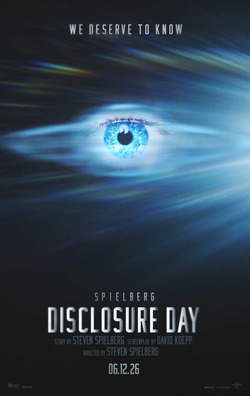
A couple of Wardex employees, Hugo and Daniel, smuggle out the video proof of the nearly eight-decade cover-up and they plan to release everything to the media.  A weather reporter, Margaret, sudden becomes psychic and receives an alien message while on air.  Wardex has kidnapped and roughed up Daniel’s girlfriend, former novice nun Jane, to force him to return the stolen data.  (Religion plays a big role here.)  Noah, the head of Wardex, uses advanced technology to track Daniel, Jane, and Margaret, as they are trying to meet up.  When Margaret and Daniel finally do connect, Hugo reveals that they’re both “experiencers”—they’d been abducted as children and had been given extraordinary gifts.  Margaret’s abilities are such that she can break into and walk out of a secure military base with Daniel in tow.  As they prepare to show the evidence at Margaret’s Kansas City news station, Wardex shuts them down but Jane delivers a device that allows the broadcast to take place.  The world, which is on the brink of Armageddon—World War Three—stops to listen and begins to realize that we need to work together to save the human race.  

The plot is a bit complex to summarize fully, but this gives the general picture.  Disclosure Day is a hopeful movie.  The theme has been addressed by proponents of real life disclosure before: sharing this kind of information might well save us.  And the religious community, represented by Jane’s former monastery, is perfectly okay with this development.  There’s a lot to say about such a film, and I try to constrain my word counts here.  It’s the kind of movie that grows better with reflection—the writing is a bit trite in places—and the alien tech is a bit hard to believe.  Of course, we don’t know what off-world tech can really do.  But at the end of the day, religion plays a major role in the truth being revealed.  Worth thinking about.


Close Commandments

Okay, so I’ll admit that Jeffrey Kripal’s Authors of the Impossible put me in the mood for Close Encounters of the Third Kind. Watching this movie always calls for an investment of time and some emotional energy since it does drag a bit and there are some ponderously majestic scenes that simply make me want to scream. As I powered up the old DVD player this weekend, however, I received an epiphany while watching the movie for the first time in years. Early on during Richard Dreyfuss’s breakdown, the kids (incongruously) gather around the television with excitement to watch the Ten Commandments. The reason, clearly, is that they want to stay up late, and even having to watch Cecil B. DeMille’s warhorse is an adequate excuse. I’ll admit that it was one of my motivations for watching the lush, but equally dull, Ten Commandments as a child. Yes, I took it to be a pious attempt to render God’s literally true memoirs into celluloid, but its 4-hour running time did promise to keep me out of bed until after ten.

Young Moses experiences a theophany.

As my wife and I watched Close Encounters over the weekend, I realized for the first time that much of the cinematography is based on the Ten Commandments. Dreyfuss is a visionary, a prophet, if you will. He is drawn to a sacred mountain (Devil’s Tower) where, like Moses, he makes his way up and down, unable to decide whether to enter the divine presence or not. One of the pacing problems in the book of Exodus is the mental image of an 80 year-old Moses laboriously making his way up and down Sinai as God sends him on various errands. I imagine the children of Israel having time to cast a whole herd of golden cattle. As the UFOs make their grand appearance somewhat near the end of Close Encounters Roy Neary (Dreyfuss) and Jillian Guiler climb the mountain, see the theophanic display, and start back down. Only to go up again. On their way to Devil’s Tower they drive by several dead animals, like those struck down in the fifth plague of Exodus. The army forcing the people out of the area is itself an exodus. The return of those kidnapped by the aliens is a kind of letting go of those held captive. Apparently the Egyptians and aliens have a long history anyway.

I have no idea if Steven Spielberg was intentionally modeling Close Encounters on the Ten Commandments, but corollaries are clearly there. 1977 had not yet witnessed the decline of Erich von Däniken’s star, catapulted into orbit by Chariots of the Gods? where once again we find God driving spaceships and giving the Egyptians a hand with those pesky pyramids. Even the surnames of the characters seem to be a play on their biblical roles. Roy Neary, the one who draws near to God, the only one selected to literally ascend to heaven at the end, and Jillian Guiler, whose suspicion keeps her earthbound with her son Barry, who bears an eerie resemblance to the childlike aliens whom he befriends. Berry is the movie’s Joshua, the one who will keep the faith alive for the next generation. The story came to Spielberg, according to the media, when he saw a meteor shower in New Jersey as a youth. I missed last week’s meteor shower in New Jersey, and my baby ark on the Nile never sailed.


Robopocalypse


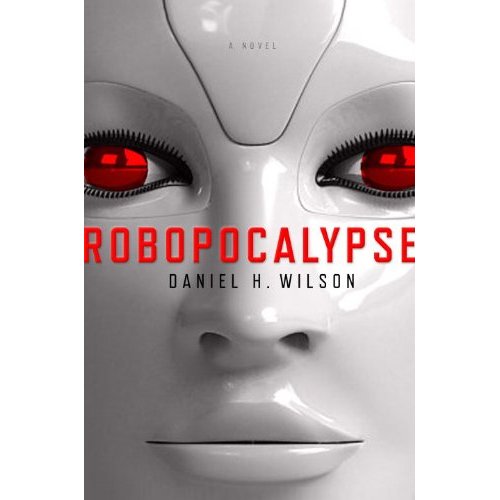
Yesterday the long anticipated novel Robopocalypse was released. Although I seldom indulge in hardcover fiction, I headed to my local Borders to purchase a copy. Sadly, it seems, my local is cutting back on first-day releases because I walked out of the store empty handed but with a robotic Armageddon in my head. Last summer I became acquainted with Daniel H. Wilson’s How to Survive a Robot Uprising, but word on the street is that this novel is serious. Steven Spielberg purchased the movie rights even before the book was released. And the concept owes its existence to religion.

If it were not for human religious sensibilities, would the concept of an apocalyptic end have ever arisen? Probing into the ancient psychology that lead Zoroastrians to suppose an ultimate conflict was just down the theological road, it is clear that even a strong moral sense alone does not dictate ultimate dissolution. By personifying evil in the form of Angra Mainyu, Zarathustra gave a (divine) human face to wickedness, and thus opened the possibility of battling against it. Evil as an abstract, non-personified force might simply be accepted as part of the universe we inherited. By providing it with will and intention, however, Zoroastrians allowed for a natural human response. Fight or flight is hardwired into our brains, but would we have dared fight a foe that is immaterial, amorphous, and completely abstract?

The nature of the enemy has transformed itself many times over the ages. Wilson, a scientist working with robotics during his education, has taken a religious theme and placed it in the context of a godless world of cybernetics. I must use caution here, since I haven’t yet acquired a copy of the book, but it remains clear that it is the humanization of non-human entities that gives force and pathos to a final conflict. Jesus charging his white horse into a foul-smelling cloud lacks the same impact. Thus mythologies are born. Mythologies that people live by and for which they frequently die. I do hope it all holds off until I can get a copy of Robopocalypse to read. Better yet, the end won’t come until after the movie is released.