Things Seen

I disagree with the critics on this one.  Things Heard & Seen is a remarkable horror film.  That’s not to say it’s without its flaws, but it is quite engrossing for the right kind of viewer.  It has elements of dark academia, as well as ghosts and a respectful treatment of Swedenborg.  And it takes place in the Hudson Valley (the headless horseman is even mentioned once).  The Bible appears both visually and is quoted.  In short, it encapsulates many of my personal interests.  And it’s not badly made.  There will be spoilers here, but it’s difficult to discuss religion and horror without them.  George Claire married Catherine because he got her pregnant.  He has, however, finished his doctorate and been offered a post at Saginaw College, in the Hudson Valley.  It quickly becomes clear that George is an entitled, self-centered liar (sounds familiar).
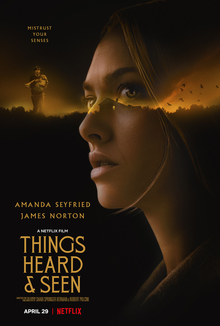
As the story unfolds, both Catherine and their daughter Franny see ghosts.  George dismisses them but even at the college the head of his department is a Swedenborgian and tells him not to dismiss the spiritual world.  George’s true character starts showing through.  He cheats on his wife.  He forged his letter of support from his Columbia doctoral advisor because his work was substandard.  When a fellow faculty member finds out, he runs her off the road, putting her into a coma.  He drowns his department head while boating on the Hudson because he also learned the truth.  He even claims to have painted pictures done by his brother.  In other words, he’s a real piece of work.  The ghosts aren’t able to save his wife when he murders her, but his colleague comes out of her coma and spills the beans.

In the end, George sails away into a Thomas Cole painting where a Swendenborgian ending overtakes him.  The use of Swedenborg adds an etherial element to the film, figuring thoughtfulness to what otherwise might be just another story about an unhinged academic.  The department head’s advice about seeing death in a Swedenborgian way was also strangely affecting.  In other words, this is thoughtful horror.  And once again it demonstrates that religion can be crucial to understanding what we really fear.  I suppose some critics dislike the unambiguous use of ghosts and the supernatural breaking into “reality,” but that seems to be precisely the point.  I only learned of this movie because Netflix recommended it, but they hit on several major themes in my work over the past several years.  I would watch this one again.


My Cultic Breakfast

The word “cult” is no longer used by religious specialists to refer to New Religious Movements, but when I was growing up in a fundamentalist home it was liberally applied to suspect groups. While having breakfast this morning I realized just how deeply rooted in American culture such groups are. I reached for my cereal. The reason that many Americans eat cereal for breakfast stems directly from the healthy lifestyle advocacy of John Harvey Kellogg of the Seventh Day Adventists. Adventists are vegetarians and are very concerned about healthy eating. Kellogg was a devout Adventist and produced Corn Flakes as a means of providing a—pardon the term—kosher choice for breakfast foods. Of course, growing up I’d been warned against the “cult” of Adventism, even as I happily munched their Corn Flakes.

So today I decided to have some Apple Jacks instead. Apples made me think of John Chapman, better known as Johnny Appleseed. Americans learn about the eccentric apple-planter from childhood, but most never learn that he was also a missionary for the Swedenborgian Church. Named after the Swedish scientist and theologian Emanuel Swedenborg, this New Church taught doctrines that set traditional Christians’ teeth on edge. Believing that Christ had already returned in the words revealed to himself, Dr. Swedenborg didn’t ingratiate the fundies by rejecting the standard interpretation of the Trinity and by promoting mystical beliefs. John Chapman spread Swedenborgian ideas along with his apple seeds. I’m sure that as we sang the Swedenborgian hymn at Methodist Church camp, we didn’t realize its heterodox origins: “The Lord’s been good to me, and so I thank the Lord, for giving me the things I need: the sun, the rain, and the apple seed—the Lord’s been good to me.”

What good is cereal without a spoon? As I grab my Oneida spoon, selected by my wife and me when we registered for our wedding, I’m sure I didn’t know at the time that the Oneida company is what is left of the Oneida Community. Founded by John Humphrey Noyes in the Burned-Over District back in 1848, the Oneida Community was one of the Perfectionist groups common at the time. Their town of Oneida held everything in common—everything. That included “complex marriage” which meant that all members had sexual access to all members of the opposite gender. They worked to support themselves, and one of their products was silverware. With the death of Noyes and concern of secular authorities about the interesting sex that was going on, the Oneida Community quietly closed, leaving us a company to produce fine stainless steel implements with which to eat our cultic breakfast.