Re-Telling Poe

Retelling stories is a very old tradition.  Fiction writers often do it.  Some even argue there are no new stories (I tend to disagree with that).  In any case, T. Kingfisher decided to try retelling my favorite short story, Edgar Allan Poe’s, “The Fall of the House of Usher.”  What Moves the Dead has Roderick and Madeline Usher and their creepy house but the story revolves around the narrator, Easton.  (There’s a helpful author’s note at the end that discusses this.)  As Kingfisher notes, the narrative warps around fully-formed new characters and the question is whether that works or not.  Anyone who’s spent much time on this blog will know that I’m a diehard Poe fan.  It takes a lot to convince me that anyone has done him justice.  What Moves the Dead is a quick read, but perhaps unsurprisingly I had trouble accepting Easton as the interloper to the story.  

One of the most compelling aspects of Poe’s tale is the point of view of his unnamed narrator.  He expresses his horror at what happens but manages to keep himself out of the spotlight.  Easton intrudes a bit too much in the narrative.  And other characters also tend to overshadow the Ushers.  The main thing that is missing, however, is Poe’s unity of effect.  There is a dread running throughout Poe’s “Usher,” and analysts have suggested that every detail of the story is relevant.  There’s a reason it’s my favorite short story—it is just so good!  So good that the few times I’ve ridden on a horse in my life, the first thought that always comes to mind is the opening of Poe’s story.

If you’re looking for a quick horror book to read, which has a bit of humor to it, What Moves the Dead isn’t bad.  Kingfisher is a talented writer and her characters are creative.  It’s just that they muddy the waters, as it were, of Poe’s masterpiece.  Ironically, I think the story would’ve been much more compelling without the Poe tie-in.  The idea of infecting mushrooms (she also discusses this in the author’s note) can be a really compelling tactic.  In fact, it is used quite a lot in horror these days (and I completely understand Kingfisher picking up another book that does what you’re trying to do when you’re in the middle of a project—that has happened to me more than once).  For me, Poe’s story is pretty much perfect and it’s difficult to improve on perfection.

With Thorns

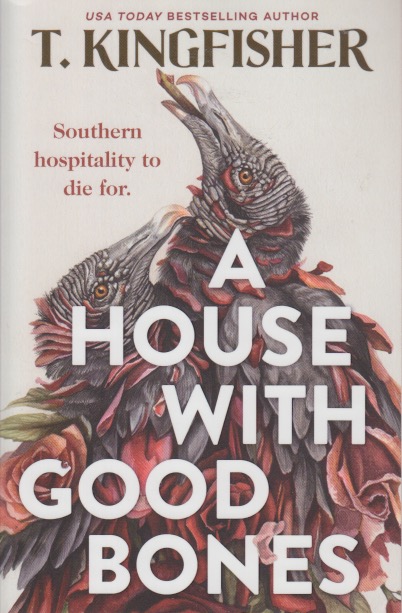
I’ve seen T. Kingfisher’s books on the tables of various bookstores and I’ve noted them.  I wasn’t sure if they were horror since the tables have always had ambiguous labels, such as Books to Read at Night, or some such.  I was in a new independent bookstore a couple weeks back and A House with Good Bones was decisively shelved with horror and so I decided to give this new (to me) author a try.  I’m glad I did.  Kingfisher writes in the vein of humor and horror, like Grady Hendrix.  This is a fetching kind of horror writing, if it’s done well.  A House with Good Bones keeps the pages turning with winsome writing as things start to get more disturbing and dark.  Samantha Montgomery, an archaeoentymologist (an archaeologist who studies insects, or an insect scientist who’s into archaeology) waiting for a dig to resume, visits her mother in North Carolina.  She learns that her mother has been acting strange.  There could be some spoilers below.

Overall, the plot is a bit complex, so some aspects will be left out.  Even if there are spoilers, you’ll need to read the book to reconstruct it all.  Fair warning.  The house seems to be haunted, but Sam doesn’t believe in ghosts.  And the haunting is unconventional—it focuses on roses.  The roses were planted by Sam’s grandmother, a woman she and her mother lived with, but who was anything but nice.  She was, however, dedicated to her roses.  While staying with there as an adult, Sam tries to do some research.  She learns that her great-grandfather was a kind of local wizard, or warlock.  Her grandmother wasn’t well liked in the small community where she lived.  As things begin to get creepier, Sam is forced to realize that despite her scientific training, houses can be haunted.  Her dead grandmother shows up, made of roses.  With the aid of a local witch, they banish the grandmother.  Then more trouble comes.

The grandmother had warned Sam of “the children underground”—her version of the bogeyman—and when the house suddenly becomes half buried, Sam and her mother learn that the children underground are real.  The novel also has a vulture theme.  I’m not doing a good job summarizing, since the story is, as I said, complex.  But it’s very enjoyable to read.  Kingfisher is funny and then scary, and passes easily between the two.  I enjoyed this book quite a lot, and I’ll be coming back for more.  And I think I know, after reading her, why Kingfisher is sometimes placed on ambiguously labeled tables at bookstores.  I always appreciate writers who make up their own genres while telling a compelling story.