Tolerance, Princeton Style

Princeton is an idealistic kind of town. A seat of great wealth, the town is dominated by the university and yet it manages to retain a sense of genteel quaintness that so often accompanies the aura of financial security. Even with my distrust of money, I love to wander its streets and imagine what the world could be like. My ideal world has bookstores, and so I always stop at the Labyrinth, the current incarnation of the university bookstore in town. Last time I was there I found an overstock sale copy of Ian Buruma’s Taming the Gods: Religion and Democracy on Three Continents. Well, both the price and the topic were right, so I read it this week. Buruma is actually a scholar of democracy, human rights, and journalism, not religion. One of the key identifiers of religion is that there is no central, unifying topic that ties all religions together, and therefore scholars of many disciplines have much to say about it. Buruma offers three chapters illustrating the way that religions interact with society, often violently. He then tenders suggestions for how this violence might be curbed.

Commenting on tensions of Islamic growth in a nominally Christian Europe, Buruma notes that one of the Enlightenment core values is a belief in universals. If truth is truth it is universal. This, he notes, often conflicts with religions since most religions also tend to make universal, often exclusive, claims. Here is precisely where human culture is brought to its knees by religion. Due to their revealed nature, western religions cannot be challenged on any rational grounds. This is as true of Mormonism as it is of Judaism. If God said it, and there is no empirical proof, people have no choice but to obey. Problem is, God can’t make up “his” mind about the final word on the subject. New religions sprout constantly, growing into inevitable conflict with their neighbors. Not to mention those who have reasoned their way out of religion.

What is the limit of religious tolerance? As Buruma notes, tolerance necessarily includes tolerating intolerance. Some religions are constrained to be intolerant of others, and how do we allow them to be part of our little tea party? (The metaphor is intentional. Think about it.) Buruma suggests, as many have, that the rule of law should settle the situation. People must learn to separate civil law from religion. But can it be done? I have serious doubts. I’ve heard this suggested before, by minds far greater than mine. Having grown up as a religious kid, however, I know that rule of law has its limits. It stops once God opens the door to direct revelation, whether to people today or thousands of years ago. Religion is not bound by the rule of law. It is its own highest authority. Many, many people throughout the world believe that. Moses, Jesus, Mohammad, all are noted to have had clashes with civil authorities of one sort or another during their lifetimes. The pattern is set. So even here in Princeton, with an engaging, thoughtful book in my greedy little hands, surrounded by great wealth, I realize just how idealistic all of it can be.

Brain Death

The computer revolution has spoiled some of the wonder associated with old films that had been formerly staged with cheap props and poorly written dialogue. (Well, computer literacy has not always improved the dialogue, in all fairness.) Nowhere is this more apparent in the science-fiction/horror genre where CGI has made the impossible pedestrian. There’s little we’re not capable of believing. Back in the fifties and early sixties when even color film often went over budget, some real groaners emerged. Over the weekend I watched one of the movies at the front of the class for poorly executed. The Brain that Wouldn’t Die, however, is experiencing something of a renaissance with a stage musical coming out next month in New York based on this campy classic. Most horror movies don’t really scare me much, probably due to overexposure. The Brain that Wouldn’t Die, however, creeped me out in an unexpected way. Daring toward exploitation status (the movie was shot in 1959 but not released for three years), the “protagonist” is Dr. Bill Cortner who specializes in transplants. When his girlfriend Jan is decapitated in an automobile accident, Cortner keeps her head alive while seeking a body onto which to transplant it. Ogling over girls in a strip club, or even stalking them from his car while they’re walking down the street, the doctor imagines what features he’d like grafted onto his girlfriend’s still living head.

Campy to a nearly fatal degree, the film is nevertheless disturbing on many levels simultaneously. Although I was born the year the film was released, I was raised to consider both genders as equal. The unadulterated sexism of a man grocery shopping for the body he wants stuck onto his girlfriend’s head was so repellant that I reached for the remote more than once. A bit of overwritten dialogue, however, stayed my hand. Kurt, the obligatorily deformed lab assistant, while arguing with Cortner declares that the human soul is part in the head, yet partially in the heart. By placing a head on another body, the soul is fractured. Now here was a piece of theological finesse unexpected in such a poverty of prose. The question of the location of the soul has long troubled theologians, an inquiry complicated by the growth of biological science. Heart transplants are common today, but the resulting people are in no way monstrous. The amorphous soul, theologians aver, is non-material yet resides within a specific biological entity. Some have even suggested that you can capture its departure by weighing a dying body at the moment of death. Others suggest no soul exists—it is a mere projection of consciousness. Cortner, however, once his eyes have opened the possibilities, can’t look back.

Our social consciousness has grown considerably since the late 1950s. Politicians and Tea Partiers who hold that era up as a paradigm of sanity do so at the price of half the human race. On the outside with the oiled hair, polished shoes, spotless automobiles, society seemed clean cut and orderly. Women, however, were relegated to inferior roles while men made the rules. Life was less complicated then. We knew who was in charge. Or did we? As a species that has evolved via sexual reproduction, it has taken us surprisingly long to realize that both genders are essential to humanity. We still tolerate gender disparity in pay scales, often shored up with the tired excuse that pregnancy and childbirth disrupt “productivity” and therefore female efforts are worth less than male—never changing due to biology. Such trumped-up excuses ring as hollow as a head without a body. Many Neo-Cons will even use the Bible to support it. John Q. Public (always male, please note), they insist, yearns for the “good old days.” The days they desire, however, were days of cheap horror and unrealistic dialogue. If they can watch The Brain that Wouldn’t Die without flinching, our future is bleak indeed.


Feeding the Multitudes (on a Budget)

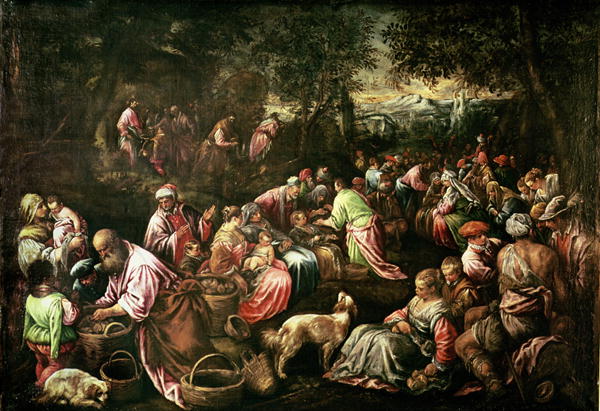
Commuting to New York City by bus can be an epiphany. When an hour-and-a-half scheduled ride stretches into two-and-a-half (I spent three-quarters as much time commuting as I did actually at work yesterday) you have plenty of time to look at the scenery. In New Jersey this translates into several towns and cities of differing socio-economic viability. The bus is a great leveler of people: corporate, business types sitting next to those who can’t afford a car or bicycle. As we trundled through Plainfield yesterday I spied a restaurant called Two Fishes & Five Loaves taglined Soul Food for all occasions. The name, of course, is borrowed from the story of the miraculous multiplication of food from the Gospels. This story fits particularly well in this setting.

According to the Gospel writers—this is the only miracle to appear in all four of the Gospels—a crowd following Jesus in a lonely place grew hungry. Instead of sending the crowds away, Jesus took the five loaves of bread and two fish they had with them and fed the crowd of 5,000 with that little morsel. When I was a student it was customary to interpret this story as one of a human-dimension miracle. The crowd, seeing Jesus sharing the food he had, each offered to share with their neighbors. Once the idea caught on, those without food had enough and those who’d brought extra had the right amount. They even had leftovers. This naturalized version of the story illustrates the message of Jesus quite nicely, although those who prefer supernatural intervention naturally reject it.

Plainfield is a town with stunning wealth and abject poverty. This situation is not unique to this location; indeed, it is a hallmark of capitalism. Those who have do not willingly give it up for the sake of those less fortunate. The free market is not really free. Today most readers like to see the story of the feeding of the five thousand as divine intervention. That matches our bail out mentality. When our circumstances make us too selfish, God comes to the rescue with conjured seafood and crumpets—or Tea Partiers—and the rest of us look on hungrily. By the end of the day, enduring that long bus ride home, I too was hoping for a miracle. Instead, as we crawled by Two Fishes & Five Loaves, loaded with people of every status, I was living in a Gospel story.


Don’t Know Much

Pennsylvania does not come immediately to mind when “big states” are mentioned. When you have to drive the breadth of the state, however, you start to get a sense of the beast. Despite its abundant natural beauty, Interstate 80 manages to keep it to a minimum, so driving home yesterday we listened to the first disc of Kenneth C. Davis’s A Nation Rising in audio-book format. Mostly known for his Don’t Know Much About — books, Davis is a popular historian with a sense of what makes the past interesting. I can’t speak for the entire book yet, but the unabridged reading of A Nation Rising certainly was an educational experience for the first hour or so I’ve heard. The book focuses on the initial fifty years of the nineteenth century (1801-1850) in the United States. Of particular interest to me is the religious angle. In the introduction Davis states that it will become clear how the concept of America as a Christian nation is a myth. Other than my usual objection to “myth” being equated with falsity, this premise does look very interesting.

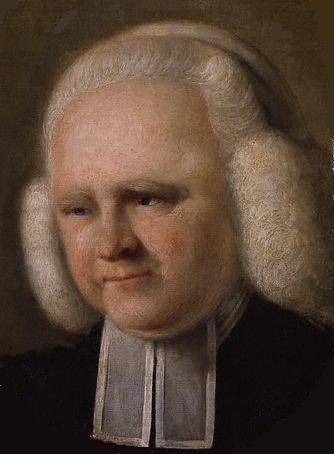
Stepping back before the nineteenth century, Davis spends several minutes (which I assume translates to several pages) describing the ancestry of Aaron Burr, one of America’s bad-boy politicians of the period. Burr was a grandson of the reformed minister Jonathan Edwards and this circumstance leads Davis to recount a bit about the Great Awakening. The first major religious revival on American soil, the Great Awakening spread throughout the States in the 1730s and ‘40s, setting the reputation of the young nation as a bastion of Reformed Christianity. Although many denominations became involved in the show, the origin and orientation of the Great Awakening was Calvinistic. Reacting against enforced Catholicism in much of Europe, many colonials flocked to America to practice their stripped down, Bible-based, generally intolerant religion in the New World. Particularly interesting in Davis’s rendition is George Whitefield. Viewing the preacher from hindsight that includes a distorted religious view of American history, Davis notes that Whitefield was as much performer as preacher.

Trying to figure out the next hot trend

Whitefield was an Anglican priest who helped set the mold for John Wesley’s success in bringing what would become the Methodist Church to America. “Whitefield pioneered the development of multiplatform marketing strategies,” using the media and staged events to draw attention to his evangelistic efforts, according to Davis. Whitefield knew that religion alone could not sway the masses. They had to be entertained. Davis notes that even the Tea Party has corollaries in early American history. What the mainstream has been slow—perhaps too slow—to realize is that entertainment works. In casting the die for American spirituality, preachers like Edwards and Whitefield knew the value of the gripping sermon vividly illustrated. The antics of many Tea Partiers reveal that they learned the lesson well. Showboating will garner more votes than substance any day. How else can we explain Ronald Reagan, Sonny Bono, Jesse Ventura, and Arnold Schwarzenegger? This is America’s truest legacy: entertaining with religious faith will take you where intellectual depth just can’t go.

I will have to wait for another car trip to hear more of Davis’s interesting perspective on American history, but in the meantime I wonder how long it will take intelligent Americans to catch on. Don’t Know Much About History is a frighteningly prescient title for those who continue to ignore religion as a political force.


Tea Party Science

I sometimes jog in the morning before the sun begins his course across the sky. Funny thing is, sometimes I beat him. I know the sun is a guy because the Bible says so. When I startle a bunny from its hiding place along my path, I am amazed that those little creatures chew the cud just like bovines. It is the word of God. Occasionally a suicidal insect tries to fly into my mouth, and unless they go about on all fours, with legs above their feet, I spit them back out. If they do meet Leviticus 11’s strict standards and I accidentally swallow, I try not to think of Deuteronomy 14.19. I am surprised that the Tea Partiers haven’t tried to correct science on this point: the Bible is clear that insects (technically “flying creeping things”) have four legs, not six. Open your eyes people! Six legs? All those sixes seem to be from the antichrist. That’s why I feel comfortable with the potential of handing our nation over to the Tea Party. Certainty is better than scientific orthodoxy, hands down.

“I don’t know how much God has to do to get the attention of the politicians. We’ve had an earthquake; we’ve had a hurricane. He said, ‘Are you going to start listening to me here?’” The words are those of Michele Bachmann. Those of us who were taught that hurricanes result from the heating of Atlantic waters, swirled by the rotation of the earth (it does not move, according to the only proven source of science, the Bible) have egg on our faces. Do I ever feel silly! Empirical evidence suggests that the earth’s crust consists of tectonic plates that sometimes bump and rub and pull apart. Earthquakes result. Last week’s earthquake creates a problem for me, however, since North America is not mentioned in the Bible. I now live in a country that can’t possibly exist. We had better elect leaders who know how all this really works.

According to a Religion News Service poll this year, 40 percent (that’s more than half, in Tea Party mathematics) of Americans believe natural disasters are signs from God. I am relieved that this clearly shows science to be wrong—surely that many individuals must be correct. That’s the way math works. I sometimes imagine the United States as the Titanic (movies are another good source of science). Ismay, the Tea Party, declares, “But this ship can’t sink!” Thomas Andrews, the engineer (representing science) replies, “She’s made of iron, sir! I assure you, she can… and she will. It is a mathematical certainty.” Ismay, believing the rich are too wealthy to die tragically, refutes the findings of science. When the colossal ship slips into the icy Atlantic, however, he’s nowhere on board. Like the rest of his party, he’s already secured himself one of the rare seats on the lifeboats inadequate to save those of us in steerage. Since the ship can’t sink anyway, why are we even worried about this?

Full speed ahead and damn the icebergs...


Religious Democracy, Media Style

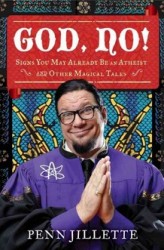
A delightfully witty book review appeared in yesterday’s newspaper introducing Penn Jillette’s book God, No! Signs You May Already Be an Atheist and Other Magical Tales. Having just learned of the book I’ve not yet read it, but I am intrigued. Penn Jillette is best known as the talking portion of the magic-debunking duo Penn and Teller. Having forged a career of exposing false claims to the supernatural mystique of stage magic, Penn and Teller delight in bucking the orthodoxy of the guild and showing that anyone clever enough can fool many people into believing what they know can’t be true. They are exploiting, of course, a phenomenon that neuroscientists have been exploring for a number of years: human brains retain belief even in the face of disproving evidence. Many religious believers call it “faith.” According to Hank Gallo, author of the review, Jillette uses his book to endorse atheism as the only real option for a thinking person. The book is generally categorized as humor.

Although Bill Maher’s Religulous makes many good points from a similar perspective, one of the haunting realities poised for religious specialists is almost a chiaroscuro with excessive contrast. It takes no special training to be a religious specialist. That is hard news to hear for those of us who’ve spent over a decade of our lives and thousands of dollars learning the trade. Comedians and others who are famous will impact far more people than this little blog ever will. Rick Perry can call together thousands to pray to pave his way to the White House. Maher and Jillette can poke fun at religious yokels and scholars will sit at their desks ignoring the crude efforts of those who have no training. There is no doubt, however, as to which will reach a wider audience.

Harry Houdini famously debunked spiritualists in his day. Like Penn and Teller, he was a stage magician who recognized that people could be easily fooled. He was able to expose mediums that scientists and academics of his day failed to uncover. It seems that those with access to the most basic of human desires—the will to believe—gain credibility more readily than an erudite yet obtuse specialist with several odd initials after his or her name and several obscure books to his or her credit. Those in the media have direct access to the mind of the public. If the tent is big enough the whole town will show up for the circus. The truth may be out there, but the minds of the public are won over by those who entertain, not those who bury themselves in dusty tomes and seldom see the light of day. The fact is people want to believe. Until a better alternative is offered, we might prepare ourselves for a long round of Texas Hold’em and a Tea Party or two.


Tomorrow Ever After

Last night as we said goodnight to Irene, my family decided to watch The Day After Tomorrow. Beyond The Perfect Storm and Twister we didn’t have any other weather-related disaster movies on hand. I became convinced long ago that weather was somehow key in the conception of divinity. Working at a seminary that required attendance at chapel twice daily where we would lugubriously and laboriously recite every verse of every Psalm according to the unforgiving schedule of the Book of Common Prayer, I began to notice the weather. Among the more common images used in the “hymnal of the second temple,” weather was seen as an essential aspect of divinity. Religions with celestial orientations frequently view the sky with a sacred aura. I began to compile all the Psalm references to the weather and eventually brought them together into a book, still unpublished. What became clear at the end of this exercise was that ancient people had no way to interpret the weather other than as a divine phenomenon. Listening to all the hype about Irene, it still seems to be the case.

In The Day After Tomorrow, our ill-fated teenagers are trapped in the New York Public Library as a super-chilled tropospheric wind freezes New York City. They build a fire and when you’re in a library, naturally, you burn books. I kept looking at all the furniture they spared as they consigned the books to the flame. A minor character called Jeremy is shown clutching a Bible. A girl named Elsa asks if he thinks God will save him. Replying that he is an atheist, Jeremy says that this is a Gutenberg Bible, “This Bible is the first book ever printed. It represents the dawn of the Age of Reason. As far as I’m concerned, the written word is mankind’s greatest achievement. You can laugh, but if Western Civilization is finished I’m gonna save at least one little piece of it.” This little dialogue represents the full circle of the celestial god. Jeremy doesn’t believe in this god, and the Bible requires human protection. Instead of being the instrument of war and political badgering and tea parties, it is seen as a symbol of enlightenment. It represents the first steps toward reason.

As Hurricane Irene still gusts outside my window, dropping rain as if New Jersey were a desert receiving its first drink in a century, the Tea Party is busy crafting ways of getting the Bible back in the White House. Their Bible is the antithesis to the Age of Reason. It is the symbol of superstition and prejudice and authoritarianism. It is the means of political power. The god of the Tea Party is a white-bearded man living in the sky, sending his fury against the liberal cities of the East Coast in a mighty wind. He is the punishing god of the Psalms. As the helicopter lifts off over a frozen Manhattan, the teenagers saved by a flawed father who walked from Philadelphia to New York to find his son, the camera pans across Jeremy as he hugs the Bible to his chest. I was in Boston for Hurricane Gloria back in 1985. Watching the waves crash on the beach at Winthrop I felt the power of fierce nature at the beginning of my own journey to, I hope, enlightenment. When it was over, however, there was not yet a Tea Party threatening an even worse, unnatural disaster to follow.

Irene, the early days


Six Red Flags

Answers in Genesis’ biblical theme park with its life-sized ark was back in the news yesterday. Journalists just seem to be fascinated that people really do believe in their religious convictions. Having grown up in a religious family, I understand where they’re coming from. The version of the Bible they offer to the public, however, is much too tame. I spent the day dreaming about a literalist Bible theme park that would put Evangelical Christianity back on the map. I’m thinking it should be in Rick Perry’s Texas and we could call it the Literalist Six Red Flags.

The first attraction would be the Garden of Eden—sans clothes. If we’re going for the full Bible experience we should go all the way. The full Methuselah. For those who are worried that this might lead to morality concerns, I would assure them that experience belies that. From the few nude beaches I’ve stumbled upon—who would’ve thought there’d be one in New Jersey? New Jersey!—it is my guess that this might be the most effective way to scare kids into religion. Why pass up an evangelical opportunity like that?

Station number two would be the Egyptian Late-Term Abortion Clinic. By this I mean Exodus chapter 1, with a nice tie-in to Leviticus 20 and Psalm 137. The pro-lifers could leave a little green but very self-righteous after seeing what the Bible prescribes for uppity children.

Our third flag could be the battle of Jericho. Especially interesting for the kids would be the visit of Joshua’s spies to the prostitute who betrayed her city. Children could blow on ram’s horns, carry a plastic ark with authentic death-rays emanating from it, and shout while the Styrofoam walls come tumbling down. If they wanted to be really literal, however, they’d have to explain that archaeology demonstrates that Jericho had been abandoned for a century before Joshua showed up, but who wants to dampen all that youthful, Christian bloodlust?

Flag four could be the story of Samson. After leaving his first wife to visit a prostitute, kids could watch in fascination as Samson heaves the city gates of Gaza from their place, showing that the Lord approves. Since he’s a muscleman who likes to have affairs, maybe we could check to see if Arnold Schwarzenegger is too busy to take on the role of God’s version of Hercules. I’m sure that Delilahs would not be too difficult to recruit. Perhaps this could be an audience participation event.

Attraction five has to be the Story of David. This would be a good opportunity for parents distraught after the previous stations to take out some aggression with the sling. I’m sure my friend Deane could come up with some giants for them to practice on. Otherwise, maybe something could be worked out with the NBA. After killing a few giants, the station could lead to the palace roof with a view to Bathsheba’s bathroom. Since David didn’t want to send her to the clinic (see station number two), he decided to have her husband killed instead. Maybe we could have a side exhibit: Uriah’s Last Ice Cream Stand. (He was only a Hittite, after all.)

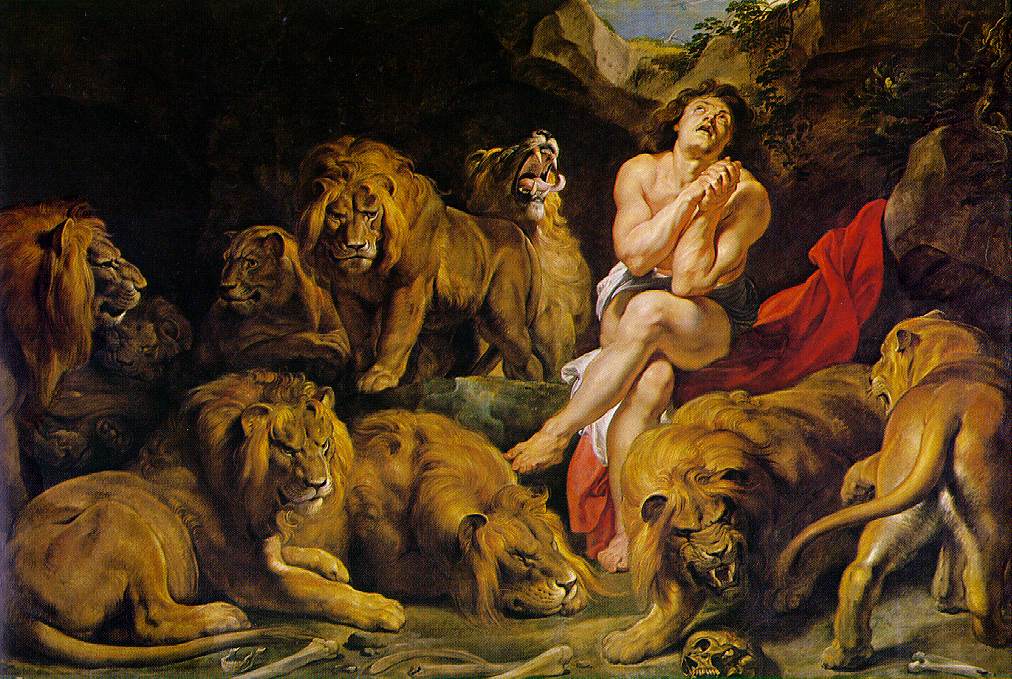
Our sixth red flag would be the Lion’s Den. Here we could offer Tea Partiers and NeoCons the opportunity to prove their faith by spending a night in a den of hungry lions. They like to claim loudly that their faith is being castigated, just like Daniel’s was—here would be the opportunity to prove it! Somehow I believe that the lion’s den would remain empty and crickets could be heard chirping throughout our Literalist Six Red Flags even before it opened its festively decorated gates.

"Oh please let Rick Perry be nominated!"


If God Could Blog

My wife pointed me to the current Shouts and Murmurs section of the New Yorker online; this issue’s is “God’s Blog” by Paul Simms. It is witty, as usual, and the comments outshine the divine post. I had a good smirk and soon forgot about it. I found my thoughts turning to recent events and the idea of God blogging returned to me with a greater intensity. What if God could blog? The responses of online experts might be notoriously predictable.

Most politicians and Tea Partiers would fail to recognize the author, I’m sure. The conservative life-style and outlook have their own particular structures that may have had roots in Christianity at one time, but have now taken on an agenda of their own. God, admittedly a long-haired liberal in his last incarnation, certainly doesn’t advocate the way his dad’s name is taken in vain by such political bluster. I suspect he’d be denied more than three times before the stock market bell sounds.

The theological liberals would probably find such an anthropomorphic activity distasteful for a being as abstract as the divine. After all, by stooping to our level and showing himself active in the world he would be raising the ugly question of theodicy again. If the Big Guy can afford the time to type out a blog post from his android in the sky couldn’t he at least solve one of the more pressing human problems such as starvation or war?

Bibliobloggers would surely rate his posts pretty low. Erudition is born of online prestige and although God is a big draw, his book is still a bestseller and literary types are much more comfortable deconstructing the written word. Besides, since he doesn’t belong to any denomination (or monotheistic religion, for that matter) his authoritative comments would certainly be disconcerting.

I suspect the atheist camp would suggest it was all a hoax. With sufficient skill the source of the posts could be pinned to a physical machine and the words themselves would be traced to a physical brain that is no more than an organic computer. The God Blog could safely be ignored.

We live in an age that has outlived the need for a live feed from the divine. Real-time responses from on high would make everyone uncomfortable. Since we construct God in our own image, those who blog already know what the divine would write if s/he could blog.


Finding Nemesis

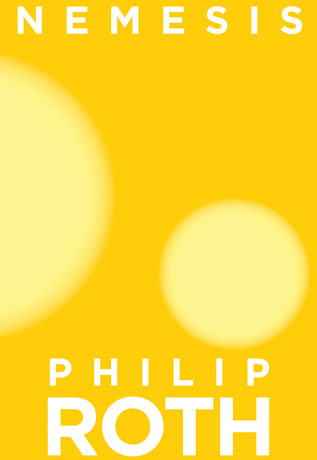
Philip Roth was an author unknown to me (shame on me!) until this summer. Over the past several years I’ve taken it upon myself to read my daughter’s high school novel-reading assignments so that we can stay current (in an aspect where a parent is permitted to do so). Her school requires summer reading and this year Roth’s novel Nemesis was on the roster. As a recent book, it is unusual in being assigned before the test of time has rendered its verdict. Set during a fictionalized polio outbreak in Newark in 1944, Nemesis follows the fortunes of Bucky Cantor, a Jewish physical education teacher in charge of a summer playground program in Newark. As his kids begin to fall to the disease, the protagonist flees to the Poconos to be with his fiancée at a Jewish summer camp. As the situation deteriorates, Bucky questions God’s role in the world of disease and in the war that continues to rage in Europe and the Pacific.

It is the classic issue of theodicy. Having been raised in a tradition that espouses God’s goodness, the protagonist has to face the death and disabling of children by a disease for which there is no cure (at the time). The issue of God’s role in the disaster is a recurring theme throughout the book. In the final chapter when the atheist narrator—himself a victim of polio and one of Bucky’s former students—questions Cantor about his beliefs, Bucky holds onto a dogged insistence that blame must be ascribed. His student opines: “it’s a medical enigma… His [Bucky’s] conception of God was of an omnipotent being who was a union not of three persons in one Godhead, as in Christianity, but of two—a sick f**k and an evil genius.” That statement gave me pause. Traditionally theodicy assumes the goodness of God and tries to bend the facts to fit the premise. Here God is in the dock and all interpretations are permitted in cross-examination.

The angst of dealing with the concept of omnipotence is real enough. In this Tea-Party world where selfish personal aggrandizement is seen as divine prerogative while children starve in misery and die painfully on an hourly basis, very real questions should be asked. Instead, most people assume the religion they have been taught is correct: often the facts of history are distorted to make such a belief match pre-decided outcomes. God is good as long as I get my share.

Reviews of Nemesis have been mixed, but Roth does a powerful job in his final chapter of this novel. The action is almost as predictable as the heat of summer, but the real substance, as usual, lies in the interpretation of the events. When God is brought into the equation, the temperature is sure to rise even further.


Holy Land Grabs

Civilization began in the “Middle East.” Ever since then, it has been a struggle to keep it together. One of the sad realities of the last century and continuing into this is that peace in this region seems as elusive as a Tea Partier with compassion. Claims to land are among the most complex of human inventions. Having never been a property owner, I’ve only ever watched this from the sidelines, but I know the endless surveying, assessing, and negotiating that goes into drawing invisible lines across the surface of our planet in order to determine who owns what. At least as early as the Code of Hammurabi, the placing of property markers was considered the concern of the gods. Humans are clearly among the most territorial of animals.

When my wife showed me a CNN story about an archaeological dig at Khirbet Qeiyafa in Israel, this old issue raised its weary head once more. The site, whose ancient name is not yet known, is being suggested as “the city of David” by archaeologist Yosef Garfinkel. The evidence for the suggestion, as far as I can tell from news reports, is that the city fits the right time period and lacks pig bones. With the Bible’s great claims for David’s very large kingdom, archaeologists have been unable to find evidence that such a grand entity ever existed. David himself is not historically attested outside the Bible. Those who make land claims based on a putative gift of God, however, must find physical evidence to back it up. This wish hovers like a dove over every excavation.

The death of an archaeologist

Archaeology has frequently been commandeered by special interest groups. The field of study began in the “Middle East” to find evidence for the historicity of biblical stories, some of which were never intended as history. Daunting emotional claims, however, weighed heavily on the minds of those who led the excavations. The Bible made what they supposed to be historical claims, so the physical evidence had to back it up. When Jericho was excavated and found to have been abandoned at the time of Joshua not a few heads were scratched. Archaeologists returned to the city in later excavations to try to question the results. Jericho was a ghost town long before Joshua came along because the story of Jericho has something more important than history to convey. That larger message, applicable throughout the world, seems to be: don’t base claims to special privilege on the Bible. Tea Partiers could even learn a thing or two from that message as well.


Lions, and Politicians, and Bears


A man was eaten by a lion in Zimbabwe yesterday. A boy on his way to school in Alaska was attacked but relatively unharmed by a brown bear. Predation. Much of the way humans act is based on our long history as both predators and prey. Evolution (may not apply in Kansas or Texas) has designed us to cope with these constant stresses of finding enough food and avoiding becoming food. A great deal of religious behavior can be traced back to avoidance of predation and success in the hunt. We like to think that we are somehow not animals, but animals are smart enough to disagree. Just ask that cheeky squirrel that finds ingenious ways to circumvent all the deterrents you put in place to assure that those seeds go to needy birds, not fat rodents. We are part of the mix. Our opposable thumbs help immensely; we build our own ecosystems to keep lions and bears out.

Yesterday was a day of predation. Even within the human sphere we find that killing others is permissible, as long as it is done slowly by those in fine clothes and fancy automobiles. Depriving the less deserving is a time-honored human behavior, after all, survival of the fittest only applies to animals, not us. Right? By backing policies that protect the wealthy in their lofty sanctuaries while others shiver in November’s Tuesday chill we show human nature. Humans are predators as well as prey.

Intriguingly, many politicians who support laissez faire economics deny evolution exists. Instituting policies that ensure survival of the wealthiest, they deny up and down that evolution has anything to do with the way that we are. It’s all in the nature of the evidence. And nature itself is evidence. We may be the smartest, most well adapted of the mammal class, and yet we can be eaten. What does the evidence suggest? From the point-of-view of a lifelong observer of religion, it suggests we are still the prey. When religion stealthily crawls into bed with politics, it is evident that even religion itself may be a deadly predator.


Zombie Walks

As October nears its creepy climax, signs of the macabre have become abundant. A trend that has reached new heights in recent years is the zombie walk. Various cities or regions host large groups of brainless, reanimated corpses in parade (rather like a Tea Party, I should imagine) to welcome in the darker half of the year. In a most unconventional display of cultural unity, groups of strangers meet for the purpose of sharing their fascination with the undead. Given the inherent potential for overly enthusiastic participation, these events are usually held during daylight hours and are becoming as accepted as trick-or-treating on Halloween.

Fear of death is sublimated in a conquest of the same with less definitiveness than traditional resurrection, but with a more gritty and graphic triumph of life. Organized religions have had difficulty maintaining numbers in much of the “developed world” while this new danse macabre has taken on a life of its own. Many find claims of divine authority in institutions that refuse to make clean breaks with sex scandals or threats of Quran burning somewhat disingenuous, while nobody questions the motives of zombies. They simply do what it takes to survive. An honest zombie stumbles toward eternal life.

Credibility is less easily commanded than it had been in former times. While many voices, such as Tea Partiers’, are claiming the need to erase the sixties and seventies and subsequent decades from the calendar so that the authoritarian Father can be returned to power, thinking people are asking what the plan might be. Is it time to break down that putative wall between church and state and declare America a plutocratic, evangelistic Republic? Never mind that inevitable conflicts will break out over who has the right to set doctrine and public policy – most citizens will be found out walking with their fellow zombies, welcoming in the darkening season.


Empty Pews

An insightful op-ed piece by Robert D. Putnam and David E. Campbell in yesterday’s paper asked the question “why youths are losing their religion.” The authors, professors at Harvard and Notre Dame, respectively, answer with the suggestion that religion and politics just don’t mix. The truism that religion and politics are taboo subjects of polite conversation was widely accepted in my younger years. During the Reagan campaigning era, however, it became clear that some unprincipled louts were drawing religion into the political mix to garner votes. Those who actually research Reagan’s religious convictions are often surprised to find that they are not as “George W. Bush” as everyone thought. It was a ploy, and a vastly successful one at that. A new avenue had been paved, however, for hotly contested elections: use the Bible. The fawning attitudes of many Americans toward the Bible they seldom read is a powerful political tool.

Putnam and Campbell note that adults coming of age in the 1990s and later have been alienated by this paring of religion and politics. The results have tended to be the rejection of organized religion that is seen as hypocritical and intolerant. The interesting factor is that it is the political agenda that is hypocritical and intolerant, but organized religion is paying the price for going along with the Ralph Reeds, Jerry Falwells, and Pat Robertsons of the early religious right. One guy from an old book once said something like “what you sow you also shall reap.” The political use (abuse) of religion has only and always been about power.

The authors are able to provide statistics to back up their models, but their reasoning is clear enough on its own. Some of us have experienced first hand the ugly, hideous agenda behind the angelically smiling evangelistic face. Those who hold to it may be naïve enough to believe that it is actually religion that they are serving, but the sad truth is their positions are cravings for power. There are those who actually relish the days of imperial Christianity when, despite its Roman Catholicism, the church made Europe tremble. They forget that pilgrims and colonists moved to this land to flee such tyranny. Americans, reluctant to elect Roman Catholics to the presidency because of the latent fear of a hierarchical religion — so close to kingship — now bow down before political rulers in religious garb. Decidedly Protestant. And the Tea Party continues to crank out candidates who do not even realize that the separation of church and state is a founding principle of this nation. If there is a backlash coming, it is a well deserved one indeed.


The Power of Hope

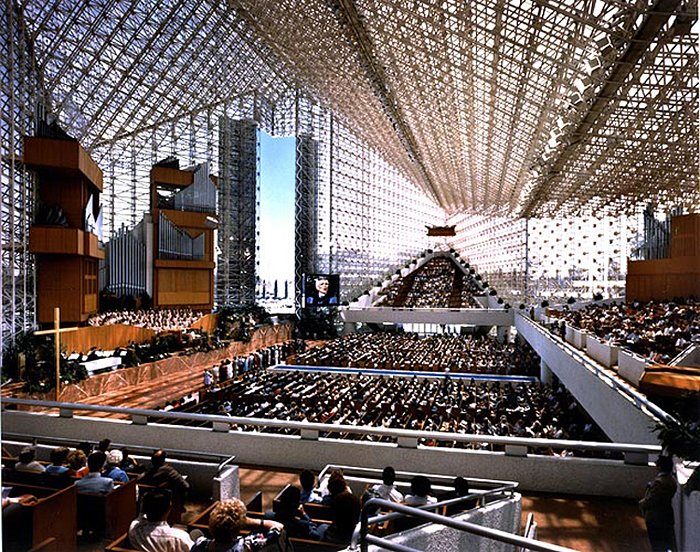
My wife pointed out at article on MSNBC yesterday that stated Robert H. Schuller’s Crystal Cathedral is filing for bankruptcy. Internet reaction has been predictably hostile, clawing at the craven, money-driven industry of television ministry. There is no question that many television ministries quickly grow corrupt under the lure of immense wealth. The average American citizen is glad to part with some money if it can buy favor with the man upstairs. When a minister is able to construct such edifices as the Crystal Cathedral with the good-will offerings of the faithful, well, s/he’s an entrepreneur, the kind of people God likes, according to the Tea Party. Schuller was famous for his positive thinking and insistence that God will do great things for you. When recession hits, however, not even God remains solvent.

According to the article, various corporate sponsors of the Cathedral are having difficulty holding up their end of the contract. Positive thinking extends only as far as the goodwill of the banks. Is there any question who the real god is here? Americans love the non-biblical concept that God helps those who help themselves. Making more money than a humble clergy-person ought to make may improve the sense of optimism, but it loses touch with where the average citizen lives. It is easy to be optimistic when you have a heavenly bankroll on your side.

Yes, but can it keep birds from flying over your head?

Over the weekend my family looked at slides from our years in Europe. The great cathedrals, even if in ruins, convey a sense of stoic strength, genuine commitment. Built with the hard-won resources, if not the actual physical labor of the local populace, these cathedrals were made of stone. I recall standing in the nave of Salisbury Cathedral while the tour guide pointed out that the very stone pillars supporting its huge steeple were bowed under the weight of all that stone above. Some day it may collapse under its own pressure, but it will have always survived longer than the Crystal Cathedral. Religion, if I may use a metaphor, is more authentic when it deals with stone rather than glass. The religion that struggles with the intractable realities of daily life will inevitably last longer than the feel-good, glass-plated, Tea Party serving “religion” of feel-good Christianity. It is too bad about the Crystal Cathedral, but maybe the entrepreneurs should be asking serious questions right now about which god they truly serve.