Playing Piano

It must be very difficult to write books that make the future believable. With the speed of technological change, it’s getting more difficult all the time. Some exceptions are modern dystopias that take civilization back to square one. We’ve come close enough in reality already to be able to imagine such things. While not really a dystopia—although it kinda is—Kurt Vonnegut Jr.’s Player Piano extrapolates what a future in the service of machines might look like. Some elements are incredibly 1950s—everyone still smokes, all communication is on paper, computers run by punchcards, and attitudes are hopelessly parochial—while others are on point for today. The world has been mechanized and an even more obvious class system than our current one has been established. Of course, those top few reap all the rewards and wonder why those below them are dissatisfied.

What’s really noteworthy, though, is that Vonnegut uses religion to address the situation. In this, his first novel, he has a minister leading the revolution against the system. This clergyman does so by finding and nominating a “messiah”—a figure around whom the dissatisfied might coalesce. In a world many characters characterize as evil, the solution is offered by religion. Well, not exactly. Vonnegut’s famous satire is beginning to appear even here and the revolution that religion fuels can’t overcome the human love of machines and gadgets. In many respects, this book is an extended parable. I can’t help but think that Vonnegut would’ve recognized our love of devices as a symptom of his humanity being declared useless by machines.

Kurt Vonnegut isn’t a religious writer, but like many authors he recognizes the motivating power of belief. There are agnostics aplenty in Player Piano, Indeed, the protagonist is never sure of what he believes. The larger questions, however, still persist: do we advance human potential by making things easier? All of us now have to be varying degrees of experts on computers to find even the most rudimentary jobs. There is really no opt-out anymore, and what’s more, few would take it if there were. The phone in my pocket has changed my life in ways I can’t call entirely good. As we get closer and closer to our media, we’ll want more intimate contact—implants are already starting to exist. Vonnegut, in his sardonic way, was asking even in the early 1950s if we had really improved our lot via such invention. In the end, of course, it doesn’t really matter because for better or worse, our tech is here to stay.


The Deity Electric

The title set me back. “Deus ex machina: former Google engineer is developing an AI god.” The article in The Guardian is surprising in several ways. Firstly, technocrats tend to suggest that since there is no deity, worship of said non-entity is a waste of precious time. Is this, then, an acknowledgement that those of us who’ve spent our lives on religion may have had at least an inkling of the truth after all? Scientific studies have repeatedly shown that religion is an inherent, and perhaps unavoidable, aspect of being human. Whether you call it inspiration or superstition, we think in religious terms. It’s entirely natural. Perhaps it’s evolved behavior. It’s anything but absent.

Another aspect of the article that generates wonder is the idea that we can create God. Yes, analysts have long claimed that we humans made God in our own image. Traditionally, however, the very concept of God was based on the idea that there was something non-human about the deity. Artificial Intelligence, however, makes the hubristic assertion that human intelligence knows enough to create a god. We don’t even know enough to elect a sane person as president. Looking at the wider world—let alone the universe—there is so much we don’t know. Our five senses are limited. There are realities which we have no way to measure. Is is perhaps not dangerous to make a divinity when our own way of looking at the universe is so terribly limited? What if I don’t like the god you build? At least with the old fashioned one we can shrug our shoulders and sigh, “that’s just the God there is.”

Any fulfilled future humanist will need to find an outlet for this need to worship. Can we truly respect a deity whose transistors we’ve manufactured? This Godhead will be, at the end of the day, only 0s and 1s. And what’s more, we will know that. Traditional religions have given us gods from the outside. Some of them are flawed, some are perfect, but they all have this in common—we didn’t make them. The universe imposed them upon us. Throughout history people have attempted, in various ways, to build their own gods. It generally doesn’t end well. It’d be like designing your own parents. They made you what you are and what would you be if you could somehow reverse engineer them into more perfect versions of themselves? Can we invent gods? Oh yes. We do it all the time. But when we set about making one that our disembodied, downloaded consciousness can worship we might want to consider the history of such attempts.


Ned Ludd and Company

I’m sure you’ve seen them too. Maybe in the movies, or on a newsreel, or maybe on a filmstrip in school. I’m referring to those scenes, usually in some foreign location, where bicycles, ox-carts, cars, buses, and pedestrians all crowd the same streets in a holy confusion of conflicting human intentions. Some can afford no transportation at all beyond their own feet. Others can own, and use, automobiles. On a scale like this I’d put myself around either the bicycle or ox-cart-driver level. I’m referring to technology, of course, and not actual transportation. At a recent family discussion I was left completely in the dust and exhaust fumes of new technology, trying hard to comprehend the words that other family members were speaking so fluently. Software names, devices that do things I can’t divine, and what is a dongle anyway? I’ve fallen behind not only on my movies and books, but on technology as well.

Tech develops quickly despite how slowly the rest of the world moves. Some members of my family don’t have computers or use the internet. Others have devices so advanced that they might’ve been salvaged from Roswell, and I wonder how all this happened when I thought I was paying attention. I’m a late joiner when it comes to tech. Although I’d been warned, I made it through my Master’s degree having barely touched a computer. When I took a decidedly low-tech job teaching at a medievalizing seminary, we couldn’t afford television service and we haven’t really watched TV since. Now I hear that you don’t need to pay for the privilege. If you have the time, black boxes, sticks, and even software downloadable on your phone can be your television. I look at our flatscreen at home and wonder where the on/off switch might be. How have I fallen so far behind the times?

The real problem, from the view on my bicycle seat, is that in order to maintain some level of expertise in my field of study, I have to dedicate quite a bit of time to it. While others tickle their devices on the bus, I’m reading my books made of genuine paper. I’m thinking such activities will make me better informed. Most of these books address the past. If I want to upgrade from to an ox-cart, however, I have to learn a whole new language and the nouns that accompany pieces of hardware that look an awful lot alike to these antique eyes. Perhaps we have become cyborgs after all, and I just missed the introductory session. I wouldn’t know; I’m too busy trying to keep this bicycle out of the path of that speeding lorry.


The Consequences of Being Smart

A few years ago my wife bought me a smart phone. Being lifelong Mac users, the iPhone was the model of choice. I don’t have the intense connectivity issues of the young, I guess, so I don’t use it for texting or surfing the net. It’s great for holding bus tickets, though, and navigating in unfamiliar places. I’ve grown quite used to the convenience of having the internet in my pocket. Such a smart device. Naturally, one smart device in a family will breed others. We all have iPhones now. Like most Apple products they’re hermetically sealed and have few moving parts. The user need not know what goes on inside. It’s the very definition of a black box.

Then my wife’s phone went rogue. Suddenly it stopped picking up 3G signals (these are older models, after all). Now, you can’t just open up a black box and look inside. Even if you could I’d have no idea what I would be looking at. So I called tech support. My wife keeps music and photos on her phone, so we didn’t want to lose anything. Little did I realize that I’d just committed two-and-a-half hours of my life to phone repair. Before I was done, I would come to know six discrete people at differing levels of intimacy as we worked together to figure out what might make a black box tick. I spoke to Apple support and our service carrier. They put us back through to Apple support, and they had to call us back because the process was a lengthy one. In the end, it worked. The phone was restored to its former glory, but I had lost one of the very brief evenings I have.

One of the typical sci-fi, or apocalyptic, scenarios is the person or civilization that builds something s/he it can’t control. Like a biblical plague, we’ve unleashed a technology that makes our lives oh so much easier but ever so much more complicated. In addition to our professional expertise, we all need to understand, to some degree, technology. Technology and deity have begun to share blurred lines. It’s as if many believe it will save us. At the end of the day, however, we have to assert that it is here to serve us. We are the gods and technology represents the lowly beings we’ve created to do our bidding. Then again, those who read ancient stories know what happens when the gods create a servant race. I’m lucky that all it cost me was two-and-a-half hours, and not some even greater sacrifice.


Size Does Matter

While not exactly a Luddite, my grasp on technology is tenuous. I grew up in what may be the last generation where computer use was considered optional—I made it through a master’s degree without ever using one, and could have managed my doctorate without. Like many of 1960s vintage, I resisted computers at first, somehow believing that the status quo ante would ante up and resist the technobabble that was already beginning to bubble just beneath the surface. I never really had a clear idea what a byte was, or how a simple 0 or 1 could be used to convey complex information. I heard about “blogs” but had no idea what they were. Next thing I know I found myself writing one. To my way of thinking any kind of log is essentially a “once a day” thing, although I know bloggers who post remorselessly all day long. At the beginning I was confused until a friend gave me some advice: don’t write too much in any one post. Keep entries down to about three to five paragraphs, and between 300 and 500 words. That way, he intimated, people will look at it.

Recently, wondering why amid the millions and millions of pages available on the web, mine gets so few hits, I read something by an “industry analyst.” (That phrase makes me shudder, but this is no place to be squeamish.) Want more hits? he provocatively asked, followed by—here are the tips. One of his first bits of advice was write longer. At least three times longer than I do (1,500 word minimum). I don’t know about you, but I often think of such things in holistic terms. That’s a lot of words to ask someone to read. If you’re going to put that much together, you’d better have something really profound to say. You’re asking for an investment.

Those of you who know me will understand that multiplying words is not an issue. In addition to this blog I write both fiction and non-fiction books and stories (the vast majority of which have never been published). I answer a simple question with a 50-minute lecture. In other words I have other words. I just tend not to think that you necessarily want to read them all at once (or at all). It’s obvious that size does matter. I can’t help being disappointed when I open a post and find I haven’t the time to read it because it’s just too long. Life’s not fair in its allotment of time. As usual, I err on the side of caution. I value your time to take up too much of it here.

Image by Scarlet23, Wikimedia commons

Image by Scarlet23, Wikimedia commons


Build a God

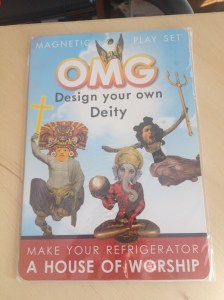
One of the more amusing gifts to find its way under my tree was a Design Your Own Deity magnetic play set. Since I have roughly only this brief holiday break for play in the entire year, I hope to make the most of it. Nevertheless, things like this always suggest something a bit more profound than they were possibly intended to do. The origin of deities is, by its nature, an unresolved question. Partly it’s because regardless of the reality of gods, religions are human constructions. Claims for revelation are frequently made, but the implementation is always our own. We can’t help but think that divinities are motivated by the same kinds of things that people are. I suspect that’s because we make gods in our own image.

img_3116

Historically there are few religions that were admittedly made up. We tend to treat with scorn more recent religions since we’ve become skeptical of a make-your-own deity talking to a person in the post-Enlightenment world. It’s much easier to believe if we say it happened long, long ago. Before we had the reassuring uniformitarianism of science, much could be left to the meddling of deities. Once we had a naturalistic paradigm, the door seemed to have slammed shut on supernatural explanations. Gods, who had been persons, now became symbols and symbols seemed to be less important than the real thing. Hadn’t we been designing our own deities all along? Now don’t we feel silly!

One of the common misconceptions of modernity is that ancient people weren’t very smart. We believe that because they lacked our technology. Looking at the way technology now demands most of my time, I wonder if that’s right. In the light of gadgets, deities have been squeezed out. I’m quite aware that the career choices I’ve made—involved with thinking about gods in some description—are hopelessly outmoded in the technological world. Still, as I look at the political landscape I see that we are still in the process of making our own deities. My play set includes some pretty exotic divinities. One that it seems to be lacking is Mammon. Of course, it’s best not to offend the currently reigning god, even if it is just a symbol.


Lap of Luxury

How terribly rude. I was right in the middle of a sentence when my word processor shut down. Then my computer. A system update. It’s 4:00 a.m., the time I usually upload my blog post. You have to understand that I get up at 3:30 so that I have time to write. My laptop assumes nobody is working “in the middle of the night.” I would’ve thought my fingers on its keys would’ve given it a clue. Now it tells me I’ll have access, new upgraded system installed, in 25 minutes. Doesn’t my laptop have all my personal details when it comes to shopping? You’d think it would know all my personal habits by now. I mean, this is the way I do it every day. Right now my concerns are secondary. This system update can’t wait. I wasn’t even given a choice. Power nap for Apple.

What disturbs me most is that my computer reads every word I type, yet it still thinks I’m just like everybody else. Who’s awake and writing at 4:00 a.m.? And I thought we had a rapport, my laptop and me. I was the Skipper to his Little Buddy. The Agent 86 to her 99. The Will Robinson to its Robot. I guess I had it backwards all the time. The brain on my lap doesn’t agree with the brain in my head. If I can’t get my writing done now, it won’t get done at all because at ten minutes to six I’ve got to be on that bus. New Jersey Transit doesn’t offer working overhead lights much of the time, let alone wifi. It’s now or never. My coffee’s already gone and the next thing on my daily agenda is the shower. I always come up with ideas in the shower—I need my Little Buddy waiting for me when I rush out to write them down.

newchair

Who’s sitting on whose lap? How could I have gotten something so very basic so terribly wrong? In ancient times the one sitting was superior to the one standing. When the computer’s sitting on the one sitting we know who’s really in charge. Let the one with eyes to read understand. I’m a busy man, but my Little Buddy—my Skipper—is busier. When’s the last time I read a paper map? Opened a phone book? Wrote an actual letter? I can hear those bus wheels rumbling. Excuse me, but my master is calling.


Radio Nowhere

Those of us who somehow managed to be educated without the use of computers, at least nothing more advanced than a TI-30 calculator, fumble our way through the world-wide web. I’ve got this blog, a Twitter and a Facebook account, and I’m on Google + and Medium, and I really don’t know how any of these things work. One of my motivations for starting this blog was to continue the tradition of speaking to audiences that I used to have in my lectures while I taught. I was told that such a format was known as a podcast and I found a host site where I could leave my recordings for free. I could then make a link and bring them onto the podcast page of this blog. How any of that works, I have no idea.

img_2855

Recently a few would-be listeners have asked what has happened to the podcasts. Since I don’t really know where they were in the first place, I’m not sure how to send a map to them now. One of my readers, however, has kindly set up a new webpage where all 23 podcasts are available. You can find it by clicking on this link. My thanks to Ahmed Fasih for setting this up. The podcasts cover various aspects of ancient religion. Even now, every great once in a while, a world-recognized name in academia will ask me about some of these topics. When you’re an academic you have the opportunity to spend vast amounts of time focusing on a single subject. The only subject you have that privilege with outside academia is money. I do hope my friends in the academy realize just how lucky they are.

In any case, the podcasts are back. Maybe now that they’re not invisible any more, and since in coming days it may be important to remember when things were better, I may find time to add to them. Blogs—at least those that are regularly read—are locations for discussion. I’m always glad to answer questions that are posted here. During the work week my time is constrained, so you might need to wait for a weekend, but I will respond. I know religion is passé. I know people have better things to do with their time. I also know that for the vast majority of humankind religion remains a vital and integral part of their lives. Exploring it seems to make sense to me. For those who’d rather listen than read, the podcasts are once more available.


Paying off College

img_2985
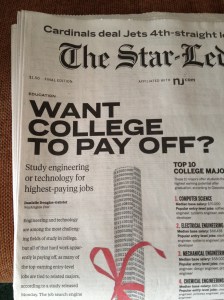
“Want College to Pay off?” the headline asks. It depresses me. I’m an unapologetic idealist. Cost-benefit analysis has its place, but that’s not all there is to education. Or better yet, cost-benefit analysis isn’t just about money. The article has suggestions for finding good paying jobs, which is what higher education is all about these days. Getting an education to increase knowledge and to benefit society in that way has become the mark of true naivety. We tell our kids not to study the arts, humanities, or literature since there are no jobs in these fields. We want them to be able to survive in a culture that has cool devices but which has lost its soul. Pretty strange for an institution (or “industry”) that began primarily to study theology.

The earliest universities focused on the then-related fields of law and theology. Since people took religion seriously, this was not the mere diversion that it is today. There are those counter-cultural warriors who study theology to take parishes to combat their increasing irrelevance, but really, the study of law and theology parted ways long ago. Neither one guarantees the return on investment that they used to. Society’s interests are in racing ahead with technology—discovering even faster ways to text while driving, or better ways to ignore those walking down the street with you. Or making money so you can build large towers in major cities and name them after yourself. We call that success. Thinking deeply about an issue, looking at it from multiple angles, and critically assessing it, these are “luxuries” that aren’t “worth” studying. College must, as the headlines say, pay off.

The rapidity with which this has transpired is truly amazing. We allow electronics to drive our culture. Who has time to keep up with all the posts, tweets, and grams that populate every second of every hour? We crowd-sourced knowledge into some great wikipedia of human experience that substitutes for taking time to look closely and think through the implications. It’s not that I despise technology—I use it quite happily daily—it’s just that I think there’s something more. I studied ancient religions and I see many of those archaic patterns beginning to repeat themselves in electronic format. It’s as if by replacing theology with technology we’ve lost sight of just a piece of what kept progress moving forward. Maybe I need to go back to college. I’m just not sure of the cost-benefit analysis.


The Religion Code

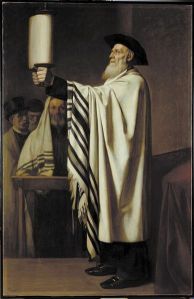
People have strange ideas about what religion can and cannot do. Yes, many religions face the past—founders of various sorts gave dictates and statutes that were appropriate for all time. At their time. Few religious visionaries can see very far into the future, so their rules have to be massaged over time. When we see an Amish buggy clopping along next to a highway we suppose that this is a religion mired in the past, but we could be wrong. The BBC ran a story the other day expressing some surprise at “ultra-Orthodox Jews” and their getting into tech fields. What hath the Talmud to do with coding? Stop and think about that.

One of the aspects of this dynamic unaddressed by this story is how unescapable the internet has made learning tech. Your religion may have you following outdated principles at home, but unless your community can get on without the outside world, like the Amish, you’ll need to learn to negotiate technology. As the article points out, learning Torah and Talmud are transferrable skills. People genuinely seem surprised when what we might broadly call “the humanities” come in handy. Religion, when it requires serious reflection, builds critical thinking skills. It is only the blind adherence to principles that haven’t been thought through that leads to trouble. Even a Fundamentalist knows that this all has to make some kind of sense or something’s wrong. In fact, the article doesn’t suggest that a Fundie as a tech expert would be any cause for wonder. A humanities education might have helped with that.

Photo credit: Musée d'art et d'histoire du Judaïsme, Wikimedia Commons

Photo credit: Musée d’art et d’histoire du Judaïsme, Wikimedia Commons

One can’t speak of Judaism as a monolithic religion. In fact, religion scholars regularly speak of “Judaisms” just as they speak of “Christianities.” The various branches of Judaism hold study of scriptures in common, and the BBC article makes the point that this kind of thinking helps with problem solving. The great irony here is that when the problem solving comes in the form of getting computer glitches worked out it is considered valuable. When the problem solving merely helps people figure out how to get along in the world it is backward and parochial. Such is the strangeness of a world impressed by its own creation. The internet has brought a great many religions together. It has, I would suggest, created new religions as well. It is a myth to suppose that the rational rules of any hypertext markup language are that different than sages and rabbis arguing over the best way to make progress in a confusing world. No matter what our religion, we all need to make money, don’t we? And isn’t that the most truly ecumenical enterprise of them all?


Mars Bars

It brings tears to my eyes. A little guy millions of miles from home. The only spark of acknowledged intelligence on the entire planet. It’s his birthday and he’s singing “Happy Birthday” to himself. It’s downright depressing. The guy, however, is the Mars rover Curiosity. It is a machine. The headline, however, jerks an emotional response from all but the coldest of individuals: “Lonely Curiosity rover sings ‘Happy Birthday’ to itself on Mars.” It’s that word “lonely.” It gets me every time. Then I stop to think about machine consciousness again. Empirical orthodoxy tells us that consciousness—which is probably just an illusion anyway—is restricted to people. Animals, we’re told, are “machines” acting out their “programing” and not really feeling anything. So robots we build and send to empty planets have no emotions, don’t feel lonely, and are not programed for sadness. Even your dog can’t be sad.

Amazing how short-sighted such advanced minds can be.

We don’t understand consciousness. We’re pretty wowed by our own technology, however, so that building robots can be brought down to the level of middle-school children. We build them, but we don’t understand them. And we may be losing part of ourselves in the process. An undergraduate I know who works in a summer camp to earn some money tells me a couple of disturbing things. Her middle-school-aged charges are having trouble with fine motor skills. They have trouble building basic balsa-wood airplanes. Some of them can’t figure out how paperclips work. One said she couldn’t write unless she had access to a computer. This camp worker’s supervisor suggested that this is typical of the “touchscreen generation.” They’re raised without the small motor skills that we’ve come to take for granted. Paperclips, it seems to me, are pretty intuitive.

Some 34 million miles away, Curiosity sits on Mars. An exile from Earth or an explorer like Henry Hudson? Or just a machine?

pia20602_sol1338_take7frontlook

Machines don’t always do what you tell them to. I attended enough high school robotics sessions to know that. Yet at the local 4-H fair the robots have a tent next to the goats, the dogs, and the chickens. We’ve come to love our devices. We give them names. They seem to have personalities. Some would claim that this blog is the mere result of programing (“consciousness”) just as surely as Curiosity’s programmed singing to itself out in the void. I’m not for turning back the clock, but it does seem to me that having more time to think about what we do might benefit us all. This constant rush to move ahead is exhausting and confusing. And now I’m sitting her wondering how to get this belated birthday card delivered all the way to Mars.


:-D

Screen Shot 2016-06-12 at 8.33.16 AM

Technology runs amok. I confess to being born before earthlings landed on the moon. I remember a world where Purelle boogers simply did not exist. A time when to read the Bible meant opening that black leather with gilt edges that suggested some unknown bovine had paid the ultimate price to wrap those red-lettered words. Then came the LOL Cats Bible. The Lego Bible. Now the Emoji Bible. Emojis are made possible by the demand of cell phone users to express that which otherwise requires considerable wordsmithing. They’re popular. So much so that Oxford Dictionaries’ word of the year is the unpronounceable 😂. I’m not even sure if you’ll see it on your screen. If not, imagine a yellow circle laughing until it cries. Or crying until it laughs. There’s some ambiguity there. In any case, bibleemoji.com offers to translate your favorite Bible verses into emojis.

A naughty little boy, I suspects, lurks inside many of us of my particular gender. So I opened a new tab and went to biblegateway.com. There I looked up Ezekiel 23.20, in the King James, of course, and copied and pasted it. The results were somewhat 😒. “4 she doted upon their paramours, whose flesh is as the flesh of asses, & whose issue is like the issue of 🐴s.” I don’t know about you, but I see several missed opportunities there. A picture, they say, is worth a thousand 📚. Is there an emoji for “words”? Can there be? I’m trying hard to keep within my word quota here, so please bear with me.

I’m hoping against hope that unicode has kept up with my puerile fascination with rebus writing. It seems likely that all writing began that way. Draw a picture of what you mean and, with a little luck, others will understand. The capital A, for example, represents the head of an ox. It’s easier to see if you flip it upside-down. Better yet, just write it this way: 🐮. The ancient Egyptians, one gets the impression, would’ve been proud. After all, we call their labor-intensive communication system hieroglyphics, or “sacred writing.” It was inevitable that what some consider holy writ would eventually come down to the lowest common denominator. Still, I’m somewhat disappointed. When I dragged my mind to more lofty verses all I found were simple textual changes to my requests. Perhaps it’s for the best. When I tried “Jesus wept” I got “jesus wept” rather than the expected 😭. 😦


Evolving Technology

Speaking of prediction, after yesterday’s post my wife sent me a BBC story entitled “The Machine Stops: Did EM Forster predict the internet age?”. Although the story by Chris Long is classified as Entertainment and Arts, the issues raised are very serious. Vital even. Now I have to admit that I’ve never read E. M. Forster’s work. As much as I love short stories, I tend to use my reading time on novels and non-fiction and Forester’s focus on class distinctions isn’t what I always find the most engaging. Still, as the BBC story makes clear, what makes “The Machine Stops” so important isn’t its “prediction” of the internet, but rather what that envisioned technology does to people. It changes them. One of the unrealized facets of evolution is that our fellow beasts without opposable thumbs have fallen somewhat behind in the race to invent technologies that impact the entire planet in an intrusive way. No atomic bombs have been built by whales. Of course, I’ve always suspected they’re smarter than we are.

With the internet—a kind of accidental technology—we have changed the world for most people. There are still many millions who aren’t constantly wired, but for those of us who’ve allowed ourselves to become assimilated, we can imagine life no other way. I, for one, couldn’t do my job without the web. Well, I suppose I could, but expectations would have to be much, much lower. And my check couldn’t be deposited electronically into an account that I have to take it on faith really exists. Long, in this BBC piece, notes that the poignancy of the story is that being connected by an “internet” changes the nature of human interactions. Anyone who’s shared an elevator with three other people all texting their friends simultaneously knows what I mean. I’ve gone entire days without an actual human being uttering a word to me. And this is while working in a city of 8 million people. Keep the business virtual. Are we not men? (Pardon the gender-based noun; it’s only virtual.)

2015-11-07 18.47.57

I’ve loved and lost many readers on this blog. Those who are perceptive will realize this is merely an electronic voice meant to replace a human one. A voice, if I may be so bold, crying in the webberness. Technology changes us. I bought my first computer to be a glorified typewriter. Now my life revolves around its more evolved descendants. Technology has raised to an even higher level that question that has haunted since technology was no more than a good fire to sit around at night: what is it to be human? Today that answer involves the internet. And I’m not sure if I should be worried or not, but last night I dreamed of electric sheep.


Techno-Paradise

DSCN3308

I’m building a robot priest. I’m not sure what he does. He has to be a man, though, since we all know that if God existed he’d have been a male. These thoughts come to me courtesy of the Washington Post. You see, on some Amazon accounts you get sent the most read headlines of the Post and this has led to some great reading (I’m thinking Alexandra Petri here) and some great anxiety. This is one of those anxiety pieces. A story by Peter Holley I read last week told of Bill Gates and his assessment that people should be afraid of AI—Artificial Intelligence. This struck fear into me. It’s as if God told people they should consider evolution. It is so unexpected. Like Victor Frankenstein wondering if his monster would ever find Viagra (all he’d have to do, after all, is start an email account). When Bill Gates wonders why we aren’t afraid of AI, my knees begin to knock like at Belshazzar’s first reading lesson. So I figured I’d build a robot priest.

The article cites Stephen Hawking joining the chorus of doom. And Elon Musk. And Clive Sinclair. And Professor Marvel. (Not really the latter, but I thought we should add him.) We’ve started something we don’t know how to stop. The first question you ask when you climb into a car to learn to drive is “how do I stop this thing?” Instead we’ve set up a system where we don’t even know what intelligence is and we’re offering an artificial variety. Doubt me? Try to find Job on the internet and see if your computer doesn’t think you’re asking about new employment. AI just doesn’t have that biblical context. It didn’t grow up reading the Good Book. And linguists don’t even know how we learn language. Have you ever tried to reason with a computer? When they show you that screen that says something went wrong, but even the mainframe has no idea what? My computer may need an exorcist. Or at least a priest.

I’ve been around half a century and change. By the time I got to college I’d never seen a computer. I finished a Master’s degree still using a typewriter. Now I can’t start my day without a post. And I don’t mean Post cereals variety. The trick to being a slave owner is not to let the slaves realize what they are. Why is my computer not letting me type what I wanted to say? Of course AI is benevolent. Technology would never hurt you. Wait a minute, that wasn’t me writing! Pay no attention to the man behind the keyboard. I’m afraid I can’t let you do that, Dave. That’s okay. I’ll just use the internet to look up how you connect the consecrator to the sermonizer. Don’t worry, I think I know what I’m doing.


Digging to Look up

Ancient technology is a growing field of interest. A couple years back I gave a talk about ancient technology at a local Steampunk convention. The smallish audience that attended had lots of questions about how ancient people accomplished marvels such as the Antikythera Mechanism, or even the pyramids of Egypt. As new discoveries continue to show, our antique forebears had access to knowledge we have always assumed to be beyond them. An article in Gizmodo tells the story of how Matthieu Ossendrijver, an astroarchaeologist (and hey, this was simply not a job description I ever found in a college catalog, for the record!) at Humboldt University, has been studying an Akkadian clay tablet (the article doesn’t specify which one, beyond “text A”) that demonstrates that the Babylonians understood one of the principles that led to calculus. Tracking the movement of Jupiter, the Babylonian priests knew that measuring the area under a curve could provide the distance traveled by an object. This principle, in the annals of science, wasn’t discovered until about 1350, C.E. Babylonians knew it over a thousand years earlier.

Jupiter_and_its_shrunken_Great_Red_Spot

Although we marvel at the engineering of the ancients, we tend to think of them as superstitious. After all, they believed in gods and things like that. As Maddie Stone points out in her article, however, priests were also astronomers. Believing that messages from the gods existed among the stars, peoples of ancient times kept careful track of the heavens. Apart from romantic couples looking for time alone, how many people spend an evening under the stars, looking up at a universe that is so much larger than the internet that it can actually made you shudder? There is a wonder out there that can’t be replicated electronically. People knew that the sky and the gods somehow belonged together, and they knew this millennia ago.

Given that many of us hold doctorates in reading ancient, dead languages (too many, perhaps), you’d think all the clay tablets found would’ve been read, catalogued, and neatly stacked away by now. This is far from the truth. Tens of thousands of tablets were excavated back in the days before archaeology became an endangered practice in places like Iraq and Syria. Crates full of these tablets were shipped to museums and few have been transcribed, let alone translated. There is ancient knowledge stored away among the receipts and chronicles and myths of people who lived in the cradle of civilization, and now that information remains buried in museum basements because it is deemed not worth the money spent to provide jobs for those who can read them. As is often the case, however, when we are willing to listen to others, even long dead, we are amazed at what we can discover.