Iconic Book

A recent Associated Press story celebrated the achievement of Phillip Patterson. In an age when we just can’t get enough technology, when we live with, sleep with, and dream of electronically generated reality, Mr. Patterson was feted for his arcane accomplishment. Decidedly low tech, at that. After four years Phillip Patterson has finished copying a book, word-for-word. I don’t even have to mention which book, because we already know it can only be the book that Americans recognize without reading. It is the iconic book. The holy book. Sometimes working up to 14 hours a day on the quest, according to AP, Patterson was not undertaking a spiritual journey here. He was simply wanting to learn about the book. If it had been any other book, it would hardly have been newsworthy.

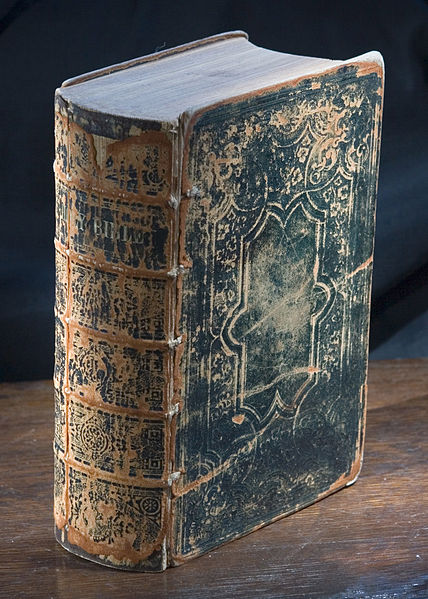
An iconic book (photo by David Ball)

An iconic book (photo by David Ball)

I have recently been introduced to the concept of the iconic book. A colleague of mine kindly shared the idea during a campus visit. He and I happen to share advanced training in reading the same book, but, as he pointed out, it is the book and not its contents that our society recognizes. This is what makes it an iconic book. When we go to court we are asked to place our hands upon it and swear—something the book itself would doubtlessly consider some form of idolatry. We use it for inaugurating the highest officials in our land. We see it laid out in public places and private homes. We consider harming or disrespecting it to be an act of sacrilege. To us, it is more than paper, ink, leather and glue.

The dedication of Phillip Patterson ought to be celebrated. As he noted, to learn more about a book, you have to be willing to dig deeply. Look at every single word. Not that such treatment is fashionable. In a society enamored of power, we prefer the power of the iconic book over its often troubling content. It is certainly much easier trumpeting it than reading it. As I listen to the debates about public policy, the endless attempts to legislate morality, I ponder how little people actually read Mr. Patterson’s book. That’s what makes his accomplishment so remarkable. In producing an iconic book, a book that I don’t need to name because anyone might figure out what it is, our protagonist actually read it. In this age of technology, that is an accomplishment to be celebrated indeed.


Next to Godliness

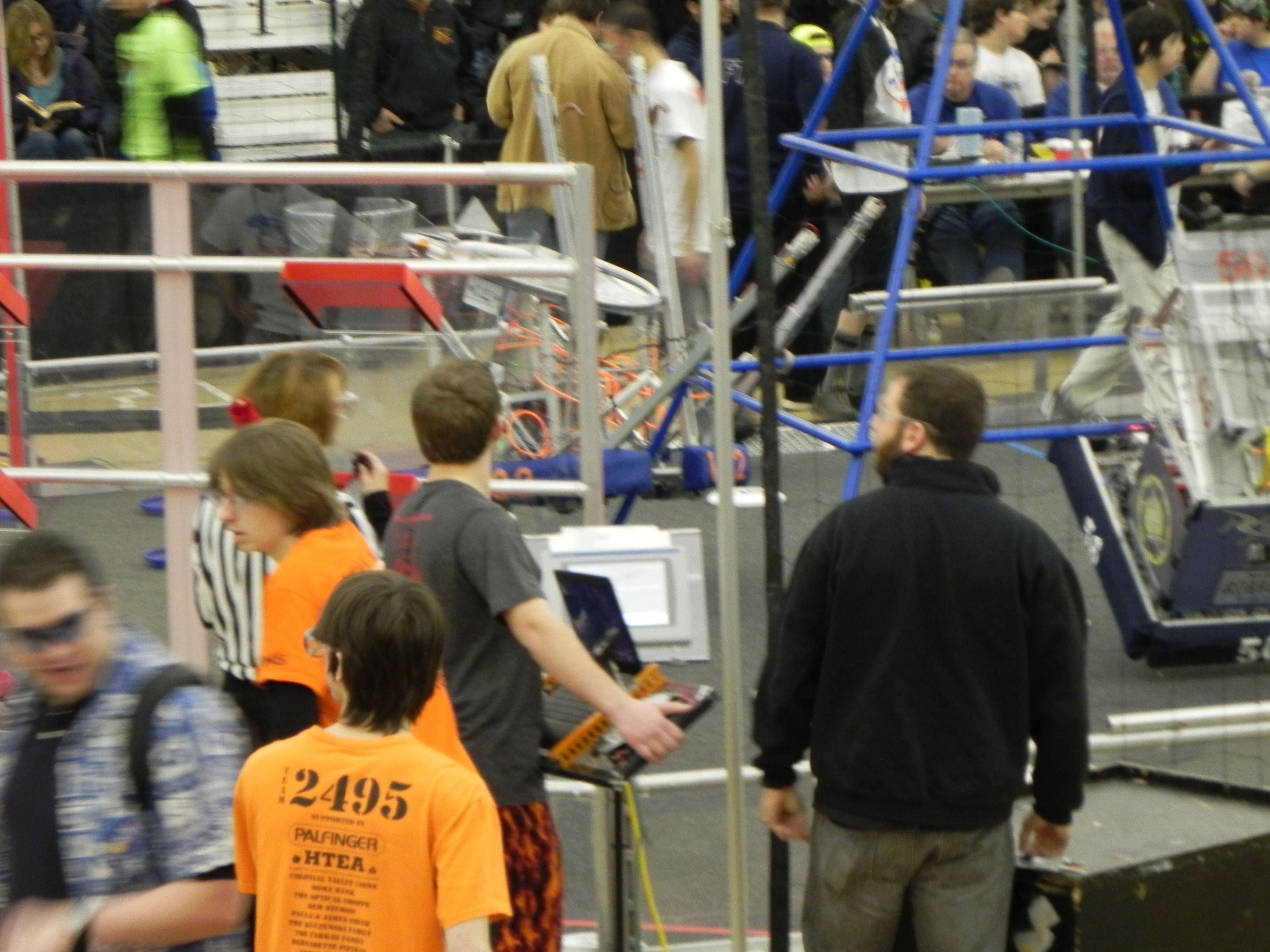
Catholics, secularists, and even a Pharaoh or two. Loud, pounding music. Dancing teenagers. It must be FIRST Robotics season again. Although I’m ambivalent about the implications of a world filled with robots, I can’t help but be impressed by what high school students can do when they are mentored so closely by adults eager to share the tricks of the trade. If you’re not familiar with FIRST Robotics, here are the basics: each January a new game objective is released. Participating high schools throughout the world have six weeks to plan, design, construct, and program a robot to perform the tasks spelled out. Since this is a busy time of year for many schools, dedicating extra hours to building a robot leads to complaints and loss of sleep—maybe a skipped supper or two. When they come together on the playing field, however, all that is forgotten and the wonder is that kids, who are often disparaged in our society, have managed to construct a working, complex machine capable of tasks impossible for many adults (for example, doing chin-ups).

Every year I can’t help but think how like a religious service these events are. The robots are like deities to be served and the technology flits about like mechanized angels. There is an increasingly complex hierarchy of officials telling you what you can’t do (now this is beginning to feel like work!). At the end of the day, however, the kids get to be the stars in a competition that puts brains over brawn. And the robots are treated with extreme deference, because we know that we wouldn’t stand a chance if they had a will anything like the deities of yore.

The religious imagery, however, is never absent. Technology represents humans doing things without divine intervention. These are empirically devised devices, performing according to the laws of physics. And yet, teams from Catholic high schools, bearing mythologically-laden names, join in the world where no gods need apply. Robots, as initially named by Karel Čapek, were human servants, the ultimate in godliness—making images in our likeness to do our bidding. And yet we can’t escape the language of religion when thinking about our own creations. The fascination applies to non-parochial schools as well, with some teams claiming names echoing themes from holy writ. Creating autonomous beings is next to godliness. We make our own future, and, god-like, we hope that nothing goes wrong.

Humans and machines

Humans and machines


Used Against You

Many times I’ve confessed to being a reluctant Luddite. My reluctance arises from a deep ambivalence about technology—not that I don’t like it, but rather that I’m afraid of its all-encompassing nature. This week’s Time magazine ran a story on how smartphones are changing the world. My job, meeting the goals set for me, would be impossible without the instant communication offered by the Internet. Everything is so much faster. Except my processing speed. We all know the joke (which would be funny if it weren’t so true) that if you’re having trouble with technology, ask a child. In my travels I see kids barely old enough to walk toddling around with iPhones, clumsily bumping into things (i.e., human beings) as they stare at the electronic world in the palm of their tiny hands. And once the technocrats have taken over, “progress” is non-negotiable.

I made it through my Master’s degree without ever seriously using a computer. Even now I think of this very expensive lap-warmer before me as a glorified word processor. Over the weekend I succumbed to the constant lure of Mac’s new OS, Mountain Lion. Some features of this blog had stopped working, and, being a Luddite, I assumed that it was outdated software. Of course, to update software, you need an operating system that can handle it. So here I am riding on a mountain lion’s back, forgetting to duck as the beast leaps dramatically into its lair. In this dark cave, nursing my aching head, I realize that I have become a slave to technology. For a student of religion who grew up without computers, I’ve got at least half-a-dozen obsolete ones in my apartment, each with bits and fragments I’m afraid to lose, despite the fact that I’m not even sure where to take them to retrieve the data. When I sat down to write my post this morning I received a message that Microsoft Word is no longer supported by Mountain Lion. Fortunately my daughter had the foresight to purchase Pages, so life goes on.

This blog has an index. It is an archaism. Indexes are not necessary with complete searchability. It is there mostly for me. In my feeble attempts at cleverness, I sometimes forget what a post is about, based on its title. The index helps me. In a truly Stephen King moment, I found this morning that my index had infinitely replicated a link to my post on the movie Carrie, so that any link after that will lead you directly to the protagonist of Stephen King’s first novel. It will take a few days to clean that up. There’s probably an app for it. For those of us brought up before household computers were a reality, however, there is a more religious explanation. Yes, my laptop is clearly haunted. And in the spirit of Stephen King I type these words while awaiting the top to snap down with the force of an alligator byte and break off my fingers. I should be worried about it, but instead, I’m sure there’s an app to take the place of missing digits. Even if there isn’t I’m sure my iPhone will happily survive without the constant interference of a Luddite just trying to call home.

Not a lap-pet.


Stobor and Dogs

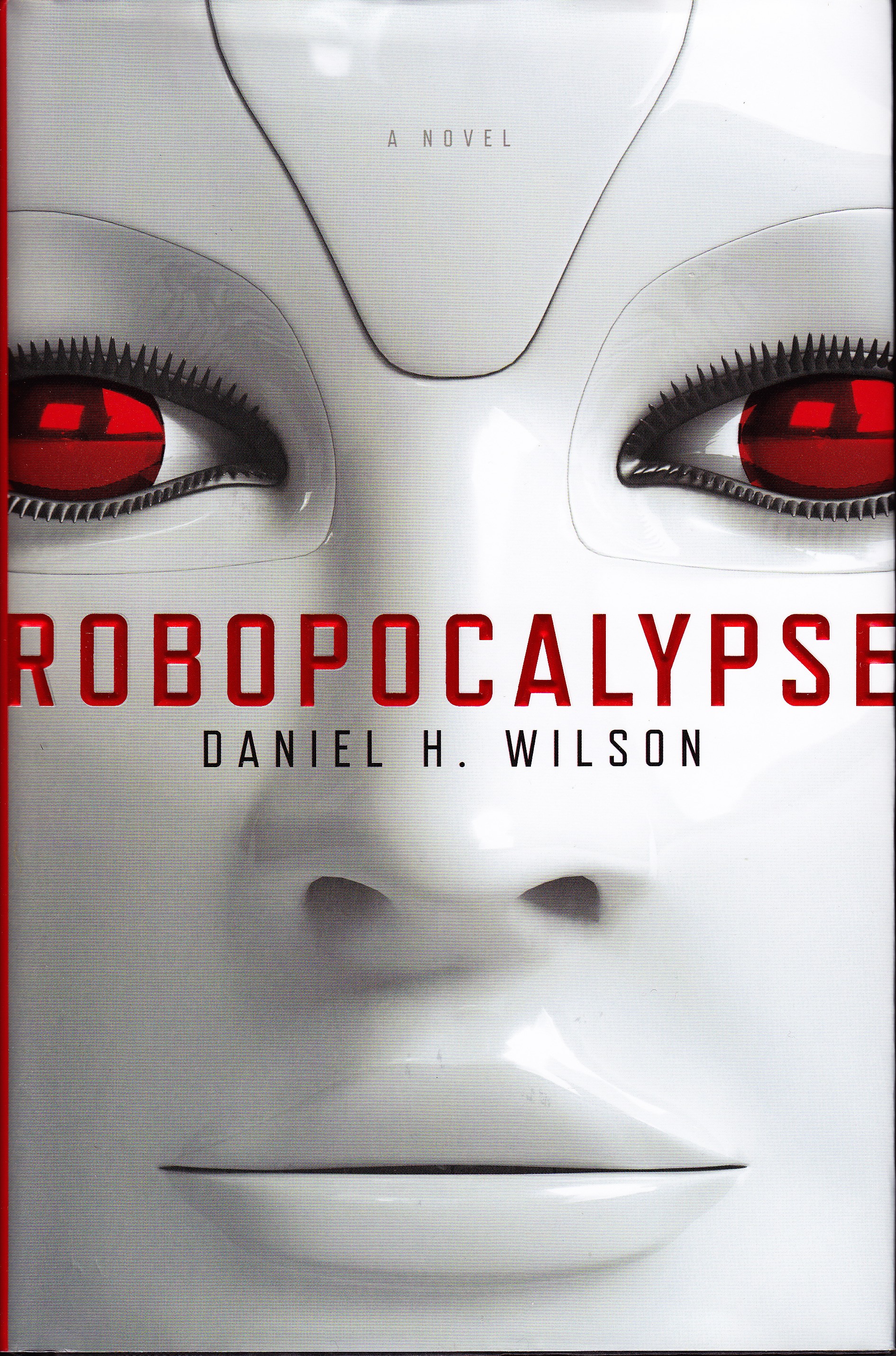
Having spent seventeen hours on public transit of various sorts yesterday, I had plenty of time to read. My chosen book for this trip was Daniel H. Wilson’s Robopocalypse. In my recent reading spate of dystopia novels Wilson’s vision seems more likely than others and thus perhaps a bit scarier. An obvious reason for this is that much of our tax money goes toward military projects that are, naturally, secret. A large part of Robopocalypse deals with military robots gone feral. Well, not really feral. The robots are controlled by a mastermind computer virus. In the first chapter this robot overlord declares to its creator, “I am your god.”

That statement is probably, metaphorically, true already. We live in a world where culture would change irrevocably without our current technology. Without it even fewer people would be reading the words I daily post here. Without it industry would shift into reverse back to the days of Thomas Edison or Eli Whitney. Present-day culture would be unrecognizable. Although not the best-written novel I’ve read, Wilson’s story does raise a salient issue—at some point the tool becomes the master of its user. For many years those who loudly proclaimed the superiority of Homo sapiens declared that we were the only tool-making animals. Subsequent observation has, of course, proven that to be inaccurate. Nevertheless, once knowledge of tools is acquired a trajectory is set. We lose a little bit of control.

Has technology replaced God? For some it clearly has. God is a symbol of comfort and meaning. As I watch thumbs busily texting away on planes, trains, automobiles—and especially in the middle of lectures—I realize that this altar of technology boasts many worshippers. There are very few scenarios where advanced technology is not present, like an omniscient being. Thankfully we have a few more years before Raymond Kurzweil’s artificial brain comes online. We should use those few remaining years to prepare ourselves for either an epiphany or an apocalypse. When the slaves become the masters, we are firmly in the territory of dystopia, at least from a human perspective.


Palm Versus Palm

“Mankind [sic] has managed to accomplish so many things: We can fly!” The words are not mine, but, depending on whether he was standing or sitting when declared, the Pope’s or God’s. In his Palm Sunday sermon yesterday the Pope addressed the issue of technology. Acknowledging flight a mere century after it began is breakneck speed for the Roman Catholic Church, but the concern behind the sentiment is real enough. Can religious systems survive the full onslaught of the technological revolution? As one small sample of the larger picture, ethics must react to increasing advanced technological scenarios. Raymond Kurzweil’s proposed Singularity where human and machine are fully integrated is perhaps an extreme example, but by no means the most extreme. Without fully understanding the context, our technical ability has soared way beyond our capacity to foresee implications. Believe it or not, many people alive today cannot use personal computers, have no palms, no cells. Sounds like they might be living free.

Palm Sunday is a day of tradition, heavily freighted as the start of Holy Week (in the Western tradition; of course, many Christians think it is a little too early some years, but that’s for a different post). Fronds from actual trees are waved as the Pope speaks. In the crowd palms are also being utilized to send the news home that one is waving a palm in the presence of the Pope. Traditional Christianity can survive with only the most rudimentary of tools. Religion, from the available evidence, began in the Paleolithic Era – earlier, I am pretty sure, than even the first integrated circuit. With its iron grip on the human psyche, religion is not about to disappear. Instead, technology is either ignored or embraced by it. As long as religions rely on human participation, however, technology will need to be reckoned with.

It's still a date (or palm)

The fact is technology has changed the perception of the world for many, especially in the western world. Even the revolution in Egypt earlier this year was conceived on the Internet. All the indications point to increased usage of technology rather than its imminent demise. Yet religious leaders still enjoin us to wave palm branches. Virtual Church websites abound where the faithful can wave electronic fronds and nary a tree will be harmed. Sermons, discussion groups, Bible readings, prayers – they can all be dispensed through wireless networks and modems. While many traditionalists turn from such ideas in disgust, it would behoove us all to pay attention. With the Vatican now onto the fact that we are flying, within mere decades we might receive a divine message on – oh, wait a minute – I’ve got mail!


Time Isn’t Holding Us

Ancient is much more recent than it used to be. Perhaps it has something to do with the two massive earthquakes over the last couple of years that have together sped the earth’s rotation by almost three microseconds. Perhaps. A more likely explanation is that excessive technology makes us soft. We expect new toys, new tech solutions on nearly a daily basis, and with the communications revolution, we are rarely disappointed. I wonder if we’ve forgotten how to help ourselves. This is especially evident in the lack of initiative I sense among many students. Of course, I am ancient.

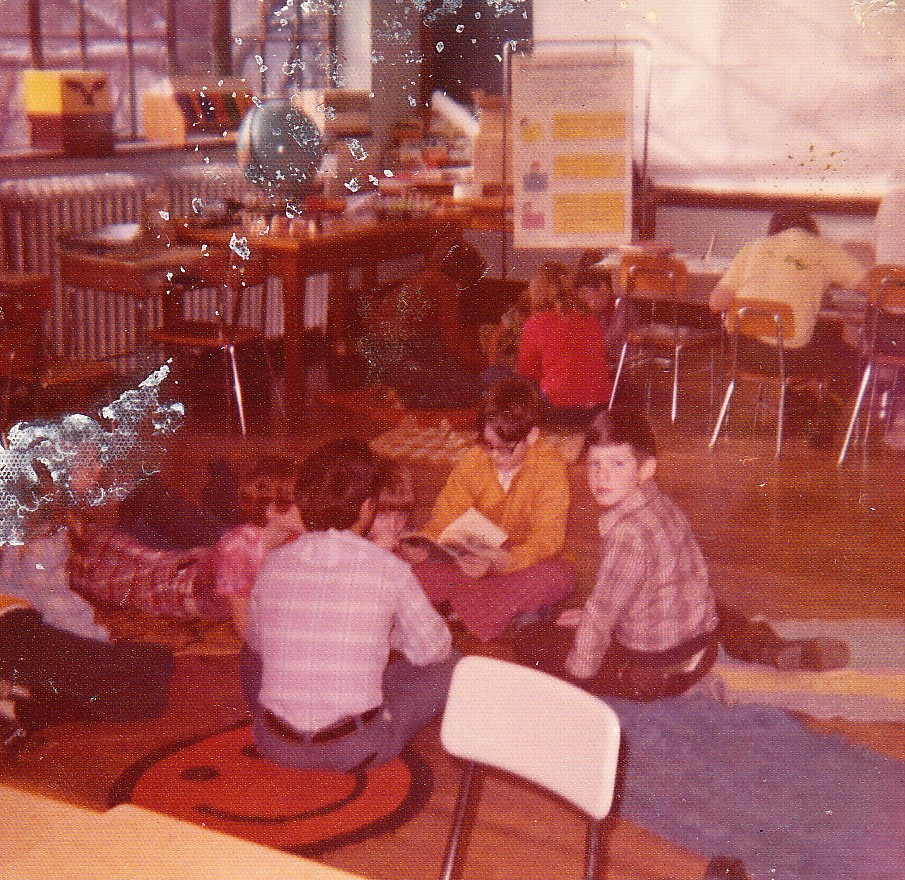
When exam time rolls around, the present-day student requires a study guide. When I was a student, after dodging all the dinosaurs running around the campus, I never received a study guide for a test. If a test is coming, read, re-read, i.e., study, your notes. Maybe read a textbook? Nowadays a study guide is required for that message to be sent home. And then there’s the emails. Once the study guide is distributed (electronically, of course) the emails gush in asking what exactly I mean by this or that. Since I reiterated the point endlessly in class, accompanied by a PowerPoint slide with the answer writ large, verily, I roll my eyes and drop to my three-legged stool in dismay. Can it really be that college students require detailed answers in advance for a multiple-choice test of only 40 questions? Back in my day, a multiple-choice test was a gift that felt like sixth grade had rolled around again.

Sixth grade: what's he got in his hands?

Time, since Einstein, has been relative. And since I am an antiquity, I can perhaps be forgiven for citing Supertramp’s “The Logical Song.” As a studious young man, religious from epidermis to viscera, I was sent off to get an education. Years later, kicked out of the academy for good behavior, I see the wisdom of the lackluster 70’s band: “But at night, when all the world’s asleep, the questions run so deep for such a simple man.” The lyrics are easily found on the Internet. It is simpler than walking over to the CD rack to check manually. Back in my day, I would never have even imagined skipping an exam and then asking the professor what he was going to do about it in the next class period. Email, in this instance, is easily forgotten. I’ll get back to you once I engage the electronic lock to keep out this velociraptor (if anyone can remember back to 1993).


When Machines Fall in Love

When I want to have a good scare, I seldom think to turn to Time magazine. This week’s issue, however, has me more jittery than a Stephen King novel. One of the purest delights in life is being introduced to new concepts. Those of us hopelessly addicted to education know the narcotic draw of expanding worldviews. Once in a while, however, a development changes everything and leaves you wondering what you were doing before you started reading. A change so profound that nothing will ever return to normal. Singularity. The point of no return. According to the cover story by Lev Grossman, we are fast approaching what theorist and technologist Raymond Kurzweil projects as the moment when humanity will be superseded by its own technology. The Singularity. Noting the exponential growth of technology, Singularitarians – almost religious in their zeal – predict that computing power will match and then surpass human brain speed and capacity by 2023. By 2045 computers will outdistance the thought capacity of every human brain on the planet (more challenging for some than for others, no doubt). The software (us) will have become obsolete.

A corollary to this technological paradise is that by advancing medical techniques (for those who can afford them) and synching tissue with silicone chip, we may be able to make humans immortal. We will have finally crossed that line into godhood. Kurzweil notes laconically, death is why we have religion. Once death is conquered, some of us will be left without a job. (Those of my colleagues who actually have jobs, that is.) We have empirically explained events as far back as the Big Bang, and no deities need apply. The evolution of life seems natural and inevitable with no divine spark. And now we are to slough off mortality itself. O brave new world!

There was a time when mythographers created the very gods. They gave us direction and focus beyond scraping an existence from unyielding soil. We have, however, grown up. There are a few problems, nevertheless. Scientists are no nearer explaining or understanding emotion than they were at the birth of psychology. We might explain what chemicals produce which response, but we can’t explain how it feels. Emotion, as the very word indicates, drives us. Until Apple comes out with iMotion and our electronic devices feel for us we are stuck falling in love for ourselves. Computers can only do, we are told, what they are programmed to do. The mythographer steps down, the programmer steps up as the new God designer. Having dealt extensively with both, I feel I know which I trust better to provide an emotionally satisfying future.

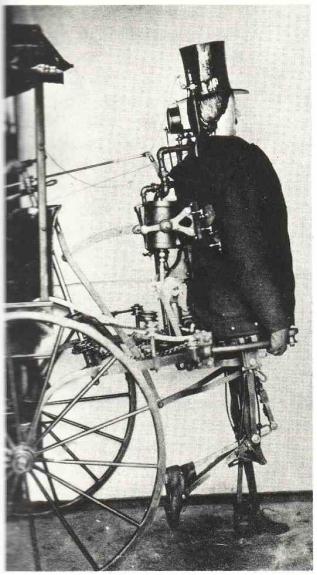
Zadoc P. Dederick's Steam-Man


iConfess; Indulge Me

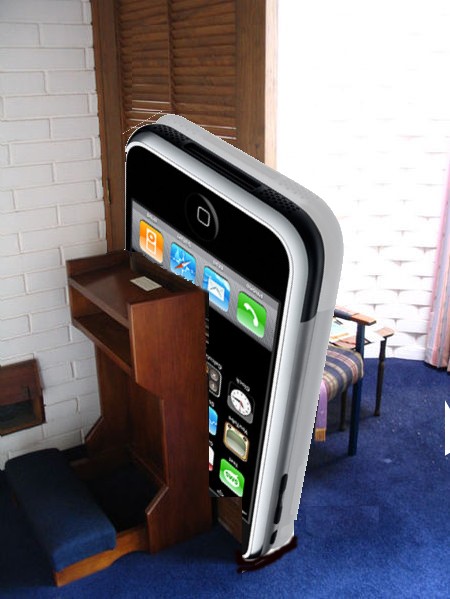
I confess to being a Luddite at times. I was a late-onset cell-phone user and my last laptop (Macintosh, of course) survived ten years of hard, academic use before an accidental drop forced me into a newer model. Now I walk through student centers and see banners advertising “new apps” and wonder what an app is and whether it is something I should have already had old versions of. I’ve figured out that “app” is an apocopated form of application, and that it generally has something to do with handheld electronic devices. Now it seems that I’ve been out-teched by the Catholic Church. That great bastion of faith that agonized over Galileo for four centuries has now whizzed by guys like myself who cut our high-tech teeth on telephones that had rotary dials.

What is this new app? According to the New York Daily News, the app is called Confession. The program apparently lets you choose a commandment that you’ve violated and offers a list of sins to tick off. (I envy the priest who got that job!) A press of the button and your sins are forgiven. Sure is a lot easier than getting down on your knees and telling it all to a guy you barely know. This handy app even automatically tracks the time since your last confession, so you can give it to the holy father in nanoseconds. It only costs $1.99.

Technology has wreaked havoc on ecclesiastical tradition. Only the most severely shortsighted of churches denies the draw and retention of the electronic revolution. Problem is, the worldview that generated these religions simply doesn’t fit into a palm-sized box. The world of century one was full of demons and dragons, and all on a very flat earth. Confession, when it became a requirement, was a visceral outpouring of deep secrets and fears before a black-garbed authority figure who had the power to dole out Hail Marys like a theophanic thunderstorm. Now it can be done at the stoplight on the way to Starbucks. The last time the church had asked for payment for forgiveness Martin Luther nailed 95 Theses to the Wittenberg Door. Today, I’m sure, it would be an electronic error report posted to a Wiki-board Domain, whatever that might be.

Forgive me, Father -- oh! I've got email!


Let’s Do the Time-Warp Again!

Yesterday MSNBC reported that the Vatican has again called for a conference involving serious scientists to discuss the implications of astrobiology — life in space. Despite the mocking sneers of the media, growing numbers of serious thinkers are doing the calculations and scratching their heads. When I was a child, I was assured that earth-like planets elsewhere in the universe were virtually impossible, statically. Now we know of several rocky orbs circling distant suns. Our own sudden advances in technology have started some to think that if we raced from heavier-than-air flight to the moon in only 66 years, and from landline to audio implant in about a century, maybe other intelligent life could do the same? What would the implications be for the geocentric world of Genesis and the Gospels?

The Catholic Church and Science are hardly best buddies; frequently they are not even on speaking terms. No, the tide did not change to a warm embrace with the (centuries late) apology to Galileo or the sudden realization under John Paul II that evolution is “more than just a theory.” All one has to do is think of the issue of stem-cell research and the eagerly offered hand is suddenly withdrawn. But on the issue of aliens, perhaps the church can race ahead of the projected God-of-the-gaps, do an end-run, and be ready to embrace E.T. when he finally makes himself known.

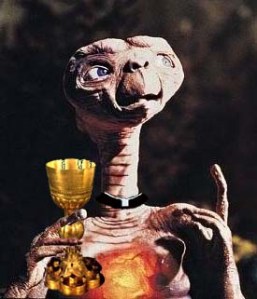
Don’t get me wrong, I am grateful that the Vatican has embraced evolution and thumbed its Roman nose to the creationists. (They deserve even more than that!) I am glad they are considering the possibilities of extra-terrestrial life. There is, however, a nagging doubt in my mind that they may be coming to the conclusion that the late Larry Norman once did that “if there’s life on other planets, then I’m sure that he must know, and he’s been there once already and has died to save their souls.” What good is advancement in science if mythology refuses to budge? What would an extra-terrestrial priest look like? What if they don’t have blood to fill their chalices? Do they have trumpet-horns on their saucers to announce the second coming? Yes, let’s explore our universe, but let’s not forget to update our credibility meters as well.

ETpriest

Our father which art in heaven?