Scary Movies About Scary Movies

Hi all, here’s a guest post to enjoy:

In a meta-twist on the horror movie genre comes the horror film about horror films. Here are some of the most popular and well-executed (see what we did there?) navel-gazing scary films, ie. scary movies about scary movies.

Paranormal Activity (2007)

Rated R

Director: Oren Peli

Starring: Katie Featherston, Micah Sloat, Mark Fredrichs

This film has a relatively standard horror plot: a family is stalked by a murderous demon. What makes this film unique, however, is how it’s told. Much of the film is seen through the vantage of security cameras and other devices used to make it appear they were all culled together to thread together the story. This movie spawned a whole series of eight films.

Stream Paranormal Activity on Paramount+, Pluto TV and Netflix.

The Blair Witch Project (1999)

Rated R

Director: Daniel Myrick and Eduardo Sánchez

Starring: Heather Donahue, Michael C. Williams, Joshua Leonard

When this film – likely the progenitor of the entire found-footage horror sub-genre, first released, its uniquely modern (for the time) style of storytelling scared viewers in a whole new and unfamiliar way. Told through a video camera held by an increasingly panicked teen, this poorly lit, blurry, grainy, unsteady, hyper-realistic video-as-film follows friends investigating the myth of a witch and ending up getting lost in the woods.

Stream The Blair Witch Project on Apple TV and Vudu.

Scary Movie (2000)

Rated R

Director: Keenan Ivory Wayans

Starring: Anna Faris, Shawn Wayans, Marlon Wayans, Regina Hall, Shannon Elizabeth

Warning: This film is as much a comedy as it is a horror film. This parody of slasher flicks satirizes popular ones of the day and their classic tropes. Don’t let the comedy fool you though; it’s still got its fair share of scares! The movie spawned four sequels applying the same formula to formulaic haunted house, mysterious object, alien invasion and demon-possessed children movies.

Stream Scary Movie on Apple TV and Vudu.

Midnight Movie (2008)

Rated R

Director: Jack Messitt

Starring: Rebekah Brandes, Daniel Bonjour, Greg Cirulnick, Mandell Maughan

The polar opposite of the Wayan brothers’ franchise, this horror film takes its horror seriously. Replete with classic blood and gore with a little sex and nudity thrown in (thank you, Mr. Hitchcock,) it involves a rare midnight screening at a dilapidated old theater of a slasher film whose maker apparently went insane from it. That doesn’t dissuade the audience, however, all of whom are unaware that when the lights go down, this bloodbath features audience participation.

The Final Girls (2015)

Rated PG-13

Director: Todd Strauss-Schulson

Starring: Taissa Farmiga, Malin Akerman, Adam Devine

An orphan and several other high-school teens watch a B-movie slasher flick made by the orphan’s mother – an 80s scream queen, before she allegedly died. Suddenly, the friends all find themselves trapped inside the movie and face-to-face with some startling truths. To live to tell the tale however, they must adapt to the classic tropes of the genre.

Stream The Final Girls on Apple TV and Vudu.

Recap

After watching these scary movies about scary movies, you’ll never look at another horror movie the same way again!
Book and Bell

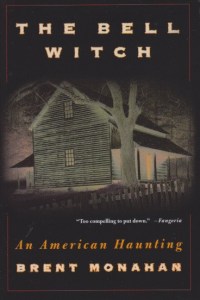
The Bell Witch: An American Haunting, by Brent Monahan, is a book I’ve read before.  The subtitle was used for a cinematic version.  I discovered the book, however, through what might be considered a chance encounter with the author.  He was teaching a course on offering distance education courses at Rutgers University, and, as an adjunct teaching over eight classes per year, I’d been selected for the distance education program.  (As life goes, of course, I was hired by Routledge for a full-time job before I could actually deliver the course.)  By a strange irony, I had watched An American Haunting just the weekend before the course, and I had no idea who would be teaching it.  Neurotically punctual, I was the first one there for the class, and as Dr. Monahan and I talked, I knew I’d need to read the book.  I posted on it back when I did, but this time I decided to pay better attention than one can on a bus.

Of course, when you watch the movie first, which I had, you know “the reveal” well before it comes late in the novel.  In case you’ve done neither, I won’t give it away.  The tale is based on an historical haunting, attested in sources from near the period.  And it is a strange kind of possession story.  The “witch” is actually a demon conjured by a trauma, and although book wraps things up nicely, it leaves a few questions at the end.  I suppose that’s appropriate for a scary book.  One of my current projects involves tracing the accounts behind fictionalized narratives to their originals.  The Bell Witch was well researched, and is a good example of how the line between fiction and fact can be effectively blurred.

The Bell Witch legend is credited with influencing several horror films, including The Blair Witch Project and others which tellingly have “Bell Witch” in their titles.  The story has a fairly incredible longevity, given that it was a localized legend from early in the nineteenth century.  Monahan’s novel is written as a “confession” from the schoolmaster, and historical personage Richard R. P. Powell.  This blurring of the lines makes for the kind of ambiguity that gives horror its particular ability to stand between fact and fiction.  The early versions of the lore, combined with elements intended to offer verisimilitude, leave plenty of queries at the end.  So much so that I’ve occasionally contacted the author for clarification.  What really happened?  It depends which side of the line you prefer.


Come Salem Away

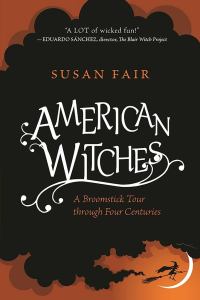
It’s the season.  Here in the fast waning days of September we can already taste October and thoughts turn toward ghosties and ghoulies and their kin.  Susan Fair’s American Witches: A Broomstick Tour through Four Centuries is, as any book in the nation of Salem, a mere skeleton crew of a long and feared tradition.  As is true of most things in the last two years, this book takes on a poignancy that was perhaps unintentional since it was written for fun.  It is a somewhat uncanny combination as it is—witch accusations often led to (and perhaps lead to, far from official eyes) someone dying.  We fear witches.  Fair reaches back pretty far, going even to the point of discussing those (generally women) hanged on ships on their way to America because their shipmates thought them witches.

Salem so dominates our witch consciousness that we sometimes forget these other episodes.  Fair explores, along with snarky asides, many early cases outside Salem.  In fact, the sad chapter in our history where hearsay became fact—one can’t help but think of “fake news”—the mass, “legal” murders carried out in Salem, is part of a larger pattern.  Not surprisingly women feature as the victims in this unholy web of fear and piety.  The combination is a dangerous one and otherwise rational people sanction evil rather than confront what is a mere perception of evil.  Fair moves on, however, to discuss other witchcraft scenarios—the witches (fortune tellers) of New York, the murder of a “witch” in Booger Hole, West Virginia (did I mention there was snark?), and the hex murder of York, Pennsylvania.  All of these represent an underlying fear that won’t go away.

This breezy tour ends near the author’s hometown outside Burkittsville, Maryland.  Although it is widely known that The Blair Witch Project was fiction from start to finish, this tiny town has been beset by those who refuse to accept that reality.  Such credulousness should stand as a warning to a country even capable of electing someone like Trump.  We are a suggestible nation with many people incapable of independent thought.  We are natural believers.  At the same time we’re a people that sees no value in studying religion even as it destroys us.  It’s like that embarrassing relative we never talk about.  But people still come to Burkittsville nevertheless.  Fair’s book was written before the election that showed who we really are.  Although the writing is charming, it’s hard to laugh about the subject these days.  We have forgotten Salem and all it taught us.


All Things Being Equinox

The weather around here has been appropriately gloomy for the autumnal equinox.  Although Hurricane Florence gave us a day of rain, the heavy clouds have been part of a pattern that has held largely since May.  Given the gray skies, we opted to watch Alfred Hitchcock’s The Birds last night.  My wife isn’t a horror fan, but she does like Hitch.  We’ve watched The Birds together many times, but this is the first time since I wrote Holy Horror.  I was somewhat surprised to recall how much Scripture plays into the script.  This is mostly due to a drunken doomsday sayer in the diner.  After the attack on the school kids of Bodega Bay, he declares that it’s the end of the world and begins citing the Bible.  He’s there for comic relief, but the way the movie ends he could be right.

When I was writing Holy Horror I had a few moments of panic myself.  Had I found all the horror films with the Bible in them?  Could anyone do so (without an academic job and perhaps a grant to take time off to watch movies)?  I eventually realized that I was merely providing a sample in that analysis.  Several weeks after I submitted the manuscript I watched The Blair Witch Project.  There was the Bible.  The same thing happened last night under a glowering late September sky.  The Birds has the Bible.  Two weeks ago I saw The Nun; well, that one’s almost cheating.  But you get the picture—the Good Book appears rather frequently in horror.  That’s what inspired me to write the book in the first place.

Now that nights are longer, and cooler, the grass has somewhat poignantly relinquished its aggressive summer growth.  Most of the ailanthus trees have been cut down (I must be part lumberjack).  My outside hours are limited not only by work but by the fading light.  In the words of the sage, “winter’s tuning up.”  We moved to a house we saw in the spring as days were lengthening.  Now we’ve come to the dividing line that will slowly leech the light from our evening skies.  I suspect that as I go back and watch some of my old favorites again I’ll discover something I already knew.  The Bible and horror belong together because both are means of coping with the darkness.  Call it puerile if you will, but there is something profound about this connection.  It just has to be dark for you to see it.