Horse Senses

If a horse can be made a senator, surely an ass can be made a president.  History can be unkind to those who think too highly of themselves.  It’s a horse of a different color than Incitatus that’s on my mind today.  This past week I read a news story in the Washington Post about Justice (there may be some double-meanings here, so hold onto your horses).  Justice used to be called Shadow, and Shadow was an abused horse.  Justice is now suing his former owner.  The story explores the question of whether animals can sue.  As a vegan for moral reasons I can see the point, but I also have to wonder how you defend those who have no voice to be heard, kinda like the electorate in the sham of a democracy.  How do we know what a horse really wants?
If horses could draw or sculpt, Xenophanes quipped, their gods would look like horses.  Asses, it stands to reason, worship one of their own.  Animals should have rights, but the difficult question falls onto our species—how do we know what they want?  Anyone whose spent time with animals knows that they think.  I can see a cat in a neighbor’s yard from my window.  Separated by a flimsy-looking hurricane fence is the next yard over where two large dogs often prowl.  If the cat and dogs happen to be out at the same time, there will be barking and braying but the cat will not appear to show concern.  The way my heart hammers at those barks, however, I have to suppose my feline friend also feels a bit of fear at the threat.  The cat must decide how to act, but it also must know that a barely visible fence keeps the canines at bay.

What does Justice want?  It’s a loaded question, for sure.  As much as we wish there might be, there is no Lorax to speak for the trees.  Or horses.  Nevertheless it’s obvious that horses think.  Perhaps like Job, Justice wondered why he was being punished after being a good horse.  The church magnanimously grants that animals cannot sin, after all.  One must wonder, however, about breeds developed by human engineering to be destructive, but that’s another parable.  While Justice might be given a day in court, and might win a cozy stall and protection from the elements, those of use bound by language will never know if justice has been served.  The limitation is our own.  Just ask Balaam.

Inhumane Society

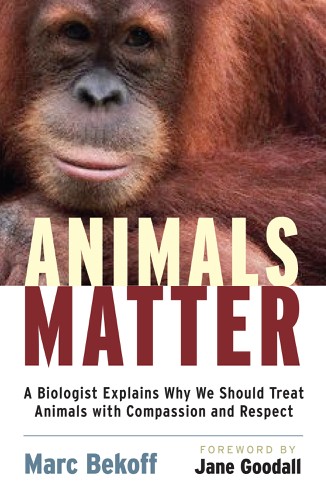
AnimalsMatter“I’m a member of PETA,” I’ve had more than one wag say, quoting bumper sticker wisdom as if it were profound, upon learning I’m a vegetarian. “People Eating Tasty Animals,” they then spell out with a smirk. I stopped eating animals at about the turn of the millennium, and since then I’ve discovered more and more reasons that it was the correct decision. I’ve just read Marc Bekoff’s Animals Matter: A Biologist Explains Why We Should Treat Animals with Compassion and Respect. It saddens me that in our world where nothing escapes being posted on Facebook, people still tend not to notice the suffering we impose upon animals as a matter of course. I’ve always been inclined to look closely at things, including animals. Watching them, it is clear that humans are indeed animals only differently evolved. Our mannerisms, our emotions, even our expressions, can be found among our animated kin. We share a planet on which we all evolved together, so why do we find it so easy to exploit other creatures?

One of the reasons Bekoff notes, without being judgmental, is that some religions inform us that people alone are special because we bear the image of God. Although God is supposed to be altruistic, we don’t wish to share that exalted status with any other species, apparently. Even in the twenty-first century many otherwise intelligent people still claim that animals feel no pain. Can’t reason. Are mere machines. We’ve been taught to distrust common sense that informs us that if an animal in distress acts like a human in distress that it experiences the same anxiety. The more we study animals the more human they become. The theology of Genesis has much for which it will be called to answer.

It seems, however, that the Bible is used as a mere excuse here. We exploit other animals because we can. We have taught bovines and ovines to trust us so that we may more easily slaughter them. Perhaps this is an exercise in divine image bearing, but somehow I doubt it. Reading Animals Matter in many ways felt like listening to a scientist who has taken the message of the Lorax to heart. We treat animals the way we do because we don’t understand their language, but we are morally obligated to speak for those who have no tongues. Although accessible to younger readers, Animals Matter is nevertheless a profoundly disturbing book. What does it say about the highly evolved when they exploit their relatives who’ve not learned the language of humans? Or, more accurately, who’ve not learned to vocalize like humans. Other animals speak, just like people sometimes, if we would only translate their actions into words.