Long Winter

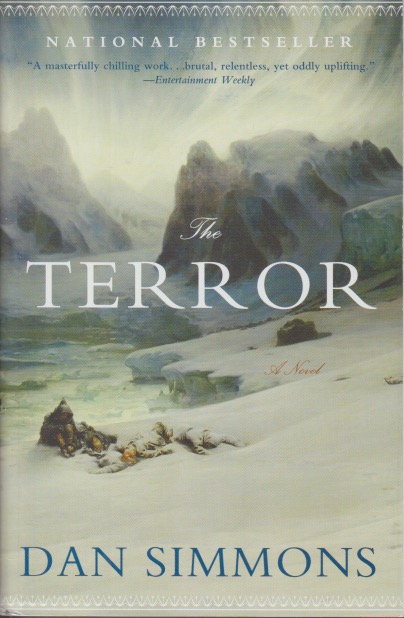
I have to confess that I often feel uncharitable towards very long books.  Mainly, I think, that is because one of my main blogging topics is books and when it takes a long time to read one I have to come up with other things to write about.  Still Dan Simmons’ The Terror had been strongly recommended.  I found it in an indy bookshop on independent bookstore day and began reading it sometime back in May.  It started out strong, but about three-hundred pages in began to feel a bit tedious and self-indulgent.  (I’ve done that myself with my fiction, so this criticism is also aimed at the one writing this reflection.)  In case you haven’t read it, the Terror of the title is HMS Terror, the ship captained by Francis Crozier under the command of Sir John Franklin, captain of HMS Erebus.  Both ships, seeking the northwest passage, froze in the Arctic ice in 1846 and their combined crews of 129 died without ever being found.

That’s a strong basis for a horror novel.  Your mind can’t help but wonder what it’d be like to be stuck in the dark, sunless winter, temperatures well below what most of us could survive, and realizing that you were never going to get out.  Simmons traces the story arcs of several of the crew that historically populated the ships.  Since there were no survivors, just about anything is fair game.  Including creating a monster to attack them.  Even as I began to warm to the book in the last hundred or so pages, it seems that some of this could’ve been trimmed and the same sprawling majesty been preserved.  Maybe I’m just jealous because none of my novels have been published and I keep being told you have to keep things short to get any traction.

In any case, by the end of the book I was really drawn in.  This was after the villain got his own, and Crozier starts to recognize the indigenous Arctic people for their truly remarkable survival skills.  (Not vegan friendly, of course, since vegetation doesn’t thrive in ice-bound conditions.)  It comes to a remarkable conclusion and I gradually found myself letting go of my petulance for having to invest so much time in one book.  I’m a slow reader with a very large pile of books yet to read.  In any case, Simmons won me back.  I quite enjoyed his Night of Summer and A Winter Haunting many years ago.  If you’re not afraid of big books, and you’d like to read about what can go wrong with a group of men trapped in the Arctic, then The Terror may be for you.


Terror Able

Saturday afternoons were made for B movies. After a hectic week, nothing soothes like grainy picture quality and poor dialogue. This weekend offered a chance to view The Terror. This 1963 Roger Corman film won its bad marks the honest way – by earning them. Nevertheless with Jack Nicholson playing against Boris Karloff and a plot so convoluted that I had to draw a chart to figure out what I’d just watched, the movie lived up to its grade. Throw in Francis Ford Coppola as an associate producer and it’s party time. Corman’s legendary cheapness and fondness for disproportionate claims of scares that never materialize only add to the charm. After watching the opening sequence one gets the distinct impression that Franklin J. Schaffner had watched this film before setting up the climatic scene of Planet of the Apes.

In keeping with a recent trend on this blog, the plot involved a witch. An old woman from Poland resettles in France to avenge her murdered son. The crone casts a spell transforming a bird into a beautiful young woman. The first words of the spells sent me fumbling for the “rewind” button. “Tetragrammaton, tetragrammaton,” the old woman intones to begin her spell. In a movie fraught with dialogue problems, this might be considered simply a choice of foreign-sounding, mysterious syllables to be uttered for an audience not expected to know that tetragrammaton is the title of the sacred four-letter name of Yahweh. By this point the plot was so convoluted that making God the agent behind a pagan curse seemed almost natural.

The analog with the Bible soon became clear. The Bible holds its sway over many because of its often beautiful rhetoric. Sparing the time to study what the rhetoric might have meant in its original context is an exercise few believers can afford to undertake. Our world has become so full of things that taking time to explore the implications of one’s religion must compete with ever increasing Internet options, thousands of channels of television, and plain, old-fashioned figuring out how to get along. Religion is a luxury item and, as experience tells us, it is best not to look too closely at luxuries – their flaws too readily appear upon detailed inspection. Allowing religion its exotic sounding mumbo-jumbo preserves its mystery and power. And if a witch says a theologically freighted word we can just chalk it up to entertainment. We are too busy to examine what our religions really say. Roger Corman may have unintentionally discovered a real terror in a movie that will keep no one awake at night.