Not Frightening

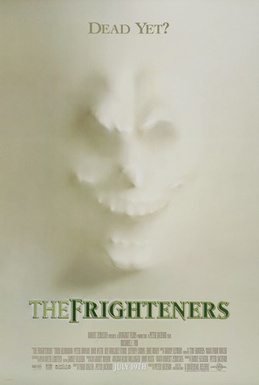
Years ago a friend, which I define as someone who wishes me no specific bodily harm, suggested I watch The Frighteners.  It finally came to a free streaming service (with commercials), so I gave it a go.  I really enjoyed parts of it, but on the whole, there was too much going on to make it an effective film.  It’s a horror comedy, and once films like that stretch beyond 90 minutes they tend to need a lot of magic juice to keep the engine running.  So, here’s the basic idea: Frank can see ghosts.  With the help of a couple of ghosts he makes a living driving spirits from peoples homes, after setting them up.  Unfortunately there’s a serial killer ghost actually killing people.  Since Frank tends to be the last one the victims see, there is some suspicion that he’s involved in their deaths.  

A young widow, Lucy, is a doctor and is trying to help a woman (Patricia) who seems to be abused by her mother.  It turns out that Patricia is associated with a serial killer from many years ago, and it’s unclear whether or not she’s innocent.  Meanwhile, a neurotic FBI agent comes to town and decides Frank is guilty and tries to kill him without due process.  Meanwhile, more and more people are dying.  It’s probably a spoiler to say that the serial killing ghost is the same as the serial killer that Patricia was in love with and she’s still helping him to get to a record number of deaths.  Frank ends up dying twice but is brought back to life at the end, after Patricia and the serial killer are taken to Hell.

The movie is stylish and a bit of fun, but if you’re watching it on a streaming service with commercials it ends up being over two hours long.  Some parts are funny, but not hilarious.  Some parts are spooky, but not really scary.  The plot is complex and takes its time unfolding.  The serial killers attempting to break a record is disturbing and not exactly in good taste.  The acting is good but the viewer’s left feeling a bit confused as to what the message is and how they ought to feel.  It’s the kind of movie that I might find myself in the mood to watch again, someways down the road, but in the short term, I’m glad to have seen it once.  I’m not sure my friend and I share taste when it comes to movies, but at least he’s not wishing me any harm.


Death in Cambridge

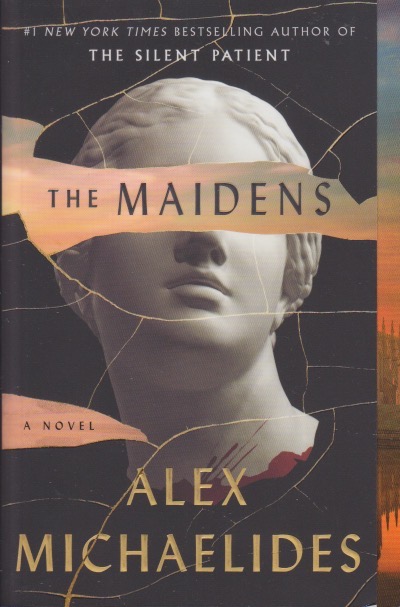
In an effort not to give too much away, I’ll try to give only the bare bones and some impressions.  The Maidens, by Alex Michaelides, is considered a dark academia novel.  It revolves around a series of murders in Cambridge and the informal investigations by a psychologist (Mariana), whose niece attends St. Christopher’s College.  There is, not surprisingly, a lot of psychological tension.  It’s also a good illustration of the human condition—our psychology can often be disrupted by those closest to us.  We’re a complex lot.  The whole story is also set against the backdrop of classic Greek tragedies.  Mariana is half Greek herself, living in England.  She’s also a widow and, although not a minor, a woman without parents or siblings.  As a psychologist, she tries to help others sort out their lives.

Perhaps some of us are born prone to trauma through some combination of naiveté, innocence, and neurodivergence.  It’s well known that what simply rolls off one person will traumatize another.  People sometimes comment that it’s surprising that I watch horror, but the fact is that it’s generally removed from my personal traumas.  Looking back over some sixty years, I see quite a lot of trauma and I empathize with Michaelides’ characters who experienced such deficits, some of them without even knowing it.  This really stood out to me while reading the novel.  With the exception of some of the maidens, just about everybody is hurting.  Who are these eponymous maidens?  A group of students who have coalesced around an American professor of ancient literature.  And they’re also the ones who tend to get bumped off.

This is a book that moves along.  Part of the reason is that it has short chapters, something I’ve come to appreciate over my life as things get busier and busier.  Long chapters can be a challenge.  A novel I read recently had no chapters at all (but at least there were scattered extra-spaces between collections of paragraphs).  But what really keeps the pages turning is the story.  Michaelides is very good at misdirection, which is why I didn’t describe the plot in any detail.  You have to read it to see how things unfold and I don’t want to spoil that for anyone.  A literary murder-mystery, it has no speculative elements, apart from a few coincidences.  It does, for at least some readers, have quite an impact.  For me, it influenced my thought process for the rest of the day after I finished it.  At that, with all the books I read, is pretty rare.


Hitchcock’s Freud

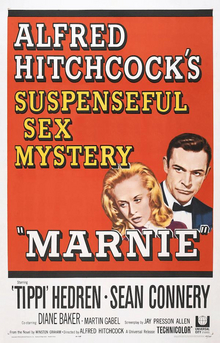
When you can’t have horror, Hitchcock will sometimes do.  Having seen most of the big classics, Marnie came to the top of our list, and I found it had some triggers.  I suspect that’s true for those who have experienced childhood trauma and who sometimes do things as an adult without knowing why.  At least that’s what I took away from it.  To discuss this will require spoilers, so if you’re behind on your Hitchcock you might want to catch up first.  Here goes.  Marnie’s mother was a prostitute who turned to religion.  The reason is that one night during a storm young Marnie was frightened and one of her mother’s clients tried to comfort her.  Supposing he was molesting her daughter, she attacked him and when he hurt her, young Marie killed him.  All of this was repressed in her memory and now, as an adult, Marnie is a kleptomaniac who has the many phobias that that night impressed upon her.

Then along comes Mark.  Although he knows Marnie is a thief, he falls in love with her.  From a wealthy family, he’s influential enough to get charges against her dismissed, which he does once they marry.  He tries to unravel why Marnie won’t sleep with him, why she can’t stand red, why thunderstorms terrify her.  In a very Freudian move, he recognizes that her relationship with her mother is the key.  Hiring a private investigator, he discovers what happened to Marnie as a child and then takes her to confront her mother.  Marnie has never felt her mother’s love, but she didn’t remember the incident and didn’t know that her mother took the murder rap for her and subsequently distanced herself from her daughter.

I have to admit that I found this more disturbing than most Hitchcock films I’ve seen.  The ending, which I revealed in the first paragraph, brought quite a few of my own childhood issues to the surface.  Parents try to do the best they can, at least most of the time, but we damage our children psychologically, generally unintentionally.  And trauma in your youngest years never leaves you.  I can mask and pretend—that’s the way you survive in this world—but a number of my experiences as a pre-teen affect me every day, whether I realize it or not.  Where I choose to sit in a room.  How I respond to unexpected events or sudden changes.  Why I immediately have to know what that noise is and where it came from.  These are all part of the legacy my childhood left me.  I think Marnie would understand.


Bad Intensions

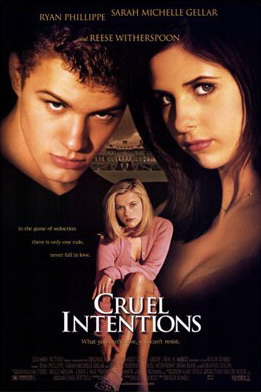
What, exactly, defines dark academia?  I ask myself that question a lot.  Looking for movies that might help answer that question sometimes brings about unexpected results.  A film that appears on several dark academia lists is Cruel Intentions.  I’d never seen it before and since it’s generally classified as a teen romantic drama, it isn’t exactly what I tend to go seeking.  Still, that definition is important to pin down, dark academia.  So I tried.  It presents itself, at least up front, as a teen sex comedy.  A rich playboy at a private school, and his scheming step-sister, enjoy destroying the innocence of new coeds.  She uses coke and he appears to be addicted to sex.  There’s not much to really like about either one.  Then the unexpected happens—he falls in love with one of his intended victims.

If the plot sounds a little familiar, it may be because it is a retelling of Dangerous Liaisons, a movie I’ve never seen based on a novel I’ve never read.  What makes it dark academia is that it takes place in a private school.  An exclusive private school (but aren’t they all?).  And it does take a dark turn toward the end.  The cad (Sebastian by name) is eventually caught in his relentless womanizing and although the woman he truly loves is a forgiving sort, it can’t save him in the end.  The movie has the fun of double-double crossing and certainly doesn’t paint a very flattering portrait of the rich.  Indeed, Dorian Gray comes to mind as well.

The movie, qua movie, is enjoyable enough.  The acting is pretty good.  I’d seen it described as a thriller as well, and there may be some junior-level thriller moments.  Dark academia, at its best, has some crossover with thrillers, or even horror.  Since the aesthetic appeals primarily to the young, it is perhaps inevitable that it goes gently into that dark night.  I’m trying to get a handle on it because it has captured my imagination.  In many ways dark academia has helped make sense of what has happened in my life.  I love the gothic aspect of the genre.  The few shots of the gothic architecture of Manchester Prep were appreciated, but the movie as a whole doesn’t have much of a gothic feel, beyond the monied privilege of kids who’ll probably never have to do a day’s work in their lives.  Dark indeed.


Late Shift

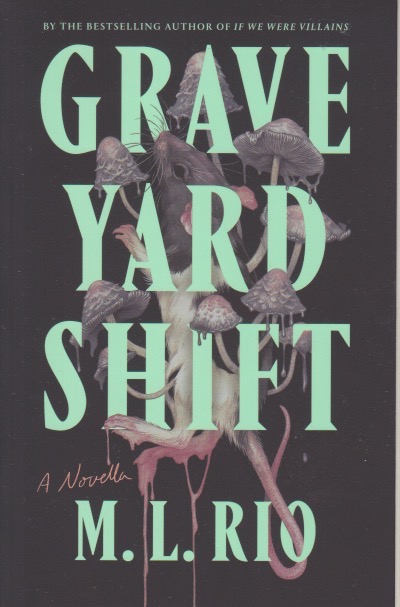
M. L. Rio is best known for If We Were Villains, a book I have on my shelf but haven’t read yet.  She’s one of those rare PhDs who can write, and her punchy, irreverent style has a way of drawing you in.  Graveyard Shift is actually a novella (a cynic would say a way to get you to pay a full novel price on a piece a bit too short to qualify), so it’s a quick read.  It’s a little difficult to classify, genre-wise.  The copyright page suggests thriller, which means not-quite-horror, but with elements of it.  Taking place over one night (and just over 100 pages), its the story of how a college student journalist and her friends crack the case of a mysterious shallow grave they discover one night at their usual hangout, behind an abandoned church, Saint Anthony the Anchorite.  Edie, the journalist, has to find a story to headline the next day’s edition, and the grave provides it.

The story involves mushrooms and rats, sleep deprivation, and lots of smoking.  Still, it’s a well-crafted tale that holds your interest.  Of course, I noticed the centrality of the church to the story.  It’s so much a part of things that the disparate group of friends identify themselves as Anchorites.  An anchorite is essentially a hermit—a monk who prefers not to live communally (cenobites, a name taken up by the Hellraiser franchise, are monks in community).  Of course, the friends aren’t monks, just young people in a college town who like to be out at night, and maybe solve mysteries.  The church is both a focal point and a kind of vector in this world where unusual activities take place after dark.  It shouldn’t be a spoiler to say the friends solve the mystery and begin to help address one another’s problems.

I like brief books.  I don’t mind moderately long novels—when they start getting over 400 pages I get a bit anxious.  I have to admit that Goodreads has made me conscious of how many books I read in a year.  And since I like to blog about books, it also helps to finish them in a timely way.  Besides, escapism is especially important at the moment.  If you like stories about college kids, under-employed professors, bartenders and others who manage to eke out a living before family and mortgage change everything in your life, you’ll probably like this one.  It’s not really a horror story, but it’ll keep you turning pages, which is what books of any size are meant to do.


The Werewolf in Summer

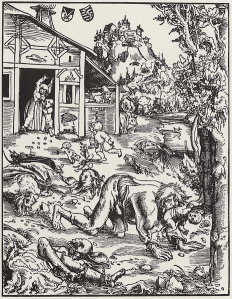
464px-Werwolf

It must be incredibly difficult to write a truly scary song. I don’t mean the kind of scare that most heavy metal can innately deliver, but I mean the kind of thrill that a classic horror movie gives. I’m constantly looking for the movie that can recreate the chills without getting blood all over the carpet. Music, however, soothes the savage beast. I remember when Michael Jackson’s Thriller came out. Now, nothing about Jackson’s musical style shows any hint of being scary. It’s too upbeat. In the end the ghost will be a mere reflection in the mirror, and the zombies will fade with the sunrise. I had some people tell me back then that it gave them the chills just listening to it. Amateurs. A couple weeks back I wrote a post on Radiohead’s “Burn the Witch.” It’s kind of scary, but it doesn’t keep me up at night. I haven’t heard Paul Simon’s new album Stranger to Stranger, but when I learned from NPR that it has a track called “The Werewolf,” I knew I’d eventually add it to my growing stack of MP3s.

Like Thriller, the musical style of the song isn’t inherently scary. The organ in the final minute is pretty effective, though. What’s scary about “The Werewolf”? The lyrics. Simon is, to this child of the sixties, the foremost lyricist of his genre. Rich, complex, nuanced, his words tell a story and that story is scary. While I prefer my werewolves with different baggage, it’s pretty clear that like most shapeshifters the werewolf stands for hunger. There’s violent rage, of course, but like the wendigo, hunger drives those who can’t fulfill their desires in human shape. The Howling, for example, shows how lust can make a werewolf. There is a lust more dangerous than that of the flesh, and that is the greed that leads to societies with one-percenters who just can’t stop eating.

When we see Trump-clones who pay no taxes at all, due to the good that being uber-rich offers the economy, we should listen for howling in the night. Too many an April has rolled around where those of us called “middle class” stare in wonder at just how large a cut our government takes. The werewolves don’t wait for October to come around. No, those who are hungry eat all the time. I don’t find Simon’s music to be particularly scary. The tempo is upbeat and his voice just can’t feel threatening. Still, I’m shivering after listening to “The Werewolf” even though the shortest night of the year is fast approaching on padded paws.