Influential Brethren

Outsized ideas from under-recognized sources always captivate me.  I have to admit that my own childhood fascination concerning, and fear of, “the rapture” still haunts me.  While our house isn’t large, the other day I couldn’t see or hear my wife anywhere when I knew she was home and my first thought was that she’d been raptured and I’d been left behind.  Please don’t try to console me with logic; I know very well the problems with this initial assessment and knowing the history of the idea of the rapture can’t stop the primal fear when it strikes.  So it is with religious ideas inculcated in the young.  That’s why I knew I had to read Massimo Introvigne’s The Plymouth Brethren as soon as I heard of it.  The Plymouth Brethren, and specifically one of their formative leaders, John Nelson Darby, were the inventors of the rapture.

Introvigne’s book doesn’t trace rapture history (other books do that), but he does narrate, in an admirably succinct treatment, whence the Brethren arose.  In the nineteenth century in the British Isles, some were very concerned that Christianity had gone off the rails.  Accommodating with secular society, it had become heavily doctrinal and, worse, political.  Breakaway groups were common, including those who went back to the “Bible alone” as the basis for assessing what being Christian truly was.  The Plymouth Brethren developed in this atmosphere and they still remain a relatively small Christian sect (I use that term completely neutrally).  Even though they themselves splintered over time, they were never a very large group.  They, however, invented the rapture.

John Nelson Darby, one of the founders of the movement, believed history was divided into dispensations, or periods, predetermined by God.  The dispensation in which we now live (and in which they lived two centuries ago) would include a dramatic rapture that would allow Darby’s understanding of eschatology to fall within the system he developed.  This idea was picked up by Cyrus Scofield and included in his enormously influential Scofield Reference Bible.  That Bible, although many evangelicals considered the Plymouth Brethren as a kind of “cult,” was used as the unquestioned roadmap for the end times.  It was picked up by such promoters as Hal Lindsey and Timothy LaHaye and made into a meme that just about any educated person recognizes.  We all know what “the rapture” is, although the Bible itself doesn’t spell it out at all.  Introvigne’s book is very informative on the Brethren but his chapter on their ten main divisions is, necessarily, a touch confusing.  Well balanced and fair, this is a great source for those who wonder who these people were that gave us such worries when our wives have “disappeared” into some other part of the house.
Doomsday, Again?

It’s hard to keep a good apocalypse down. Ever since Jesus of Nazareth did his best Arnold Schwarzenegger impression of “I’ll be back” some of his followers have obsessed when just when that will be. Sorry for the late notice, but the current prediction is for tomorrow. If you’ve got any weekend plans, you might want to rethink them. I know traffic in Jersey is already bad enough without white horses breaking through the clouds. An article my wife promptly sent me from NPR, “Is The Apocalypse Coming? No, It Isn’t!” by Marcelo Gleiser, addresses the documentary The Sign. No doubt about it, there’s some impressive astronomical gyrations here, but planets moving through constellations do not an apocalypse make. As Gleiser points out, the real question is why people believe such predictions so passionately.

Larry Norman’s song “I Wish We’d All Been Ready” captures the mood nicely. Growing up in a tradition that believed, as only literalists can, that this world is the center of the cosmos, Norman’s song haunted my teenage years. These were the heady days of Hal Lindsey and a very hot Cold War. I had to register for the draft. There was unrest in the Middle East. Sonny and Cher had split up. The signs were aligned, it seemed. As they had been nearly every year since about 30 CE. Paul of Tarsus was waiting. And John of Patmos. And Timothy LaHaye. True believers all. Conviction begets conviction. Seeing another fully convinced is a powerful incentive.

Even now, if I’m honest, I shudder a little when I hear such predictions. What if, by some odd chance, they are right? Raised in that tradition, it’s nearly impossible to jettison that private fear. Rationally I know that clever people can make all kinds of connections that have nothing to do with the Bible. I know that John’s Revelation isn’t about the end of the world. I know that the views of Paul were bound by the developments of his age. I know the Rapture was invented in the nineteenth century (CE). Still, the chill slithers through me when I consider how it felt as an uncertain teen on the brink of Armageddon. I could envision it clearly. Some who were utterly sure swayed me. Specific dates and times weren’t biblical, but the wait for any moment now was even more terrifying. Tomorrow will begin and end just as any other day on planet earth. And another apocalypse will enter the planning stages, coming soon to a universe near you.


Power in the Blood

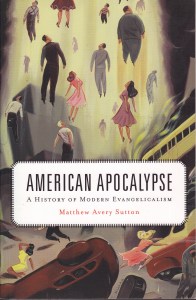
Converts, they say, are often the worst. It matters less what the conversion is to or from, since the zeal of the newly enlightened is impossible to match. The textbook example with religion, especially in America, is Evangelicalism. Those who’ve “found Jesus” are eager and too willing to tell others about it. You don’t often hear, however, of those who grew up Evangelical, but then had second thoughts. Often they disappear quietly. Evangelicalism is a potent force in American life. Intellectuals, embarrassed by it, tend to pretend it doesn’t exist. Or it’s on its way out. No need to approach, with nervous laughter, those who actually believe this stuff. Evangelicals, however, can get presidents elected and their zeal can take away any number of freedoms deemed “godless” by those who may have no more education than the local bartender. Matthew Avery Sutton’s American Apocalypse: A History of Modern Evangelicalism is masterful. Although not comprehensive (the movement is too large for that) this book does not shy from the unifying fact behind radical evangelicalism—the belief that the end is nigh.

Oh, I know. Those of us who are educated have no need to take such nonsense seriously, right? Sutton may change your mind on that. When you realize just how close to disaster after disaster this thinking has led (and continues to lead, under the current administration) us, you might want to take the Fundamentalists a bit more seriously. They constitute the largest religious bloc in the nation. One of the baffling things about them is their protean nature. What’s the difference between an Evangelical and a Fundamentalist? And what’s with the obvious differences between a Timothy LaHaye and a Billy Graham? And where do these people get all their money? (Fundamentalists have always been close to nearly endless, well, funding.) Republican presidents from far before Nixon realized that big business and conservative theology, although strange bedfellows, are remarkably compatible. (Each thinks the other side doesn’t realize it’s being used.)

American Apocalypse is an important book. Written before perhaps the strangest turn in US history last November, it might have helped to show that Trump was a serious threat from the beginning. If only the educated took it seriously. Evangelical antipathy to women’s rights, civil rights for minorities, and socialized medicine run very deep. It’s the Old Boys’ Club with a vengeance. Recent events have shown yet again how important it is to understand these ways of thinking. And those of us with insider knowledge have never been welcome in the academy. That’s okay, though. If I go back to my roots I’ll realize the world’s about to end any day now. Those who’re smart might think about taking equestrian training because I’m sure there will be white horses involved. If only I could get myself converted back.


What Rapture

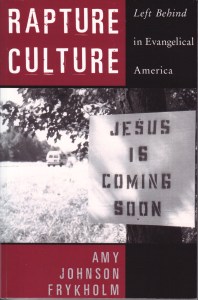
rapturecultureEvangelical culture must be an endlessly fascinating area of study for sociologists. So pervasive that many people who aren’t religious buy into aspects of it, this social movement has shaped American thought in often unexpected ways. Take the rapture, for example. Here is a non-biblical concept, invented in the late nineteenth century and so thoroughly disseminated that most people simply accept it as standard Christian belief. It’s not. Amy Johnson Frykholm pieces part of this puzzle together by focusing on the Left Behind series. Rapture Culture: Left Behind in Evangelical America is one of those books where you find plenty of food for thought as you go along. Not that the novel series itself is profound, but the impact that it has is.

The origins of the rapture go back to a way of thinking called dispensationalist premillennialism. That alone could be why so few people know about it! All this phrase means is that some Christians believe history is divided into distinct periods (dispensations), one of which is the end of the world. Among dispensationalists, there is disagreement on when the rapture will come, and those in the majority believe it will happen before the millennium (not the Y2K millennium, but the millennium of God’s reign on earth before the world ends—the next dispensation). These are the premillennialists. It’s easy to think that since this system is pure mythology it must be simple. It’s not. This is a complex mapping of the future based on an intimate knowledge of obscure verses from the Bible. The Left Behind series, written by Jerry Jenkins under the guidance of the finally departed Timothy LaHaye, brought this idea into mainstream culture. There was even a movie.

Many educated citizens don’t realize that Left Behind has a Harry Potter-like following. Sales of the series are into the millions of units and many of those who read them take them somewhat seriously. Frykholm interviewed such readers to find out what they actually thought about the series and whether it was something they believed in. As might be expected, answers differ considerably on these points. For me one of the real takeaways is that we ignore evangelical culture at our own peril. I learned about the rapture form Chick tracts—I’ve posted about them before—that I read in my childhood. By the time of Left Behind I’d been through enough courses that I knew it was all based on a fictional event. But many don’t realize that. And many of them showed up in the last presidential election.


Behind Left Behind

Now that September’s here, we can begin thinking back over the summer, scratch our heads, and say “huh?” We’ve been so blinded by the Trump that we haven’t had time to reminisce over what’s been happening fundamentally. I mean among the Fundamentalists. This summer Timothy LaHaye went to his reward, followed this week by Phyllis Schlafly. I’m sure they’re basking in an all white, straight, and Protestant Heaven. For those of you unfamiliar with LaHaye’s name, you’ll know his fruits. The Left Behind series was his brainchild and many other aspects of this not-yet-raptured world spun from his squeaky-clean mind. He and Ms. Schlafly spent their lives telling others how to be good. I’m sure their only regret is that they won’t be here to be raptured away so they can see the look on the rest of our faces. No matter, they’ve gone to a better place.

Also this summer Lyle Jeffs, another sort of Fundamentalist, also disappeared. Under arrest for some suspected crime or other, Jeffs escaped from the FBI by worming out of an ankle monitor. His attorney, however, has suggested that Jeffs was raptured instead. Come to think of it, that could explain these other disappearances as well. It’s a regular Bermuda Triangle of Fundamentalists, it seems. The rapture is the ultimate excuse because the Almighty can trump any suit, any hand. Maybe they all just wanted to get off the earth before this fall’s elections. Fundamentalism, it seems, is missing from the political docket this year. Whereas since I’ve been able to vote candidates have been raising issues of concern to the more right-wing contingent, this year the fundies seem to have vanished. Maybe the rapture did occur after all.

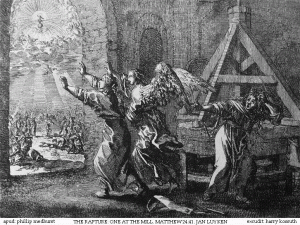
teachings_of_jesus_39_of_40-_the_rapture-_one_at_the_mill-_jan_luyken_etching-_bowyer_bible

You see, I’ve read enough of the scenarios to know that those left behind are always confused. They don’t believe in a rapture and the missing people are only part of the problem. Things are going awry (again, look at the politics and differ!). What will life be like in this post-rapture world? How will we survive with our conscience gone? All things considered, it’s going pretty well. Missing the rapture was one of my greatest childhood fears. Like all good Fundamentalists I assumed I wouldn’t be deemed worthy of that first reaping. I’d be left to suffer through tribulation and, hopefully, beyond that salvation might lie. LaHaye and Schlafly got out before the action started. Lyle Jeffs, his lawyer suggests, did too. The FBI found olive oil all over the ankle tag and, perhaps, the signs of a struggle. I’ve watched enough movies to know that when someone is raptured, however, all their clothes are left behind. The only way mortals ever face the Almighty is naked as the day they were born again.


Contriving the Rapture

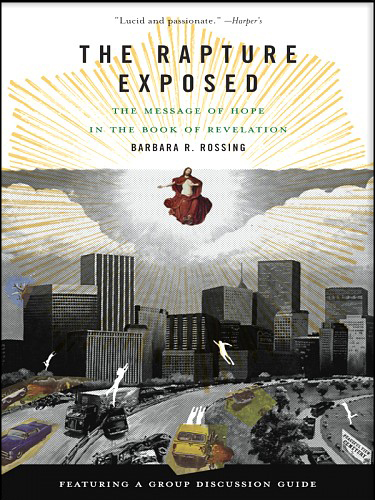
In the light of last month’s failed rapture attempt, I decided to read a book that I picked up some years ago that had been written in the wake of the millennial scare. Having grown up with nightmares of the rapture, I learned during my first college class on the book of Revelation that it was relatively modern meme, invented in the nineteenth century. Barbara Rossing’s The Rapture Exposed seemed a good way to refresh my memory without having to go through all those boxes of books in the attic to find my original textbooks. Rossing, a Lutheran minister and New Testament professor, brings to light some very important facts beyond the historical roots of this theological fabrication—facts that should concern religious and secular alike. The rapture was invented by John Nelson Darby, a founder of the Plymouth Brethren and convoluted biblical scholar. Basing his roadmap of the future singularly on Daniel 9, he concocted the rapture to make sense of his apocalyptic epiphany. Drawing diverse sections of Paul’s letters to the Thessalonians, the Gospel of Matthew, and the book of Revelation together, he mixed thoroughly, half-baked it, and pulled the rapture out of the oven.

The idea caught like wildfire. Today young people who’ve never read the Bible and who’ve seldom attended religious services know what the rapture is. What they do not realize is that nearly all of the Christian tradition rejects it, seeing it for what it is—a Johnny-come-lately of amateur theology that sees the Bible through the lenses of dilettante-sensibilities like those of Michael Drosnin (The Bible Code man). Instead of seriously reading the Bible and trying to understand it, society prefers to see it as a little bit of magic in the midst of our scientific and technical world view. It is a safe place where bits of the supernatural are preserved and that defies rational explanation. Rossing’s book does a good job of exposing the wrong-headedness of LaHaye’s Left Behind conclave, but she overlooks an important feature of this coterie: they have an unconfessed agenda.

The unspoken agenda is best summed up by Lt. Frank Drebin of Police Squad when he says, “blowing away a fleeing suspect with my 44 magnum used to mean everything to me. I enjoyed it, well who wouldn’t?” Rossing misunderstands Fundamentalism when she expresses surprise at the bloodlust present in the Left Behind novels. What she doesn’t take into account is that, as a collective, Fundamentalists thrive on self-righteousness. Feeling the same violent urges that others do—all humans experience violent emotions—they sublimate that aggression and save it for the unrighteous—God’s enemies. When the gloves come off in the apocalypse, that hatred bursts out in good, old-fashioned bloodletting—albeit with combat helicopters and high-tech weaponry. Of the Christians I know who own guns, the Fundamentalists are most avid in their rights to do so. In college I met my first Christian survivalists and I learned that the rapture was a ruse. It is a deadly mix, especially when this warped theology makes it into politics. Although Rossing’s vision of a new earth in the second half of her book may not appeal to everyone, Americans should read at least the first few chapters to learn why the rapture will never occur.


Jesus’ Broken Dates

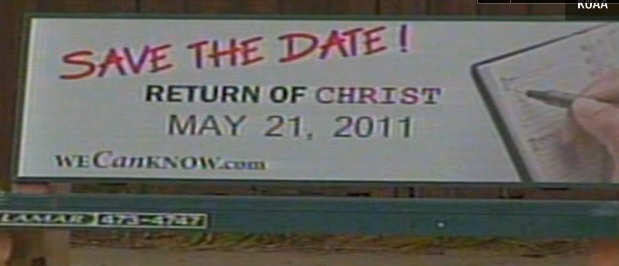
Jesus apparently has his calendar out. Again. This time it looks like May 21 is a red-letter day (he has a predilection for red-letters too). Well, at least it’s penciled in, like many other broken dates. An unemployed woman in Colorado Springs has decided to spend her dwindling reserves on bus bench advertisements reading “Save the Date / Return of Christ / May 21, 2011,” according to CNN. She states in the interview that she believes her job until judgment day is to get the world ready. She will find herself standing in the unemployment line on May 23 (the 22nd is a Sunday), more likely than not. Even more disturbing than the mostly harmless neurotic behavior of the unemployed (who am I to cast the first stone?) is the choice of Jerry Jenkins as an expert witness in the story.

Who questions a bus bench?

Jenkins and perennial Paleo-Con Timothy LaHaye wrote the “Left Behind” series that made more than a cottage industry out of repackaging Christian apocalyptic mythology into slick, science-fictionesque novels. They have more than a vested interest in promoting “and they lived horrifically ever after” scenarios. There is good money to be made by trolling the fears of the gullible. Very good money.

Our Colorado Springs prophet took her date from a billboard in Texas, a leading purveyor of rapture-mania. The thing that’s been left out of this – and many other apocalyptic episodes – is a serious consideration of the Bible. As most biblical scholars know, doomsday predictions generally derive from misinterpretations of ancient metaphors. Jesus, at least according to the canonical Gospels, was much more concerned about fair treatment of the poor and disadvantaged than he was about raining down brimstone on Babylon. Instead of spending money to warn the folks of Colorado Springs about yet another end of the world, why not donate the money to a local food bank and try to make the world a little bit better place?