
A horror film that relies more heavily on religion than just about any I’ve seen is Tin & Tina. What really happens is up to you to decide because different characters have different interpretations. Adolfo and Lola can’t have children. Lola was pregnant with twins but a miscarriage with complications left her sterile. The couple visits a convent to adopt two children. Lola is attracted to two seven-year-olds with albinism. The twins are very religious, while Adolfo and Lola aren’t. The religion of the kids leads them to strange behaviors which can be disturbing, or even dangerous. Lola begins to suspect they are trying to kill her, and, after she miraculously becomes pregnant, her son. In a fit of rage Adolfo burns their Bible and the couple return the children to the orphanage. Then Adolfo is struck by lightning and the house burns down. Or is his death really the doing of the children?
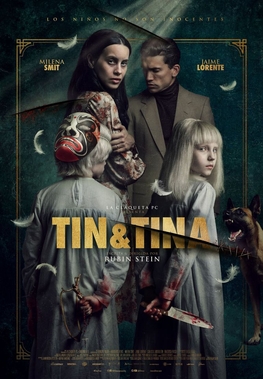
In the view of the nun at the orphanage, the children are completely innocent. Her teachings, however, raise some doubts. When the family dog, which is terrified of the children, bites Lola, the children “cleanse” him by taking out his heart and washing it, assuming the dog will be resurrected. Or do they? A bully who teases them at school has an accident, but Lola believes that the twins caused it. (There is some evidence of this, but it is ambiguous.) When Lola refuses to let her newborn be baptized, the twins do it by holding him upside down in a fountain. Are they attempting to drown him? Each time they act innocent and quote the Bible to justify what they’re doing. Lola believes they were in the house the night Adolfo burned to death, and the children believe whatever someone sows, they reap. He had burnt their Bible.
Horror is often ambiguous. Tin & Tina (their names short for Augustine, for they were in an Augustinian convent) remains ambiguous throughout. Are these kids really just doing what they believe is right and only look guilty, or are they carrying out rough justice and using the Bible as an excuse? The movie opens by defining the word “theophany”—an appearance of God. The nun insists that they’re innocent, so Lola adopts them again at the end. Many scenes here resemble The Omen, but overall the movie is unnerving. And the tension doesn’t end when the credits roll. In many ways this is a textbook example of religion and horror. And like most matters religious, what you believe, in the end, is up to you.

